
James H. Ford II, PhD, Kim A. Hoffman, PhD, and Kimberly Johnson, MBA
CHAPTER OUTLINE
■ FRAMEWORK FOR CHANGE
■ DEFINING AND MEASURING QUALITY TREATMENT AND OUTCOMES
■ ACCREDITATION FOR TREATMENT PROGRAMS
■ BUILDING SYSTEM CAPACITY TO DELIVER EFFECTIVE TREATMENTS
■ INTEGRATED SUBSTANCE USE AND PRIMARY CARE
■ CONCLUSIONS
Outcomes from addiction treatment services compare favorably with treatments for other chronic conditions such as hypertension, diabetes, and asthma (1). However, addiction traditionally has been treated under an acute care model where treatment is short term, and post–acute support occurs within self-help groups. A consequence of the discrepancies between the treatment of substance use disorders and other chronic illnesses is a persistent expectation that patients with diagnosed drug and alcohol disorders remain symptom free (i.e., without substance use) after their treatment ends. For most other chronic health conditions, the expectation is for long-term symptom management rather than symptom elimination. A contemporary understanding of addiction as a treatable health condition includes a recognition that withdrawal of treatment or related supports may promote a reemergence of symptoms; continuing care by a health care provider as well as active self-management and recovery supports are essential for sustaining positive outcomes associated with treatment (2,3).
Efforts to improve the quality of addiction treatment and enhance effectiveness generally fall into four categories:
1. Defining and measuring quality and treatment outcomes
2. Accrediting and licensing programs and treatment settings (i.e., office based) that deliver treatment
3. Building capacity for efficient and effective treatment delivery
4. Integrating substance use treatment with primary care
This chapter covers each of these categories. It reviews efforts to define appropriate outcomes and current trends in accrediting and licensing and efforts to increase the focus on quality improvement in addiction treatment.
FRAMEWORK FOR CHANGE
Institute of Medicine Reports
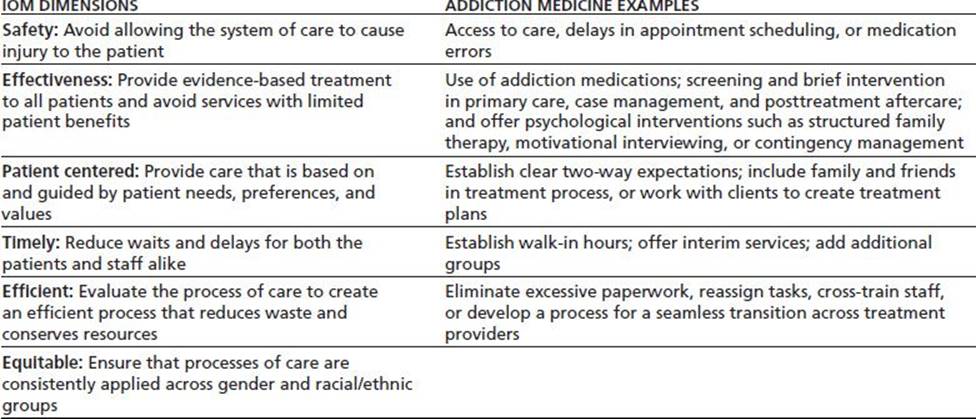
The Institute of Medicine (IOM) within the National Academy of Sciences advises federal policy makers about health concerns and public health policy issues. In a series of reports, the Institute identified needs for better health care and outlined strategies to improve the quality of health care in America. To Err is Human: Building a Safer Health System (4) found that medical error was a major source of morbidity and mortality in the US health care system and challenged health care systems to track and eliminate error through implementation of performance standards that emphasize patient safety. Crossing the Quality Chasm: A New Health System for the 21st Century (5) was the follow-up report providing guidance on redesigning systems of health care to better address chronic care, make greater use of information and technology, coordinate care, incorporate process and outcome measures into systems of care, and continually improve the effectiveness of service providers. Six dimensions of quality were specified: Care should be safe, effective, patient centered, timely, efficient, and equitable (Table 31.1). The most recent report, Improving the Quality of Health Care for Mental Health and Substance Use Conditions (6), asserts that the Crossing the Quality Chasmframework can be extended to treatments for alcohol, drug, and mental health disorders. The report notes that proven science-based treatments are not used routinely, services are often fragmented and that substandard care leads to greater expense and suffering. In addition to the human costs associated with this treatment gap, there are implications for their employers and the workforce; for the nation's economy; as well as for the education, welfare, and justice systems. The report, sponsored by the Substance Abuse and Mental Health Services Administration (SAMHSA), explicitly recommends that alcohol, drug, and mental health treatment systems emphasize the six dimensions of quality of care and that public agencies and other payers promote the development of process and outcome measures that track quality of care (6). Since this report, significant efforts have been taken to improve measurement and quality although much work is yet to be done.
TABLE 31-1 SUMMARY OF INSTITUTE OF MEDICINE DIMENSIONS OF CARE
The most recent IOM report on substance use disorders titled Substance Use Disorders in the U.S. Armed Forces recognizes the effect of combat on substance use among Veterans (7). The IOM committee found substance use and misuse in the military have increased and now represent a significant public health problem. The leading causes for concern are elevated rates of alcohol misuse (33% of active duty military screen positive for alcohol abuse on the AUDIT), binge drinking (47% of active duty service members report drinking 5 or more drinks at least once in the past month), increased nonmedical use of prescription analgesics (rate was 2% in 2002 and 11% in 2008), and high opioid prescription rates (military physicians wrote more than four times as many opioid prescriptions in 2009 as they did in 2001). The report strongly recommends the full implementation of the Department of Defense evidence-based guideline for treating substance use disorders— specifically, that the Department of Defense increases their use of evidence-based practices to consistently implement prevention, screening, diagnosis, and treatment services. In addition, the report exposes some of the barriers to care that currently exist in the military. To address these systemic barriers to care, the IOM recommendations include (a) enhancing the use of technology, (b) providing confidential care, (c) making greater use of continuing care, (d) expanding access to care, and (e) creating of a 21st century workforce (7).
Over the next decade, drug and alcohol treatment services can anticipate mandates for evidence-based, patient-centered care delivered in ways that are safe, timely, efficient, and equitable. One important common theme that carried across all four IOM reports on quality is that system design, reimbursement processes, and service delivery have more impact on treatment results (patient outcomes) than variation in individual practitioner knowledge or behavior. In other words, improved outcomes will come more readily from improved systems than from additional training. Though human resource development is important, better system design trumps improvement of skills as a leverage point for improving outcomes for populations. Mandates such as the Patient Protection and Affordable Care Act (Affordable Care Act) stipulate that drug and alcohol treatment services must provide evidence-based, patient-centered care delivered in ways that are safe, timely, efficient, and equitable.
Patient Protection and Affordable Care Act
The Affordable Care Act creates new incentives to reform health care and build patient-centered and robust monitoring systems although it is unclear whether the current system of care, built on small nonprofit clinics, has the resources to meet the proposed mandates. For example, federal legislation requires the development of electronic medical records that are interoperable and include all patient medical care. Research shows, however, that most treatment centers are too small to afford investments in electronic health records(8–10). Treatment agencies already find it difficult to remain economically viable (11), and staff usually do not have strong professional management and business practice skills (12,13). Assuming the Affordable Care Act is fully implemented in 2014, many addiction treatment programs may not be capable of providing the mandated professionally and medically oriented services.
As Medicaid becomes the primary health insurer for low-income individuals, federal initiatives may stimulate substantial change in the delivery and financing of addiction prevention and treatment. Federal block grant funds could be redirected to support Medicaid instead of coming to freestanding treatment centers as direct grants. New types of services will be covered, including prevention and early interventions that should result in more medical practices screening for substance abuse, conducting brief interventions, and referring patients to specialty care as necessary. Children can remain on their parents' insurance until the age of 26, maintaining coverage for treatment during the high-risk period of early adulthood. Moreover, treatment agencies may be required to meet Medicaid eligibility standards that are likely to require practitioners with professional licenses and graduate degrees. Currently, only about 50% of the counselors have graduate degrees (14) so the ramifications of this kind of mandate could be substantial. Providers must evaluate the implications of the Affordable Care Act such as how to address the needs of new types of clients and focus on delivering the highest standard of care.
Mental Health Parity
The Affordable Care Act requires that all benchmark and benchmark equivalent state Medicaid plans must comply with the federal parity law, the Paul Wellstone and Pete Domenici Mental Health Parity and Addiction Equity Act (MHPAEA). Under this law, insurance companies can no longer arbitrarily limit the number of hospital days or outpatient treatment sessions, or assign higher copayments or deductibles for those in need of behavioral health care services. The act, signed into law in 2008, affects large employers, Medicaid managed care plans, and some State Children's Health Insurance Program plans. The act closes some gaps left by the 1996 Mental Health Parity Act and preserves existing state parity laws. Prior to MHPAEA, it was legal for insurers to limit care for mental health and substance abuse services and require patients to pay more out-of-pocket costs for such services than they would pay for care for diabetes, heart disease, or other medical conditions. Now, financial copays and limits on amount of care for behavioral health services must be similar to those provided for medical/surgical care. This federal legislation eliminates barriers to the use of services for alcohol, drug, and mental health disorders and may lead to greater use of mental health and addiction treatment services.
Detractors of parity legislation suggest that costs for employer premiums for patients will increase as a result of greater use. However, a study of the Federal Employees Health Benefits Program, which started requiring parity for mental health coverage in 2001, did not find this to be the case (15). A study of Oregon's mental health parity law, which was implemented in 2007 and prohibits commercial health plans from imposing limits on behavioral services that are not also imposed on medical–surgical services, improved insurance coverage without substantial cost increases (16). These studies suggest that restrictions on how plans manage mental health and substance abuse services can improve patient care without substantial increases in costs.
DEFINING AND MEASURING QUALITY TREATMENT AND OUTCOMES
Public expectations, demands for accountability from payers and policy makers, and a strong desire from within the field of addiction medicine to improve performance drive efforts to define and measure effective treatments and treatment outcomes. Measurement is a key to improvement. Measures of performance before and after the introduction of changes enable managers to verify desired impacts and to monitor, track, and maintain performance over time. Payers, including the U.S. Department of Health and Human Services, SAMHSA and its Center for Substance Abuse Treatment (CSAT), Veterans Health Administration (VHA), and state and county governments have and continue to collaborate with researchers, treatment providers, and professional trade groups to construct and evaluate measurement systems and to promote quality improvements. Their efforts to define and measure the quality of addiction treatment include measures that track system performance (i.e., Washington Circle measures), catalogues that identify and promote the use of proven treatments (i.e., National Quality Forum Consensus Standards) and seek to understand and identify the prevalence of substance use within specific populations like the VHA.
Washington Circle Measures
The CSAT has provided support to the Washington Circle Group to develop and test measures that monitor the performance of health plans and public treatment systems. To date, a total of six measures have been developed and evaluated in the field (Table 31.2) (17,18). A panel of experts recommended the development of additional measures as well as research on measurement within the field (19).
TABLE 31-2 WASHINGTON CIRCLE MEASURE DEFINITIONS

The initiation and engagement measures are included in the Health Plan Employer Data and Information Set (HEDIS) measures that health plans submit annually to the National Commission for Quality Improvement. HEDIS reports suggest that health plan performance on these measures varies by type of plan: commercial (initiation = 45%; engagement = 14%), Medicare (initiation = 51%; engagement = 5%), and Medicaid (initiation = 41%; engagement = 10%) (17). These rates have declined over the relatively brief period during which health plans have been reporting the data (17). Evaluation of these measures in the grant-funded public sector reveals differing levels of initiation and engagement by level of care: outpatient (initiation = 42% to 73%; engagement = 24% to 67%) and intensive outpatient (initiation = 44% to 88%; engagement = 34% to 76%) (18). Continuity of care measures postdetoxification; aftercare and residential treatment were also developed. The adoption and use of these measures by Single State Authorities for substance abuse treatment show variability in state capacity to calculate these measures and variation in the measures across states (20).
Research on these measures is limited. Studies typically explore the relationship between the measures and selected societal or treatment outcomes. For example, an analysis of administrative data from Oklahoma found that individuals who initiated and engaged in treatment for alcohol and drug disorders were less likely to be arrested or incarcerated (21). In another study involving adolescent treatment agencies, continuity of care post–residential treatment potentially predicts 3-month recovery; adolescents who engage in treatment had lower likelihoods of reporting any substance use, alcohol or heavy alcohol use, and marijuana use (22–24). The proximal process measures seem to anticipate improvements on distal outcome measures. The impact of Washington Circle initiation and engagement measures also shows initial promise in exploring chronic disease management care for substance dependence (25). However, many of these studies rely on analysis of administrative data and are not measuring the impact of quality improvement initiatives on levels of initiation and engagement or their relationship to distal outcomes.
Improvements in initiation and engagement in treatment in some cases may have to do with the physician's knowledge of addiction, but are instead related to organizational issues related to the intake process, eligibility requirements, access to treatment on demand, convenient office hours and transportation, or efforts to adequately engage patients in the ongoing treatment process. To address these issues, it is important to explore existing processes and implement system changes that enhance these outcomes. For example, a provider could offer “minimal treatment” or “interim maintenance” for opioid treatment program waiting lists; examine and improve their existing paperwork process; or offer walk-in appointments to clients. Other promising practice examples can be found through the NIATx or AHRQ Practice-Based Research Network (PBRN) websites.
National Quality Forum
The National Quality Forum (NQF) is a congressionally chartered membership organization charged with using empirically based consensus process to define and disseminate standards and measures for the health care system. The federal Office of Management and Budget directs federal agencies (e.g., the Centers for Medicare and Medicaid Service) to use voluntary consensus standards in lieu of government-unique standards in procurement and regulatory matters. A recent NQF report, National Voluntary Consensus Standards for the Treatment of Substance Use Conditions, identifies 11 treatment practices, organized into four domains and subdomains, as evidence-based treatments for alcohol, tobacco, and drug use disorders (26). Table 31.3 summarizes the domains and subdomains.
TABLE 31-3 SUMMARY OF NATIONAL QUALITY FORUM CONSENSUS STANDARDS FOR THE TREATMENT OF SUBSTANCE USE CONDITIONS

The endorsement of these practices by the NQF's members (more than 437 organizations, including health care providers, consumer groups, professional associations, purchasers, federal and state agencies, research and quality improvement organizations, and suppliers) is the first formal consensus on evidence-based practices for treatment of substance use conditions. While follow-up work continues to define, test, and disseminate operational measures for the NQF-sanctioned practices, the impact in the fields of mental health and substance abuse care is minimal compared to other health care settings (27). The NQF standards for initiation and engagement have been included as continuous quality measures that are to be reported by eligible professionals by 2014 in order to receive incentive payments or avoid penalties in the final rule for stage two criteria for meaningful use of electronic health record systems (28). The NQF is also exploring the development of measures and an associated framework intended to address the multiple chronic conditions present in many individuals seeking treatment for these conditions (29).
Veterans Health Administration
A study of addiction treatment centers within the VHA examined relationships between center performance on Washington Circle measures and improvements in scores on the addiction severity index (ASI) alcohol and drug domains and found no significant influence; better rates of identification, initiation, and engagement were not related to greater improvement on the ASI measures (30). A separate study using the VHA defined continuity of care measure (two substance use disorder visits in three consecutive 30-day periods) also found that improvements on ASI measures were not associated with better continuity of care; however, meeting the HEDIS definition of engagement was associated with improvements on ASI domains (31,32). A study exploring the probability of advancing to treatment initiation and engagement given the initial setting of presentation and specialty care found that 25% of initiation and 40% of engagement occurred outside of a specialty care setting; however, patients presenting in such settings have higher rates of initiating treatment and once initiated, to engage in further treatment than patients who present in non–specialty care settings (33). In terms of access to medications for alcohol use disorders, recent studies within the VHA found that the overall prescribing rates of medications approved for treatment of alcohol dependence (acamprosate, oral and injectable naltrexone, and disulfiram) to patients with alcohol misuse disorders were between 2% and 6% of patients from FY2006 through FY2009 (34,35). Depending on how prescribing rates are measured, the studies found variations in the overall prescribing rates and facility performance (35). Another study explored the use of opioid agonist treatment (OAT) in licensed clinical or office-based settings within the VHA. Although limited to a small sample of facilities, the results found that a higher percentage (27.3%) of veterans were receiving OAT with the majority of the patients receiving methadone (22.2%) in a clinical setting versus receiving buprenorphine (5.1%) in an office-based setting (36). As with alcohol medications, the prescribing rates varied across facilities. The results from these studies (a) highlight the importance of clearly defining and agreeing to measures before embarking on quality improvement efforts, (b) provide evidence that similar measures may yield different results, (c) suggest that these measures should be used to assess facility performance not quality of care, (d) highlight the importance of treatment integration within the VHA, and (e) indicate that the use of alcohol and OAT medications is still not widespread in the VHA addiction treatment system.
ASAM Standards Workgroup
The American Society of Addiction Medicine (ASAM) has created a work group to identify the critical outcomes that care systems should accomplish for patients with addiction and the role of the addiction specialist physician in maximizing the likelihood that these outcomes are achieved.
The plan is to identify standards for addiction specialist physicians that address their role in direct patient care and improving system outcomes, giving priority to standards that have the highest impact on quality, are feasible, and reduce costs. They will review current measures and define the domains of addiction specialist physician performance, which should be measured for accountability purposes. In addition, the group will identify and prioritize gaps in standards, measures, and their evidence bases to form a research agenda (37).
ACCREDITATION FOR TREATMENT PROGRAMS
Performance measures are often examined in accreditation reviews. Accreditation is recognition by peers that an organization meets standards of performance that represent safe and competent treatment. Three bodies—the Joint Commission (TJC), the Commission on Accreditation of Rehabilitation Facilities (CARF), and the Council on Accreditation for Children and Family Services (COA)—are the primary entities that provide peer-reviewed accreditation for alcohol and drug treatment programs (38). The 2010 National Survey of Substance Abuse Treatment Services (N-SSATS) notes that less than half of the facilities reported accreditation from TJC (19%), CARF (22%), or COA (5%) (39).
Accreditation Process
Accreditation requires an organization to conduct an extensive internal analysis of its performance. Accreditation standards focus on broad domains, including governance, consumer rights and privacy, human resource development, use of treatment and or clinical interventions, methods to continually improve quality, maintenance and use of records, business systems, and facilities. The standards are aimed at minimum at promoting patient safety and optimally at improving patient outcomes. The organizational self-analysis is followed by a site visit by peers or accreditation surveyors, who independently verify the existence and performance of components noted in the self-assessment. Surveyors identify strengths and the need for improvement and then present a recommendation to the accrediting body for multiyear, limited, conditional, or denial of accreditation.
Accreditations for Opioid Treatment Programs
An exception to the limited accreditation of treatment programs are outpatient opioid treatment programs. As a result of a transfer of authority from the U.S. Food and Drug Administration (FDA) to SAMHSA in 2001, federal regulations (42 CFR Part 8) require that opioid treatment programs receive certification from a national accreditation organization or state agency documenting that the treatment program meets regulatory standards and will comply with the standards. Accreditation was expected to promote more consistent use of individualized treatment plans based on current best practice guidelines for medical and clinical care and facilitate evaluation of clinical outcomes (40). There are seven approved accrediting bodies including CARF, TJC, and COA as well as the National Commission on Correctional Health Care, the Healthcare Facilities Accreditation Program, and several states. They review opioid treatment programs to confirm that the services comply with federal standards, including the elements found in regular accreditation reviews and some specific to opioid treatment services: specialized services for pregnant patients, HIV counseling and education, and procedures to dispense medications in compliance with federal rules (40).
The CSAT conducted an evaluation of the shift from an enforcement model administered by the FDA to a regulatory model administered by the CSAT and carried out by approved accrediting bodies that was published in 2006 (41). Eighty-six percent of programs that responded to a survey conducted as part of the evaluation reported that accreditation improved their service quality. Survey respondents identified improved quality assurance activities as the single largest effect of the shift from enforcement to accreditation.
BUILDING SYSTEM CAPACITY TO DELIVER EFFECTIVE TREATMENTS
Since 2001, a number of national-level efforts have focused on improving the quality of treatment offered, particularly among the block grant-funded programs. Contemporary quality improvement strategies begin with recognition that insufficient quality often reflects poor system and process design. As in other industries, process improvement strategies in addiction treatment strive to construct processes that minimize variability and eliminate error to improve efficiency and enhance customer satisfaction with the product or service. Shewhart (42,43) and his students Deming (44) and Juran (45) were pioneers in the application of these techniques to manufacturing. Over time, the concepts have been extended to service industries including health care (46,47).
Network for the Improvement of Addiction Treatment
The Network for the Improvement of Addiction Treatment (NIATx) is the primary mechanism that has been used to apply process improvement strategies to the programs that treat alcohol and drug disorders. Change teams within participating organizations learn to use process improvement tools and techniques to meet the Washington Circle measures including reduced time to admission, decreased no-shows, enhanced retention in care, increased admissions, and increased use of evidence-based practices (48,49). Five key process improvement principles have been identified through meta-analysis to facilitate organizational changes to enhance the quality of addiction treatment services: understanding the customer, fixing key problems, picking a powerful change leader, seeking outside ideas and encouragement, and using rapid Plan, Do, Study, Act (PDSA) cycles (50,51). Together, these principles have the potential to influence organizational culture and reflect an orientation to continuous improvement. The use of the NIATx approach for quality improvement is also applicable for providers as they seek to address the IOM six dimensions of care (52).
Understand the Customer
Process improvement stresses the need to understand and involve customers in identifying and fixing problems. Focus groups and interviews with clients can help increase understanding of treatment experiences. Another useful tool is the walk-through; observers simulate the patient experience and participate in the processes that are required for patients, documenting their experiences. Change leaders use a walk-through to gain insight into problems in treatment processes. Walk-through protocols typically start with the admission process. A senior manager develops a patient script (description of the patient and the presenting problems), calls the treatment center for an appointment, completes the admission process, and notes positive and negative findings. Typically, the walk-through scenario includes a “family member” (e.g., sister, spouse, or parent) who shares the experience and makes additional observations. Individuals who conduct the walk-through should record notes both expected and unexpected about all stages of the experience (e.g., initial assessment, first treatment session) and identify what surprised them as well as opportunities for improvement. For example, the front office staff was friendly and efficient or the intake process involved multiple steps with redundant paperwork. As part of the walk-through process, they should ask other staff about their ideas to change or improve the process. These walk-through notes create stories with impact and illuminate problematic facets of the process that can then be addressed in process improvement protocols.
A review of walk-through reports from 327 applicants of NIATx projects revealed a number of issues treatment programs needed to improve including conflicting and incorrect information to applicants, redundant and burdensome intake forms, unanswered telephone lines, and unreturned voice mails (53). There were also challenges addressing complex patient needs (such as co-occurring disorders) and weaknesses in agency infrastructure (53). Change teams use the results of walk-through to identify process problems that can be corrected and improved.
Fix Key Problems
Agency change requires active support from the highest levels of the organization. The chief executive will often be supportive of change that addresses issues that affect revenue and costs (54). Missed appointments, for example, reduce counselor productivity, and anticipated revenue is lost. Strategies to reduce no-show rates, therefore, can lead to increased revenues and improved counselor productivity.
Phoenix Center in Greenville, South Carolina, for example, completed a walk-through and found that they had a waiting list for detoxification beds at the same time as having five empty beds. To reduce the waiting list and fill the beds, the program implemented a series of change cycles. The specific changes were to eliminate scheduled detoxification admissions appointment, reduce phone screen questions, adjust staff schedules during peak admission times, post bed availability, and ask clients “What time can you be here today” versus “We have an appointment available on.” As a result of the change, bed utilization increased 10% from 90% to 99%, and monthly program revenues increased by 11%. In another example, the Aegis Medical System that operates 25 opioid treatment programs across California conducted a walk-through of the admissions process. The results found that the first appointment, which included paperwork and a medical assessment, lasted 4 hours and the first clinical intervention was scheduled for 1 to 3 weeks later. They also analyzed 17 months of discharge data and set as a goal to reduce the first 90 days attrition rate by 10% over a 6-month period. The staff tested a change called “Five in Five” where the client had their medical assessment on day one and then on four subsequent days met with the clinician to tell their story and establish a relationship. As a result of the change, the attrition rate fell by 75% from 16% to 4% in 2 months with a projected increase in the annual revenue of $388,000. The change was diffused to all Aegis opioid treatment programs.
Pick a Powerful Change Leader
The change leader (the individual who leads a team in creating and implementing organizational change) is an integral part of the successful change effort in the organization. It can also be an excellent career development opportunity. To help prepare individuals, NIATx developed a Change Leader Academy designed to teach the skills to become an effective change leader (55). To date, approximately 1,100 individuals have completed this training. Not every counselor or employee, however, has the skill to lead change, and many do not seek the responsibility of leading change. It is important, therefore, to choose individuals with the right mix of aptitude and ability. Change leaders should have the respect of their peers and of staff and leaders throughout the organization. They must also have access to agency management. Within the organization, the change leader is responsible for running the change team meetings, and as such, they should have effective project management skills including being organized, a good delegator, and comfortable with using data to guide improvement efforts. Over time, a well-developed organization will use the opportunity to lead change teams as a strategy for grooming future managers and leaders within the organization.
Seek Outside Ideas and Encouragement
NIATx members get ideas for service improvements from other NIATx participants and from other industries. The vice president of quality improvement at the Ritz Carlton spoke at a NIATx conference and shared his perspectives on serving hotel guests and the hotel's expectations for customer orientation among all employees: “Ladies and Gentlemen Serving Ladies and Gentlemen.” Though the Ritz typically serves a clientele different from that found in most publicly funded drug abuse treatment services, its emphasis on treating guests and staff as ladies and gentlemen can be applied in any business, including addiction treatment. Opportunities to learn from others are not limited to the hospitality field. For example, an organization might be able to learn from a local car dealer how to engage clients, from an air traffic control how to hand-off clients within or across organizations, or from retailers who open up new lines when the queue gets too long. Leveraging these ideas requires an ability to think outside the box, recognize that other organizations experience similar problems, and adapt their solutions to the specific situation in your organization.
Use Rapid Plan, Do, Study, Act Cycles
Plan, Do, Study Act (PDSA) cycles are a central component of process improvement. Planning includes specification of the problem that will be fixed, collection of data to assess the extent of the problem, and development of a change that will implemented. Process improvement is about action. Change teams test the proposed change—(do). A key facet is that the test is for a limited time and limited number of patients. Initially, it is a feasibility test. Can we make the change and does the change produce the desire effect? A few simple measures are collected and analyzed (study): Did a change occur in the frequency or extent of the problem? Based on the planning, doing, and studying, the change team decides what to do next (act). The change can be abandoned if it does not work. It may be modified to enhance the effect. If the pilot was successful, it expands to include more patients and more counselors or more sites and, eventually, is institutionalized through changed policy and procedure manuals. PDSA cycles are rapid. Two weeks or less is usually sufficient to learn whether the change is viable and if additional time and resources should be invested.
Analysis of admissions data from the first cohort of NIATx participants over a 15-month reporting period found a 37% decline in days to treatment, from about 20 days in October 2003 to 12 days in December 2004 (49). Significant improvements were also observed in retention in care. In October 2003, about 72% of the patients who completed one unit of care returned for a second unit of care; by December 2004, 85% of the admissions received at least two units of care (49). Further analysis with a second cohort of NIATx participants replicated these findings and showed that participants from the first cohort sustained the improvements (56). Although gains may appear to be modest, the impact of process improvement seemed to increase over time, and preliminary analyses suggest that programs can sustain the improvements in access and retention. Additional analysis of NIATx data suggests that reduction in days to treatment enhances the likelihood that individuals will complete four treatment sessions (57). The learning community promotes collaborative opportunities for participants to learn from each other. Analysis shows that small, localized learning communities are effective at reducing wait time and improving adoption of evidence-based practices (58,59). Finally, qualitative analyses of NIATx implementation highlighted the relative ease within organizations of implementing the NIATx process improvement model (60), while some programs struggled with the development of change measures and use of process data (8).
NIATx 200
Due to the success of the initial NIATx program, the National Institute on Drug Abuse subsequently funded 201 treatment programs in Massachusetts, Michigan, New York, Oregon, and Washington State to participate in a randomized trial designed to assess the key elements of NIATx training. The programs were randomly assigned to four different levels of NIATx support in an effort to understand if particular components worked better than others: (a) interest circle telephone calls plus access to the NIATx Web site, (b) coaching plus access to the NIATx Web site, (c) learning sessions plus access to the NIATx Web site, and (d) interest circle telephone calls, coaching, and learning sessions plus access to the NIATx Web site (61).
Analyses assessed the influence of each study condition on change in days to treatment and retention in care. Results indicate that wait time significantly improved over a 14-month period for each level of support except interest circle calls (62). Providers in the coaching support saw a 4.6 days/clinic reduction in wait time versus a 3.5 days/ clinic reduction in the learning session and a 4.7 days/clinic reduction in the combination intervention. None of the levels of support resulted in a significant improvement in continuation defined as the percent of clients retained from first to fourth treatment session. Providers in the coaching and combination levels of support significantly increased the number of new patients—19.5% (coaching) and 8.9% (combination), respectively. A calculation of the benefit/ cost ratios found that the coaching level of support was more cost-effective than the learning session or combination supports at reducing wait time or improving the number of new patients. Additional research found that agencies were able to reduce the time from first contact to the first appointment by an average of 1.4 days (63) and that better managed programs had significantly shorter wait times (64). Findings from the NIATx 200 study further suggest that NIATx is an effective process improvement technology that can help improve certain aspects of the treatment systems for alcohol, drug, and mental health disorders.
Advancing Recovery
Advancing Recovery, sponsored by the Robert Wood Johnson Foundation, invited states and providers to collaborate and facilitate the implementation of evidence-based practices for the treatment of alcohol and drug disorders. The project was designed to promote implementation of the National Quality Forum's five sets of evidence-based practices: (a) use of medications, (b) screening and brief interventions in primary care settings, (c) seven psychosocial interventions (motivational interviewing, motivational enhancement therapy, cognitive behavioral therapy, structured family therapy, contingency management, community reinforcement, and 12-step facilitation), (d) posttreatment aftercare, and (e) case management, wraparound, and supportive services. Participating states (Alabama, Arkansas, Colorado, Delaware, Florida, Kentucky, Maine, Missouri, Rhode Island, and West Virginia) and cities (Baltimore and Dallas) made changes in systems to support and encourage the use of these categories of treatment services. A model of change emerged from the Advancing Recovery experience to guide the change efforts and provide structure for state and provider initiatives (60). The model articulates four specific conditions, five levers, and three supports for change. Participants used a variety of strategies to achieve their goals, yet all relied on incremental testing to achieve results, which found that the rate of medication adoption was higher than continuing care management (65). This study led to two randomized trials of the model specifically to support the adoption of medication-assisted treatment, and both are in the early phase of implementation.
INTEGRATED SUBSTANCE USE AND PRIMARY CARE
There is an increasing recognition that general medicine practitioners should be the “first-line” experts for substance abuse due to their regular contact with patients who may need intervention. A study of primary care practices found a high prevalence of alcohol (60%) and drug use (5%); among the drinkers, one in five (22%) had either an “at-risk” pattern of use or an alcohol-related health problem (66). Patients with substance use disorders are likely to have a comorbid condition such as heart, liver, and gastrointestinal disorders (67). Specialty addiction treatment centers developed because medical care was not attending to the needs of individuals with substance use disorders. However, primary health care workers regularly see patients who have (or risk having) a substance abuse problem.
The separation of treatment for medical and behavioral illness is an area that is increasingly being addressed. For example, the White House Office of National Drug Control Policy (ONDCP) 2012 National Drug Control Strategy asserts that addiction treatment should be integrated into mainstream health care and suggests concrete steps toward the goal of improved access to addiction treatment services (68), including the integration of Screening, Brief Intervention, and Referral to Treatment (SBIRT) into primary care. At its core, SBIRT has three goals: (a) screening to rapidly assess the severity of substance use and identify the appropriate level of treatment, (b) a brief intervention that focuses on increasing insight and awareness regarding substance use and motivation toward behavioral change, and (c) referral to treatment, which can provide access to more extensive treatment (69). The Health Resources and Services Administration has taken steps to promote the use of screening services, such as including SBIRT in the Uniform Data Systems to track screening activity in Federally Qualified Health Centers. States are encouraged to adopt SBIRT as a reimbursable service and train more service providers in SBIRT. In 2011, more than 2,200 health care professionals were trained in SBIRT through a series of different CSAT funding mechanisms. These include Medical Residency Cooperative Agreements, State Cooperative Agreements, and Targeted Capacity Expansion Campus Screening and Brief Intervention grants. The number continues to grow through other similar programs at the local, state, and federal level. Lastly, the strategy also stressed the importance of screening and early intervention in women's health care settings, as this has the potential to reduce the estimated 400,000 infants affected by prenatal alcohol or illicit drug exposure. Given the anticipated changes to substance abuse treatment services due to the Affordable Care Act, there are both clinical and business case reasons for substance abuse screening, brief intervention, and treatment, to be integrated with primary care services. As routine screening for alcohol and drug use disorders expands, there is a greater likelihood of intervention prior to problem onset.
Although there has been some movement to integrate primary care services within specialty clinics, the ONDCP Strategy reflects the general trend in policy and resources into primary care settings rather than the other way around. An advantage to this arrangement concerns the reduction in stigma that may occur for individuals seeking substance abuse treatment from a primary health care provider, compared to a stand-alone specialized service. Moreover, demand for addiction treatment will grow as more Americans become insured under the Affordable Care Act. Many doctors are not trained in how to identify or treat addiction. But with new research into how it affects the body and the brain, more doctors are coming to an understanding of addiction as a medical problem and addressing it like a chronic disease. Until recently, there have been no national standards for training in addiction medicine, and medical students receive little addiction training. In 2011, however, 10 addiction medicine residencies around the country were accredited by the American Board of Addiction Medicine (ABAM) Foundation. The 1- to 2-year programs include a 12-month core educational component with rotations in inpatient and outpatient settings. Ensuring that doctors and other medical staff are equipped with the necessary skills promotes a more holistic approach to patient care, enabling them to attend to the physical health needs of patients and simultaneously attend to comorbid substance misuse to support better health outcomes.
These same specialty boards require that physicians at the time of recertification and licensing requirements implement a performance in practice project (70,71). Launched in 2006, the Improving Performance in Practice initiative uses quality improvement tools and techniques including PDSA cycles designed to improve processes of care. The tools and techniques outlined in this chapter provide an approach that physicians could use to achieve their maintenance of certification requirements. A recently funded study will test this assertion in conjunction with the American Academy of Addiction Psychiatrist.
There are a number of tools for physicians to ensure quality in an office-based addiction treatment. The CSAT offers Treatment Improvement Protocols (TIPs), three of which are for prescribers treating either alcohol or opioid addiction (72–74). Each of these manuals comes with a Knowledge Application Program (KAP) Key that is a short version of the critical clinical information outlined in the TIP.
The Physician Clinical Support System (PCSS-B) provides physicians with training, support, and mentoring in becoming buprenorphine prescribers. Buprenorphine prescribing requires an 8-hour training and an application for a waiver from the Drug Enforcement Administration. The training, waiver process, and PCSS-B are all part of an effort to ensure quality in the treatment of opioid-dependent patients (75).
One final tool that is being used increasingly by physicians in primary care who wish to treat patients with substance use disorders are prescription drug monitoring programs (PDMP). In many states in the United States, PDMPs provide physicians with timely information on the scheduled drugs their patients are prescribed by other physicians as well as themselves. Requesting data from the PDMP on prescriptions filled by a patient with a substance use disorder in addition to drug testing can serve as a risk management tool, but also as a quality management tool as treatment may need to be adjusted if patients are not filling their prescriptions or are on multiple medications prescribed by other medical professionals.
The use of medications to treat addictive disorders needs to continue to be integrated into the treatment system at a faster pace and for more patients. The pace that changes are made will be impacted by individuals' ability to pay and payers' willingness to include these medications on formularies.
CONCLUSIONS
Quality improvement efforts are affecting the organization and delivery of treatment for alcohol and drug disorders. These efforts should include a focus ensuring that the care delivered is consistent with the IOM six dimensions of quality. Strategies to define, measure, and improve quality of addiction treatment services influence standards of care and the ways in which quality is evaluated. Quality interventions that build on the foundation of the NIATx may be especially promising and have a growing body of research that supports them. Treatment programs participating in the NIATx gain encouragement and ideas from participation in learning communities and support the application of process improvement to systems of care for alcohol and drug disorders. Outcome studies suggest that process changes can lead to reductions in days to admission and to improvements in retention in care. NIATx change initiatives have many advantages and the key resources needed to widely spread and sustain changes.
The NIATx approach also attempts to promote a spread of process improvements across statewide treatment systems. Advancing Recovery is another effort to spread system change. There is an explicit focus on changes in state regulations and financing to sustain and spread process improvements and evidence-based practices. The key NIATx principles of change work for individual organizations and are also applicable to multiorganizational system changes to facilitate adoption of evidence-based practices. Additional principles, however, also need to be considered when addressing statewide adaptations/changes not only at the provider and Single State Authority level but within other state agencies such as Medicaid and Youth and Families. Formal working relationships, for example, need to be stabled between organizations when large-scale system changes are planned.
Continuing medical education is evolving to be more practice oriented in general, focusing less on information provision and more on supporting change in practice and development of skills. As physicians are asked to demonstrate their ability to institute change and ensure quality treatment, demonstration of the use of the tools of quality management including the institutionalization of quality improvement mechanism becomes an essential component of a medical practice.
One area not addressed in this chapter is innovation. Because it is a labor-intensive field with low paid staff and high turnover, the addiction treatment field is well positioned to benefit from innovation. Certainly, the work that is being conducted to find cost-effective medications and behavioral interventions is crucial. However, there are many other initiatives to automate and streamline service delivery: computer-based screening and brief interventions, cell phone applications for relapse prevention, development of predictive models that use real-time data from sensors or ecologic momentary assessments, and the use of games to increase engagement in the recovery process. These leaps forward could dramatically change the landscape of addiction care and shift the criteria for defining quality as well as the way we measure it.
ACKNOWLEDGMENTS
We would like to acknowledge the contributions of Dr. Dennis McCarty, Dr. Victor Capoccia, and Dr. David Gustafson, whose works in previous editions of the Principle of Addiction Medicine provided the foundational basis upon which we developed our chapter. We also would like to thank Dr. Corey Waller and Judith Martin for their thoughtful review and comments regarding improvements to this chapter.
REFERENCES
1.McLellan AT, Lewis DC, Obrien CP, et al. Drug dependence a chronic medical illness: implications for treatment, insurance and outcomes evaluation. JAMA 2000;284(13):1689–1695.
2.White WL. Addiction recovery: its definition and conceptual boundaries. J Subst Abuse Treat 2007;33(3):229–241.
3.The Betty Ford Institute Consensus Panel. What is recovery? A working definition from the Betty Ford Institute. J Subst Abuse Treat 2007;33(3):221–228.
4.Institute of Medicine. To err is human: building a safer health system. Washington, DC: National Academy Press, 2000.
5.Institute of Medicine. Crossing the quality chasm: a new health system for the 21st century. Washington, DC: National Academy Press, 2001.
6.Institute of Medicine. Improving the quality of health care for mental and substance-use disorders: quality Chasm series. Washington, DC: National Academy Press, 2006.
7.Institute of Medicine. Substance use disorders in the U.S. armed forces. Washington, DC: The National Academies Press, 2012.
8.Wisdom JP, Ford J, Hayes RA, et al. Addiction treatment agencies' use of data: a qualitative assessment. J Behav Health Serv Res 2006;33(4):394–407.
9.Wisdom JP, Ford JH, McCarty D. The use of health information technology in publicly funded U.S. substance abuse treatment agencies. Contemp Drug Probl 2010;37(2):315–339.
10.Wisdom JP, Ford JH, Wise M, et al. Substance abuse treatment programs' data management capacity: an exploratory study. J Behav Health Serv Res 2011;38(2):249–264.
11.McLellan AT, Carise D, Kleber HD. Can the national addiction treatment infrastructure support the public's demand for quality care? J Subst Abuse Treat 2003;25(2):117–121.
12.Corredoira RA, Kimberly JR. Industry evolution through consolidation: implications for addiction treatment. J Subst Abuse Treat 2008;31(3):255–265.
13.Kimberly JR, McLellan AT. The business of addiction treatment: a research agenda. J Subst Abuse Treat 2006;31(3):213–219.
14.McCarty D, Fuller B, Arfken C, et al. Direct care workers in the National Drug Abuse Treatment Clinical Trials Network: characteristics, opinions and beliefs. Psychiatr Serv2007;58(2):181–190.
15.Goldman HH, Frank RG, Burnam MA, et al. Behavioral health insurance parity for federal employees. N Engl J Med 2006;354(13): 1378–1386.
16.McConnell KJ, Gast S, Ridgely MS, et al. Behavioral health insurance parity: does Oregon's experience presage the national experience with the Mental Health Parity and Addiction Equity Act? Am J Psychiatry 2012;169(1):31–38.
17.Garnick DW, Lee MT, Chalk M, et al. Establishing the feasibility of performance measures for alcohol and other drugs. J Subst Abuse Treat 2002;23(4):375–385.
18.Garnick DW, Lee MT, Horgan CM, et al. Adapting Washington Circle performance measures for public sector substance abuse treatment systems. J Subst Abuse Treat 2009;36(3):265–277.
19.Garnick DW, Horgan CM, Acevedo A, et al. Performance measures for substance use disorders–what research is needed? Addict Sci Clin Pract 2012;7(1):18.
20.Garnick DW, Lee MT, Horgan C, et al. Lessons from five states: public sector use of the Washington circle performance measures. J Subst Abuse Treat 2011;40(3):241–254.
21.Garnick D, Horgan C, Lee MT, et al. Are Washington Circle performance measures associated with decreased criminal activity following treatment. J Subst Abuse Treat 2007;33(4):341–352.
22.Garner BR, Godley MD, Funk RR, et al. The Washington circle continuity of care performance measure: predictive validity with adolescents discharged from residential treatment. J Subst Abuse Treat2010;38(1):3–11.
23.Garnick DW, Lee MT, O'Brien PL, et al. The Washington circle engagement performance measures' association with adolescent treatment outcomes. Drug Alcohol Depend2012;124(3):250–258.
24.Lee MT, Garnick DW, O'Brien PL, et al. Adolescent treatment initiation and engagement in an evidence-based practice initiative. J Subst Abuse Treat 2012;42(4):346–355.
25.Kim TW, Saitz R, Cheng DM, et al. Initiation and engagement in chronic disease management care for substance dependence. Drug Alcohol Depend 2011;115(1):80–86.
26.National Quality Forum. National voluntary consensus standards for the treatment of substance use conditions: evidence-based treatment practices. Washington, DC: Author, 2007.
27.Pincus HA, Sparth-Rublee B, Watkins KE. The case for measuring quality in mental health and substance abuse care. Health Aff 2011;30(4):730–736.
28.http://ushik.ahrq.gov/MeaningfulUseMeasures. Accessed November 6, 2012.
29.National Quality Forum. Multiple Chronic Conditions Measurement Framework. http://www.qualityforum.org/Publications/2012/05/MCC_Measurement_Framework_Final_Report.aspx. 2012. Accessed January 17, 2013.
30.Harris A, Humphreys KN, Finney JW. Veterans Affairs facility performance on Washington Circle indicators and casemix-adjusted effectiveness. J Subst Abuse Treat 2007;33(4):333–339.
31.Harris AHS, Humphreys K, Bowe T, et al. Does meeting the HEDIS substance abuse treatment engagement criterion predict patient outcomes? J Behav Health Serv Res 2010;37(1):25–39.
32.Harris AHS, Humphreys K, Bowe T, et al. Measuring the quality of substance use disorder treatment: evaluating the validity of the department of Veterans affairs continuity of care performance measure. J Subst Abuse Treat 2009;36(3):294–305.
33.Harris AHS, Bowe T, Finney JW, Humphreys K. HEDIS initiation and engagement quality measures of substance use disorder care: impact of setting and health care specialty. Popul Health Manage2009;12(4):191–196.
34.Harris AH, Kivlahan DR, Bowe T, et al. Pharmacotherapy of alcohol use disorders in the Veterans Health Administration. Psychiatr Serv 2010;61(4):392–398.
35.Taylor SF, Harris AHS. Comparing alternative specifications of quality measures: access to pharmacotherapy for alcohol use disorders. J Subst Abuse Treat 2012;42(1):102–107.
36.Oliva EM, Harris AH, Trafton JA, et al. Receipt of opioid agonist treatment in the Veterans Health Administration: facility and patient factors. Drug Alcohol Depend 2012;122(3):241–246.
37.ASAM Standards of Care and Performance Measures for Physicians Addressing Substance Use and Addiction Across Various Healthcare Settings: A Proposed Approach. June 8, 2012.
38.Institute of Medicine. Managing managed care: quality improvement in behavioral health. Washington, DC: National Academy Press, 1997.
39.Substance Abuse and Mental Health Services Administration. National Survey of Substance Abuse Treatment Services (N-SSATS): Data on substance abuse treatment facilities. Rockville, MD: Substance Abuse and Mental Health Services Administration, 2010.
40.Substance Abuse and Mental Health Services Administration. Opioid drugs in maintenance and detoxification treatment of opiate addiction: final rule. Fed Regist 2001;66(11):4076–4102.
41.Wechsberg WM, Kasten JJ. Methadone maintenance treatment in the U.S.: a practical question and answer guide. New York, NY: Springer Publishing Company, 2007.
42.Shewhart WA. Economic control of quality of manufactured product. New York, NY: D. Norstrand Co., Inc., 1931.
43.Shewhart WA. Statistical method from the viewpoint of quality control. Lancaster, PA: Lancaster Press, 1939.
44.Deming WE. Out of the crisis. Cambridge, MA: MIT-CAES, 1986.
45.Juran JM. Juran's quality control handbook. New York, NY: McGraw-Hill Publishing Company, 1988.
46.Barney M, McCarty T. The new six sigma: a leader's guide to achieving rapid business improvement and sustainable results. Upper Saddle River, NJ: Prentice Hall, 2003.
47.Berwick D. Escape fire: designs for the future of health care. San Francisco, CA: Jossey Bass, 2005.
48.Capoccia VA, Cotter F, Gustafson DH, et al. Making “stone soup”: how process improvement is changing the addiction treatment field. Jt Comm J Qual Patient Saf 2007;33(2):95–103.
49.McCarty D, Gustafson DH, Wisdom JP, et al. The Network for the Improvement of Addiction Treatment (NIATx): enhancing access and retention. Drug Alcohol Depend 2007;88(2–3):138–145.
50.Gustafson DH, Johnson KA, Capoccia, V, et al. The NIATx model: process improvement in behavioral health. Madison, WI: Center for Health Enhancement Systems Studies, University of Wisconsin, 2012.
51.Hoffman KA, Green C, Ford II JH, et al. Improving quality of care in substance abuse treatment using five key process improvement principles. J Behav Health Serv Res 2012;39(3):234–244.
52.McCarty D, Gustafson D, Capoccia VA, et al. Improving care for the treatment of alcohol and drug disorders. J Behav Health Serv Res 2009;36(1):52–60.
53.Ford J, Green CA, Hoffman KA, et al. Process improvement needs in substance abuse treatment: admissions walkthrough results. J Subst Abuse Treat 2007;33(4):379–389.
54.Quanbeck AR, Madden L, Edmundson E, et al. The business case for process improvement in addiction treatment. J Behav Health Serv Res 2012;39(1):91–100.
55.Evans A, Rieckmann T, Fitzgerald M, et al. Teaching the NIATx model of process improvement as an evidence based practice. J Teach Addict 2007;6(2):21–37.
56.Hoffman KA, Ford JH, Choi D, et al. Replication and sustainability of improved access and retention within the Network for the Improvement of Addiction Treatment. Drug Alcohol Depend2008;98(1–2):63–69.
57.Hoffman KA, Ford JH, Tillotson CJ, et al. Days to treatment and early retention among patients in treatment for alcohol drug disorders. Addict Behav 2011;36 (6):643–647.
58.Roosa M, Scripa JS, Zastowny TR, et al. Using a NIATx based local learning collaborative for performance improvement. Eval Program Plan 2011;34(4):390–398.
59.Rutkowski BA, Gallon S, Rawson RA, et al. Improving client engagement and retention in treatment: the Los Angeles County experience. J Subst Abuse Treat 2010;39(1):78–86.
60.Crevcouer-MacPhail D, Bellows A, Rutkowski BA, et al. “I've been NIATxed”: participants' experience with process improvement. J Psychoactive Drugs 2010;(s6):249–259.
61.Quanbeck AR, Gustafson DH, Ford JH II, et al. Disseminating quality improvement: study protocol for a large cluster randomized trial. Implement Sci 2011;6(44):1–10.
62.Gustafson DH, Quanbeck AR, Robinson JM, et al. Which elements of improvement collaboratives are most effective? A cluster-randomized trial. Addiction 2013;108(6):1145–1157.
63.Quanbeck A, Wheelock A, Ford II JH, et al. Examining access to addiction treament: scheduling processes and barriers. J Subst Abuse Treat 2013;44(3):343–348.
64.McConnell KJ, Hoffman KA, Quanbeck A, et al. Management practices in substance abuse treatment programs. J Subst Abuse Treat 2009;37(1):79–89.
65.Schmidt LA, Rieckmann T, Abraham A, et al. Advancing recovery: implementing evidence-based treatment for substance use disorders at the systems level. J Stud Alcohol Drugs2012;73(3):413–422.
66.Manwell LB, Fleming MF, Johnson K, et al. Tobacco, alcohol, and drug use in a primary care sample: 90-day prevalence and associated factors. J Addict Dis 1998;17(1):67–81.
67.Gourevitch MN, Arnsten JH. Medical complications of drug use. In: Lowinson JH, Ruiz P, Millman RB, Langrod JG, eds. Substance abuse a comprehensive textbook, 4th ed. Philadelphia, PA: Lippincott Williams & Wilkins, 2005:840–862.
68.Office of National Drug Control Policy. National Drug Control Strategy 2012. Washington, DC: Office of National Drug Control Policy, 2012.
69.Babor TF, McRee BG, Kassebaum PA, et al. Screening, brief intervention and referral to treatment (SBIRT): toward a public health approach to the management of substance abuse. Subst Abuse2007;28(3):7–30.
70.Josephson SA, Engstrom JW. Residency training: developing a program of quality and safety to train resident neurologists for the future. Neurology 2012;78(8):602–605.
71.Duffy FF, West JC, Fochtmann LJ, et al. Performance in practice: physician practice assessment for the care of adults with schizophrenia. Focus 2012;10(2):157–171.
72.Center for Substance Abuse Treatment. Incorporating Alcohol Pharmacotherapies into Medical Practice. Treatment Improvement Protocol (TIP) Series 49. HHS Publication No. (SMA) 12-4380. Rockville, MD: Substance Abuse and Mental Health Services Administration, 2009.
73.Center for Substance Abuse Treatment. Medication-Assisted Treatment for Opioid Addiction in Opioid Treatment Programs. Rockville (MD): Substance Abuse and Mental Health Services Administration (US); 2005. (Treatment Improvement Protocol (TIP) Series, No. 43.) Available from: http://www.ncbi.nlm.nih.gov/books/NBK64164/
74.Center for Substance Abuse Treatment. Clinical Guidelines for the Use of Buprenorphine in the Treatment of Opioid Addiction. Rockville (MD):Substance Abuse and Mental Health Services Administration (US); 2004. (Treatment Improvement Protocol (TIP) Series, No. 40.) Available from: http://www.ncbi.nlm.nih.gov/books/NBK64245/
75.Egan JE, Casadonte P, Gartenmann T, et al. The Physician Clinical Support System-Buprenorphine (PCSS-B): a novel project to expand/improve buprenorphine treatment. J Gen Intern Med2010;25(9):936–941.