
Eric J. Nestler, MD, PhD
CHAPTER OUTLINE
■ BLOCKADE OF DRUG TARGETS
■ MIMICRY OF DRUG ACTION
■ BLOCKADE OF THE ADDICTION PROCESS
In terms of lost lives and productivity, drug addiction remains one of the most serious threats to our nation’s public health. Addiction can be defined as the loss of control over drug use, or the compulsive seeking and taking of a drug regardless of the consequences. Available treatments for addiction remain only somewhat effective for most individuals (1). Consequently, there is intense interest in better understanding the neurobiology of addiction in the hope that such knowledge will lead eventually to more effective treatments.
Diverse types of chemicals–drugs of abuse–cause addiction. Such drugs share no similarities in chemical structure, and yet they produce similar behavioral syndromes: addiction. Considerable progress has been made in understanding how drugs of abuse cause addiction. The initial protein targets for almost all drugs of abuse are known (Table 4-1) (2). Also, several circuits in the brain, containing these drug targets, have been shown to mediate the addicting actions of drugs of abuse (2–5). Most attention has been given to the nucleus accumbens (a part of the ventral striatum) and its dopaminergic input from the ventral tegmental area of the midbrain as key substrates for these drug effects. Other brain regions interact with this circuit, including several regions of prefrontal cortex, amygdala, hippocampus, and hypothalamus, to name a few.
TABLE 4-1 ACUTE ACTIONS OF SOME DRUGS OF ABUSE

a Activity at µ (and possibly) δ receptors mediates the reinforcing actions of opioids; κ receptors mediate aversive actions.
b Cocaine and amphetamine exert analogous actions on serotonergic and noradrenergic systems, which may also contribute to the reinforcing effects of these drugs.
c Gi couples D2-like dopamine receptors, and Gs couples D1-like dopamine receptors, both of which are important for dopamine’s reinforcing effects.
d Ethanol affects several other ligand-gated channels, and at higher concentrations voltage-gated channels as well. In addition, ethanol is reported to influence many other neurotransmitter systems, including serotonergic, opioidergic, and dopaminergic systems. It is not known whether these effects are direct or achieved indirectly via actions on various ligand-gated channels.
e Activity at CB1 receptors mediates the reinforcing actions of cannabinoids; CB2 receptors are expressed predominantly in the periphery, but may also be involved in central actions. Endogenous ligands for the CB1 receptor include the arachidonic acid metabolites, anandamide, and 2-arachidonylglycerol.
Data from Nestler EJ. Molecular basis of neural plasticity underlying addiction. Nat Rev Neurosci 2001;2:119–128.
These brain structures are referred to as reward pathways, which are very old from an evolutionary point of view and which presumably evolved to mediate an individual’s responses to natural rewards, such as food, sex, and social interaction. Drugs of abuse activate these reward pathways, in the absence of natural rewards, with a force and persistence not seen under normal conditions. Over time, repeated drug exposure causes adaptations in the brain’s reward pathways, which seem to have two major consequences. First, during periods of active drug use or shortly after ceasing drug intake, the ability of natural rewards to activate the reward pathways is diminished, and the individual experiences depressed motivation and mood. Taking more drug is the quickest, easiest way for a person with addiction to feel “normal” again. Second, drug use causes long-lasting memories related to the drug experience, such that even after prolonged periods of withdrawal (months, years), stressful events or exposure to the drug or to drug-associated cues can trigger intense craving, and in many cases relapse, in part by activating the brain’s reward pathways. Roughly half of the risk for addiction is genetic, although few specific genes that constitute this risk have to date been identified (6,7). A great deal of effort is aimed at identifying these specific genes and the mechanisms by which diverse nongenetic factors interact with the genes to influence the development of an addictive disorder.
Addiction should be viewed as distinct from physical dependence, wherein individuals become physically sick when drug administration ceases (2). Physical dependence per se is neither necessary nor sufficient to cause addiction: some drugs of abuse do not cause appreciable physical dependence, and some medications used in general medicine cause physical dependence but are not addicting (e.g., β-adrenergic antagonists such as propranolol). Moreover, physical dependence and withdrawal syndromes for drugs of abuse and nonabused medications are largely mediated by different central nervous system regions than those important for addiction. Nevertheless, some of the clinical progress in the addiction field has come from improved methods of treating the physical dependence and severe withdrawal syndromes associated with opioids and alcohol (1). Knowledge of opioid action on opioid receptors at a cellular level led to the development of several medications now used to treat opioid withdrawal. Buprenorphine is a partial agonist at the µ opioid receptor and is used to treat withdrawal from opioids (8). Clonidine, an α2-adrenergic agonist, produces cellular effects similar to opioid receptor activation, and dampens many of the physical signs and symptoms of opioid withdrawal in humans (8). These approaches are in striking contrast to the extremely painful “cold turkey” method that characterized opioid detoxification a generation ago. Similarly, based on the knowledge that alcohol and sedative–hypnotics both facilitate gamma-ami-nobutyric acid (GABA) receptor function, benzodiazepines (or other medications that modulate GABA systems) are now used routinely to prevent the life-threatening sequelae of alcohol withdrawal.
The impact of these advances, however, is limited because treatment of physical dependence and withdrawal does not target the core clinical symptoms of addiction—namely, drug craving and relapse to drug use even after prolonged abstinence. Unfortunately, treatment of the core symptoms of addiction has proved much more difficult than is treatment of physical withdrawal syndromes.
BLOCKADE OF DRUG TARGETS
Approaches pursued to date can be divided into several categories, including blockade of drug targets, mimicry of drug action, and blockade of the addiction process (Fig. 4-1). The most straightforward strategy is to block the drug from getting to its target. Such a treatment agent should have the additional requirement of not affecting that target on its own. The best example of this approach is naltrexone (7). In theory, naltrexone is inactive in the absence of an opioid, but blocks the ability of opioids to produce their many effects, including addiction. Indeed, naltrexone can be used to treat opioid addiction but has its limitations. Naltrexone is in fact not inactive in the absence of exogenous opioids. This is because the drug blocks the actions of the body’s endogenous opioid peptides (enkephalin, endorphin, and dynorphin); this can cause negative emotional effects (such as depressed mood), which reduce patient compliance (7). As a result, naltrexone is mostly effective for highly “motivated” addicted individuals whose employment can be used to coerce compliance. Based on animal studies showing that alcohol’s and nicotine’s addicting actions are mediated in part via activation of endogenous opioidergic neurons (Fig. 4-1), naltrexone has been used to treat addiction to these drugs as well. Some efficacy is observed clinically, but the effects of naltrexone are relatively small in magnitude and effective for a subset of patients only (9).
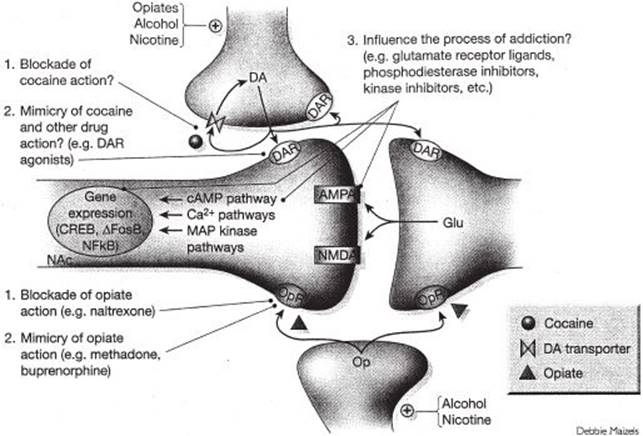
FIGURE 4-1 General strategies used to treat drug addiction or associated physical withdrawal syndromes. A dendritic spine of a nucleus accumbens (NAc) neuron and its innervation by terminals of glutamatergic (Glu), dopaminergic (DA), and opioidergic (Op) neurons are shown. 1: One approach is to block the ability of a drug to reach its initial protein target: for example, naltrexone’s antagonism of opioid receptors (OR) or a hypothetical drug that interferes with cocaine’s actions on the dopamine transporter. Not depicted is the use of immunologic methods (such as a cocaine or nicotine vaccine) to prevent a drug from entering the brain. 2: A second approach is to mimic drug action: for example, sustained activation of OR by methadone, or activation of DA receptors (DAR) by various agonists or partial agonists. 3: A third approach is to influence the process of addiction: for example, via perturbation of Glu receptors (AMPA, NMDA, metabotropic receptors) or a host of postreceptor signaling proteins (such as those involved in the cAMP, calcium, and MAP kinase pathways and in the regulation of gene expression—ΔFosB, CREB, or NFκB) that have been implicated in addiction. (From Nestler EJ. Molecular basis of neural plasticity underlying addiction. Nat Rev Neurosci 2001;2:119–128; Hyman SE, Malenka RC, Nestler EJ. Neural mechanisms of addiction: the role of reward-related learning and memory. Annu Rev Neurosci 2006;29:565–598; Robison AJ, Nestler EJ. Transcriptional and epigenetic mechanisms of addiction. Nature Rev Neurosci 2011;12:623–637.)
A related approach with cocaine or other stimulants (amphetamine, methamphetamine) has not yet been effective. The most important mechanism of action of cocaine is inhibition of presynaptic dopamine transporters (Fig. 4-1). The goal for treatment would be to prevent cocaine’s binding to the transporter without affecting the transporter’s normal functioning. Despite intense effort, suitable molecules have not yet been developed and validated. An alternative to such a “cocaine antagonist” is the “cocaine vaccine,” which would block cocaine’s entry into the brain through immunologic approaches. By immunizing with cocaine coupled to a carrier, it has been possible to generate immunity in animals (10). When the animals are subsequently challenged with cocaine, the drug’s clearance is increased, its penetration into the brain is decreased, and its behavioral effects are attenuated. Cocaine vaccines are now in clinical development and could prove useful, but there are several potential drawbacks. First, cocaine already has a very short half-life. It is not clear whether increased clearance made possible by active immunity would have a functionally meaningful effect in humans. Second, a cocaine vaccine would not be active against other stimulants, and cocaine users could rapidly switch to another drug. The use of a cocaine vaccine also raises important ethical considerations, such as the potential loss of privacy (the presence of such antibodies would “mark” a person with addiction) and whether the vaccine should be voluntary (11). An alternative to such an active vaccine would be passive immunity, also under investigation, where a user would be injected at set intervals with anticocaine antibodies. Similar efforts are under way to generate a vaccine toward nicotine, which is in early clinical trials.
Cannabinoids, the active ingredients in marijuana, act through the stimulation of CB1 receptors. Moreover, there is evidence that other drugs of abuse (e.g., opioids, alcohol) may produce part of their addicting effects via the activation of endogenous cannabinoids in the brain (see Table 4-1) (12). This has led to the speculation that CB1 antagonists may be of use in treating various addictions. Rimonabant is a CB1antagonist, approved in Europe for the treatment of obesity. Its potential efficacy in treating addiction remains unknown. An important cautionary note is that use of rimonabant is associated with the onset of depressive symptomatology in some patients, including the incidence of suicide, which has severely limited utility of this pharmacologic approach.
MIMICRY OF DRUG ACTION
Contrary to efforts to block drug effects, there have been considerable interest and progress in treating addiction by mimicking drug action. This approach is based on the notion that blocking drug targets, as mentioned previously, would leave the addicted person with an altered, addicted brain and the intense drug craving it produces. In contrast, by activating drug targets, it might be possible to partially alleviate this drug craving and allow the brain to slowly recover. A critical aspect of this approach, and presumably of brain recovery, is to use long-acting medications that would do more than simply mimic a drug of abuse; they would need to do so in a sustained manner, thereby avoiding the rapid on and off phases of repeated drug exposure. Although the effectiveness of drug mimicry has been documented clinically, it is poorly understood at the neurobiologic level.
The best-established example of this approach is methadone, a particularly long-acting opioid receptor agonist. The only difference between methadone and other opioids is its long half-life, which means that, at the proper dose, opioid-dependent patients on methadone have a modest level of sustained activation of opioid receptors. This enables patients to avoid the daily extremes of “highs” on drug administration and withdrawal as the drug effects wear off. This, in turn, enables the patients to return to a more normal life of steady work and social interactions. Decades of experience have documented the safety and efficacy of methadone in the treatment of a subset of patients with opioid dependence, although it is difficult to predict which individuals will respond (13,14). Another long-acting opioid agonist, levo-alpha-acetylmethadol, is used similarly, although it causes cardiac side-effects in some patients. A variation in this theme is buprenorphine (15). As a high-affinity partial agonist, buprenorphine binds to opioid receptors and produces a mild agonist effect. Higher doses of the drug do not produce stronger effects because the ability of buprenorphine to activate the receptor is intrinsically low. However, buprenorphine, bound to the receptor at high affinity, can block the effects of opioid drugs of abuse, which limits the ability of a person with an addiction to obtain a drug “high" during treatment. Despite the clear utility of this general approach, and considerable success in many patients, there remains significant concern towards methadone and related treatments, because the addicted person is still being exposed to opioids and may be vulnerable to deleterious effects of these medications.
Another example of the mimicry approach is the use of nicotine patches or chewing gum to treat tobacco addiction. The resulting sustained release of low levels of nicotine can dampen craving for cigarettes in some patients long enough to help the individuals quit smoking (16). However, such approaches are not effective in most smokers, perhaps because of the very stable nicotine-induced changes in the brain that sustain the addiction. Perhaps agonists or partial agonists selective for particular nicotinic cholinergic receptors in the brain that mediate nicotine addiction would be more effective than low levels of nicotine itself. Indeed, one such nicotinic partial agonist, varenicline, has been approved for treatment of nicotine addiction, and early clinical experience supports effectiveness in smoking cessation (17).
Mentioned briefly earlier is the important role of dopamine in drug addiction. Stimulation of dopaminergic transmission in the nucleus accumbens and elsewhere seems to be the most important mechanism of stimulant action and contributes to the actions of other drugs of abuse as well (Fig. 4-1) (4,5). Thus, activation of opioid, cholinergic, or cannabinoid receptors increases dopaminergic transmission in these brain regions. Based on this knowledge, there has been intense effort to use dopamine receptor antagonists and agonists in the treatment of addiction. The goal is to develop agents that regulate the general process of addiction, which might be equally effective for all drugs of abuse. Use of dopamine antagonists is based on the notion that inhibition of drug effects would limit drug use, whereas use of dopamine agonists is based on the notion that mimicry of drug effects would be more efficacious. The former approach has not been promising. Although dopamine receptor antagonists can block acute drug effects, there is no evidence that they limit drug craving or self-administration in the long term. They may even make animals and humans more sensitive to drugs of abuse via adaptive increases in dopamine receptor signaling efficacy. In contrast, there is some promise for the use of D1 receptor agonists and D2 receptor partial agonists, which dampen cocaine craving and relapse in animal models (18,19). Studies in humans are a high priority but are limited by the lack of availability of suitable compounds for human use.
BLOCKADE OF THE ADDICTION PROCESS
A great deal has been learned over the past decade about the changes that drugs of abuse cause in the brain’s reward pathways to produce addiction (2,20). Current research aims to exploit this information for the development of more effective treatments. However, efforts in this realm are almost entirely speculative and must be viewed with skepticism. It is clear, for example, that glutamatergic innervation (from prefrontal cortex, amygdala, and hippocampus) is crucial for the normal activity of the nucleus accumbens and ventral tegmental area. Moreover, drugs of abuse alter levels or activity of glutamate receptors within these regions (4,21–24). This raises the possibility, untested to date in humans, that drugs aimed at any of several types of glutamate receptors might be of use in the treatment of addiction. Given the prominent role of glutamatergic mechanisms in learning and memory, and increasing evidence that important aspects of addiction can be viewed as a form of memory, it is possible that glutamatergic agents, given in conjunction with behavioral therapies, might be most efficacious at fundamentally altering addictive behavior. For example, we now know that extinction of a memory is not the passive process of undoing that memory, but rather the formation of an active new memory that supersedes the old one. Hence, a drug that enhances glutamatergic transmission and, therefore, new memory formation, given in concert with behavioral extinction trials, might be a novel approach to treating addiction-related memories that are thought to underlie aspects of craving and relapse.
In a similar way, numerous other neurotransmitter, neuropeptide, and neurotrophic factor systems are altered by drugs of abuse and, in turn, modulate drug effects in laboratory animals: GABA, neuropeptide Y, corticotropin-releasing factor, serotonin, norepinephrine, melanocortins, and brain-derived neurotrophic factor, to name just a few. One example is gamma-vinyl GABA, a GABA transaminase inhibitor, which shows some promise toward cocaine and other stimulants in animal models and early clinical studies, although further work is needed to validate its true effectiveness (25). As these effects are better defined in animal models, and putative treatment agents suitable for human investigation are developed, these mechanisms can be tested in clinical populations.
Drug addiction also involves adaptations at postreceptor, intracellular signaling cascades, including alterations in gene expression (2,20). Moreover, modification of particular signaling proteins can have dramatic effects on an animal’s responses to drugs of abuse. Examples include several proteins that regulate the function of G protein–coupled receptors: G proteins, G protein–receptor kinases, arrestins, and regulators of G protein signaling proteins (26–28). Because the acute targets of many drugs of abuse are G protein–coupled receptors, it is possible that agents affecting these modulatory proteins could exert interesting functional effects on the receptor systems so as to treat aspects of addiction. Similarly, given the evidence for an important role of the cyclic adenosine monophosphate (cAMP) pathway in addiction (2,29) and of the transcription factor ΔFosB (30), it is conceivable that novel agents directed against protein components of these pathways (such as phosphodiesterase inhibitors, which would enhance cAMP function) might warrant investigation as clinical treatments. Still another example is inhibitors of histone deacetylases (HDACs), enzymes that regulate gene expression by acetylating nearby histones. Recent evidence demonstrates that manipulation of specific HDACs, or of several other chromatin-modifying enzymes, in the brain exerts a dramatic effect on drug-elicited behaviors (31). Drug discovery efforts should, of course, focus on subtypes of these intracellular signaling proteins that are highly enriched in the brain’s reward pathways and would therefore represent potentially viable medication targets.
One of the central problems in approaching addiction is that truly effective treatments are not yet available. Thus, it is impossible to know what types of treatment are theoretically possible. For example, before the advent of antidepressant medications, there was considerable debate about the nature and magnitude of improvement possible with chemical treatments. By analogy, the drug abuse field now aims to identify medications that dampen drug craving or reward without interfering with motivation for natural rewards. Only as putative treatment agents are developed and tested in animals and humans will insight into the feasibility of this aim become available.
Perhaps an even greater obstacle in the development of new treatments for addiction is the relative lack of interest by the pharmaceutical industry. This problem has many factors, including the perceived stigma of dealing with addiction as well as the presumption that markets for addiction treatment agents might be too small. The latter would appear to be a major miscalculation by the industry. Experience tells us that the size of many markets only becomes apparent when truly effective treatments are available. Antidepressants, now a worldwide market of more than approximately $15 billion, are a case in point. By analogy, treatment agents that can correct compulsive behavior towards drug rewards, if they can be developed, would represent enormous successes, given their potential to treat not only drug addictions but addictions to non-drug stimuli, such as gambling, food, and sex, which are mediated in part by similar mechanisms. Such treatments could be highly successful and offer dramatic improvement in public health.
ACKNOWLEDGMENTS
Preparation of this review was supported by grants from the National Institute on Drug Abuse. Earlier versions of this chapter were adapted with permission of the publisher from Nestler EJ. From neurobiology to treatment: progress against addiction. Nat Neurosci 2002;5(Suppl):1076–1079. © 2002, Nature Neuroscience, New York, NY.
REFERENCES
1.Dackis C, O’Brien C. Neurobiology of addiction: treatment and public policy ramifications. Nat Neurosci 2005;8:1431–1436.
2.Nestler EJ. Molecular basis of neural plasticity underlying addiction. Nat Rev Neurosci 2001;2:119–128.
3.Koob GF, Le Moal M. Drug addiction, dysregulation of reward, and allostasis. Neuropsychopharmacology 2001;24:97–129.
4.Wolf ME. The Bermuda Triangle of cocaine-induced neuroadaptations. Trends Neurosci 2010;33:391–398.
5.Kalivas PW, Volkow ND. New medications for drug addiction hiding in glutamatergic neuroplasticity. Mol Psychiatry 2011;16:974–986.
6.Kendler KS, Myers J, Prescott CA. Specificity of genetic and environmental risk factors for symptoms of cannabis, cocaine, alcohol, caffeine, and nicotine dependence. Arch Gen Psychiatry 2007;64:1313–1320.
7.Bierut LJ. Genetic vulnerability and susceptibility to substance dependence. Neuron 2011;69:618–627.
8.Sigmon SC, Bisaga A, Nunes EV, et al. Opioid detoxification and naltrexone induction strategies: recommendations for clinical practice. Am J Drug Alcohol Abuse 2012;38:187–199.
9.Krystal JH, Cramer JA, Krol WE, et al. Veterans Affairs Naltrexone Cooperative Study 425 Group. Naltrexone in the treatment of alcohol dependence. N Engl J Med 2001;345:1734–1739.
10.Shen XY, Orson FM, Kosten TR. Vaccines against drug abuse. Clin Pharmacol Ther 2012;91:60–70.
11.Cohen PJ. Immunization for prevention and treatment of cocaine abuse: legal and ethical implications. Drug Alcohol Depend 1997;48:167–174.
12.Parolaro D, Vigano D, Rubino T. Endocannabinoids and drug dependence. Curr Drug Targets CNS Neurol Disord 2005;4:643–655.
13.National Consensus Development Panel on Effective Medical Treatment of Opiate Addiction Effective medical treatment of opiate addiction. JAMA 1998;280:1936–1943.
14.Kreek MJ. Methadone-related opioid agonist pharmacotherapy for heroin addiction. History, recent molecular and neurochemical research and future in mainstream medicine. Ann N Y Acad Sci2000;909:186–216.
15.Ling W, Smith D. Buprenorphine: blending practice and research. J Subst Abuse Treat 2002;23:87–92.
16.Raupach T, van Schayck CP. Pharmacotherapy for smoking cessation: current advances and research topics. CNS Drugs 2011;25:371–382.
17.Doggrell SA. Which is the best primary medication for long-term smoking cessation—nicotine replacement therapy, bupropion or varenicline. Exp Opin Pharmacother 2007;8:2903–2915.
18.Pulvirenti L, Koob GR. Dopamine receptor agonists, partial agonists and psychostimulant addiction. Trends Pharmacol Sci 1994;15:374–379.
19.Self DW, Barnhart WJ, Lehman DA, et al. Opposite modulation of cocaine-seeking behavior by D1-like and D2-like dopamine receptor agonists. Science 1996;271:1586–1589.
20.Hyman SE, Malenka RC, Nestler EJ. Neural mechanisms of addiction: the role of reward-related learning and memory. Annu Rev Neurosci 2006;29:565–598.
21.Carlezon WA Jr, Nestler EJ. Elevated levels of GluR1 in the midbrain: a trigger for sensitization to drugs of abuse? Trends Neurosci 2002;25:610–615.
22.Kalivas PW. Glutamate systems in cocaine addiction. Curr Opin Pharmacol 2004;4:23–29.
23.Kauer JA, Malenka RC. Synaptic plasticity and addiction. Nat Rev Neurosci 2007;8:844–858.
24.Sutton MA, Schmidt EF, Choi KH, et al. Extinction-induced upregulation in AMPA receptors reduces cocaine-seeking behaviour. Nature 2003;421:70–75.
25.Gorelick DA, Gardner EL, Xi ZX. Agents in development for the management of cocaine abuse. Drugs 2004;64:1547–1573.
26.Raehal KM, Schmid CL, Groer CE, et al. Functional selectivity at the μ-opioid receptor: implications for understanding opioid analgesia and tolerance. Pharmacol Rev 2011;63:1001–1019.
27.Hooks SB, Martemyanov K, Zachariou V. A role of RGS proteins in drug addiction. Biochem Pharmacol 2008;75:76–84.
28.Wang H, Zhang M. The role of Ca2 +-stimulated adenylyl cyclases in bidirectional synaptic plasticity and brain function. Rev Neurosci 2012;23:67–78.
29.McGinty JF, Whitfield TW Jr, Berglind WJ. Brain-derived neurotrophic factor and cocaine addiction. Brain Res 2010;1314:183–193.
30.Nestler EJ. Transcriptional mechanisms of addiction: role of deltaFosB. Philos Trans R Soc Lond B Biol Sci 2008;363:3245–3255.
31.Robison AJ, Nestler EJ. Transcriptional and epigenetic mechanisms of addiction. Nat Rev Neurosci 2011;12:623–637.