
Definition
• Solitary benign smooth muscle tumor
Clinical features
Epidemiology
• Uncommon solitary tumor in the large airways or parenchyma of adults, usually women
Presentation
• Cough, obstructive pneumonia, hemoptysis, wheezing if mass protrudes into large airway; otherwise asymptomatic
Prognosis and treatment
• Complete excision is curative
Pathology
Histology
• Sharply circumscribed nodule of bland spindle cells, with eosinophilic cytoplasm and blunt-end oval nuclei, arranged in whorls or fascicles
• Stromal fibrosis and entrapped bronchiolar epithelium may be present
• Mitotic figures, if present, are rare, and necrosis is absent
Immunopathology/special stains
• Positive for smooth muscle markers: muscle-specific actin, smooth muscle actin (SMA), desmin, calponin, caldesmon
• Negative: S100, cytokeratin
Main differential diagnoses
• Leiomyomatous hamartoma: more common, intraparenchymal, with small amounts of fat or cartilage and entrapped respiratory epithelium
• Benign metastasizing leiomyoma: multiple leiomyomas in women with uterine leiomyomas
• Metastatic leiomyosarcoma: history of leiomyosarcoma
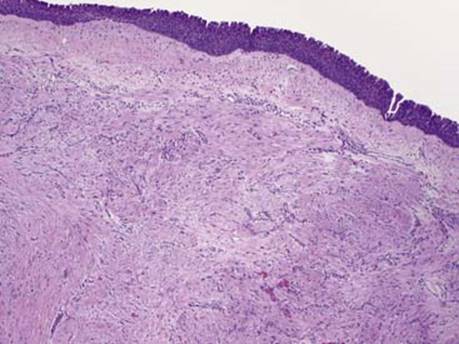
Fig 1 Leiomyoma. At low power, bland spindle cells form a subepithelial nodule.
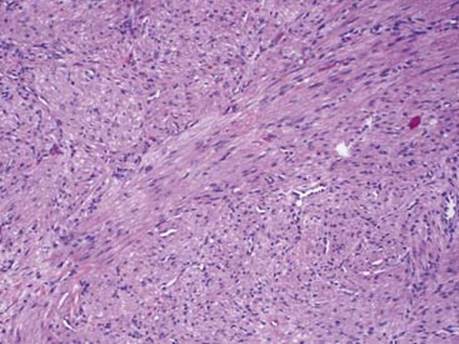
Fig 2 Leiomyoma. At higher power, the eosinophilic cytoplasm, blunt oval nuclei, and fascicular arrangement of the tumor cells are seen.
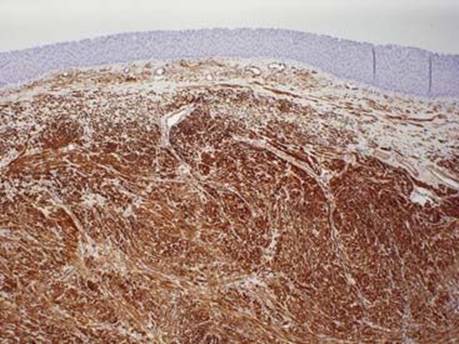
Fig 3 Leiomyoma. Tumor cells are strongly positive for smooth muscle markers, including SMA, as illustrated here.