
Definition
• Clinically defined as a productive cough, occurring on most days for 3 or more months for at least 2 successive years in the absence of any known cause of chronic cough
Clinical features
Epidemiology
• Commonly affects middle-aged adults but can be seen at any age
• Affects approximately 5.4% of the population in the United States
• High-risk population includes people who smoke and those exposed to high concentrations of dust and irritating fumes
Presentation
• Chronic productive cough, dyspnea, wheezing
• Physical examination: coarse rhonchi and wheezes
Prognosis and treatment
• Stop smoking and avoid exposure of stimulating dust and irritating fumes
• Relieve symptoms and prevent complications with bronchodilators and anticholinergics
• 5-year survival is approximately 50% if FEV1 falls below 50% of predicted values
Pathology
Histology
• Chronic bronchitis with mucostasis, submucosal glandular hyperplasia with increased Reid index (>0.5), goblet cell metaplasia/hyperplasia and chronic inflammation
• Chronic respiratory bronchiolitis
Immunopathology/special stains
• Not contributory
Main differential diagnoses
• Because it is defined clinically and the pathological features are nonspecific, the differential is also based on clinical presentation

Fig 1 Chronic bronchitis. Low-power view shows bronchus with goblet cell and mucous gland hyperplasia. Note that some of the mucous glands are small due to adjacent fibrosis.
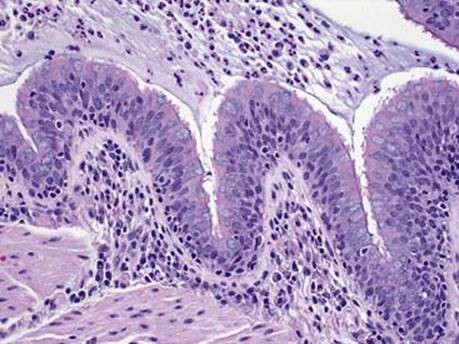
Fig 2 Chronic bronchitis. High-power view shows goblet cell hyperplasia and chronic inflammation in the submucosa and acute inflammation mixed with intraluminal mucus.
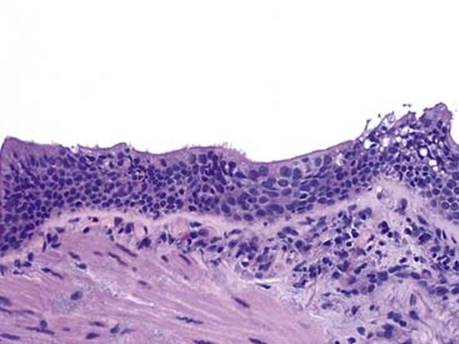
Fig 3 Chronic bronchitis. This patient was followed up in a high-risk clinic (because of a long history of smoking) and had this endobronchial biopsy, which shows squamous metaplasia.