
Definition
• Necrotizing eosinophilic and granulomatous vasculitis (also called allergic granulomatosis and angiitis) involving small vessels associated with bronchial asthma and peripheral eosinophilia
Clinical features
Epidemiology
• One of the rarest small-vessel vasculitides, almost exclusively affecting patients with asthma
Presentation
• Vessels of the lung, heart, peripheral nerves, skin, and spleen are affected
• Allergic rhinitis, bronchial asthma, and peripheral eosinophilia often precede development of vasculitis (“prevasculitis” stage)
• p-ANCA positive in 50% of cases
• Diagnosis requires fulfilling four or more of the following diagnostic criteria (from Masi AT, Hunder GG, Lie, JT, et al: The American College of Rheumatology 1990 criteria for the classification of Churg-Strauss syndrome (allergic granulomatosus and angiitis), Arthritis Rheum 33:1094-1100, 1990):
• Asthma
• Eosinophilia (more than 10% of white blood cells in leukocyte differential)
• Mononeuropathy or polyneuropathy
• Migratory or transitory pulmonary infiltrates attributable to vasculitis
• Paranasal sinus pain, tenderness, or radiographic opacification
• Biopsy demonstrating accumulation of eosinophils in extravascular spaces
Prognosis and treatment
• Leading cause of death is coronary arteritis or myocarditis
• Treatment: corticosteroids, cyclophosphamide, azathioprine
• About 25% of patients have a relapse after treatment
• About 90% still require corticosteroid therapy for asthma even after successful treatment of vasculitis
Pathology
Histology
• Variant of polyarteritis nodosa with necrotizing eosinophilic and granulomatous vasculitis involving small vessels (small arteries, arterioles, capillaries, venules, and veins) of the lung, heart, peripheral nerves, skin, and spleen
• Intravascular and extravascular granulomas
Immunopathology/special stains
• Not contributory
Main differential diagnoses
• Wegener granulomatosis: vasculitis involves pulmonary and glomerular vessels; no association with asthma or eosinophilia
• Lethal midline granuloma: frequent cytological atypia; Epstein-Barr virus infection
• Microscopic polyangiitis: no association with asthma or eosinophilia; leukocytoclastic vasculitis with no granulomas or eosinophils

Fig 1 Churg-Strauss syndrome. Cutaneous Churg-Strauss vasculitis: section of skin showing fibrinoid necrosis of vessel walls and hemorrhage, low power.

Fig 2 Churg-Strauss syndrome. Cutaneous Churg-Strauss vasculitis: fibrinoid necrosis of vessel wall with adjacent inflammatory infiltrate of mostly eosinophils, medium power.
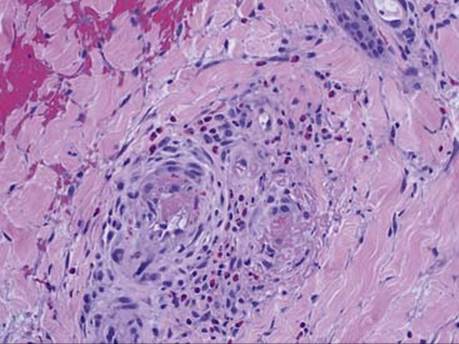
Fig 3 Churg-Strauss syndrome. Cutaneous Churg-Strauss vasculitis, high power.

Fig 4 Churg-Strauss syndrome. Involvement of vasa nervorum, low power, in a patient with peripheral neuropathy in lower extremity.

Fig 5 Churg-Strauss syndrome. Eosinophils infiltrate the wall of a blood vessel adjacent to a peripheral nerve, medium power.

Fig 6 Churg-Strauss syndrome. High power of same patient as in Figs 4 and 5.

Fig 7 Churg-Strauss syndrome. Unusual case of Churg-Strauss vasculitis involving colonic vasculature.

Fig 8 Churg-Strauss syndrome. Higher magnification of Fig 7 demonstrating fibrinoid necrosis and eosinophilic infiltrates.