
Definition
• RB-ILD is a disease of the small airways commonly occurring in smokers, with thickening of airway walls on imaging
Clinical features
Epidemiology
• Associated with cigarette smoking with a dose-related effect
• In nonsmokers, RB manifests as interstitial lung disease
• In smokers, RB, RB-ILD, and desquamative interstitial pneumonia (DIP) are considered to be on the same spectrum of disease; RB is at the asymptomatic end
Presentation
• Presents in early midlife (late 30s), about a decade earlier than DIP
• Initial presentation is mild shortness of breath and coughing
• Pulmonary function testing may show both obstructive and restrictive features; diffusing capacity is mildly reduced
Prognosis and treatment
• RB-ILD has an excellent prognosis
• Patients with mild symptoms will improve after smoking cessation
Pathology
Histology
• Scant inflammation along the terminal airways
• Bronchiolar metaplasia extending from terminal airways toward alveolar ducts
• Lightly pigmented macrophages are present within bronchiolar lumens and adjacent alveoli
• Scant peribronchiolar fibrosis may extend to contiguous alveolar walls
Immunopathology/special stains
• Not contributory
Main differential diagnoses
• Bronchiolitis of other causes
• Other small airway diseases such as idiopathic constrictive bronchiolitis: more severe pulmonary function abnormalities
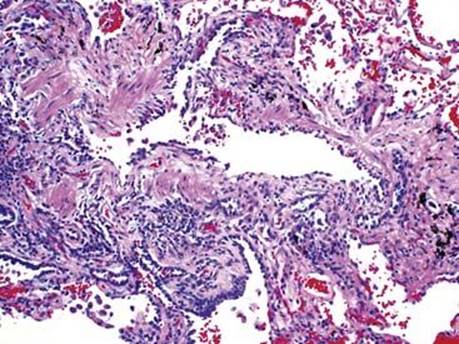
Fig 1 Respiratory bronchiolitis–associated interstitial lung disease. Small airway with thickened wall and scant inflammation. Note normal alveolar architecture.

Fig 2 Respiratory bronchiolitis–associated interstitial lung disease. Pigmented macrophages within small airways.
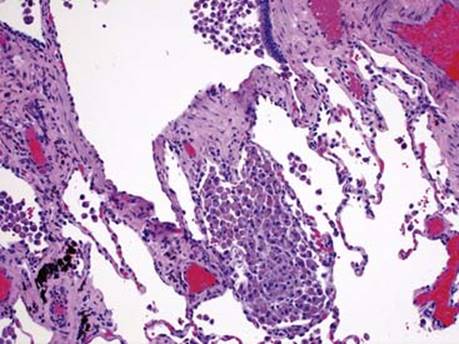
Fig 3 Respiratory bronchiolitis–associated interstitial lung disease. Extension of pigmented macrophages from the small airways into the adjacent alveolar space.