
David M. Cline
 The American Board of Emergency Medicine (ABEM) administers three written exams each year: the Qualification Exam (formerly the Certification Exam), the ConCert Exam (formerly the Recertification Exam), and the In-Training Exam. The year 2004 marked the beginning of Emergency Medicine Continuous Certification (ConCert) and the Lifelong Learning and Self-Assessment (LLSA) exams.
There are requirements for eligibility for initial ABEM certification and maintaining certification in addition to content testing. For up-to-date information concerning these exams, review the ABEM Web site: www.abem.org.
The American Osteopathic Board of Emergency Medicine (AOBEM) administers one Certification Examination per year in mid to late March. AOBEM implemented a Continuous Certification in Emergency Medicine process, which is termed Continuous Osteopathic Learning Assessment (COLA). There are requirements for eligibility for initial AOBEM certification and maintaining certification in addition to content testing. See www.aobem.org for details.
ABEM WRITTEN QUALIFICATION EXAM
The ABEM Qualifying Examination is given each year in early November at several locations throughout the country at computer testing centers; check for test site information at www.abem.org.
The ABEM Qualifying Examination contains approximately 305 single-best-answer, positively worded, multiple-choice questions.
Between 10% and 15% of the questions will have a pictorial stimulus.
Each examination appointment is approximately 8 hours in length, with approximately 6 and ½ hours devoted to actual testingtime (1.3 minutes per question). There is a break for lunch separating two separately timed testing sessions of 3 hours and 10 minutes.
The pass/fail criterion for the Qualifying Examination is 75% correct of those test items that are included in the examination for the purpose of scoring.
Typically, two-thirds to three-fourths of the test are scored, with one-fourth to one-third of the test questions representing new trial content. These investi-gational questions are compared with standardized questions for reliability and may be included as scored items the following exam cycle. Typically, a question requires 2 years from the time of creation to use as a scored item.
The pass rate for the Qualifying Exam during the past 20 years has been 90% for first-time takers, and 78% overall.
Beginning with the 2002 examinations, the subject matter of the written exams is based on The Model of the Clinical Practice of Emergency Medicine and its revisions.
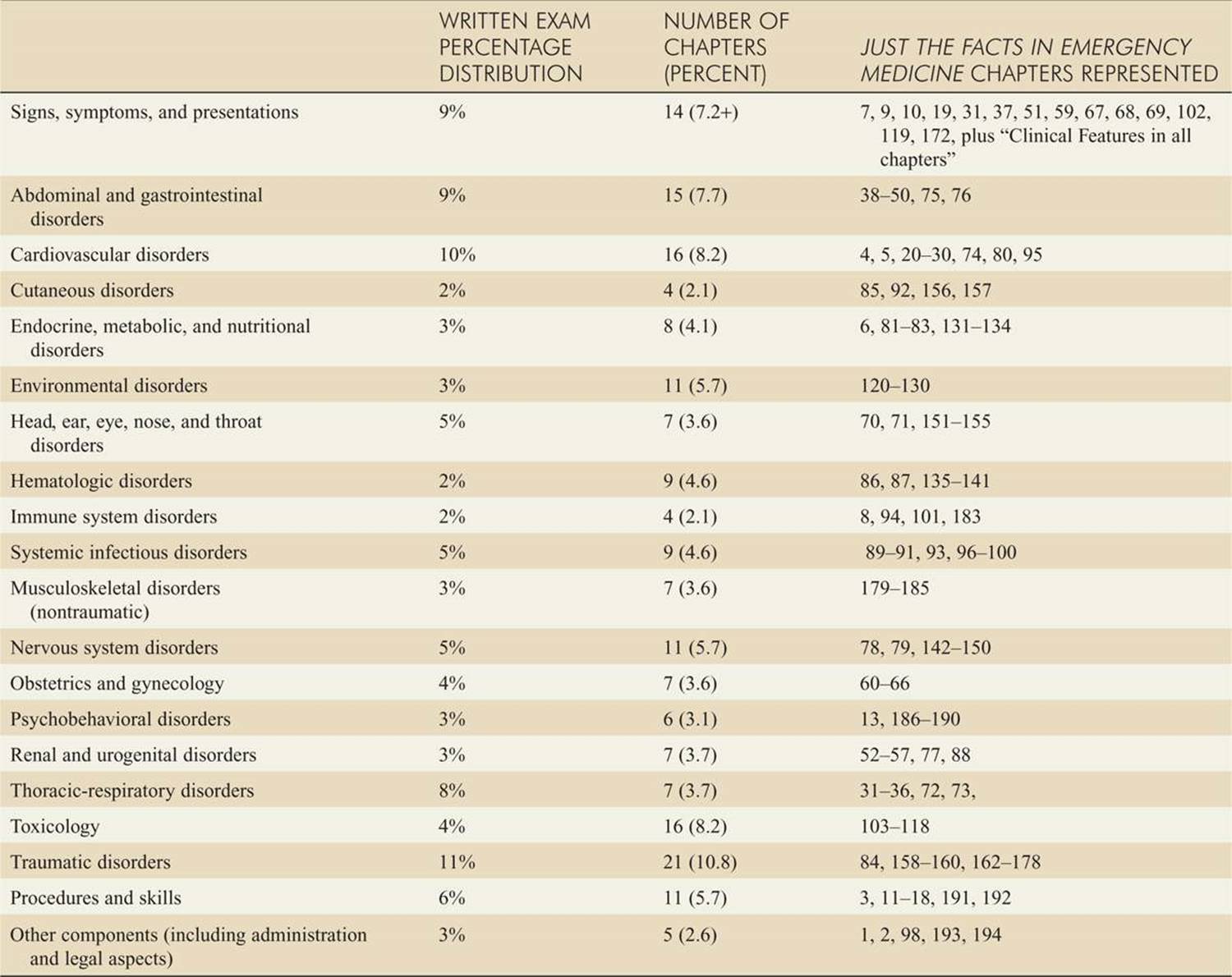
A percentage breakdown of the exam content compared to the chapters of this book is listed in Table 1-1. Although many of the questions are different, the content percentages are the same for all three ABEM written exams. Just the Facts in Emergency Medicine (3rd edition) includes several chapters that include multiple topics; therefore, our chapters do not precisely correlate with the exam question content areas.
Another consideration for physicians preparing for the written exams is the acuity breakdown. The questions on the exam are rated by patient acuity (or issues surrounding the care of patients in each acuity category) with 27% critical, 37% emergent, 27% lower acuity, and 9% unrelated to acuity. Therefore, when reviewing specific topic areas, the reader should focus on the issues surrounding the assessment and care of critical or emergent patient presentations, as this content represents 64% of the exam.
Compared to the ConCert Exam (formerly the Recertification Exam), the Qualification Exam has more pathophysiology-based questions. Roughly 60% of the questions are management based, many of which require a diagnosis be made from the clinical description. Diagnostic criteria are covered in 20%, and 10% are pathophysiology based. The remaining 10% of questions relate to emergency department administration, emergency medical service (EMS), disaster medicine, and miscellaneous issues.
Certification expires every 10 years. Recertification requires participation in the Continuous Certification process (see later in this chapter).
TABLE 1-1 Percentage Distribution of Test Items in Emergency Medicine, 3rd ed. by Core Content Category Compared to Chapter Listing of Just the Facts in Emergency Medicine, 3rd ed.
ABEM CONTINUOUS CERTIFICATION (RECERTIFICATION)
The recertification process has been renamed Continuous Certification and now requires four components: (1) professional standing, (2) yearly Lifelong Learning Self-Assessment tests that are based on journal articles, (3) assessment of cognitive expertise (the ConCert exam), and (4) assessment of practice performance.
All diplomates of the boards should check the Web site for information concerning their requirements for recertification, which vary according to the year their current certification expires.
Information concerning the professional standing requirement (no. 1 above) and assessment of practice performance (no. 4 above) can be found at the ABEM Web site: www.abem.org.
The yearly required readings for the LLSA tests can be found at the ABEM Web site: www.abem.org. The LLSA tests are based on these readings.
The new ConCert Exam is a 5.25-hour experience (4.25 hours in the actual exam) and is available at over 200 computer-administered testing centers across the country. See the ABEM Web site for more details: www.abem.org.
The ConCert Exam consists of approximately 205 multiple-choice questions that are single-best-answer, positively worded questions focused on what the practicing emergency physician needs to know when treating patients.
Of the test questions, approximately 15% will include a pictorial stimulus, and these are generally during the first portion of the exam.
The content of the exam comes from The Model of the Clinical Practice of Emergency Medicine and its subsequent revisions.
For a period of a few years, the ConCert Exam contained questions related to the content of the LLSA articles; however, that is no longer the case, unless the article’s recommendations have become standard practice in the specialty.
The pass/fail criterion for the ConCert Exam has historically been approximately 75% correct of those test items that are included in the examination for the purpose of scoring.
Typically only two-thirds to three-fourths of the test are scored, with one-fourth to one-third of the test questions representing new trial content. These investigational questions are compared with standardized questions for reliability and may be included as scored items the following exam cycle.
The pass rate for the ConCert exams since 2004 to date has averaged 95%.
Compared to the Qualification Exam, the ConCert Exam is more clinically based and has fewer patho-physiology-based questions.
The content of the LLSA readings is published on the ABEM Web site. In the first decade of their existence, the topics of LLSA readings were chosen from focused areas of the model curriculum. For example, for the year 2013, the topics are thoracic-respiratory disorders, immune system disorders, and musculoskeletal disorders. Beginning in 2014, the readings will be chosen from the broad spectrum of the EM model and will no longer recycle over a 9-year period.
A percentage breakdown of the exam content compared to the chapters of this book is listed in Table 1-1. Although many of the questions are different, the content percentages are the same for all three ABEM written exams. Just the Facts in Emergency Medicine includes several chapters that include multiple topics; therefore, our chapters do not precisely correlate to the exam question content areas.
Recertification must be accomplished every 10 years to maintain ABEM Board Certification.
ABEM IN-TRAINING EXAM
The In-Training Exam is given to all emergency medicine residents each year in late February.
The test consists of approximately 225 questions and lasts 4 hours and 30 minutes (1.1 minutes per question), given in a single session.
Unlike other ABEM exams, there is no pass/fail criterion; rather, residents are compared to other residents across the country at their same level of training. Scores for individual training programs are compared with other training programs across the country, and this information is provided to residency program directors.
Subject matter of the exam is based on The Model of the Clinical Practice of Emergency Medicine and its revisions.
The target at which all questions are aimed is the expected knowledge base and experience of an emergency medicine third-year resident.
A percentage breakdown of the exam content compared to the chapters of this book is listed in Table 1-1. Although many of the questions are different, the content percentages are the same for all three ABEM written exams. Just the Facts in Emergency Medicine includes several chapters that include multiple topics; therefore, our chapters do not precisely correlate to the exam question content areas.
AOBEM WRITTEN CERTIFICATION EXAM
The AOBEM Certification Exam is given mid-to-late March each year.
ABEM and AOBEM written test content areas are similar; however, ABEM includes pediatric content throughout its organ-based system categorization as well as administrative and disaster medicine in its other components categorization, and AOBEM includes vital signs and presentations in its similar systems-based categorization. See the AOBEM Web site for details.
The percentage breakdown of the exam content is similar to the topic areas listed in Table 1-1.
Like ABEM, AOBEM uses a preset passing score, but it is not currently published. Also, each exam contains non-scored test items that are in the process of evaluation and standardization.