
D. Adam Algren
DIGITALIS GLYCOSIDES
EPIDEMIOLOGY
 Digitalis preparations are used in the treatment of supraventricular tachydysrhythmias and congestive heart failure.
The annual incidence of digoxin toxicity is slowly decreasing due to declining use of digoxin.
PATHOPHYSIOLOGY
Digitalis inhibits the sodium-potassium-adenosine triphosphate (Na+-K+-ATPase) pump. Ultimately, intracellular calcium concentrations increase, which is responsible for the inotropic effect of digitalis. Elevated intracellular calcium also increases auto-maticity and can result in spontaneous depolarization and tachy arrhythmias.
Digitalis increases vagal tone and decreases conduction through the atrioventricular node, resulting in bradycardia.
CLINICAL FEATURES
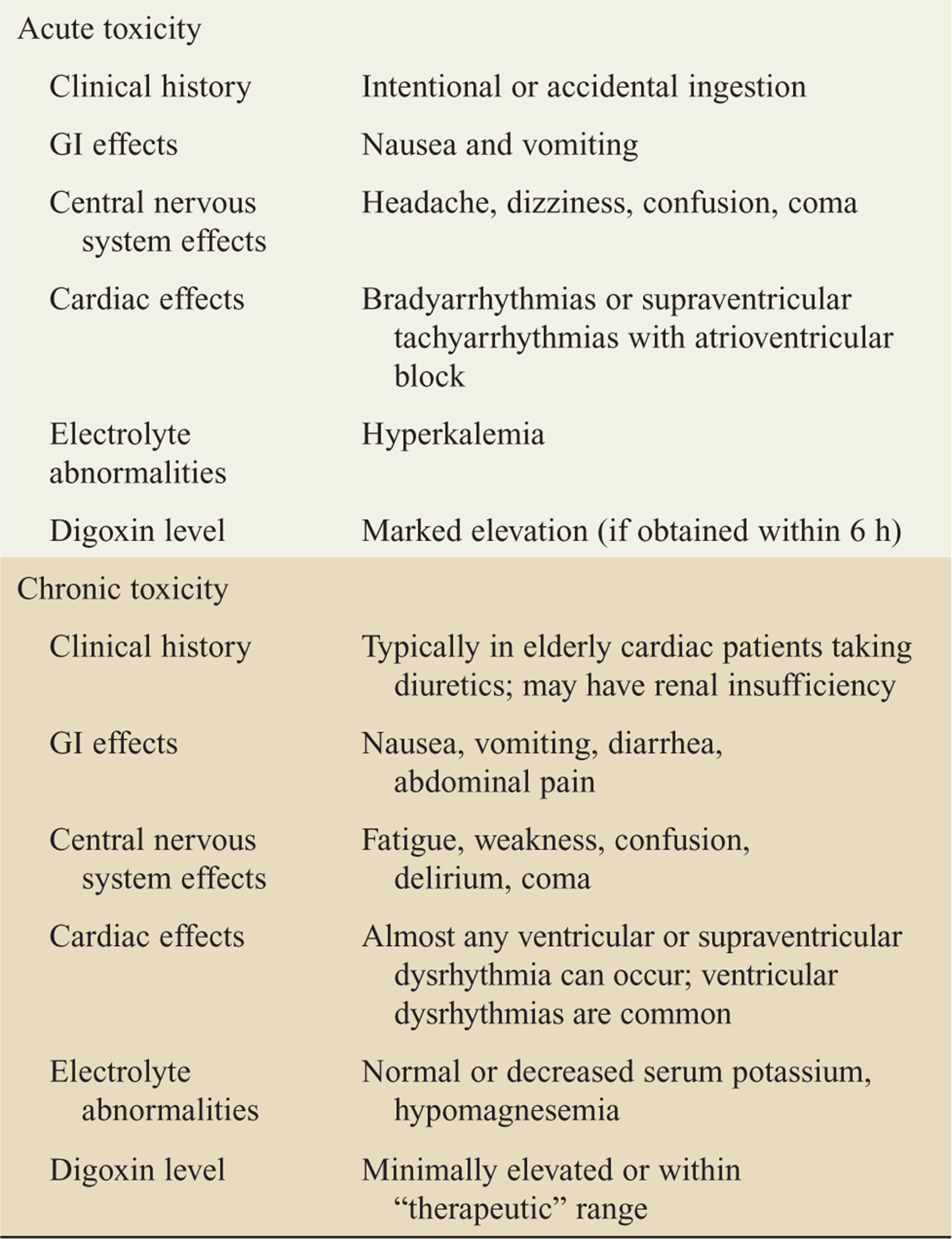
Toxicity can occur following an acute ingestion or develop during chronic therapy (Table 110-1).
Chronic toxicity is more common in the elderly and occurs in those with predisposing illnesses (heart disease, renal/liver failure, hypothyroidism, chronic obstructive pulmonary disease), electrolyte disturbances (hypokalemia, hypomagnesemia), or drug interactions (quinidine, amiodarone, spironolactone, calcium channel blockers, macrolide antibiotics).
DIAGNOSIS AND DIFFERENTIAL
Hyperkalemia is often seen in acute poisoning but may be absent in chronic toxicity.
Serum digoxin levels are neither sensitive nor specific for toxicity. However, patients with higher digoxin levels (>2 nanograms/mL) are more likely to experience toxicity.
The differential diagnosis includes sinus node disease or toxicity from calcium channel blockers, β-blockers, class IA antidysrhythmics (quinidine, procainamide), clonidine, organophosphates, or cardiotoxic plants, such as rhododendron or yew berry.
TABLE 110-1 Clinical Presentation of Digitalis Glycoside Toxicity
EMERGENCY DEPARTMENT CARE AND DISPOSITION
Management priorities include supportive care, prevention of further absorption in cases of an acute ingestion, and antidote administration, if indicated. All patients require continuous cardiac monitoring, vascular access, and frequent reevaluation.
Consider activated charcoal, 1 gram/kg following acute ingestions.
Use atropine, 0.5 to 2.0 milligrams (0.02 milligram/kg) IV, and cardiac pacing to treat bradydysrhythmias.
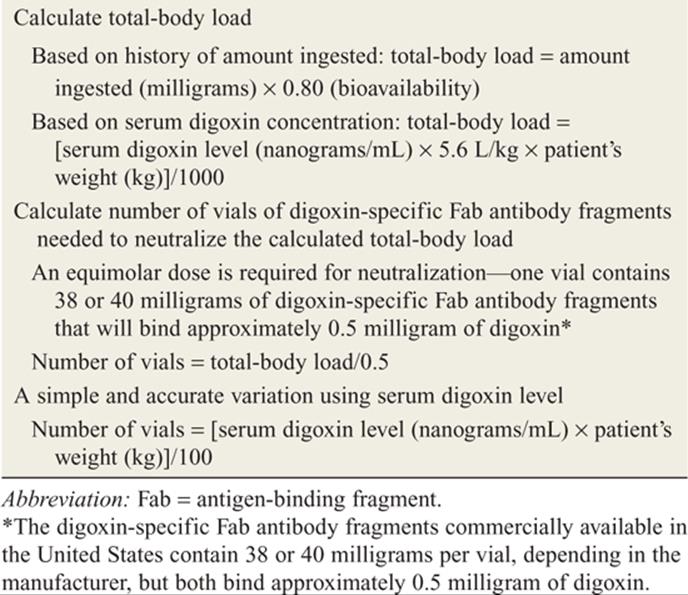
Digoxin-specific Fab is indicated for ventricular dysrhythmias, hemodynamically significant bradydys-rhythmias, and hyperkalemia greater than 5.5 mEq/L. Dosing of digoxin-specific Fab is calculated according to Table 110-2.
Treat ventricular dysrhythmias with phenytoin, 15 milligrams/kg, infused no faster than 25 milligrams/min; lidocaine, 1 milligram/kg, or magnesium sulfate, 2 to 4 grams IV, are alternatives.
Electrocardioversion may induce refractory ventricular dysrhythmias and should be considered only as a last resort. The initial setting should be 10 to 25 J.
Treat hyperkalemia with glucose followed by insulin; other options are sodium bicarbonate, potassium-binding resin, or hemodialysis. Historically, calcium administration in the setting of digoxin toxicity was thought to be associated with an increased incidence of ventricular dysrhythmias and death. However, recent literature suggests that use of calcium is likely safe.
Admit patients with signs of mild toxicity to a monitored setting, and those with significant toxicity should be managed in an intensive care unit. Repeat digoxin levels following digoxin Fab are not accurate and should not be obtained.
Discharge patients not requiring digoxin Fab if they remain asymptomatic with normal serum potassium and digoxin levels after 6 to 12 hours of observation.
TABLE 110-2 Calculation of Digoxin-Specific Fab Antibody Fragment Dose
β-BLOCKERS
EPIDEMIOLOGY
β-Blockers are used in the treatment of various cardiovascular, neurologic, ophthalmologic, and psychiatric disorders.
In 2008, the American Association of Poison Centers received 21,282 reports of β-blocker exposures resulting in six deaths.
PATHOPHYSIOLOGY
β-Blockers alter activity of myocardial, vascular, and smooth muscle cells by attenuating calcium entry into the cell. In cases of toxicity, their negative inotropic and chronotropic effects result in progressive brady-cardia and hypotension.
Different agents possess varying pharmacologic properties including β-reeeptor selectivity, membrane-stabilizing activity (sodium channel blockade), lipid solubility, and partial agonist activity. These different properties influence the clinical spectrum and severity of toxicity.
Sotalol is unique in that it is also a class III antiarrhythmic because of its ability to block potassium channels.
CLINICAL FEATURES
Toxicity usually develops within 6 hours of ingestion of an immediate-release product. In the case of sustained-release preparations, toxicity may be delayed up to 12 hours.
The primary effects of toxicity involve the cardiovascular system and include hypotension, bradycardia, conduction abnormalities, cardiogenic shock, and asystole.
Sotalol is unique in that it can produce QT interval prolongation and is associated with ventricular dysrhythmias such as torsades de pointes.
Noncardiac manifestations of toxicity include altered mental status, psychosis, seizures, hypoglycemia, and bronchospasm.
DIAGNOSIS AND DIFFERENTIAL
The diagnosis is clinical. Drug levels are not commonly available and do not help in acute management.
An ECG should be obtained in all cases. Laboratory studies are directed at identifying underlying medical conditions or complications.
The differential diagnosis includes overdose of calcium channel blockers, α2-agonists, digoxin, organ-ophosphates, and cardiotoxic plants (such as oleander, foxglove, and rhododendron).
EMERGENCY DEPARTMENT CARE AND DISPOSITION
The goal of treatment is restoration of perfusion to critical organs by increasing heart rate and myocardial contractility.
All patients should have continuous cardiac monitoring and vascular access established. Administer crystalloid boluses to treat hypotension.
Obtain bedside serum glucose in the setting of altered mental status.
Administer activated charcoal, 1 gram/kg, within 1 to 2 hours of ingestion if no contraindications are present. Gastric lavage prior to administration of charcoal may be beneficial if performed within 1 to 2 hours of ingestion. Whole-bowel irrigation can be considered in cases of sustained-release preparations.
Atropine, 0.5 to 1 milligram (0.02 milligram/kg, minimum dose 0.1 milligram) IV, can be given for bradycardia, but it is unlikely to be of benefit in cases of severe β-blocker-induced bradycardia or hypotension.
Glucagon has inotropic and chronotropic effects and is the agent of choice for the treatment of toxicity. It is administered as an IV bolus of 3 to 5 milligrams (0.05 milligram/kg). This is followed by a continuous infusion of 1 to 10 milligrams/h. Nausea and vomiting are common side effects of glucagon.
Vasopressors, such as norepinephrine (2-30 micro-grams/kg/min), epinephrine (1-20 micrograms/kg/min), and/or dopamine (2.5-20 micrograms/kg/min), can be used for refractory bradycardia and hypotension.
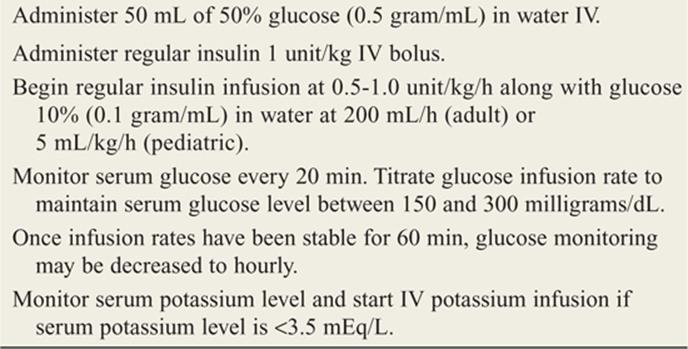
Hyperinsulinemia-euglycemia (HIE) therapy can improve myocardial contractility (Table 110-3).
Calcium may be of limited benefit in cases of refractory hypotension. Either calcium gluconate or calcium chloride may be administered (10 mL of 10% [0.15 mL/kg] repeated three to six times as necessary). Although calcium chloride contains more elemental calcium than calcium gluconate, it is very irritating to soft tissues and should ideally be administered via a central line.
Cardiac pacing may be attempted for refractory bradycardia, but is not always successful and may not reverse hypotension.
Use lidocaine, magnesium sulfate, isoproterenol, and overdrive pacing to treat sotalol-induced ventricular dysrhythmias.
Hemodialysis may be of benefit in cases involving acebutolol, atenolol, nadolol, or sotalol.
Admit patients who develop bradycardia, hypotension, conduction disturbances, or altered mental status to an ICU.
Admit patients who have ingested a sustained-release preparation or sotalol to a monitored setting due to concern for delayed toxicity.
Those patients who remain asymptomatic 6 hours following ingestion of an immediate-release preparation can be medically cleared.
TABLE 110-3 Protocol for Hyperinsulin/Euglycemia Therapy in Severe Calcium Channel Blocker Overdose
CALCIUM CHANNEL BLOCKERS
EPIDEMIOLOGY
Calcium channel blockers are used in the treatment of hypertension, angina, vasospasm, and supraventricular dysrhythmias.
Calcium channel blockers are associated with more deaths than any other class of cardiovascular drugs.
In 2008, the American Association of Poison Control Centers received 10,398 calcium channel blocker exposure reports that were associated with 12 deaths.
PATHOPHYSIOLOGY
Intracellular calcium is the primary stimulus and determinant for cardiac and vascular smooth muscle contraction. It is also responsible for stimulating impulse formation in the sinoatrial pacemaker cells.
Calcium channel blockers block L-type calcium channels and prevent entry of calcium into cells, resulting in smooth muscle relaxation, decreased cardiac contractility, blunted cardiac automaticity, and intracardiac conduction delay.
The three classes of calcium channel blockers are the phenylalkylamines (eg, verapamil), benzothiazepines (eg, diltiazem), and dihydropyridines (eg, nifedipine, amlodipine, etc.).
CLINICAL FEATURES
Toxicity primarily involves the cardiovascular system and can result in bradydysrhythmias, atrioventricular blocks, and hypotension.
In cases of dihydropyridine overdose, reflex tachycardia may develop initially.
In severe cases, all classes of calcium channel blockers can cause complete heart block, depressed myocardial contractility, and vasodilatation ultimately resulting in cardiovascular collapse. Verapamil is the most cardiotoxic.
Noncardiac consequences include hyperglycemia, lactic acidosis, and noncardiogenic pulmonary edema.
Altered mental status is usually due to hypoperfusion. If noted in the setting of a normal blood pressure, other etiologies should be considered.
DIAGNOSIS AND DIFFERENTIAL
The diagnosis is clinical. Identification of the formulation type (ie, immediate vs. sustained-release preparation) is helpful in anticipating the clinical course and disposition.
In the setting of dihydropyridine overdose, vasodilatation may result in flushed skin, hypotension, and tachycardia.
Hypoperfusion may result in lactic acidosis.
Hyperglycemia is common and helps to distinguish calcium channel blocker from β-blocker toxicity, which is often associated with hypoglycemia.
The differential diagnosis for bradycardia and hypotension includes hypothermia, acute coronary syndrome, hyperkalemia, and toxicity due to cardiac glycosides, β-blockers, class IA and IC antidysrhythmics, and central α2-adrenergic agonists (clonidine).
EMERGENCY DEPARTMENT CARE AND DISPOSITION
All patients require supplemental oxygen, cardiac monitoring, and vascular access. Bedside glucose testing should be performed in patients with alerted mental status.
The goal of treatment is to improve cardiac output and systemic vascular resistance.
Administer activated charcoal, 1 gram/kg within 1 to 2 hours of ingestion if no contraindications exist. Gastric lavage may be beneficial if performed within 1 hour of ingestion. Whole-bowel irrigation can be considered for cases involving sustained-release preparations.
Administer crystalloids for hypotension, with care taken to avoid fluid overload.
Atropine 0.5 to 1 milligram (0.02 milligram/kg, minimum dose 0.1 milligram) and calcium may be of limited benefit in cases of severe toxicity. Either calcium gluconate or calcium chloride can be administered (10 mL of 10% [0.15 mL/kg] repeated 3-6 times as necessary). Although calcium chloride contains more elemental calcium than calcium gluconate, it is very irritating to soft tissues and should ideally be administered via a central line.
Norepinephrine (2-30 micrograms/kg/min), epine-phrine (1-20 micrograms/kg/min), or dopamine (2.5-20 micrograms/kg/min) can be used for refractory bradycardia and hypotension.
Hyperinsulinemia-euglycemia (HIE) therapy can improve myocardial contractility and blood pressure (Table 110-3).
Glucagon is variably successful in the treatment of calcium channel blocker toxicity. It is administered as an IV bolus of 3 to 5 milligrams (0.05 milligram/kg) followed by a continuous infusion of 1 to 10 milligrams/h. Nausea and vomiting are common side effects.
IV fat emulsion (20% solution) has shown promising results in the treatment of severe toxicity. A bolus of 1.5 mL/kg IV is followed by a continuous infusion of 0.25 mL/kg/min.
Admit patients with bradycardia, hypotension, or conduction disturbances to an ICU. Admit patients who have ingested a sustained-release preparation to a monitored setting due to concern for delayed toxicity.
Patients who remain asymptomatic 6 hours after ingestion of an immediate release agent can be medically cleared.
ANTIHYPERTENSIVE AGENTS
EPIDEMIOLOGY
Multiple classes of medications are used in the treatment of hypertension. Given the high prevalence of hypertension, these agents are commonly prescribed.
Toxicity can occur following an acute ingestion, or complications may develop during chronic therapy.
For a majority of agents, life-threatening toxicity is not expected with acute overdose.
DIURETICS
Diuretics include thiazides (hydrochlorothiazide), loop diuretics (furosemide, bumetanide, ethacrynic acid, torsemide), potassium-sparing diuretics (spironolac-tone, triamterene, amiloride), and carbonic anhydrase inhibitors (acetazolamide).
CLINICAL FEATURES
THIAZIDES AND LOOP DIURETICS
Patients may present with hypotension, tachycardia, hyponatremia, hypokalemia, hypocalcemia (loop diuretics), hypomagnesemia, hyperuricemia (thiazides), and hypochloremic metabolic alkalosis.
POTASSIUM-SPARING DIURETICS
Toxicity manifests as volume depletion, hyperkalemia, hyponatremia, and hypochloremia.
CARBONIC ANHYDRASE INHIBITORS
Overdose may result in volume depletion, electrolyte disturbances, and non–anion gap metabolic acidosis.
EMERGENCY DEPARTMENT CARE AND DISPOSITION
Management is supportive and includes fluid resuscitation and correction of electrolyte and pH abnormalities.
Use IV normal saline to correct hypovolemia, hyponatremia, and alkalosis.
Asymptomatic patients can be medically cleared after several hours of observation.
Admit patients with hypotension or significant electrolyte abnormalities.
SYMPATHOLYTIC AGENTS
EPIDEMIOLOGY
These agents work to decrease central sympathetic outflow and act as peripheral α1-receptor antagonists.
CLINICAL FEATURES
Peripheral α1-adrenergic receptor antagonists (ie, doxazosin, prazosin, terazosin) may produce hypotension with reflex tachycardia.
Clonidine and other α2-agonists produce hypotension and bradycardia. Other findings include respiratory depression, hypothermia, CNS depression, and miosis.
Guanabenz, guanfacine, methyldopa, and reserpine can cause hypotension, symptomatic bradycardia, dry mouth, and mental status changes.
EMERGENCY DEPARTMENT CARE AND DISPOSITION
Treatment involves aggressive supportive care. All patients require continuous cardiac monitoring and vascular access.
Recurrent apnea from clonidine, most commonly seen in children, may necessitate endotracheal intubation.
Administer crystalloid for hypotension.
Dopamine or norepinephrine may be necessary in cases of refractory hypotension.
Atropine is indicated for management of symptomatic bradycardia associated with clonidine.
Naloxone may be effective for refractory cases of clonidine-induced hypotension or CNS/respiratory depression. If utilized, large doses (up to 10 milligrams) are often required.
ANGIOTENSIN-CONVERTING ENZYME INHIBITORS AND ANGIOTENSIN II RECEPTOR ANTAGONISTS
Hyperkalemia may develop during chronic therapy. Angioedema is the most severe adverse effect associated with angiotensin-converting enzyme inhibitors (ACEIs) and angiotensin II receptor antagonists (ARBs).
Although uncommon, hypotension is the most common concern in overdose.
Care is supportive. Hypotension may be treated with IV normal saline, followed by vasopressors such as dopamine.
Naloxone has been reported to reverse ace inhibitor-induced hypotension, although it is not always effective.
DIRECT VASODILATORS
CLINICAL FEATURES
Toxicity from hydralazine is uncommon. Hypotension is the most common presentation. Symptomatic tachycardia and/or myocardial ischemia may also be noted.
Minoxidil causes hypotension and tachycardia.
Toxicity from sodium nitroprusside includes hypotension. With high doses, cyanide toxicity may develop. Shock and lactic acidosis are the hallmarks of cyanide toxicity.
Thiocyanate, a detoxification byproduct of nitroprusside, can also accumulate in patients with renal failure resulting in altered mental status, nausea, and abdominal pain.
EMERGENCY DEPARTMENT CARE AND DISPOSITION
Use IV fluids to treatnitroprusside-relatedhypotension. Given the short half-life of the drug, immediate discontinuation is typically all that is required.
Use IV fluids and vasopressors to treat hypotension related to hydralazine and minoxidil. Norepinephrine and phenylephrine are vasopressors of choice.
Avoid thiocyanate toxicity by limiting the duration of infusion and restricting the use of nitroprusside in patients with renal insufficiency. In severe cases, thiocyanate may be removed by dialysis.
Avoid cyanide toxicity by coadministration of sodium thiosulfate or by limiting the duration of infusion.
For further reading in Tintinalli’s Emergency Medicine: A Comprehensive Study Guide, 7th ed., see Chapter 187, “Digitalis Glycosides,” by Jennifer S. Boyle and Mark A. Kirk; Chapter 188, “β-Blockers,” by Jennifer L. Englund and William P. Kerns II; Chapter 189, “Calcium Channel Blockers,” by Alicia B. Minns and Christian Tomaszewski; and Chapter 190, “Antihypertensive Agents,” by Andrew Stolbach and Arjun Chanmugam.