
C. Crawford Mechem
 Emergency medical services (EMS) are the extension of emergency medical care into the prehospital setting.
The U.S. EMS Systems Act of 1973 set aside large federal grants to develop regional EMS systems. Approximately 300 EMS regions were established around the United States. To receive funding, the Act required that EMS systems address 15 key elements, which have become the foundation for many EMS systems today.
The Omnibus Budget Reconciliation Act of 1981 eliminated direct federal funding. Instead, federal funds were given to states in the form of block grants for health services. The result was a decrease in overall funding and decreased coordination of EMS systems around the country, a change that has had long-term consequences.
EMS SYSTEM OVERVIEW
A review of the 15 elements of EMS systems identified by the EMS Systems Act of 1973 provides insight into the current structure of EMS systems and the challenges they face.
MANPOWER
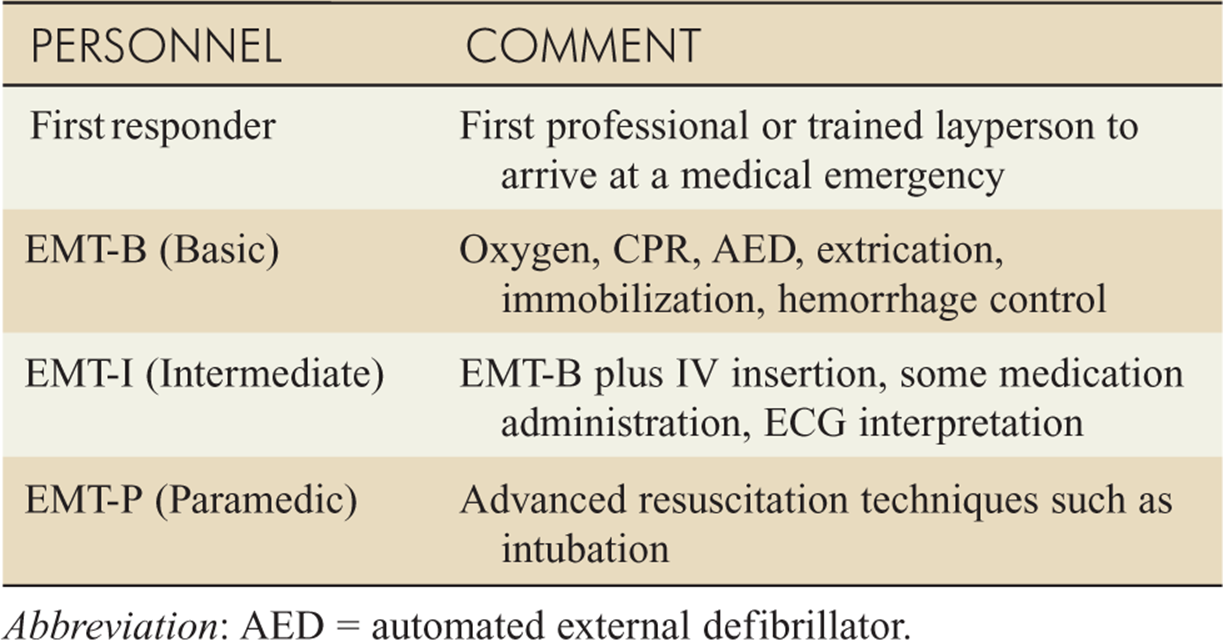
EMS personnel commonly fall into one of four levels of training based on the U.S. Department of Transportation EMS provider curricula (Table 193-1).
TABLE 193-1 EMS Personnel
TRAINING
Training includes initial provider training and continuing education.
As EMS call volume increases, providers often find themselves caring for a disproportionate number of patients with minor medical issues. Skills retention may become an important issue for EMS agencies.
COMMUNICATIONS
As the nationwide emergency telephone number in the United States, 9-1-1 has greatly facilitated public access to emergency medical care.
Enhanced equipment that automatically gives answering centers the number and location of the caller is becoming widespread.
Emergency call takers undergo training to ensure they collect the necessary information, dispatch appropriate resources, and offer pre-arrival medical instructions while the ambulance is en route.
Ambulance personnel also have the ability to communicate with the destinated hospital, both for notification and for medical direction from physicians.
TRANSPORTATION
Ambulances are designed to ensure that EMS providers can perform lifesaving interventions while safely transporting the patient.
Basic life support (BLS) ambulances carry equipment appropriate for EMT-Bs, including oxygen, AEDs, bag-mask ventilation devices, immobilization and splinting equipment, and dressings for wound care and hemorrhage control.
Advanced life support (ALS) ambulances are equipped for EMT-Ps and carry IV supplies and medications, advanced airway devices, cardiac monitors, and other specialized equipment.
Air transport should be considered for critically ill patients when the ground transport time is anticipated to be long.
FACILITIES AND CRITICAL-CARE UNITS
EMS patients are often transported to the closest appropriate hospital or to the hospital of the patient’s choice.
In recent years, the number of specialty hospitals has increased, including pediatric hospitals, trauma centers, spinal cord injury centers, burn centers, stroke centers, cardiac centers, and hospitals with large numbers of critical care beds.
Because of increasing hospital censuses, boarding of admitted patients in the ED, and general crowding, EDs may request that EMS services divert patients to other hospitals.
PUBLIC SAFETY AGENCIES
EMS systems should have strong ties with police and fire departments. In addition to providing scene secu rity, public safety agencies can perform first responder services, including CPR and use of AEDs for cardiac arrest victims.
In turn, EMS personnel often provide medical support to police and fire departments in hazardous circumstances or extended operations.
CONSUMER PARTICIPATION
Public support is necessary for a good EMS system. One way to accomplish this is to encourage public representation on regional EMS councils to partici pate in policy making.
ACCESS TO CARE
EMS systems should ensure that all individuals have access to emergency care regardless of their ability to pay or type of insurance coverage.
Communities need to ensure that EMS assets can reach patients in a timely fashion, even in remote parts of the country.
Potential strategies include deploying ambulances throughout the area with one central dispatch center or heavy reliance on air medical services, weather permitting.
PATIENT TRANSFER
Patients are often transferred from one medical facil ity to another for a higher level of care.
The U.S. Emergency Medical Treatment and Active Labor Act (EMTALA) sets forth rules that hospitals participating in the Medicare program must adhere to when considering a patient transfer.
Under the EMTALA, all patients must receive a medical screening examination and be stabilized before transfer to another facility is considered, and there must be explicit acceptance of the transfer by the receiving hospital.
COORDINATED PATIENT RECORD KEEPING
EMS records need to be legible, intelligible, readily accessible to hospital providers, and compliant with the U.S. Health Insurance Portability and Accountability Act of 1996 (HIPAA).
PUBLIC INFORMATION AND EDUCATION
EMS systems have a responsibility to train the public how to access them and use them appropriately.
EMS agencies can play an important role in public training and education, including CPR, first aid, and disaster preparedness principles.
Experience has shown that in disaster situations, a public that is adequately prepared and is trained to administer first aid will be in a better position to safely await help.
REVIEW AND EVALUATION
To ensure that patients receive the highest quality care, EMS agencies must have in place a system for ongoing review and evaluation.
A continuous quality improvement program, including EMS provider and physician input, should be established to assess system performance and formulate improvements.
This should involve routine audits of radio or telephone communications, response times, scene times, and patient care records.
DISASTER PLAN
The EMS system is an integral part of disaster preparedness and should be involved in planning along with other agencies and the medical community.
EMS agencies must maintain a high level of disaster preparedness.
This involves having written policies and procedures, stockpiling supplies that may be rapidly depleted in multi-casualty situations, and participating in regional disaster drills with other agencies and hospitals.
MUTUAL AID
EMS services should develop mutual aid agreements with other jurisdictions so that uninterrupted emergency care is available when local agencies are overwhelmed.
Working out in advance details such as reimbursement, credentialing, liability, and chain of command at incident scenes will enhance interagency cooperation and response.
CURRENT CHALLENGES AND FUTURE TRENDS
The 2006 U.S. Institute of Medicine publication, Emergency Medical Services: At the Crossroads, detailed many of the challenges EMS faces today. These include fragmentation and lack of interoper ability between EMS systems, between EMS and other public safety agencies, and between EMS and the rest of the health care system.
Cuts in funding and staffing limitations impact the ability of EMS agencies to provide routine care. They also limit agencies’ surge capacity, referring to their ability to accommodate a sudden, large increase in demand for services, as in a disaster.
Research has demonstrated the importance of BLS skills in cardiac arrest and other emergencies. These skills include early use of AEDs and performance of high-quality, uninterrupted CPR.
Advances in ALS skills are helping to enhance patient outcomes. Obtaining prehospital 12-lead ECGs on patients with chest pain is becoming common. This results in shorter door-to-balloon times in patients with ST-elevation myocardial infarctions.
For further reading in Tintinalli’s Emergency Medicine: A Comprehensive Study Guide, 7th ed., see Chapter 1, “Emergency Medical Services,” by C. Crawford Mechem.