
Matthew Hansen
EPIDEMIOLOGY
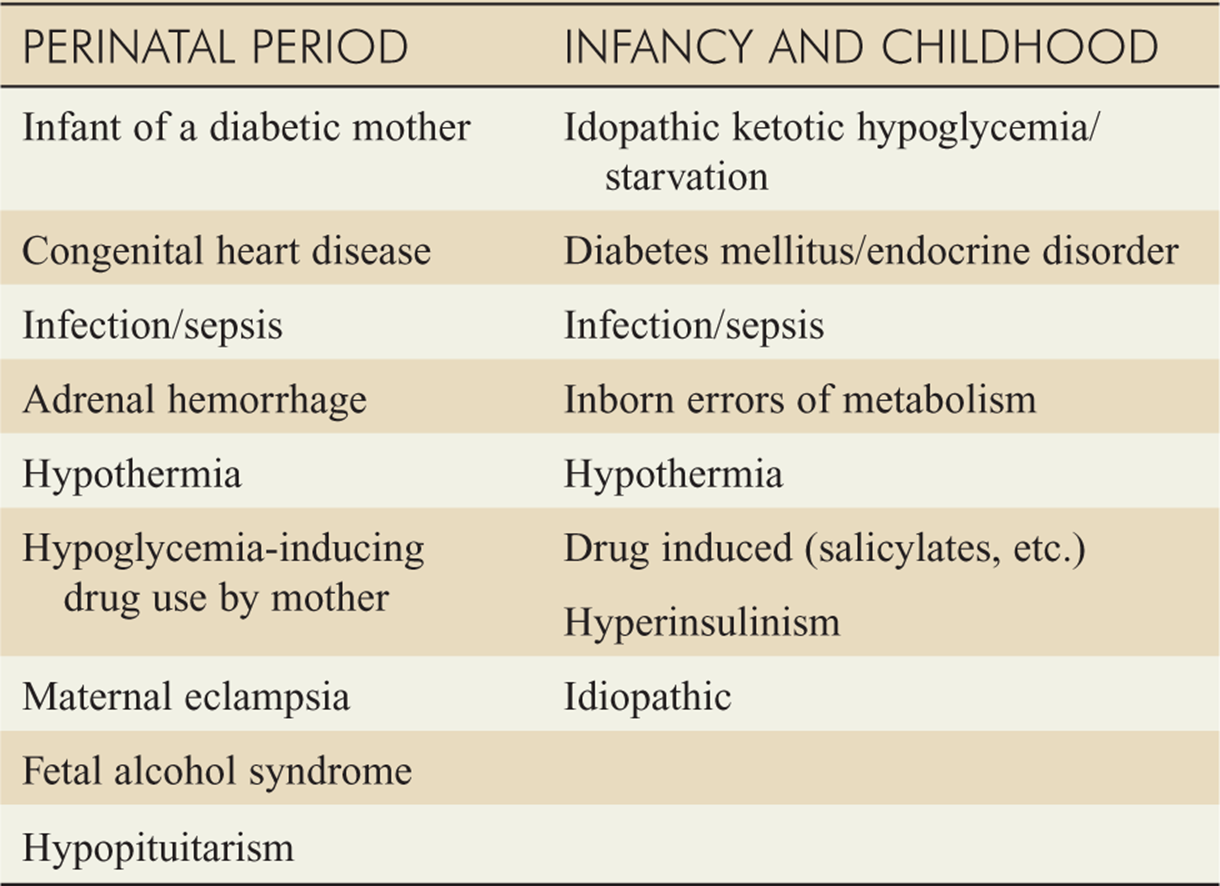
 Hypoglycemia is more common in neonates and infants than older children. Conditions associated with hypoglycemia in infants and children are listed in Table 81-1.
Congenital adrenal hyperplasia occurs in about 1:10,000 live births. Seventy-five percent of affected newborns exhibit the classic salt wasting, virulizing variant.
Inborn errors of metabolism encompass a diverse group of rare disorders, and many are included on state newborn screening exams in the United States, although disorders screened vary by state.
TABLE 81-1 Conditions Associated with Hypoglycemia in Infants and Children
PATHOPHYSIOLOGY
Young children are predisposed to hypoglycemia because of a higher basal metabolic rate and lesser glycogen stores.
For children younger than 2 years who are fasting, nearly all endogenously produced glucose is required and used by the brain.
As glucose levels fall, counterregulatory hormones including glucagon, cortisol, growth hormone, and epinephrine are released, stimulating gluconeogenesis. The clinical effects of epinephrine release are called the adrenergic response.
Congenital adrenal hyperplasia is caused by a deficiency of one of several enzymes in the cortisol production pathway.
Inborn errors of metabolism result from abnormal metabolism of fat, carbohydrates, or protein; symptoms are caused by the accumulation of toxic substrates resulting from the metabolic derangement.
CLINICAL FEATURES
Hypoglycemic patients present with either neuroglycopenic or adrenergic signs and symptoms.
Neurologic symptoms associated with hypoglycemia include altered level of consciousness, focal neurologic deficits, and seizures in young infants, as well as confusion, ataxia, and blurred vision in older children.
Adrenergic symptoms associated with hypoglycemia include anxiety, tachycardia, perspiration, tremors, pallor, weakness, abdominal pain, and irritability; these symptoms may be absent in young infants.
Hypoglycemia in neonates and infants are usually nonspecific and include poor feeding, jitteriness, emesis, ravenous hunger, lethargy, altered personality, repetitive colic-like symptoms, hypotonia, and hypothermia.
Hypoglycemia often accompanies a critical illness (eg, sepsis) and the features of that illness may dominate the clinical picture.
Congenital adrenal hyperplasia most frequently presents within the second week of life with vague symptoms such as lethargy, poor feeding, irritability, vomiting, or shock. Female infants will frequently have virulized genitalia (ie, cliteromegally).
Inborn errors of metabolism present with nonspecific symptoms similar to those of sepsis, congenital adrenal hyperplasia, or hypoglycemia. Seizures may occur.
DIAGNOSIS AND DIFFERENTIAL
Plasma glucose concentration <45 milligrams/dL constitutes hypoglycemia in any symptomatic patient and <35 milligrams/dL in any asymptomatic patient. Bedside glucose should be checked immediately in any critically ill child.
The differential diagnosis of hypoglycemia differs by age, and may accompany many systemic disorders, illnesses, and ingestions, but is commonly associated with critical illness from any cause including sepsis, congenital heart disease, and inborn errors of metabolism.
The classic electrolyte abnormalities seen in congenital adrenal hyperplasia are hyponatremia and hyperkalemia. The differential diagnosis includes sepsis, congenital heart disease, and metabolic diseases.
Diagnosis of specific metabolic disorders is beyond the scope of ED care and not important for initial stabilization. Key labs include glucose, urine ketones, plasma ammonia, complete metabolic screen, blood gas analysis, and lactate.
Figure 81–1 outlines disorders associated with specific patterns of lab abnormalities.
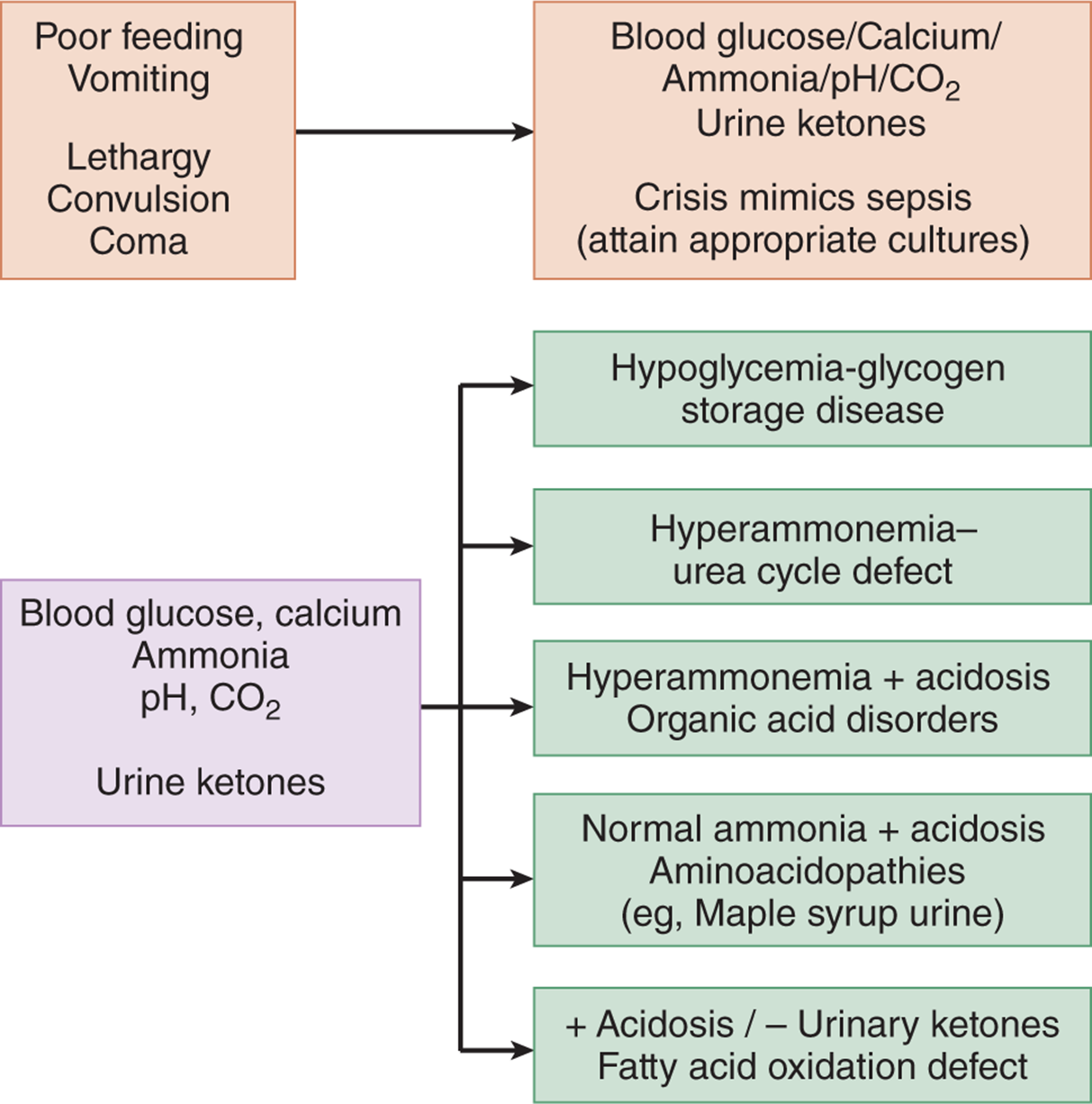
FIG. 81-1. Approach to suspected metabolic disorders.
EMERGENCY DEPARTMENT CARE AND DISPOSITION
HYPOGLYCEMIA
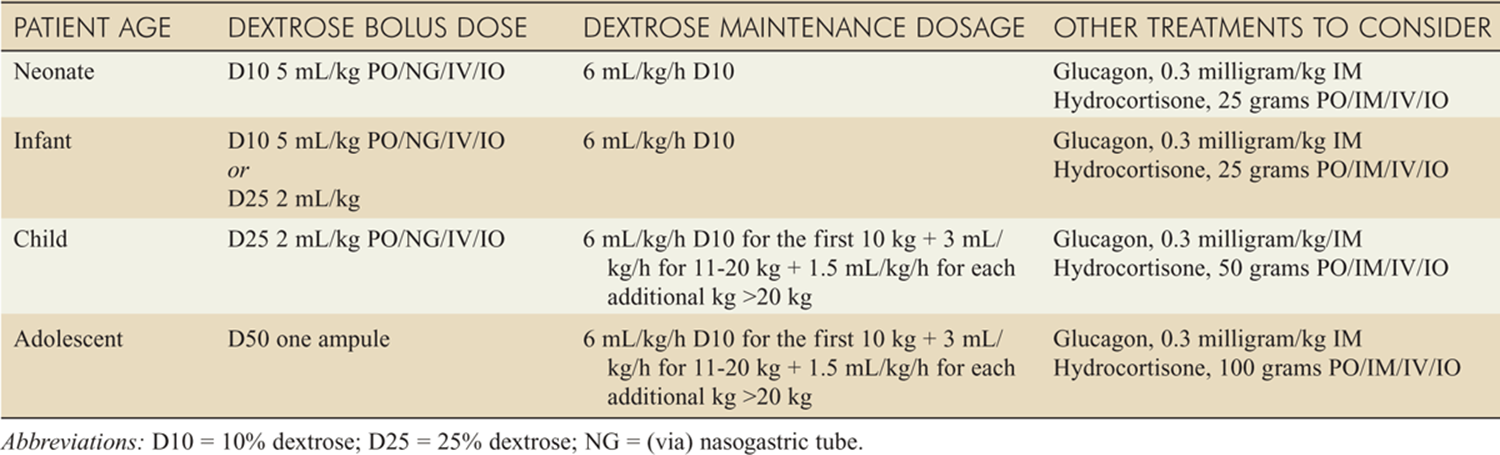
The dose of dextrose is 0.5 to 1 gram/kg for any age patient, which can be given via IV, IO, NG, or PO route. Table 81-2 outlines the age-based ED management of hypoglycemia.
Administration of D25W and D50W is not recommended for younger patients since both are hyperosmolar and increase the risk in smaller veins for phlebitis, extravasation, and surrounding tissue necrosis, and potentially intracranial hemorrhage in neonates.
Consider glucagon, 0.3 milligram/kg IM when IV or 10 access is unavailable. Glucagon only works in patients with intact glycogen stores, and may be ineffective in those with severe systemic or metabolic disease.
TABLE 81-2 Emergency Department Treatment of Hypoglycemia
CONGENITAL ADRENAL HYPERPLASIA OR ADRENAL INSUFFICIENCY
Administer hydrocortisone empirically when standard resuscitation efforts fail to improve the clinical condition, especially when considering adrenal insufficiency as a cause. The dose is 25 milligrams for neonates and infants, 50 milligrams for children, and 100 milligrams for adolescents. Hydrocortisone can be given IV, IO, or IM in all age groups.
Treat patients with congenital adrenal hyperplasia and hyperkalemia associated with ECG changes or arrhythmias with IV calcium gluconate 100 milligrams/kg. Do not give insulin and glucose to neonatesas this may cause profound hypoglycemia. Asymptomatic hyperkalemia will correct with hydrocortisone treatment.
INBORN ERRORS OF METABOLISM
Initial stabilization of children with inborn errors of metabolism focuses on restoring circulatory volume with normal saline boluses of 10 to 20 mL/kg, providing glucose to stop catabolism and further production of toxic metabolites, and enhancing elimination of toxic metabolites.
Stabilize and support airway and breathing, but exercise caution with paralysis and mechanical ventilation as severe metabolic acidosis may be worsened by a relative respiratory acidosis from inadequate ventilatory rate.
Treatment for hypoglycemia is listed in Table 81-2.
Make patients NPO and begin D10 infusion at twice normal maintenance rate (see Chapter 83 for maintenance fluid calculations).
Treat hyperammonemia with sodium benzoate, 250 milligrams/kg IV or IO as a continuous infusion over 24 hours and arginine 210 milligrams/kg IV or IO over 90 minutes. Consider hemodialysis for serum ammonia levels >300 milligrams/dL.
Consider carnitine, 400 milligrams IV, IO, or PO for patients with known organic acidemias.
In children with known or suspected metabolic disorders, discharge criteria include stable vital signs, ability to tolerate PO, normal electrolytes, normal pH, normal ammonia level, and overall well appearance on examination. Prior to disposition from the ED, care of children with known or suspected metabolic disorders should ideally be discussed with a local metabolic specialist. There should be a low threshold for admission or transfer of these patients to a children’s hospital.
For further reading in Tintinalli’s Emergency Medicine: A Comprehensive Study Guide, 7th ed., see Chapter 137, “Hypoglycemia and Metabolic Emergencies in Infants and Children,” by Nadeemuddin Qureshi, Mohammed Al-Mogbil, and Osama Y. Kentab.