Moving a patient should only be done if absolutely necessary, especially if they are not in a stable condition.
When moving, your aim is to cause the least amount of trauma to the patient and yourself.
If there is a suspected spinal injury, it is always better to move the patient along the long axis of the body.
To prevent injury to yourself when lifting a patient (or anything), keep your back straight and lift with your legs.
Avoid twisting and keep the weight close to your body.
Move in smooth motions, i.e., avoid jerking.
Drags are best used over a short distance and fairly smooth terrain. They are useful if the situation is time sensitive and/or the patient is too heavy to carry.
Be careful if walking backwards.
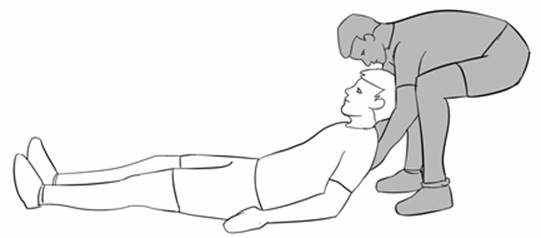
Pull the patient by his/her clothes or from under his/her arms.
The patient’s head rests on your forearms.
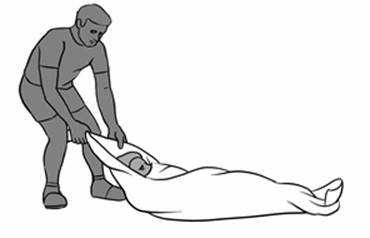
Roll the patient onto a blanket or something similar (raincoat, tent etc.).
Pull the blanket with the patient on it to safety.
Essentially, the patient is placed into a backpack.
You put the patient on your back, just like you would a backpack.
Cut leg holes in the base of the pack if needed.
At least two rescuers are needed for a chair carry.
The patient is carried whilst sitting in a chair.
One rescuer lifts the back of the chair whilst the other lifts the front legs.
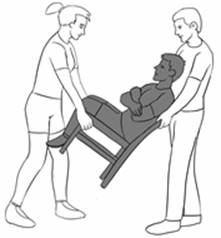
This can be difficult if the patient is larger than you.
Crouch down and grab the patient’s right wrist with your left hand and position it over your shoulder.
Wrap your arm around the patient’s legs (or between them) to grab around the patients’ right thigh.
Stand up (using leg muscles) and adjust the patient’s weight to a balanced and comfortable position.
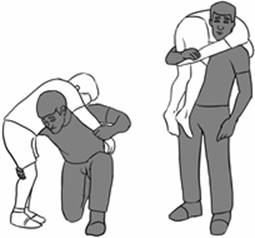
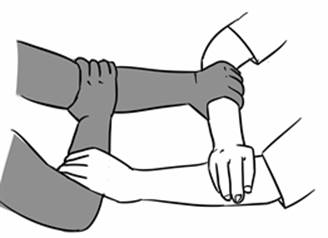
Two rescuers use their arms to create a ‘seat’ on which the patient can sit and be carried to safety. The patient must be able to support himself/herself by holding around the rescuers’ backs.
Each rescuer holds his/her own left forearm with the right hand, palm facing down.
The two rescuers then use their free hands to grab each other’s respective forearms in order to make a square for the patient to sit on.
The improvised harness carry is a secure way to carry a patient on your back. Place padding in-between the harness and body for comfort, especially around the shoulder straps.
Find some type of rope about 50cm (20in) long. The wider the better (within reason). Thick webbing is ideal.
Make a bight (loop) in the center of the webbing.
Put this loop through the patient’s legs, from back to front.
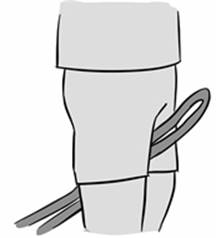
The ends wrap behind each leg respectively and then pass through the loop at the front.
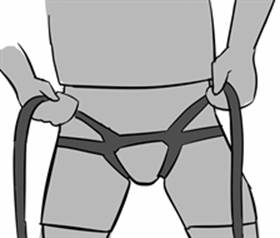
Kneel down in front of the patient with your back towards him/her.
Bring the two ends over your shoulders and then back through the patient’s legs.
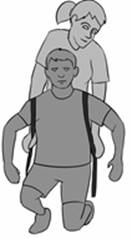
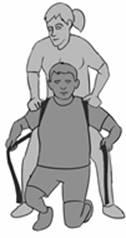
Loop to the outside of the patient’s legs and tie the ends together just below your chest so it is tight but comfortable.
Pass the ends through their respective shoulder straps and then tie them off.
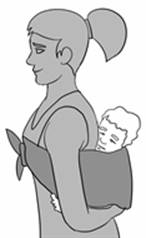
The papoose sling is useful for carrying infants and small children.
Tie a rectangular piece of material around your waist and neck to form a pouch at either your front or back.
Place the child inside.
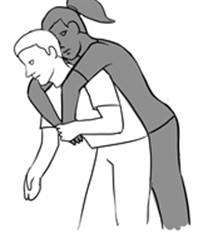
The patient climbs on your back and holds on.
If the patient is unconscious, you can grab the patient’s arms and cross them around your chest.
Whilst keeping a straight back, lean forward slightly to help lift the patient off the ground.
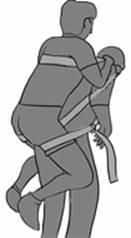
A length of rope (approximately 5 m in length) or likewise material can be used to support a patient that you piggy back. A wider material will add comfort as will padding.
Place the center of the rope behind the patient and bring the end forward under each armpit.
The ends come over your shoulders and then wrap around the patient’s thighs before being secured around your waist.
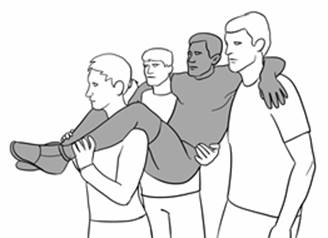
One rescuer hugs the patient from behind at his/her chest.
The second rescuer is in front of the patient and faces away from him/her, lifting the patient’s legs.
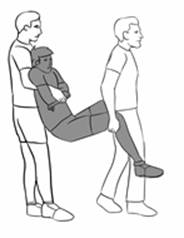
The wheelbarrow carry requires 3 rescuers. It is good for long distances.
Two rescuers stand next to each other, facing the direction of travel.
The patient places his/her arms over these two rescuers’ shoulders.
A third rescuer is in front of the patient, also facing the direction of travel, and carries the patient’s legs over his/her shoulders.
There are two basic types of litters, non-rigid and rigid.
Non-rigid litters are faster to improvise but are not good for those with potentially critical injuries.
The improvised rigid litter is used when all other methods of transporting the patient are unsuitable.
It is never good practice to move a patient with a suspected spinal injury in any improvised litter, but if there is no way around it, a rigid litter is preferable.
Should there be a doubt about what to use, use a rigid litter.
Ensure spine stabilization; Must Read - Secondary Exam - Spine Stabilization.
When moving the patient, move in small increments, preferably using axial movement as opposed to sideways movement.
The person at the head calls the movement.
Extra care must be taken when making a stretcher for a person with a possible spinal injury. Pad it well. The patient must be very well secured, i.e., unable to slide. You can achieve this by crossing straps and padding any gaps.
When transporting patients in an improvised litter:
Elevate the injured limb.
Elevate the head slightly.
Keep legs elevated if in shock.
Lay unconscious patients on their side.
Give them something to hold.
When securing the patient you can use padding (blankets, sleeping bags, clothes etc.) to increase comfort, stability and insulation. When doing so:
Allow them to see what is happening around them.
Construct a diaper if needed.
Ensure the litter is easily moved.
Ensure the patient is still accessible for assessment.
Place some padding under the knees to prevent full extension.
Protect the patient from the environment, e.g., falling debris.
Many different non-rigid litters can be made depending on what you have available, e.g.:
Branches and heavy duty parkas.
Paddles with life jackets.
Poles and packs.
Poles with rope.
Items needed are 2 fairly straight pole-like objects, e.g., branches and a large blanket or similar, e.g., tent, tarp.
Wrap the blanket around the poles as many times as possible. The more times you wrap it, the more secure it will be.
The patient’s weight holds it all together.
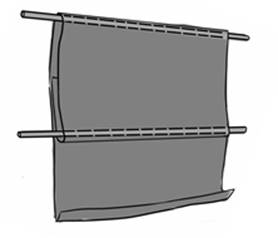
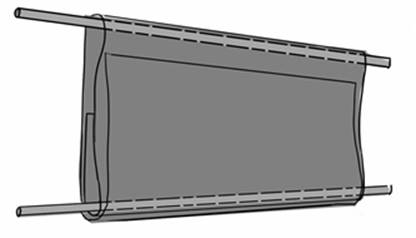
An entire litter can be made of rope if needed.
Lay the rope on the ground in a zigzag type formation, forming approximately 8 loops on the left and 8 loops on the right.
The total length should be about the same size as the finished litter.
Ensure you have enough rope leftover on either end to tie off each loop.
Make sure the loops won’t slip through these tie off knots. A clove hitch works well.
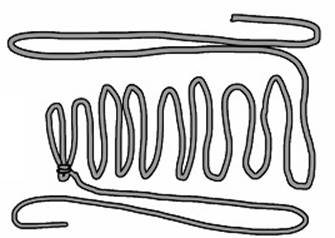

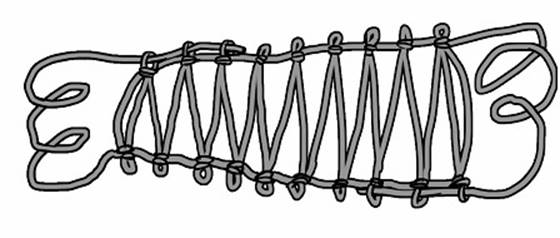
Thread the leftover rope through the ends of the loops. This ensures the knots won’t slip off the bends.
Tie the ends off.
Improvements can be made by using poles and adding lots of padding.
A kayak can create a great rigid litter but requires destroying the kayak if it is not an open deck.
Remove the seat, flotation materials and the upper deck if needed.
This type of litter is sturdier than most improvised litters and adding more insulation, e.g., a sleeping bag, can help if the patient is suffering hypothermia or similar.
The downside is that the patient is severely restricted and enclosed which may have a claustrophobic effect.
The following equipment is needed:
Ø Padding (sleeping pads, clothing etc.).
Ø Poles (skis, paddles, branches etc.).
Ø Rope.
Ø Tarp (blanket etc.).
Lay the rope out in U-shaped loops that taper off at the ends.
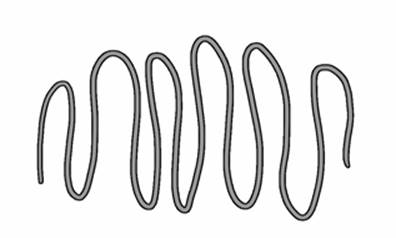
Tie a loop at the front end of the rope.
Put the tarp on top of the rope.
Next place the pads down; then lay the poles out as the patient would lie.
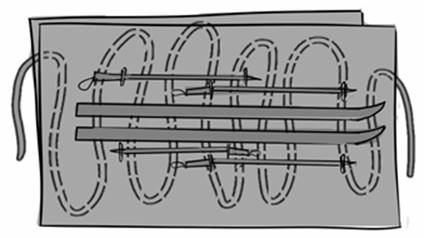
Put lots of padding on top off the poles, and then the patient goes on top of the pads.
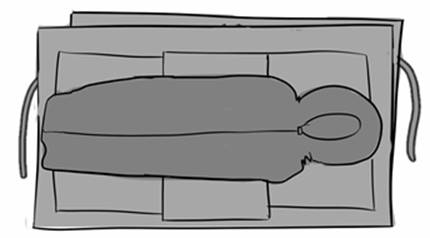
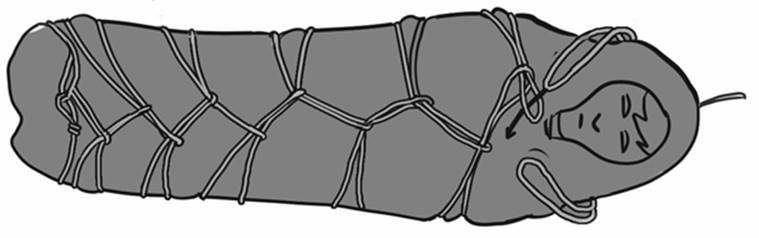
Close the daisy chain by bringing one loop through the pre-tied loop, then continuing to ‘thread’ these loops together to enclose the patient.
Once you reach the patient’s armpits, bring a loop over each shoulder and tie it off.
This method will work with either an external or internal framed backpack.
Turn the pack ‘face’ down.
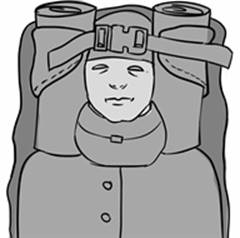
The patient lies on the pack with his/her head on the padded hip belt.
Secure the patient to the pack.
The hip belt can be used to strap down the patient’s head. Put lots of padding between the hip belt and the patient’s head if possible.
The more people you have to carry the litter the better.
Ideally, you will have 4 to 6 people actually carrying the litter, as well as 2 people clearing the path.
Extra people are useful to rotate the carriers. It can be done without stopping (carefully) with the fresh people coming in from the back. Everyone then moves up, which allows the two people at the front to have a rest. These two people then move to the back. This can be done continuously so everyone gets a periodic rest from carrying the litter.
The patient is usually carried with his/her feet first in the direction of travel. One exception might be when going uphill, in which case the head should be higher.
Frequently check vital signs.
For high angled elevation, i.e., if ropes are needed, ensure the patient is secured to the litter well.
Improvised Sled/Sledge/Toboggan
Constructing an improvised sled-type vehicle may be useful if moving the patient over long distances, depending on the terrain. Also, if you have something to drag it other than manpower, it saves a lot of energy, e.g., dog, motor sled.
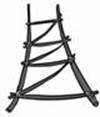
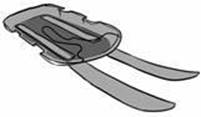
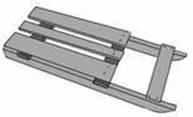
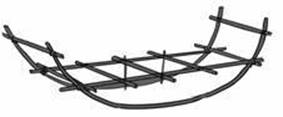
There are many ways they can be constructed. If you have a pair of skis, they come in very handy. Ensure the patient is very well secured and attach a way to drag it, e.g., rope.
Here are some examples: