Although rare, getting struck by lightning is not unheard of. Lightning can be present without rain or visible clouds.
People that have previously been struck or near struck are more susceptible, and about one out of every ten people that get struck by lightning die.
There are a number of ways lightning can cause injury:
Contact with a conductive material that is hit or splashed by lightning.
Direct hit.
Splash (it first strikes an item then ‘jumps’ to the victim).
Vicinity, where the strike is close enough to affect the victim.
Signs of impending lightning strike:
Blue halo around objects.
Hair stands on end.
High-pitched or crackling noises.
A number of injuries may be sustained from a lightning strike. Common ones are:
Altered mental state.
Burns.
Treatment for Lightning Strike
Victims of lightning do not stay ‘charged’ so rescuers are safe to treat any injuries that have occurred.
Treat any injuries.
Prevention of Lightning Strike
Know the weather forecast.
If you see lightning then hear thunder before you can count to 30 seconds:
Seek shelter in a sturdy building (not a tent or ‘tin shed’) or a metal topped vehicle (a sturdy building is preferred).
Close all windows.
Avoid all windows, open doors, fireplaces, metal structures etc.
Stay inside until 30 minutes after the last lightning is seen and/or the last thunder is heard.
Note: being in a metal topped vehicle may seem counter intuitive. Here is the reasoning:
Ø A soft top vehicle will not help you since the lighting will go straight through it.
Ø If lightning strikes the metal topped vehicle it will be grounded due to the tires. You will be safe (safer than outside) as long as you are not touching the metal frame whilst inside the vehicle.
If there is no adequate shelter:
If in a group, spread out.
Avoid cave entrances.
Avoid exposed areas, isolated tall objects, pools of water, anything metal, wet objects etc.
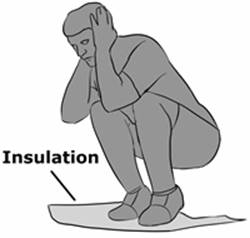
Crouch down on the balls of your feet and tuck your head in, i.e., make yourself as small as possible.
Do not touch the ground with your hands.
Insulate yourself from the ground, e.g., with a sleeping pad, rope.
Seek shelter in low ground.