
112. A 35-year-old woman works as a keyboard operator and must type for 6 hours per day. Over the course of a few months she has developed pain in her wrists (right worse than left), as well as some paresthesias into the lateral palmar aspect of her hands. There is no atrophy. Conservative treatment for her condition consists of which of the following?
a. Exploratory surgery
b. Wrist splints
c. Hydrocodone
d. Shoulder sling
e. Back brace
113. A 28-year-old police officer has been generally healthy except for mild, easily controlled hypertension. He sustains a gunshot wound to the upper arm. This type of trauma may cause partial damage to the median nerve that may leave the patient with which of the following?
a. Easily provoked pain in the hand
b. Weakness on wrist extension
c. Atrophy in the first dorsal interosseous muscle
d. Numbness over the fifth digit
e. Radial deviation of the hand
114. A 19-year-old man is involved in a street fight in which he is viciously attacked with a lead pipe. A particularly forceful blow hits his left elbow. Blunt trauma to the elbow may lead to the development of which of the following?
a. Wristdrop
b. Weakness of the abductor pollicis brevis
c. Clawhand or benediction sign (impaired extension of digits 4 and 5)
d. Ulnar deviation of the hand
e. Poor pronation of the forearm
115. A 21-year-old right-handed woman works at an airport as a luggage handler. She is usually on the tarmac working in an environment in which loud noises are routine. Ear protection must be worn to protect against loss of hearing and the development of which of the following?
a. Vertigo
b. Tinnitus
c. Ataxia
d. Diplopia
e. Oscillopsia
116. A young man fractures his humerus in an automobile accident. As the pain from the injury subsides, he notices weakness on attempted flexion at the elbow. He develops paresthesias over the radial and volar aspects of the forearm. During the accident, he probably injured which one of the following nerves?
a. Suprascapular nerve
b. Long thoracic nerve
c. Musculocutaneous nerve
d. Radial nerve
e. Median nerve
117. A 37-year-old alcoholic man awakes with clumsiness of his right hand. Neurologic examination reveals poor extension of the hand at the wrist. He most likely has injured which one of the following nerves?
a. Median nerve
b. Brachioradialis nerve
c. Musculocutaneous nerve
d. Radial nerve
e. Ulnar nerve
118. A 72-year-old man slipped and fell in the bathroom 1 week ago. He hit the right side of his head, but did not think it was necessary to seek medical attention. He finally goes to his doctor because his son thinks his balance is off. Computed tomography (CT) of the brain may fail to reveal a small subdural hematoma in this patient for which of the following reasons?
a. The lesion is subacute
b. The hematoma extends into the brain from the subdural space
c. The resolution of the CT machine is greater than 2 mm
d. The subdural hematoma is less than 4 hours old
e. The patient has extensive cerebral atrophy
119. A 16-year-old boy is struck on the side of the head by a bottle thrown by a friend involved in a prank. He appears dazed for about 30 seconds, but is lucid for several minutes before he abruptly becomes stuporous. His limbs on the side opposite the site of the blow are more flaccid than those on the same side as the injury. On arrival in the emergency room 25 minutes after the accident, he is unresponsive to painful stimuli. His pulse is 40 beats per minute, with an electrocardiography (ECG) revealing no arrhythmias. His blood pressure in both arms is 170/110 mm Hg. Although papilledema is not evident in his fundi, he has venous distention and absent pulsations of the retinal vasculature. Which of the following is the best explanation for this young man’s evolving clinical signs?
a. A seizure disorder
b. A cardiac conduction defect
c. Increased intracranial pressure
d. Sick sinus syndrome
e. Communicating hydrocephalus
120. A 52-year-old patient presents with headache and sudden onset of mania. Her head CT is shown below. Two hours later her blood pressure is 225/110 mm Hg, her heart rate is 40 beats per minute, and her consciousness is fluctuating. Which of the following is the best management over the next 4 hours for this patient?
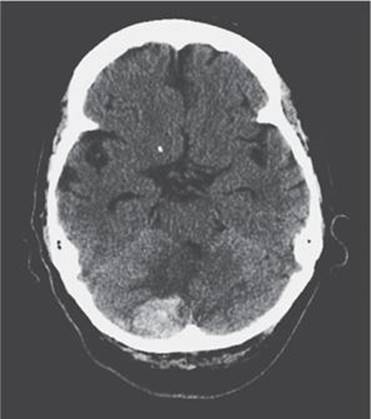
a. Craniotomy
b. Antihypertensive medication
c. Transvenous pacemaker placement
d. Ventriculoperitoneal shunt
e. Antiepileptic medication
121. A 64-year-old woman slips and falls on an icy sidewalk. She hits the side of her head on the curb. After a momentary loss of consciousness she recovers, but is in some pain. Fifteen minutes later her level of consciousness begins to fluctuate and she is brought to the emergency room comatose. Magnetic resonance imaging (MRI) of the patient’s head within the first few hours of injury will most likely reveal which of the following?
a. A normal brain
b. Intracerebral hematoma
c. Temporal lobe contusion
d. Subarachnoid hemorrhage
e. Epidural hematoma
122. CT scanning of a patient’s head within 2 hours of a newly acquired epidural hematoma should reveal which of the following?
a. A normal brain
b. A lens-shaped density over the frontal lobe
c. Increased cerebrospinal fluid (CSF) density with a fluid-fluid level
d. Multifocal attenuation of cortical tissue
e. Bilateral sickle-shaped densities over the hemispheres
123. An elderly patient suffers from a relatively mild head trauma but then subsequently develops a progressive dementia over the course of several weeks. He is most likely to have sustained which of the following?
a. An acute subdural hematoma
b. An acute epidural hematoma
c. A chronic subdural hematoma
d. An intracerebral hematoma
e. An intracerebellar hematoma
124. A 42-year-old woman is involved in a head-on collision with a lamp-post at 50 mph. Her head hits the windshield. She is highly likely to have an intracranial hemorrhage in which one of the following structures?
a. Occipital lobe
b. Thalamus
c. Putamen
d. Parietal lobe
e. Temporal lobe
125. A 57-year-old woman is involved in a motor vehicle accident in which she strikes the windshield and is briefly unconscious. She makes a full recovery, except that 3 months later she notices that she cannot taste the food she is eating. This is most likely caused by which of the following?
a. Medullary infarction
b. Temporal lobe contusion
c. Sphenoid sinus hemorrhage
d. Phenytoin use to prevent seizures
e. Avulsion of olfactory rootlets
126. An 18-year-old boy is brought into the emergency room after diving into a shallow pool. He is awake and alert, has intact cranial nerves (CNs), and is able to move his shoulders, but he cannot move his arms or legs. He is flaccid and has a sensory level at C5. Appropriate management includes which of the following?
a. Naloxone hydrochloride
b. Intravenous methylprednisolone
c. Oral dexamethasone
d. Intubation and preparation for immediate surgery
e. Hyperbaric chamber therapy
127. A 53-year-old office worker presents to clinic stating, “My hands are numb.” Upon questioning she says that both of her hands have a sensation like “a shot at the dentist.” She also believes that her hands are weaker than they used to be. It fluctuates during the course of the day, but is worst at the end of the work day and during the early morning hours. The symptoms have been progressively worsening over the past 1-to-2 years. On examination the abductor pollicus brevis is weak bilaterally, and there is decreased sensation to pinprick over the anterior portions of digits 1-to-3. Which of the following will most likely be positive?
a. Tinel sign
b. Brudzinski sign
c. Kernig sign
d. Monrad-Krohn test
e. Babinski sign