
Jacques E. Chelly
Evidence shows that peripheral nerve blocks performed in either awake or lightly sedated adult patients prior to or after surgery decrease the risk of complications associated with intraneural or intrathecal injections. Evidence also suggests that the use of peripheral nerve blocks for anesthesia reduces both operating room time and length of hospital stay (Table 1-1). Further, the use of peripheral nerve blocks for postoperative analgesia has also been shown to reduce length of hospital stay. Regardless of the timing of the performance of peripheral nerve blocks, the following 12 steps need to be considered:
1. Obtain a complete and detailed history and physical examination of the patient, with special emphasis on history of coagulopathy, anticoagulant therapy, and sensory or motor nerve deficits, especially in the territory affected by the surgery and the block(s).
2. Evaluate indications and determine the absence of contraindications for anesthesia and/or postoperative analgesia. The indications for peripheral nerve blocks include most upper and lower extremity surgery. In addition, thoracic, breast, urologic (e.g., nephrectomy, prostatectomy, cystectomy), and abdominal surgeries (e.g., liver resection, colectomy, pancreatectomy) and hernia repair (inguinal and umbilical) also benefit from the use of paravertebral blocks. These blocks have been demonstrated to be as effective as epidural. The contraindications to regional blocks are local (e.g., infection or trauma, possible preoperative nerve damage), surgical (e.g., nerve repair), related to the patient's condition (e.g., uncooperative or unwilling, presence of uncontrolled seizure disorder), and related to the surgeon's preference (unwilling to have his or her patients blocked). Coagulopathy and anticoagulation therapy at the time of the performance of the block, which are often cited as contraindications to peripheral nerve block anesthesia, should be considered a relative contraindication. Thus, most of the approaches are based on reaching a nerve superficially using a small gauge needle introduced into a groove and allowing compression in the area to be applied. Coagulopathy and anticoagulation therapy at the time of the performance of the block should be considered contraindications when the technique requires the needle to pass into muscular masses and when the nerve is located deep as in the case of a lumbar plexus, any paravertebral approaches, the classic posterior Labat approach to the sciatic nerve, or the anterior approach to the sciatic nerve. However, the use of thromboprophylaxis following surgery is not a contraindication to the performance of a peripheral nerve block prior to the initiation of the thromboprophylaxis.
|
Table 1-1. Benefits and Potential Risks of Peripheral Blocks |
||||||||||||||||||||
|
||||||||||||||||||||
3. Establish which block(s) and approach and technique (i.e., neurostimulation, ultrasound, or combined) can best address the patient's needs by establishing the type of surgery being performed, and its approach and techniques. In addition, in the case of a block performed for postoperative analgesia, it is important to determine the expected duration of postoperative pain and the postoperative requirement for active vs. passive mobilization. These determinations help to differentiate between the need for a single and the need for a continuous block.
4. Obtain an informed consent for the appropriate block by providing a detailed explanation of the respective risks and benefits of general and regional anesthesia techniques and the need for immediate or prolonged postoperative analgesia. In addition to the cited benefits of peripheral nerve blocks, the use of blocks is especially advantageous in patients with American Society of Anesthesiologists (ASA) III and IV status with compromised renal, pulmonary (depending on the block), and cardiac function. For patients to make an informed decision, it is essential for them to acknowledge that a peripheral nerve block may be associated with a toxic reaction to the administration of a local anesthetic solution, including seizure, cardiac arrhythmias (related to intravascular injection, increased sensitivity, or excessive concentrations of local anesthetic solutions), and transient or permanent nerve damage (e.g., acute pain during injection and paresthesia). The patient also needs to understand that although the risk of nerve damage is minimized by the use of a nerve stimulator or an ultrasound, nerve injury remains a possible complication. Finally, the patient needs to understand that choosing a peripheral nerve block for anesthesia does not mean that he or she must remain awake during the surgery. It should be made very clear that additional sedation is available.
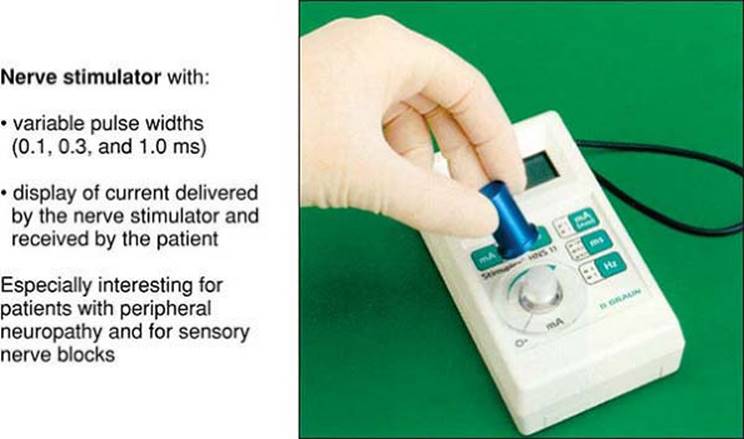
5. Next, an intravenous access is secured and a nasal cannula is placed delivering O2 2 to 3 L/min. The patient's vital signs are established and monitored (blood pressure and pulse oximetry).
6. After the patient is properly positioned, he or she may be given some sedation including midazolam IV (start with 0.5 mg i.v. in older patients and up to 2–3 mg in anxious healthy or young patients) and fentanyl 50 to 100 µg. The administration of these drugs should be titrated to the need of each individual patient. Midazolam is our drug of choice because of its relatively short half-life, lack of hemodynamic effects, and the availability of a specific antagonist (flumazenil) that can be administered immediately if necessary. It is important to recognize that most blocks can easily be performed with minimum sedation as long as a good local anesthesia is performed. In addition, not all patients are good candidates for blocks, especially those who are too anxious. In these patients, it is preferable to recommend general anesthesia and a postoperative analgesia not based on the use of a peripheral nerve block.
7. Choose the proper local anesthetic mixture and concentration based on the desired onset time for the block, the expected duration of surgery, and the need for postoperative pain control, a need for a preferential sensory block.
8. Perform the block:
a. Position the patient correctly.
b. Identify the appropriate landmarks; mark them and/or the area scanned with the ultrasound.
c. After appropriate disinfection of the area, perform an appropriate local anesthesia, usually with 1% lidocaine. The depth of the local anesthesia depends on the depth of the nerve (very superficial for an interscalene block, more profound for an anterior sciatic or lumbar plexus block).
d. Under strict aseptic conditions, introduce the insulated needle (connected to a nerve stimulator) or noninsulated needle (ultrasound); locate the nerve by advancing the needle slowly under vision (ultrasound) or by eliciting a specific motor response or an electrical paresthesia (neurostimulation) in the appropriate territory (sensory nerve).
e. Adjust the position of the needle in the optimum position either under vision (ultrasound) or by maintaining the same motor response or paresthesia with a current less than 0.5 mA (neurostimulation). However, it is also important to confirm that the motor response disappears for a current less than 0.25 mA (which theoretically prevents too close proximity between the needle and the nerve).
f. After appropriate positioning of the needle, and negative aspiration for blood, inject 1 to 2 mL of local anesthetic solution. In the case of neurostimulation, this injection should be associated with the disappearance of the elicited motor response. The current delivered by the nerve stimulator is then increased to 2 to 3 mA, which results in the reappearance of the specific motor response, confirming the appropriate positioning of the needle. In the case of ultrasound, this injection helps to verify that the needle is not intraneural. The rest of the local anesthetic solution is injected, confirming negative aspiration of blood every 5 mL.
9. After the block is performed, evaluate the intensity of the motor and sensory block by asking the patient to perform specific movements. In addition, ice and pinprick may be used to evaluate the intensity of the sensory block, usually at 5-minute intervals. If after 30 minutes the sensory block is incomplete, consideration should be given to performing a complementary nerve block distal to the first approach.
10. Before surgery, inform the surgeon of your evaluation and of the possible need for local anesthetic supplementation. Have the surgeon confirm your findings.
11. Educate the patient on:
a. what to do until complete recovery of motor and sensory function.
b. how to manage postoperative pain including the use of oral medication.
c. how to identify symptoms of local anesthetic toxicity and other relevant side effects and complications.
In the case of ambulatory surgery, it is most appropriate to discharge the patient with written and signed instructions (including a pager/telephone number that the patient can use) in case of questions or postsurgical problems.
12. In the case of an ambulatory procedure, do a postoperative follow-up by telephone the next day. A second phone call made after the expected complete recovery to document the recovery process and to record the patient's comments, if any, is also recommended. If the patient complains of complications, he or she should be asked to return to the hospital for a complete evaluation.
Suggested Readings
Capdevila X, Pirat Ph, Bringuier S, et al, the French Study Group on Continuous Peripheral Nerve Blocks. Continuous peripheral nerve blocks in hospital wards after orthopedic surgery. A multicenter prospective analysis of the quality of postoperative analgesia and complications in 1,416 patients. Anesthesiology 2005;103:1035–1045.
Chelly JE, Greger J, Al-Samsam T, et al. Reduction of operating and recovery room times and overnight hospital stays with interscalene blocks as sole anesthetic technique for rotator cuff surgery. Minerva Anestesiol 2001;67:613–619.
Delaunay L, Chelly JE. Blocks at the wrist provide effective anesthesia for carpal tunnel release. Can J Anaesth 2001;48:656–660.
Gebhard RE, Al-Samsam T, Greger J, et al. Distal nerve blocks at the wrist for outpatient carpal tunnel surgery offer intraoperative cardiovascular stability and reduce discharge time. Anesth Analg 2002;95:351–355.
Pavlin D, Chen C, Penaloza DA, et al. Pain as a factor complicating recovery and discharge after ambulatory surgery. Anesth Analg 2002;95:627–634.
Pavlin DJ, Rapp SE, Polissar NL, et al. Factors affecting discharge time in adult outpatients. Anesth Analg 1998;87:816–826.
Williams BA, Kentor M, Williams JW, et al. PACU bypass after outpatient knee surgery is associated with fewer unplanned admissions but more phase II nursing intervention. Anesthesiology 2002;97:981–988.