Nashaat N. Rizk
Harinarayan Balasubramanian
 Patient Position: Depends on the nerve.
 Indications: Neuroma, causalgia, flexion contractures, and nerve entrapment syndromes.
 Anatomic Landmarks: The same as for nerve blocks.
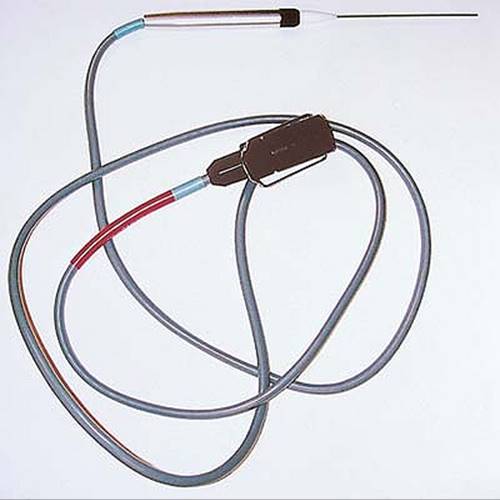
 Approach and Technique: After aseptic preparation and local anesthetic infiltration of the skin, insert an intravenous catheter over a needle through the skin and direct it closely toward the area to be frozen. Remove the needle and insert the cryoprobe (Fig. 62-1) through the catheter. Use the nerve stimulator in the cryoprobe to place the tip in the exact location. The typical duration of the cryolesion is 1.0 to 1.5 minutes. The best results are obtained with the technique of “freeze-thaw-refreeze” cycle. Once the 1.5-minute freezing cycle at -60°C to -80°C has been performed, allow the probe to thaw for 20 to 30 seconds and again refreeze for another 1.5 minutes. A minimum lesion length of 4 mm is critical in order to stop nerve conduction.
 Advantages: Low incidence of neuritis and lack of neuroma formation.
 Tips
Tips
1. Precise localization of the probe is necessary.
2. Avoid cryoneurolysis of the motor nerves.
3. Test the cryosurgical equipment thoroughly before using to ensure that there is no leak.
|
|
|
Figure 62-1. Cryoprobe. |
Suggested Readings
Patt RB, Cousins MJ. Techniques for neurolytic neural blockade. In: Cousins MJ, Bridenbaugh PO, eds. Neural blockade in clinical anesthesia and management of pain, 3rd ed. Philadelphia: Lippincott-Raven, 1998.
Saberski L, Fitzgerald J, Ahmad M. Cryoneurolysis and radiofrequency lesioning. In: Raj PP, ed. Practical management of pain, 3rd ed. Philadelphia: Mosby, 2000.
Waldman SD. Atlas of interventional pain management. Philadelphia: WB Saunders Co, 1998.