A. Interscalene Block
Anthony R. Brown
 Patient Position: Supine, with the head turned approximately 45° to the opposite side.
 Indications: Shoulder surgery.
 Needle Size: 22-gauge, 25-mm insulated needle.
 Volume of Local Anesthetic: 30 to 45 mL.
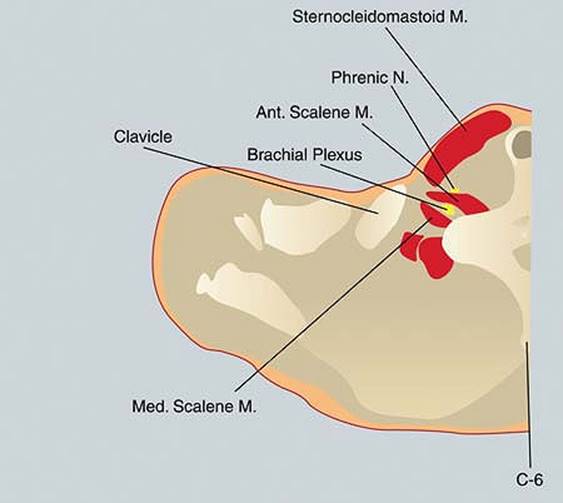
 Anatomic Landmarks: The cricoid cartilage (indicative of the transverse process of C6), the clavicular head of the sternocleidomastoid muscle, and the anterior and middle scalene muscles with the interscalene groove in between (Fig. 7-1).
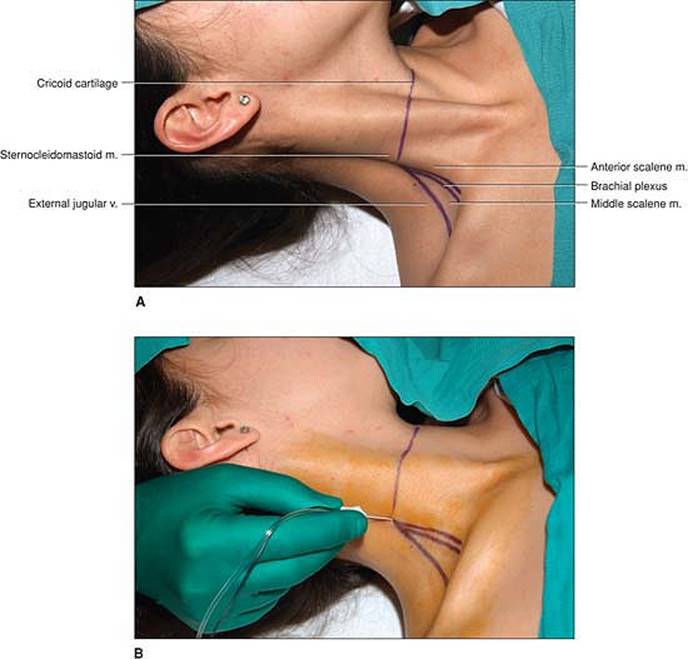
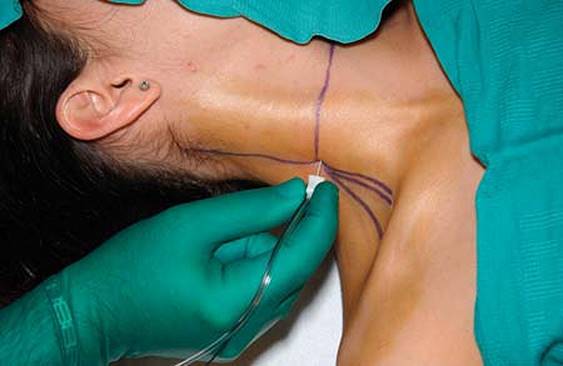
 Approach and Technique: The cricoid cartilage is identified with the head in the neutral position. The patient is then instructed to turn his or her head 30° to the opposite side and to raise the head slightly off the bed. The two heads of the sternocleidomastoid muscle are identified with particular emphasis being placed on the lateral border of the clavicular head (Fig. 7-2A). Next, the patient is asked to place the head back on the bed and relax. The anterior scalene muscle is then identified immediately lateral and deep to the lateral border of the clavicular head, and the fingers are rolled or “walked” laterally into the interscalene groove between the anterior and middle scalene muscles. The interscalene groove is marked. A horizontal line is drawn at the level of the cricoid cartilage laterally to intersect the interscalene groove. The insulated needle connected to a nerve stimulator (1.0 mA, 2 Hz, 0.1 ms) is inserted at the point of intersection between these two lines and is directed perpendicularly to the skin in a medial, caudal, and posterior direction (Fig. 7-2B). The position of the needle is adjusted to maintain the same motor response with a current less than 0.5 mA. After negative aspiration for blood, the local anesthetic is slowly injected with repeated aspiration for blood every 5 mL to be distributed around the brachial plexus (Fig. 7-3).
|
|
|
Figure 7-1. The cricoid cartilage, the clavicular head of the sternocleidomastoid muscle, and the anterior and middle scalene muscles with the interscalene groove in between. |
Testing the Motor Block: (a) Inability to elevate the arm (the “deltoid sign”). (b) The “money sign,” in which the patient rubs the thumb against the index and middle fingers indicating the onset of paresthesia or numbness in the distribution of C6 and C7.
Testing the Sensory Block: Loss of sensation over the upper lateral aspect of the upper arm in the distribution of the C6 dermatome.
 Tips
Tips
1. Sedation should be minimal, its purpose to allay anxiety without inhibiting the ability of the patient to communicate.
2. In a limited number of patients, the clavicular head of the sternocleidomastoid muscle is either not present or exists as an indistinct band. In these situations, the interscalene groove is situated 3 cm lateral to the lateral border of the main belly of the sternocleidomastoid muscle at the level of the cricoid cartilage. This “3-cm mark” is a useful aid in obese individuals as well. Additional landmarks include the external jugular vein and the pulsation of the subclavian artery as it crosses over the first rib between the anterior and middle scalene muscles at the lower end of the interscalene groove.
3. Patient discomfort is reduced by superficially infiltrating the skin with lidocaine using a 26-gauge needle.
4. To facilitate the insertion of the insulated needle, the skin can first be punctured with an 18-gauge needle.
|
|
|
Figure 7-2. A: The two heads of the sternocleidomastoid muscle are identified with particular emphasis being placed on the lateral border of the clavicular head. B: The insulated needle connected to a nerve stimulator is inserted at the point of intersection between these two lines and directed perpendicularly to the skin in a medial, caudal, and posterior direction. |
5. Insertion of the insulated needle with the bevel facing the sheath increases the likelihood of feeling the tactile sensation of “popping through the sheath.”
6. Diaphragmatic movement is indicative of stimulation of the phrenic nerve and of needle placement medial/anterior to the interscalene groove. The needle should be withdrawn and redirected in a more lateral/posterior direction. In contrast, a suprascapular or trapezius muscle contraction is indicative of needle placement lateral to the interscalene groove. The needle should be withdrawn and redirected in a more medial/anterior direction.
7. Positioning of the needle to maintain a motor response at 0.3 to 0.5 mA is associated with a high success rate.
8. It is essential that the caudal direction of the needle be maintained (Fig. 7-4). Insertion of the needle in a neutral/horizontal direction (i.e., midway between caudal and cephalad) or in a cephalad direction facilitates neuraxial positioning of the needle as well as the vertebral artery injection of local anesthetic.
|
|
|
Figure 7-3. The local anesthetic is slowly injected with repeated aspiration for blood every 5 mL to be distributed around the brachial plexus. |
9. A triangular-shaped swelling of the apex at the point of needle insertion and the base at the lower end of the interscalene groove may be noted, especially in thin individuals, as the injection progresses and is indicative of correct needle placement. In contrast, a circular swelling around the point of needle insertion is more likely indicative of injection into the subcutaneous tissues (i.e., superficial to the brachial plexus sheath).
10. “Pressure paresthesia,” which is described as a dull ache following the rapid injection of 2 to 3 mL of local anesthetic, should be differentiated from the severe pain produced by an intraneural injection. This “pressure paresthesia” appears to be more commonly encountered with an interscalene block than with other peripheral nerve blocks and may be referred to the shoulder or more distally.
11. This block is not indicated alone for a surgery involving an area around the axilla (e.g., inferior capsular shift). In addition, variations in the extent of T2 innervation may result in inadequate anesthesia of the anterior and posterior arthroscopic portal sites. These limitations can be overcome by local infiltration to the appropriate sites.
12. An interscalene block is not indicated alone for surgery to the medial aspect of the upper extremity, as nerve roots C8 and T1 are not consistently blocked with this approach to the brachial plexus.
|
|
|
Figure 7-4. The caudal direction of the needle needs to be maintained. |
13. Side effects are commonly associated with an interscalene block. A 100% incidence of phrenic nerve blockade (due to the phrenic nerve's C3-5 derivation) occurs, resulting in paresis of the ipsilateral diaphragm. This results in a 25% to 30% reduction in pulmonary function volumes. Caution is therefore advised in patients with significantly reduced lung function. The patient should be reassured that hoarseness (vasodilation of the larynx and arytenoids or blockade of the recurrent laryngeal nerve) and Horner syndrome (cervical sympathetic nerve block) are benign and transient.
14. Serious complications associated with the performance of this block include epidural, subdural, and spinal injections and even injections directly into the spinal cord; arterial (vertebral artery) and venous intravascular injections; as well as pneumothorax.
Suggested Readings
Benumof JL. Permanent loss of cervical spinal cord function associated with interscalene block performed under general anesthesia. Anesthesiology 2000;93:1541–1544.
Borgeat A, Ekatodramis G, Kalberer F, et al. Acute and nonacute complications associated with interscalene block and shoulder surgery. Anesthesiology 2001;95:875–880.
Brown A. Regional anesthesia for shoulder surgery. Tech Reg Anesth Pain Manag 1999;3:64–78.
Brown AR. The use of a “reverse” axis (axillary-interscalene) block in a patient presenting with fractures of the left shoulder and elbow. Anesth Analg 2001;93:1618–1620.
Casati A, Fanelli G, Aldegheri G, et al. Interscalene brachial plexus anaesthesia with 0.5%, 0.75% or 1% ropivacaine: a double-blind comparison with 2% mepivacaine. Br J Anaesth 1999;83: 872–875.
Klein S, Greengrass R, Steele S, et al. A comparison of 0.5% bupivacaine, 0.5% ropivacaine, and 0.75% ropivacaine for interscalene brachial plexus block. Anesth Analg 1998;87:1316–1319.
Roch J, Sharrock N, Neudachin L. Interscalene brachial plexus block for shoulder surgery: a proximal paresthesia is effective. Anesth Analg 1992;75:386–388.
Silverstein W, Saiyed M, Brown A. Interscalene block with a nerve stimulator: a deltoid motor response is a satisfactory endpoint for successful block. Reg Anesth Pain Manag 2000;25:356–359.
Urmey W. Interscalene block. Tech Reg Anesth Pain Manag 1999;3:207–211.
Urmey W, McDonald M. Hemidiaphragmatic paresis during interscalene brachial plexus block: effects on pulmonary function and chest wall mechanics. Anesth Analg 1992;74:352–357.
Winnie A. Interscalene brachial plexus block. Anesth Analg 1970;49:455–466.
B. Supraclavicular Block
Carlo D. Franco
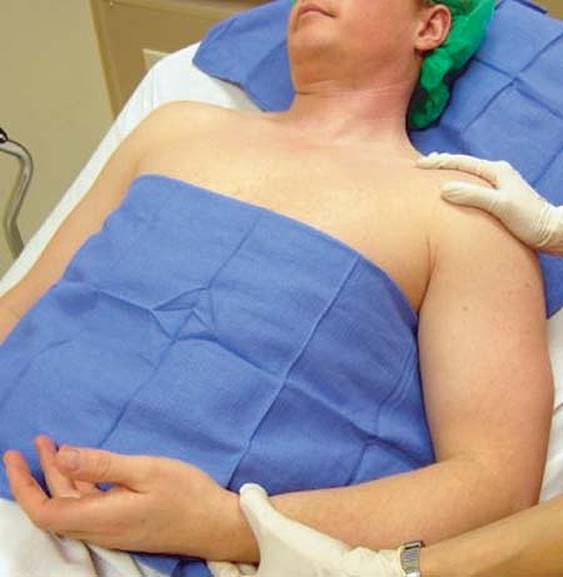
Patient Position: The patient is placed in a semi-sitting position, about 35° to 45° from the horizontal plane, with the head turned to the opposite side. The arm on the operative side is adducted, the shoulder is down and the elbow is flexed, as shown in Figure 7-5.
Indications: Anesthesia and postoperative analgesia for any surgical procedure on the upper extremity that does not involve the shoulder. It is an ideal technique for surgery on the elbow, the forearm, the wrist, as well as the hand.
Needle Size: 22-gauge, 50-mm insulated needle.
 Anesthetic Volume: 30 to 40 mL.
Anatomic Landmarks: Clavicle and lateral border of the clavicular head of the sternocleidomastoid at its insertion in the clavicle.
|
|
|
Figure 7-5. Patient positioning with shoulder down and elbow flexed. |
|
|
|
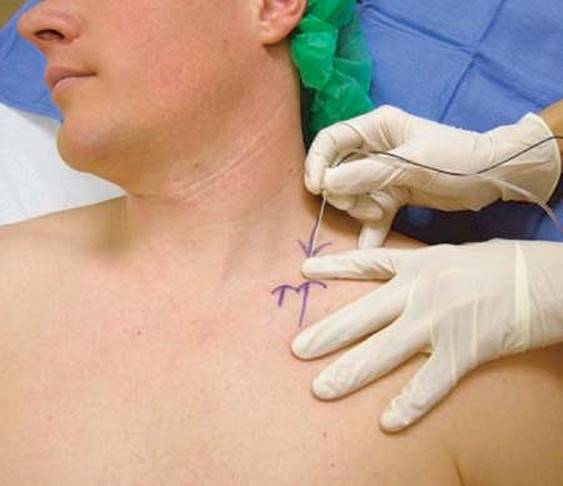
Figure 7-6. Needle insertion: Two new arrows are drawn lateral to the original one. The upper arrow pointing down shows the needle insertion point. The lower arrow pointing up together with the upper arrow show the direction of needle insertion, which is caudad and parallel to the patient's midline. |
Approach and Technique: The lateral (posterior) border of the sternocleidomastoid is identified and traced caudally to the point where it meets the clavicle. This point is marked with an arrow on the skin covering the clavicle. This mark is used as a reference to find the needle insertion point, which in adults, lies at a distance of approximately 1 in (2.5 cm) lateral to it and one fingerbreadth above the clavicle.
The index finger of the palpating hand is placed cephalad and parallel to the clavicle at this level where the operator usually is able to palpate the elements of the brachial plexus. The needle insertion point is located immediately cephalad to the palpating finger or one fingerbreadth above the clavicle as indicated by the lateral upper arrow in Figure 7-6. A small skin wheal of local anesthetic is raised at this level and the insulated needle connected to a nerve stimulator (0.8–0.9 mA, 1 Hz, 0.1 ms) is inserted first perpendicular to the skin (easier penetration) and then under the palpating finger in a caudal direction that is also parallel to the patient's midline as shown in Figure 7-6.
Usually a motor twitch of the shoulder is first obtained (upper trunk). The needle is then slowly advanced until a twitch of the fingers, either in flexion or extension is visible. The local anesthetic solution is slowly injected with frequent aspirations.
Tips
1. As it is the case with any regional anesthesia technique, positioning of the patient is very important. No attempts should be made at identifying any structures before achieving satisfactory posture. While the block can be performed with the patient supine it is more comfortable for the patient—and no more complicated for the operator—to have the patient sit up. Bringing the patient's shoulder down “opens” the supraclavicular area and facilitates the technique.
2. The point at which the lateral head of the sternocleidomastoid meets the clavicle is where the “plumb bob” technique is attempted. This point is located too close to the dome of the pleura so we use it only as a reference point from which we locate the needle insertion point in adults at about 1 in (2.5 cm) lateral to it. We call this distance “margin of safety.”
3. In patients with well-developed sternocleidomastoid muscles, the width of its clavicular head can be used to determine this margin of safety.
4. We do not routinely rely on the palpation of either the subclavian artery pulse or the scalene muscles.
5. To easier penetrate the skin the needle is first inserted perpendicular to it before changing its direction to advance it caudally, parallel to the patient's midline.
6. A motor response from one of the trunks of the plexus should be obtained in every patient at a depth of 2 cm or less. If no motor response is obtained, the nerve stimulator status and the indemnity of the electric circuit are checked before proceeding to reassess the landmarks if necessary.
7. With the supraclavicular block the type of response elicited (i.e., fingers twitch) is more important than the output at which such response is obtained provided that the output is no greater than 0.9 mA, as we demonstrated in a prospective study.
8. Flexion and extension of the wrist are acceptable motor responses but supination or pronation of the wrist and other more proximal responses are not.
9. While the block may be followed by 50% phrenic nerve paralysis it did not trigger symptoms in healthy volunteers according to a study by Neal and collaborators. Our experience confirms this.
10. A block of the intercostobrachial branches, also called “tourniquet block” or T2 block, is usually unnecessary unless the surgical incision falls in the upper medial side of the arm. Tourniquet pain usually is unavoidable after 2-h tourniquet time whether this supplemental block is performed or not. This time also marks the maximum allowable time for a tourniquet to remain inflated.
Suggested Readings
Franco CD, Domashevich V, Voronov G, Rafizad A, Jelev T. The supraclavicular block with a nerve stimulator: to decrease or not to decrease, that is the question. Anesth Analg 2004;98:1167–1171.
Franco CD, Gloss FJ, Voronov G, Tyler SG, Stojiljkovic LS. Supraclavicular block in the obese population: an analysis of 2020 blocks. Anesth Analg 2006;102:1252–1254.
Franco CD, Vieira ZE. 1001 subclavian perivascular blocks; success with a nerve stimulator. Reg Anesth Pain Med 2000;25:41–46.
Neal JM, Moore JM, Kopacz DJ, Liu SS, Krammer DJ, Plorde JJ. Quantitative Analysis of Respiratory, Motor, and Sensory Function After Supraclavicular Block. Anesth Analg 1998;86:1239–44
C. Infraclavicular Block
1. Classic Approach
Patient Position: Supine, with the hand of the side to be blocked positioned in a relaxed manner on the abdomen, and the head slightly turned to the contralateral side.
Indications: Anesthesia and immediate postoperative analgesia of any surgical procedure in the region of the distal upper arm, the forearm, and the hand.
Needle Size: 50-mm, 22-gauge insulated needle.
 Volume: 40 to 50 mL.
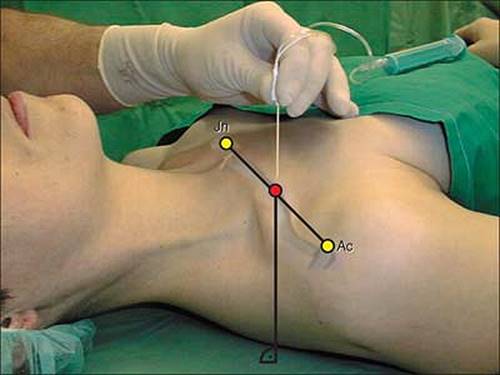
Anatomic Landmarks: The brachial plexus crosses beneath the clavicle in the vicinity of the middle of the clavicular line drawn between the halfway point of the ventral apophysis of the acromion and the jugular notch. In dissected cadavers, the plexus lay at a maximum depth of 4 cm lateral to the axillary artery and vein, where its three cords always converge at the entrance to the trigonum of the clavipectoral fascia.
Approach and Technique: The ventral apophysis of the acromion and the jugular notch is identified and the line joining these two points is drawn. The middle of this line determines the site of introduction of the needle. The insulated needle connected to a nerve stimulator (1.5 mA, 2 Hz, 0.1 ms) is introduced directly beneath the clavicle and in a strictly vertical direction (Fig. 7-7). Usually, the lateral cord (contractions of the biceps muscle) is stimulated. The position of the needle is adjusted to maintain the same motor response with a current less than 0.3 mA. After negative aspiration for blood, the appropriate volume of local anesthetic is slowly injected, with repeat aspiration for blood every 5 mL to be distributed around the brachial plexus (Fig. 7-8).
 Contraindications: Chest deformities; healed but dislocated fracture of the clavicle.
 Undesirable Side Effects: Horner syndrome, phrenic nerve paresis, vessel puncture, pneumothorax.
Tips
1. A complete blockade will develop within 5 to 15 minutes.
2. The most likely motor response predictive of a complete block is the contraction of the finger muscles: extensors or flexors (stimulation of either the radial or median nerve).
3. Precise determination of the specific anatomical landmarks is essential for the success and safety of this block. Following the described landmarks, no injury of nerves, vessels, or even the pleura have been induced in cadaver studies.
4. In contrast to the jugular notch, the exact determination of the ventral apophysis of the acromion lateral point is occasionally more difficult. This point, however, is essential for accurate determination of the puncture site. For that purpose, the clavicle may be palpated from medial to lateral leads to the acromioclavicular joint. This means the ventral apophysis of the acromion must be sought ventrally and slightly laterally. Another approach is based on following the crest of the scapula up to the acromion with the assumption that the ventral apophysis is posterior. To rule out the head of the humerus, the arm is passively moved and at the same time the assumed landmark is identified. The latter should not move in conjunction with this manipulation. The coracoid is considerably more medial and may be clearly felt in most patients.
|
|
|
Figure 7-7. The insulated needle connected to a nerve stimulator is introduced directly beneath the clavicle and in a strictly vertical direction. |
5. The measurement must be started from exactly in the middle of the jugular notch.
6. The distance between the puncture site and the clavicle must be kept at a minimum (however, painful contact with the periosteum should be avoided).
7. If blood is aspirated, it means that the puncture site is too medial. In contrast, if no motor responses are elicited, the appropriateness of the puncture site should be confirmed. If the second attempt is unsuccessful, the puncture site should be shifted 0.5 to 1.0 cm laterally. If this correction of the puncture site still does not produce the desired stimulation response, adjust the position 0.5 to 1.0 cm in a medial direction from the original site.
8. If primarily biceps muscle motor response is elicited, the position of the needle needs to be slightly more lateral and deeper (the perpendicular/vertical direction to meet the posterior cord). Finally, in the exceptional case that the puncture site cannot be defined with certainty, then another procedure should be used. Under no circumstances should one simply “poke about” or ever change from a vertical puncture direction.
9. The appropriate positioning of the patient allows optimal observation of the peripheral muscle contractions.
10. Cardinal mistakes: (a) Puncture site too lateral: false localization of the lateral landmark associated with a high risk for axillary artery or vein injury. (b) Puncture depth greater than 6 cm: In cadavers, injury to the pleura can occur (pneumothorax); however, the first rib provides relatively good protection, especially in the event of faulty medial punctures. (c) Puncture site too medial (subclavian artery, subclavian vein, or cephalic vein puncture).
|
|
|
Figure 7-8. After negative aspiration for blood, the appropriate volume of local anesthetic is slowly injected, with repeat aspiration for blood every 5 mL to be distributed around the brachial plexus. |
Suggested Readings
Kilka HG, Geiger P, Mehrkens HH. Infraclavicular vertical brachial plexus blockade. A new technique of regional anesthesia. Anästhesist 1995;44:339–344.
Kulenkampff D. Die Anästhesierung des plexus brachialis. Zentralbl Chir 1911;38:1337–1339.
Neuburger M, Kaiser H, Uhl M. Biometric data on risk of pneumothorax from vertical infraclavicular brachial plexus block. A magnetic resonance imaging study. Anästhesist 2001;50:511–516.
Raj PP, Montgomery SJ, Nettles D, et al. Infraclavicular brachial plexus block. A new approach. Anesth Analg 1973;52:897–902.
Whiffler K. Coracoid block: a safe and easy technique. Br J Anaesth 1981;53:845–847.
2. Coracoid Approach
Brian M. Ilfeld
Patient Position: Supine, arm resting at patient's side with the palm up (to make hand/wrist motion with nerve stimulation easier to identify). Patient may use a pillow behind the head, but the entire shoulder and back should lie flat against the gurney. The operator stands on the side ipsilateral to the extremity to be blocked, facing cephalad.
Indications: Surgery of the upper extremity at, or distal to, the elbow. The intercostobrachial (ICB) nerve, which often helps to innervate the skin over the medial epicondyle, is often spared surgical anesthesia with this block.
Needle Size: The brachial plexus is intersected between 2 and 8 cm deep to the skin (average: 4 cm). Therefore, for small and average-sized patients, a 5-cm, 22-gauge insulated stimulating needle is preferred. However, with larger patients, a longer needle is often necessary.
Volume: 40 to 50 mL for adults. The medial or lateral cord is most often initially identified using the coracoid technique, and a relatively large volume of local anesthetic is usually necessary to reach the posterior cord, located posterior to the axillary artery.
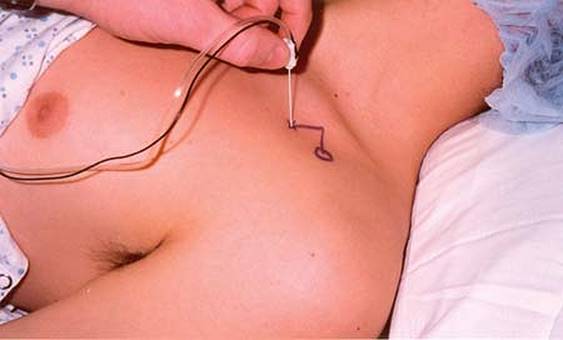
Anatomic Landmarks: The coracoid process of the scapula is the sole anatomic landmark. To find the coracoid process, place two fingers in the groove between the deltoid and pectoralis major muscles, and gently palpate laterally. From the center of the coracoid process, mark a point that is exactly 2 cm medial and 2 cm cauda1 (Fig. 7-9). This is the needle entry point.
Approach and Technique: Raise a skin wheal at the needle entry point. The needle is then inserted through the skin wheal with long axis of the needle perpendicular to the gurney in all planes (Fig. 7-9). With continuous aspiration and the nerve stimulator initially set at 1.2 mA and 2 Hz, the needle is advanced directly posterior. If the brachial plexus is not identified after 5 to 8 cm of insertion, depending on patient habitus, the needle is withdrawn to the skin and redirected either cephalad or caudal in the paramedian sagittal plane until discrete, stimulated motion occurs in any digit(s) with a current <0.50 mA. Directing the needle tip out of the paramedian sagittal plane must be avoided—neither medially toward the lung, nor laterally, toward the individual terminal nerves of the brachial plexus. Flexion or extension at the elbow or wrist that results in motion of the fingers, without intrinsic hand/digit motion, should be rejected.
Tips
1. Directing the needle tip out of the paramedian sagittal plane medially toward the chest wall increases the risk of a pneumothorax.
2. Directing the needle tip out of the paramedian sagittal plane laterally may place the needle tip lateral to the cords and result in anesthesia of only one or two terminal nerves of the arm.
3. Frequently, the first motion elicited results from direct stimulation of the pectoral major and minor muscles. The needle must be advanced further since the brachial plexus lies posterior to these muscles.
4. Any limb motion other than intrinsic finger flexion or extension must be rejected as these endpoints result in a 60% failure rate.
|
|
|
Figure 7-9. From the center of coracoid process, mark a point that is exactly 2 cm medial and 2 cm caudal. This is the needle entry point. |
5. If biceps or forearm motion occurs, redirect the needle caudal in the paramedian sagittal plane. Changes to the needle trajectory should be made in small increments.
6. The ICB nerve courses adjacent to the brachial plexus at the level of the cords. The infraclavicular block will usually produce analgesia in this nerve to cover the majority of tourniquet pain. However, while surgical anesthesia of the ICB frequently occurs, this block should not be relied on to consistently produce surgical anesthesia of the medial aspect of the arm above the elbow.
7. A “vertical” technique using a needle entry point just caudal to the clavicle and medial to the entry point of the coracoid technique has resulted in a number of reported pneumothoraxes. The investigator who first described the coracoid technique reported that even with deliberate attempts to penetrate the thoracic cavity in cadavers, it proved impossible to enter the lung using the coracoid approach.
Suggested Readings
Cornish PB, Nowitz M. A magnetic resonance imaging analysis of the infraclavicular region: can brachial plexus depth be estimated before needle insertion? Anesth Analg 2005;100:1184–1188.
Descroches J. The infraclavicular brachial plexus block by the coracoid approach is clinically effective: an observational study of 150 patients. Can J Anaesth 2003;50:253–257.
Klaastad O, Lilleas FG, Rotnes JS, et al. Magnetic resonance imaging demonstrates lack of precision in needle placement by the infraclavicular brachial plexus block described by Raj et al. Anesth Analg 1999;88:593–598.
Lecamwasam H, Mayfield J, Rosow L, Chang Y, Carter C, Rosow C. Stimulation of the posterior cord predicts successful infraclavicular block. Anesth Analg 2006;102:1564–1568.
MacLeod DB, Grant SA, Martin G, Breslin DS. Identification of coracoid process for infraclavicular blocks. Reg Anesth Pain Med 2003;28:485.
Minville V, Asehnoune K, Chassery C, et al. Resident versus staff anesthesiologist performance: coracoid approach to infraclavicular brachial plexus blocks using a double-stimulation technique. Reg Anesth Pain Med 2005;30:233–237.
Minville V, N'guyen L, Chassery C, et al. A modified coracoid approach to infraclavicular brachial plexus blocks using a double-stimulation technique in 300 patients. Anesth Analg 2005;100:2263–2265.
Rodriguez J, Barcena M, Alvarez J. Restricted infraclavicular distribution of the local anesthetic solution after infraclavicular brachial plexus block. Reg Anesth Pain Med 2003;28:33–36.
Rodriguez J, Barcena M, Taboada-Muniz M, et al. A comparison of single versus multiple injections on the extent of anesthesia with coracoid infraclavicular brachial plexus block. Anesth Analg 2004;99:1225–1230.
Rodriquez J, Taboada-Muniz M, Barcena M, Alvarez J. Median versus musculocutaneous nerve response with single-injection infraclavicular coracoid block. Reg Anesth Pain Med 2004;29:534–538.
Whiffler K. Coracoid block—a safe and easy technique. Br J Anaesth 1981;53:845–848.
Wilson JL, Brown DL, Wong GY, et al. Infraclavicular brachial plexus block: parasagittal anatomy important to the coracoid technique. Anesth Analg 1998;87:870–873.