
Christopher Ryan Heery and Teri Kreisl
Tumors within the central nervous system (CNS) are most commonly due to metastatic spread from other primary tumor sites. This chapter will focus mainly on primary CNS tumors that vary significantly in histology, epidemiology, and management.
Secondary CNS lesions (metastatic from other sites) will also be discussed. Brain metastases often occur late in the disease course and are a poor prognostic indicator. Because patients may be severely symptomatic from other sites of disease, these lesions may not be detected until autopsy in many patients with metastatic cancer. Improved imaging techniques (MRI and CT) have allowed enhanced differential diagnosis based on radiographic features and location combined with patient age (Table 32.1), but a definitive diagnosis is dependent on biopsy and histolopathologic analysis.
PRIMARY BRAIN TUMORS
Epidemiology
■Primary brain tumors comprise 1.4% of all cancers.
■In 2012, American Cancer Society estimates that 22,910 primary CNS tumors will be diagnosed, resulting in 13,700 deaths (approximately 2.4% of all cancer deaths).
■According to the Surveillance, Epidemiology, and End Results (SEER) registry for 2005 to 2009, the age-adjusted incidence of primary malignancies of the brain and CNS is 6.5 cases per 100,000 persons per year.
■There is a bimodal distribution of incidence, with peaks under 20 years (13.0% of cases) and over 65 (35.2% of cases).
■Median age at diagnosis is 57, overall; if no tumor is found by the age of 4 (tumors which may have been present at birth), the risk of a primary brain tumor appears to increase with age.
■CNS tumors are the most prevalent solid tumors in childhood, comprising 27% of all cancer diagnoses in children (second to leukemia which is 33%). Brain tumors are the most frequent cancer-related cause of death in children aged <15 years and men aged 20 to 39.
■The majority (80%) of all primary brain tumor-related deaths occur in patients aged >59 years.
■The most common CNS tumors are derived from glial precursors.
■The risk of brain tumors increases for patients with type 1 neurofibromatosis (NF1).
Clinical Diagnosis
The most common symptoms in order of decreasing frequency are
■Headache
■Seizure
■Cognitive/personality changes
■Focal weakness
■Nausea/vomiting
■Speech abnormalities
■Altered consciousness

The most common signs in order of decreasing frequency are
■Hemiparesis
■Cranial nerve palsies
■Papilledema
■Cognitive dysfunction
■Sensory deficits
■Hemiparesthesia
■Hemianopia
■Dysphasia
Acute Complications
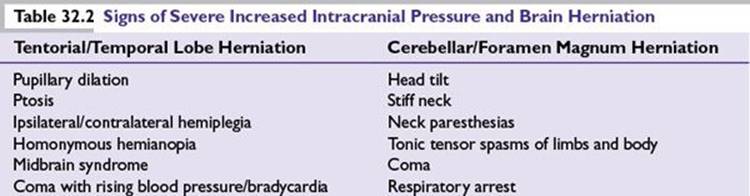
Because the skull’s rigidity does not allow for intracranial expansion, brain lesions can result in structural displacement and life-threatening consequences. Following the path of least resistance, increased intracranial pressure (ICP) may cause tentorial or foramen magnum herniation, causing significant neurologic signs (Table 32.2).
Types of Primary Brain Tumors
Gliomas
Gliomas account for approximately 65% of all intracranial tumors (range 46% to 85% in various databases), with age-related incidence by histologic subtype. Table 32.3 shows the prevalence of the pathologic subtypes of gliomas in relation to other more common primary brain tumors.
There are four major types of gliomas, based on their presumed glial cell of origin:
■Astrocytoma (glioblastoma multiforme [GBM], anaplastic astrocytoma, diffuse astrocytoma, pleomorphic xanthoastrocytoma, pilomyxoid astrocytoma, pilocytic astrocytoma, giant cell astrocytoma)
■Oligodendroglioma (anaplastic oligodendroglioma, oligodendroglioma)
■Mixed glioma (anaplastic oligoastrocytoma, oligoastrocytoma)
■Ependymoma (anaplastic ependymoma, ependymoma, subependymoma, myxopapillary ependymoma)


Grading The World Health Organization’s pathologic grading system, generally accepted by neuropathologists since 1993 (most recently updated in 2007), determines the grade (level of aggressiveness) of each histologic subtype of tumor (Table 32.4) based on the following features:
■Cellular atypia
■Mitotic activity
■Degree of cellularity
■Endothelial proliferation
■Degree of necrosis and/or microvascular proliferation
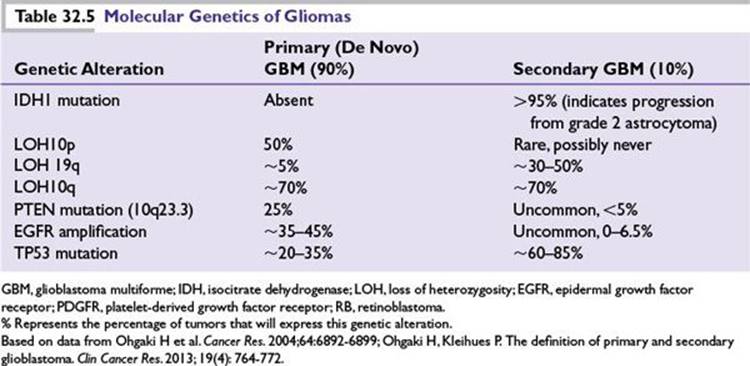
Molecular Genetics Patterns of genetic abnormalities have been identified in various glioma subtypes (Table 32.5). Secondary or progressive gliomas often demonstrate mutations of p53, but they seldom show amplification of epidermal growth factor receptor (EGFR). By contrast, primary (de novo) GBMs usually lack p53 mutations and contain an amplified EGFR. IDH (isocitrate dehydrogenase) mutations appear to be pathognemonic for secondary GBM diagnosis by current definitions of the two entities, which indicate common precursor events for all secondary GBMs.
Glioblastoma Multiforme (WHO Grade IV Astrocytoma)
■The most common adult primary brain tumor, accounting for about half of all gliomas and 10% to 15% of all intracranial tumors.
■Peak incidence is at 45 to 65 years; overall incidence is 2 to 3/100,000; male-to-female ratio is 3:2; median survival is around 3 months if untreated, approximately 12 to 15 months with standard therapy (discussed below).
■More likely to cross the corpus callosum than other types of brain tumors.
■Development may occur de novo (primary) or after progression from a lower-grade precursor lesion (secondary).
Imaging Characteristics
■Heterogeneous hypointense or isointense mass on CT or T1-weighted MRI.
■Heterogeneously contrast-enhancing mass, often the presence of necrosis visible.
■Hypervascular appearance.
■Rare calcifications (more common in oligodendroglial tumors).
■MR spectroscopy is increasingly used to distinguish tumor from other processes visualized on MRI.
■Gliosarcoma, a variant, has a mesenchymal component and a greater tendency for dural invasion.
■GBMs are characteristically infiltrative within brain parenchyma but rarely show extracerebral metastasis.
■High-grade tumors (by definition, GBM) are commonly hypermetabolic on FDG PET.
■Single-photon emission-computed tomography (SPECT) and MR cerebral perfusion imaging may distinguish radiation necrosis (hypovascular) from tumor recurrence (hypervascular).
Differential Diagnosis
■Brain metastasis
■Cerebral abscess
■Demyelinating/inflammatory process (i.e., multiple sclerosis)
■Radiation necrosis
Treatment
First Line
■Maximal surgical debulking is of primary importance after diagnosis is established (not ideal if primary CNS lymphoma is suspected). The degree of resection is a strong prognostic factor.
■The landmark study, which established the standard of care for upfront therapy, was a randomized phase 3 trial by the EORTC-NCIC (European Organisation for Research and Treatment of Cancer and National Cancer Institute of Canada Clinical Trials Group), reported by Stupp et al. in the New England Journal of Medicine in 2005.
■This study randomized 573 patients between August 2000 and March 2002 to radiotherapy (focal, 60 Gy in 2 Gy fractions given 5 days per week over 6 weeks) alone or in combination with temozolomide (75 mg/m2, PO 7 days per week during concurrent chemotherapy, then 150 to 200 mg/m2 PO days 1 to 5 of 28-day cycles for up to six cycles). Patients were stratified according to performance status, previous surgical intervention (yes/no and % resected), and treatment center.
■Concurrent chemotherapy and radiotherapy resulted in an improved median overall survival (OS) (14.6 months) compared with radiotherapy alone (12.1 months). The 2-year survival rate also favored the combination arm (26.5% vs. 10.4%) with minimal additional toxicity.
■An analysis of the tumor tissue identified methylation of the MGMT promoter as an excellent indicator of response and prognosis with temozolomide. In the combined group, patients with MGMT promoter methylation had a median OS of 23.4 months compared with 12.6 months for the patients without promoter methylation.
■Gliadel wafers (3.8% carmustine) are also FDA-approved for newly diagnosed GBM, which are placed locally into the tumor bed during surgery, followed by radiotherapy for newly diagnosed GBM (increased median OS by 2.1 months vs. radiotherapy alone). This approach carries an increased risk of CNS leakage (can cause increased infections and increased need for use of steroids to treat swelling).
Second-Line or Other Agents
■Bevacizumab (Avastin, monocolonal antibody against circulating VEGF) given 10 mg/kg IV over 30 to 90 minutes every 2 weeks—capable of inducing significant tumor responses in phase 2 studies for recurrent GBM.
■Other standard agents used to treat malignant gliomas are generally alkylating agents and include irinotecan, carboplatin, procarbazine, etoposide, carmustine, and lomustine.
■Other promising strategies using inhibitors of the EGFR, PDGFR, ras, and mTOR (mammalian target of rapamycin) signal transduction pathways are being studied. Additional treatment strategies currently under investigation include therapeutic gene transfer and immunotherapeutic approaches.
Prognosis
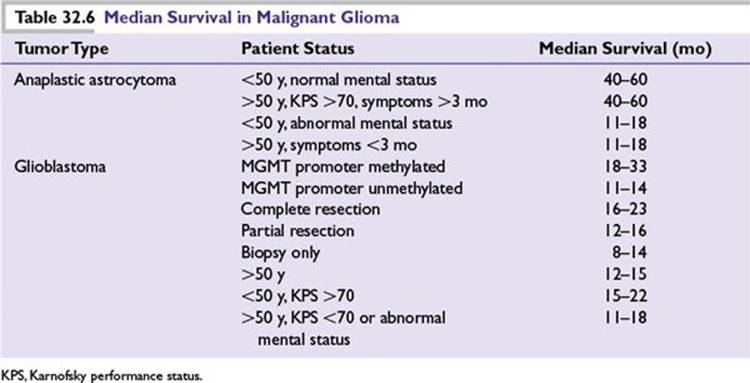
■See Table 32.6—based on several Radiation Therapy Oncology Group trials.
Astrocytoma and Anaplastic Astrocytoma
Low-Grade Diffuse Astrocytoma Low-grade diffuse astrocytomas are categorized as grade 2 and account for approximately 5% of primary brain tumors. They occur mostly in the cerebral hemispheres, but may also occur in the brain stem. Median age at diagnosis is 35 to 45.
Imaging characteristics on MRI are most commonly as follows:
■A nonenhancing lesion on T1-weighted images after contrast
■A well-delineated hyperintense lesion with little edema/mass effect on T2-weighted images
■Difficult to distinguish from nonmalignant infarct/cerebritis/demyelination
■Rare calcifications
Treatment
■Maximal surgical debulking is recommended in all cases that can be performed safely except in the case of small, asymptomatic lesions, which may be observed radiographically until resection is required.
■“High-risk” patients (two or more of age > 40, KPS < 70, tumor dimension > 6 cm, tumor crossing midline, preoperative neurologic deficit) are usually recommended to receive postoperative radiotherapy (54 Gy, based on the EORTC study indicating equivalent efficacy with improved safety compared with 60 Gy). Low-risk patients (those not meeting criteria for high risk) may be considered for observation alone.
■RTOG 98-02 is a prospective randomized clinical trial in low-grade gliomas evaluating the use of chemotherapy. It randomized patients with astrocytoma, oligodendroglioma, or oligoastrocytomas, stratified by age, histology, performance status, and extent of resection, to RT alone or in combination with PCV (procarbazine, CCNU, and vincristine) chemotherapy. The addition of chemotherapy improved median PFS, but not OS, but in the subset of patients who survived >2 years, median OS was significantly improved, as was PFS. This finding indicates a delayed benefit for chemotherapy and indicates that it might be most beneficial for the patients with best prognosis.
■Pilocytic astrocytomas, a subset of low-grade astrocytomas, are the most common pediatric astrocytic tumors and virtually the only type curable with complete surgical resection.
Prognosis The number of poor prognostic factors influences prognosis for a given patient: age, location (resectablity influenced by surrounding structures), size, and characteristics (size, enhancement on MRI) of the tumor as well as its molecular profile (IDH mutation, 1p and/or 19q mutations, which confer improved prognosis). These were combined in a recursive partitioning analysis (RPA), which separated patient characteristics into prognostic signs and then used those signs to separate patients into RPA classes (I to VI initially) with lower numbers having improved prognosis. These classes have been slightly modified over the years, but are still an excellent prognostic tool for any patient with a newly diagnosed glioma.
As surgical techniques improve, overall prognosis improves because the patients with the worst outcomes do much better with excellent resections. Prognosis of a given patient is strongly influenced by the surgical expertise, and difficult cases should be referred to centers of excellence when possible for best outcomes.
Median survival for all patients:
■Five years: 65% to 85%
■Ten years: 25% to 50%
High-Grade Diffuse (Anaplastic) Astrocytoma High-grade diffuse astrocytomas are categorized as grade 3 and account for approximately 5% of primary brain tumors. Age at diagnosis is most commonly 35 to 55. They are distinguished from low-grade diffuse astrocytomas by increased mitoses. They have a high propensity for transforming into GBM. Survival is 2 to 5 years.
Treatment
■Treat essentially identically to GBM.
■Maximal surgical debulking with or without carmustine (BCNU) wafer implantation when possible followed by adjuvant therapy (concurrent metronomic temozolomide plus radiotherapy followed by temozolomide as discussed in GBM treatment).
Oligodendroglioma and Oligoastrocytoma (Mixed Glioma)
These diffuse cerebral tumors often appear with prominent areas of calcification on CT scan. They account for 5% to 10% of all gliomas and may have a better prognosis than astrocytomas. Like astrocytomas, low-grade oligodendrogliomas may progress to a higher grade.
Treatment
■For all grades, when safe to do so, a maximal surgical resection is the initial step in management, allowing confirmation of tumor grade and the use of more directed therapy as needed.
■When only subtotal resection is available or surgery cannot be undertaken at all, patients are treated depending on risk stratification as they would be in the adjuvant setting after maximal resection.
■High-risk patients (2 or more of the following risk factors: >40 years, KPS <70, tumor >6 cm, tumor crossing midline, more than minor neurologic symptoms preoperatively, one or no deletions of 1p and 19q, or IDH not mutated) are usually treated with adjuvant radiotherapy and, in many centers, chemotherapy (a randomized trial is evaluating the role of RT alone or in combination with PCV chemotherapy; temozolomide).
■Low-risk patients (with 1 or less high-risk feature) may be observed at patient preference, but are commonly treated with RT adjuvantly. Chemotherapy may also be considered depending on the likelihood of chemosensitivity of the tumor (may be dependent on the presence of codeletion of 1p and 19q).
■Radiation therapy has been the treatment of choice for low-grade progressive and anaplastic oligodendrogliomas. However, chemotherapy with PCV or temozolomide is occasionally used as neoadjuvant therapy to delay radiation therapy with its potential long-term neurotoxicity.
Ependymoma
Ependymomas comprise a spectrum of tumors ranging from aggressive childhood intraventricular tumors to low-grade adult spinal cord lesions. Typical locations are on the ventricular surface and the filum terminale.
Epidemiology
■Ependymomas account for 2% to 10% of all CNS neoplasms.
■Seventy-five percent of ependymomas are low grade.
■Fifty percent occur before the age of 5 years.
■Intracranial tumors are 60% infratentorial, 40% supratentorial, with 50% intraventricular.
■Overall incidence of spinal seeding is approximately 7% to 15.7% for high-grade infratentorial lesions and increases with uncontrolled primary lesions.
■Highly variable biologic behavior despite pathologic appearance.
Imaging
CT and MRI are highly suggestive of the presence of ependymoma (e.g., calcified mass on the fourth ventricle) but are not diagnostic.
Treatment
■Complete resection can be curative. Subtotal resection benefit is not clearly defined, but is often a standard practice prior to radiotherapy as mainstay of treatment.
■When complete surgical resection is achieved, CSF analysis and MRI of the spine are commonly performed to rule out evidence of spinal seeding.
■Observation and limited-field adjuvant radiation therapy are reasonable options for low-grade ependymomas with no evidence of metastases.
■Subtotal resection with no evidence of metastases should have limited field radiotherapy in the setting of tumor progression.
■If recurrence occurs and radiotherapy has been previously employed, chemotherapeutic options are quite limited with poor response rates. Options include single-agent or doublet platinum regimens, etoposide, nitrosurea, and bevacizumab. Clinical trials should also be considered or best supportive care when radiotherapy is not an option. Craniospinal irradiation is warranted for evidence of diffuse seeding by cerebrospinal fluid (CSF), cytologic or radiographic studies, or for anaplastic ependymomas.
Prognosis
■Five-year survival
•Low-grade tumors: 60% to 80%
•Anaplastic ependymoma: 10% to 47%
■Long-term survival
•Surgery alone: 17% to 27%.
•Surgery plus radiation: 40% to 87%.
•Age is a dominant prognostic factor. Infants do poorly.
CHOROID PLEXUS TUMORS (NONGLIOMAS)
Choroid plexus tumors occur mostly in ventricles; in adults, occurrence is predominantly in the fourth ventricle. Tumors range from aggressive supratentorial childhood tumors to benign cerebellopontine angle tumors of adulthood. An association with Li-Fraumeni syndrome and von Hippel-Lindau syndrome has been described.
Diagnosis
■Signs of increased ICP.
■Focal findings of the fourth ventricle (ataxia and nystagmus).
■Anaplastic histologic changes warrant CSF examination for increased risk of disseminated disease.
Treatment
Surgery
■Complete resection is the goal of surgery.
Radiation Therapy/Chemotherapy
Given the rarity of these tumors, there are few prospective studies to evaluate a uniform approach. Radiation therapy, in conjunction with chemotherapy, has shown some benefit. Combinations of doxorubicin, cyclophosphamide, vincristine, and nitrosoureas have been used, as well as intraventricular methotrexate and cytarabine, but there have been no studies to evaluate these approaches.
MEDULLOBLASTOMA
Medulloblastoma is a malignant, small, blue, round cell tumor of the CNS.
Epidemiology
■Medulloblastoma comprises 25% of all pediatric tumors.
■Found predominantly in the posterior fossa in children; uncommon in adults.
■Thirty percent to 50% of medulloblastomas have isochromosome 17q.
■Associated with Gorlin syndrome and Turcot syndrome.
Clinical Presentation
■The most common presenting symptoms are signs of increased ICP and cerebellar and bulbar signs.
■At diagnosis, 5% to 25% of patients have CSF dissemination.
■Less than 10% of patients exhibit systemic metastasis, commonly in bone.
■Forty percent of patients have brain stem infiltration.
Risk Stratification
■Average risk: Localized disease at diagnosis; total or near-total resection
■High risk: Disseminated disease at diagnosis and/or partial resection
Imaging
Typically, CT or MRI reveals a contrast-enhancing posterior fossa midline lesion, most frequently arising from the cerebellar vermis.
Staging
■Based on the modified Chang staging system.
■Tumors are evaluated according to size, local extension, and presence of metastasis.
■CSF and spinal axis should be evaluated for metastasis with lumbar puncture and contrast-enhanced MRI.
Treatment
■Surgical resection.
■Radiation therapy involves postoperative 35 Gy radiation to the whole brain, with 15 to 20 Gy boost to posterior fossa. Average-risk patients may be cured with radiation alone.
■Ongoing studies are investigating the possibility of further reducing craniospinal radiation to 18 Gy in combination with local irradiation and adjuvant chemotherapy.
■Children with localized disease have shown an OS of >81% when treated with 23.4 Gy irradiation to the craniospinal axis, supplemented by 32.4 Gy local irradiation, followed by eight cycles of the following adjuvant chemotherapy regimen:
•Vincristine 1.5 mg/m2 IV weekly plus
•CCNU 75 mg/m2 PO on day 0 plus
•Cisplatin 75 mg/m2 IV on day 1
Results of this combination therapy were equivalent to
•Cisplatin 75 mg m2 IV on day 0 plus
•Vincristine 1.5 mg/m2 IV weekly plus
•Cyclophosphamide 1,000 mg/m2 IV over 60 minutes on days 21 and 22
■Small nonrandomized trials with select patients suggest that a small percentage (<20%) of patients who relapse after primary treatment can be successfully retreated and remain disease-free for >5 years with high-dose chemotherapy and stem cell support.
Prognosis
Disseminated disease is the most important prognostic factor. Other important factors are age (worse in children aged <3 years) and extent of resection (controversial).
Progression-free survival after chemotherapy and radiation is as follows:
■High-risk patients: 40% to 60%
■Average-risk patients: 65% to 91%
MENINGIOMAS
Meningiomas comprise up to 39% of primary CNS tumors. They are usually benign.
Genetics
■Monosomy 22, with frequent mutation of the NF2 gene on 22q.
■Malignant meningiomas frequently show loss of 1p, 10, and 14q.
■Female sex, ionizing irradiation, NF2, and breast carcinoma are predisposing factors.
Clinical Presentation
Meningiomas commonly present in the parasagittal region, cerebral convexity, and sphenoidal ridge. Signs and symptoms include seizures, hemiparesis, visual field loss, and other focal findings.
Imaging
■A uniformly enhancing lesion on contrast-enhanced MRI, sometimes observed with a “dural tail.”
■Isodense and isointense on unenhanced CT and MRI scans, respectively, and can display calvarial hyperostosis adjacent to lesion.
Treatment
Surgery
■Treatment goal is complete resection.
■Recurrence rate after complete resection is about 1% to 2% per year. Quality of resection and dural margins removed (1 cm is standard) predict lower recurrence rates.
Radiotherapy
■Radiation: Consider for incompletely resected or inoperable meningiomas, and WHO grade 3.
Chemotherapy
There is no effective drug for treatment of meningiomas. Despite having estrogen and/or progesterone receptors, meningiomas are generally nonresponsive to hormonal therapy with agents such as tamoxifen. Although a small phase 2 trial suggested that the antiprogestin RU-486 had antimeningioma activity, a subsequent large randomized trial of RU-486 versus placebo for locally unresectable meningiomas showed no benefit for the drug compared to placebo. Other regimens studied with little success include interferon and hydroxyurea.
PRIMARY CNS LYMPHOMA
■Intracerebral lymphoma most frequently presents as parenchymal lymphoma, but may be found in other anatomic sites such as the eye, meninges, or ependymal nodules.
■Primary CNS lymphoma accounts for 3% to 4% of all primary brain tumors, but up to one-quarter of HIV-associated lymphomas. Its prevalence in AIDS patients has declined with improved retroviral therapy.
■For unknown reasons, there has been a 10-fold increase in the last few decades in incidence of this tumor in immunocompetent patients, from 0.3/100,000 to 3/100,000. This increase has leveled off since 1995.
■Histologically indistinguishable from other systemic lymphomas. Usually most similar to diffuse large B-cell lymphoma. Rare to have concurrent systemic lymphoma (3% to 5%).
Risk Factors
■HIV/AIDS
■Immunosuppression for organ transplantation
■Autoimmune disease
■Congenital immunodeficiencies such as Wiscott-Aldrich syndrome
■Epstein-Barr virus (EBV) infection
Clinical Presentation
■Symptoms of intracranial mass (headaches and signs of increased ICP).
■Frontal lobe is most commonly involved, often with multiple lesions. Personality changes and decreased alertness are common. Basal ganglia and corpus callosum are also common sites.
■Large lesions (>2 cm) are common, variably circumscribed and multiple shapes may occur.
■Multifocal disease: 42% leptomeningeal, 15% occular seeding at diagnosis
Diagnosis and Staging
Tissue diagnosis is paramount, except when EBV DNA is evident in the CSF of an AIDS patient, combined with hypermetabolic lesion on PET or SPECT imaging. Can be diagnosed with needle biopsy, but excisional biopsy is best, as it is for lymphoma diagnosis in general. Staging studies should include the following:
■MRI of brain with gadolinium
■Lumbar puncture for CSF cytology
■Ophthalmologic evaluation with slit lamp
■Bone marrow biopsy
■Complete physical and blood work (including liver function tests)
■Consider MRI spine if symptomatic
■CT chest, abdomen, and pelvis
Treatment
Many primary CNS lymphomas may initially shrink or disappear in the presence of corticosteroids. When primary CNS lymphoma is in the differential, steroids should be withheld, if possible, until tissue diagnosis is confirmed. A ring-enhancing lesion that “disappears” after starting steroids is strongly suggestive of CNS lymphoma, although other infectious diseases (i.e., toxoplasmosis) and inflammatory/demyelinating diseases (i.e., multiple sclerosis) must be considered.
Surgery
Surgery has no role in therapy, but is used to confirm diagnosis.
Radiotherapy
Whole-brain radiotherapy (WBRT) yields 80% to 90% radiographic complete response. Common dosage is 40 to 50 Gy to the entire brain and meninges (C2 radiation). More extensive radiotherapy (including the spine or focal boosts to the area of greatest involvement) does not convey improved outcomes. Median survival is 12 to 18 months.
Chemotherapy
■The standard agents (adriamycin, cyclophosphamide, vincristine, prednisone, and rituximab) used for similar histologic systemic lymphomas (DLBCL) are not effective probably due to poor blood–brain barrier penetration.
■Methotrexate (high-dose) is the most active agent in CNS lymphoma. Studies suggest that preradiation chemotherapy with high-dose methotrexate significantly increased median survival (range: 30 to 60 months) and led to many long-term survivors.
■The role of radiotherapy for patients who have complete response to chemotherapy is unknown.
■The potential for long-term treatment-induced neurocognitive toxicity is considerably greater for patients receiving combined-modality treatment, especially when WBRT precedes high-dose methotrexate.
■Treatment is poorly tolerated in patients aged ≥60 years. Single-agent methotrexate should be the treatment of choice for these patients unless contraindicated.
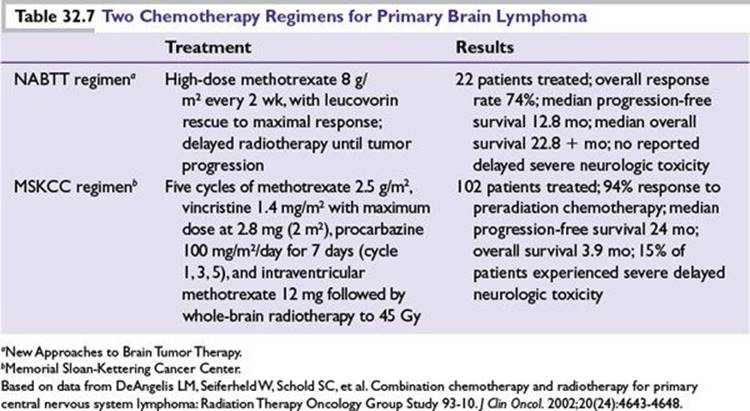
■The two most widely utilized treatment regimens for primary CNS lymphoma are the New Approaches to Brain Tumor Therapy (NABTT) regimen and the Memorial Sloan-Kettering Cancer Center (MSKCC) regimen, as outlined in Table 32.7.
PINEAL REGION TUMORS
Clinical Presentation
Because the pineal region is close to the center of the brain, symptoms are generally related to increased ICP and ocular pathway cranial nerve palsies:
■Obstructive hydrocephalus (headache, nausea, vomiting, and lethargy)
■Cranial nerve palsies (diplopia and upward-gaze paralysis)
■Elevated levels of serum tumor markers α-fetoprotein, α-human chorionic gonadotropin, and placental alkaline phosphatase
Differential Diagnosis
■Germ cell tumors (most common, ~50% germinoma, others: teratoma, choriocarcinoma, endodermal sinus tumor, embryonal carcinoma)
■Pineal parenchymal tumor (or pineal cyst)
■Meningioma
■Tectal astrocytoma
Diagnosis
■If suspicious for germ cell tumor, serum and CSF tumor markers should be checked (AFP, β-HCG, and LDH).
■Because of the differential, biopsy is indicated. Open is preferred to ensure adequate tissue.
Imaging
■Germinomas are usually isointense and homogeneous on T1-weighted images on MRI.
■Teratomas and nongerminomas tend to appear heterogenous with more invasive features. Choriocarcinoma may have indications of prior hemorrhage.
Treatment
■Germinomas—surgery not indicated, primarily treated with radiotherapy (40 Gy + 15 Gy boost). Craniospinal radiotherapy is indicated if CSF seeding is found.
■Nongerminomas—radical resection teratomas and residual masses may be required due to mixed histology. For nongerminomas, chemotherapy with radiotherapy is recommended, with etoposide and cisplatin as the main drugs.
■Others—primarily surgically treated, radiotherapy may be employed based on histology.
METASTATIC BRAIN TUMORS
Epidemiology
■Brain metastases are the most prevalent intracranial malignancy. Estimated incidence in the United States is 80,000 to 170,000 cases per year, compared to approximately 23,000 newly diagnosed primary brain tumors, highlighting the importance of proper diagnosis and management of this disease.
■An estimated 25% of adults and 6% to 10% of children with systemic cancer will develop symptomatic brain metastases.
■The most common tumors to metastasize to the brain are lung, breast, melanoma, testicular, choriocarcinoma, and renal cancers.
Clinical Presentation
Common presenting signs and symptoms of brain metastasis include
■Hemiparesis
■Change in mental status
■Gait ataxia
■Sensory loss/change
■Papilledema
■Headache
■Focal deficit
■Seizure
■Speech disturbance
Differential Diagnosis
■Primary brain tumors
■Abscess
■Demyelination
■Cerebral infarction
■Cerebral hemorrhage
■Progressive multifocal leukoencephalopathy
■Radiation necrosis
The false-positive rate for single brain metastasis may be as high as 30%. Nonmetastatic brain lesions are equally divided between primary brain tumors and infections. Meningioma must be considered in patients with primary breast cancer with a dural-based brain lesion because the prevalence of this primary brain tumor increases in breast cancer.
IMAGING
Contrast-enhanced MRI is the diagnostic imaging modality of choice. Features that favor MRI diagnosis of brain metastasis include the following:
■Multiple lesions
■Location at gray/white matter junction
■High ratio of vasogenic edema to tumor size
■If imaging indicates that metastatic CNS lesion is likely and primary is unknown, CT chest, abdomen, and pelvis should be performed to identify primary disease.
Treatment
Symptomatic Therapy
■To reduce symptoms including vasogenic edema, SIADH, and neurologic impairment, a loading dose of dexamethasone 10 mg followed by 4 mg four times per day can be given.
■Symptomatic improvement should be seen within 24 to 72 hours.
■Imaging studies may not show a decrease of cerebral edema for up to 1 week.
■Steroid use should be tapered after completion of irradiation or earlier if cerebral edema is minimal.
Seizure Management
■Because infratentorial metastases have a very low risk of seizures, anticonvulsant therapy is usually not indicated.
■In patients with supratentorial brain metastasis and no surgery or prior seizures, prophylactic anticonvulsant therapy is not routinely recommended. Generally, antiseizure medication is started only after seizure activity has occurred or for a short term after a patient has undergone craniotomy with prior history of ictal events.
■Close monitoring is advised because dexamethasone and phenytoin mutually increase the clearance of phenytoin, and an increasing number of reports suggest a correlation between Stevens-Johnson syndrome and palliative whole-brain irradiation in patients taking phenytoin.
■Because phenytoin (like most older antiepileptic drugs) induces hepatic cytochrome P450 isoenzymes, thereby considerably altering the metabolism and pharmacology of agents such as paclitaxel and irinotecan, some physicians are initiating seizure prophylaxis with newer agents that do not induce hepatic enzymes, such as levetiracetam, lamotrigine, or topiramate.
Surgery
Before recommending surgical resection, the following factors should be considered:
■Interval between diagnosis of primary cancer and finding of brain metastasis
■Type of primary cancer
■Extent of systemic disease
■Number and location of cerebral metastases
■Patient’s neurologic status
Several controlled studies suggest a benefit for surgery combined with WBRT (described below in the Radiation Therapy section) for patients with single brain metastasis and stable extracranial disease. The benefit of resection of multiple brain metastases with therapeutic intent has not been established. For patients with multiple brain metastases, the role of surgery is generally limited to the following:
■Large, symptomatic, or life-threatening lesions
■Tissue diagnosis in unknown primary
■Differentiation of metastasis from primary brain tumor (e.g., meningioma)
Radiation Therapy
■Considered first-line therapy for brain metastasis in addition to surgery when suitable.
■WBRT increases median survival to 3 to 6 months from about 1 month.
■A randomized study conducted by Patchell and colleagues in 48 patients demonstrated superiority of surgery followed by WBRT compared with WBRT alone in OS (40 vs. 15 weeks, P <0.01) as well as functional independence, and local recurrence for patients with single metastasis and KPS >70.
■The same group also randomized 95 patients between surgery alone or in combination with WBRT and found a significant decrease in tumor recurrence, and likelihood of neurologic deficit–related death. There was no difference in OS, however.
■Overall response rate is 64% to 85%.
■Fractionation schedule: From 20 to 40 Gy in 5 to 20 fractions.
■Most common schedule: 30 Gy in 10 fractions over 2 weeks (5 days per week) or 37.5 Gy in 15 fractions over 3 weeks.
■For patients with good prognosis, more prolonged fractionation, such as 40 Gy in 2 Gy fractions, may reduce long-term morbidity. For patients with poor performance status and prognosis, a shorter course of 20 Gy in five fractions is a reasonable option.
■For patients with reasonable systemic disease control and a limited number of lesions that are not considered resectable, stereotactic radiosurgery (SRS) can be considered, due to improved toxicity profile compared with WBRT.
■SRS followed by WBRT may be considered for patients with limited but unresectable lesions who otherwise have reasonable control of systemic disease, based on a subset analysis of RTOG 9508 which demonstrated a survival advantage in patients randomized to SRS plus WBRT (compared with WBRT alone) who had only one metastatic lesion.
■Approximately 50% of patients with brain metastases die from progressive neurologic disease; the rest die from progressive systemic disease.
Late Toxicities Dementia is common in patients receiving a total dose of >30 Gy, as a delayed effect and is considered a reasonable risk in patients with anticipated longer survivals. Recommended dose is 40 to 45 Gy in 1 to 2 Gy fractions.
Radiosurgery Indications include
■Young age
■Good performance status
■Limited extracranial disease
■Oligometastases; up to three lesions <3.5 cm
■Recurrent brain metastasis after whole-brain irradiation
Adverse prognostic indicators include
■Poor performance status
■Progressive systemic disease
■Infratentorial location
Interstitial Brachytherapy There is presently no indication for interstitial brachytherapy.
Chemotherapy
■In select malignancies, brain metastases may respond to systemic treatment of the underlying cancer. This is dependent on the primary tumor and drug treatment available.
■In breast cancer, regimens of combined chemotherapeutic agents are generally directed at the systemic disease. Responses have been seen in 50% to 70% of cases, and there appears to be a survival advantage in patients who respond. Common breast cancer regimens include
•Cyclophosphamide/5-fluorouracil/cisplatin (CFP)
•Cyclophosphamide/methotrexate/5-fluorouracil (CMF)
•Doxorubicin (adriamycin)/cyclophosphamide (AC)
■In small cell lung cancer, regimens including etoposide and platinating agents have been used. Overall response rates for primary brain metastasis approach 76%. Response rates decrease to 43% on CNS relapse.
■Active targeted therapies, such as erlotinib in NSCLC and vemurafenib in melanoma, have demonstrated surprisingly high response rates in patients with appropriate disease for these treatments (EGFR and V600E mutations, respectively).
Prognosis
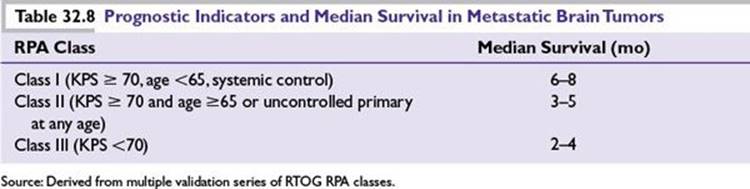
Median survival is 2.3 to 7.1 months depending on prognostic indicators (Table 32.8) that include
■Karnofsky performance status >70
■Age <65 years
■Controlled primary disease
■No extracranial metastasis
REVIEW QUESTIONS
1.A 37-year-old male presents to the emergency room with headaches that have been bothering him for about 3 weeks. They are worse when he is in bed. A CT scan of his head shows a mass-occupying lesion in the right-frontal lobe that appears heterogeneously enhancing. An MRI is performed that indicates a hypervascular appearance. He is seen by a neurosurgeon and undergoes a resection and pathology reveals a GBM. Which of the following features, if present, indicates a poor prognosis in this patient?
A.Age <50
B.MGMT promoter unmethylated
C.Had a gross total resection
D.KPS 90 prior to surgery
E.All of the above
2.A 47-year-old woman with metastatic breast cancer was diagnosed originally with stage IIIa disease 2.5 years ago. Her tumor did not express ER, PR, or Her2 by IHC. After initial surgery, chemotherapy, and radiation, she had no evidence of disease. However, about 2 years later, she developed cough that did not go away. A CT of the CAP revealed metastatic disease in the lungs and liver. She was started on single-agent chemotherapy and had a partial response. She presents today to your clinic for follow-up and reports new numbness and weakness in her right hand. That is her only symptom of neurologic dysfunction. An MRI of the brain reveals a single brain metastasis. What of the following would you like to do next?
A.Refer to radiation oncology for WBRT
B.Refer to hospice
C.Refer to neurosurgery for consideration of resection of solitary brain lesion
D.Refer to neurosurgery and radiation oncology for resection followed by WBRT
3.A 63-year-old man, in otherwise excellent health, trips over his grandchild’s toy and hits his head. He is taken to the ER as a precaution and a CT scan of his head demonstrates a uniformly enhancing lesion near the skull in the right occipital area. He reports no neurologic deficit, and a complete neurologic examination reveals no abnormality. An MRI demonstrates a uniformly enhancing lesion on T1 with no evidence of peri-tumor edema. A stereotactic biopsy of the lesion confirms the diagnosis of meningioma, low grade. What would you recommend next?
A.Radiotherapy to the lesion
B.WBRT
C.Surgical resection
D.Observation
E.Surgical resection followed by radiotherapy to the tumor cavity
Suggested Readings
1.Batchelor T, Carson K, O’Neill A, et al. Treatment of primary CNS lymphoma with methotrexate and deferred radiotherapy: a report of NABTT 96-07. J Clin Oncol. 2003;21:1044-1049.
2.Black PM. Meningiomas. Neurosurgery. 1993;31:643-657.
3.Cavaliere R, Wen PY, Schiff D. Novel therapies for malignant gliomas. Neurol Clin. 2007;25(4):1141-1171.
4.Central Brain Tumor Registry of the United States. Available at: http://www.cbtrus.org/
5.Davis FG, McCarthy BJ, Berger MS. Centralized databases available for describing primary brain tumor incidence, survival, and treatment: Central Brain Tumor Registry of the United States; Surveillance, Epidemiology, and End Results; and National Cancer Data Base. Neuro Oncol. 1999;1(3):205-211.
6.DeAngelis LM, Seiferheld W, Schold SC, Fischer B, Schultz CJ. Combination chemotherapy and radiotherapy for primary central nervous system lymphoma: Radiation Therapy Oncology Group Study 93–10. J Clin Oncol. 2002;20:4643-4648.
7.DeVita VT Jr., Hellman S, Rosenberg SA. Cancer: Principles and Practice of Oncology. 8th ed. Philadelphia, PA: Lippincott Williams & Wilkins; 2008.
8.Dolecek TA, Propp JM, Stroup NE, Kruchko C. CBTRUS statistical report: primary brain and central nervous system tumors diagnosed in the United States in 2005-2009. Neuro Oncol. 2012;14:v1-v49.
9.Duran I, Raizer JJ. Low-grade gliomas: management issues. Expert Rev Anticancer Ther. 2007;7(12 suppl):S15-S21.
10.Gaspar, Scott C, Murray K, Curran W. Validation of the RTOG recursive partitioning analysis (RPA) classification for brain metastases. Int J Radiat Oncol Biol Phys. 2000;47(4)1001-1006.
11.Hoffman HJ. Brainstem gliomas. Clin Neurosurg. 1997;44:549-558.
12.Jaeckle KA, Ballman KV, Rao RD, Jenkins RB, Buckner JC. Current strategies in treatment of oligodendroglioma: evolution of molecular signatures of response. J Clin Oncol. 2006;24(8):1246-1252.
13.Kim L, Glantz M. Chemotherapeutic options for primary brain tumors. Curr Treat Options Oncol. 2006;7(6):467-478.
14.Levin VA, Silver P, Hannigan J, et al. Superiority of post-radiotherapy adjuvant chemotherapy with CCNU, procarbazine, and vincristine (PCV) over BCNU for anaplastic astrocytoma: NCOG 6G61 final report. Int J Radiat Oncol Biol Phys. 1990;18:321-324.
15.Louis DN, Ohgaki H, Wiestler OD, et al. The 2007 WHO Classification of tumours of the central nervous system. Acta Neuropathol. 2007;114(2):97-109.
16.Maldjian JA, Patel RS. Cerebral neoplasms in adults. Semin Roentgenol. 1999;34(2):102-122.
17.Ohgaki H, Kleihues P. The definition of primary and secondary glioblastoma. Clin Cancer Res. 2013; 19(4): 764-772.
18.Packer RJ, Gajjar A, Vezina G, et al. Phase III study of craniospinal radiation therapy followed by adjuvant chemotherapy for newly diagnosed average-risk medulloblastoma. J Clin Oncol. 2006;24(25):4202-4208.
19.Perez CA, Brady LW, eds. Principles and Practice of Radiation Oncology. 4th ed. Philadelphia, PA: Lippincott–Raven; 2004.
20.Rasheed BK, Wiltshire RN, Bigner SH, Bigner DD. Molecular pathogenesis of malignant gliomas. Curr Opin Oncol. 1999;11(3):162-167.
21.Sanford RA, Gajjar A. Ependymomas. Clin Neurosurg. 1997;44:559-570.
22.Schild SE, Haddock MG, Scheithauer BW, et al. Nongerminomatous germ cell tumors of the brain. Int J Radiat Oncol Biol Phys. 1996;36(3):557-563.
23.Shaw EG, Daumas-Duport C, Scheithauer BW, et al. Radiation therapy in the management of low-grade supratentorial astrocytomas. J Neurosurg. 1989;70:853-861.
24.Soffietti R, Cornu P, Delattre JY, et al. EFNS Guidelines on diagnosis and treatment of brain metastases: report of an EFNS Task Force. Eur J Neurol. 2006;13(7):674-681.
25.Stupp R, Mason WP, van den Bent MJ, et al. Radiotherapy plus concomitant and adjuvant temozolomide for glioblastoma. N Engl J Med. 2005;352(10):987-996.
26.Tomlinson FH, Kurtin PJ, Suman VJ, et al. Primary intracerebral malignant lymphoma: a clinicopathologic study of 89 patients. J Neurosurg. 1995;82(4):558-566.
27.Vrendenburgh JJ, Desjardins A, Herndon JE, et al. Bevacizumab plus irinotecan in recurrent glioblastoma multiforme. J Clin Oncol. 2007;25(30):4722-4729.