
Philippe C. Bishop, Chris Bowden, Garret Hampton, and Lukas Amler
Personalized medicine has become a reality for many cancer patients. This is due in part to significant advances in our understanding of cancer, including fundamental mechanistic insights into the genesis and evolution of a malignancy and multiple large-scale studies that have described the spectrum of genetic abnormalities in common cancers (e.g., The Cancer Genome Atlas, or TCGA). Coupled with the routine use of tissue sampling in the clinic, the ability to efficiently analyze these tissues at a molecular level, and the increasing availability of targeted therapies, these advances have provided physicians with the tools to select the proper therapy (or therapies) at the right time in the course of disease management for patients with cancer (e.g., lung, breast, and colon cancers).
This chapter is intended to give a brief overview of personalized oncology care driven by diagnostics. We discuss novel approaches, selected technologies, and their application in the clinic, as well as mechanisms of resistance and their implications for the approach to personalized care. Lastly, we provide an outlook on the future in the field, including the universal adoption of multiplex diagnostics into routine clinical practice.
PATIENT JOURNEY
The clinical journey of an individual diagnosed with cancer is illustrated in Figure 43.1. At the ontset, a screening test, symptom, finding on physical exam, or abnormality on laboratory or imaging study will lead to the identification of a tumor. In most instances, a biopsy or surgical excision of the primary tumor or site of metastasis will establish a pathologic diagnosis.
Historically, clinical management decisions and prognostic estimates were primarily based on the results of histopathologic analyses of tumor tissue and various clinical factors (e.g., weight loss, performance status, age). Tumor behavior and response to treatment are, however, inadequately explained by tissue of origin, histology, and clinical factors alone. Patient outcomes can be significantly improved when the molecular profile (i.e., overexpressed proteins, activated signaling pathways, and genetic alterations) of the tumor and of the associated tissue microenvironment are integrated into treatment decisions. In combination with other diagnostic and demographic data, along with quality-of-life considerations, these profiles can be used to guide individualized therapeutic options to potentially improve the response to therapy and patient outcomes. Where curative or palliative options fail, the diagnostic cycle begins again with characterization of the tumor and its microenvironment, since treatment may have led to resistance and failure of the therapeutic strategy. This information may guide subsequent therapeutic interventions, potentially enabling the selection of targeted agent combinations to overcome acquired resistance and manage disease. Throughout these iterations, the information generated is not only key to guiding therapy, but may also further increase our understanding of the dynamic nature of cancer biology and inform future opportunities for research and drug development.

FIGURE 43.1 Patient journey.
MOLECULAR DIAGNOSTICS
The more comprehensive understanding of the genetic makeup of tumors achieved in the past decade has resulted in molecular diagnoses being offered to patients with metastatic breast, colon, lung, central nervous system malignancies, melanoma, and leukemia/lymphoma. Diagnostic techniques commonly employed include immunohistochemistry (IHC), which can detect aberrant expression, localization, and phosphorylation levels of proteins; in situ hybridization (ISH), which reports on the localization and expression of messenger RNA (mRNA); fluorescence ISH (FISH), which can determine chromosomal abnormalities and gene copy number alterations; and polymerase chain reaction (PCR)-based methods, which can detect somatic mutations deletions or Fusions in key oncogenes in addition to quantifying mRNA expression. Formalin-fixed and paraffin-embedded (FFPE) tissues from surgical or biopsied specimens are often used for testing in the clinic. Other clinical specimens, such as fresh frozen tissues derived from biopsies, are also used to some extent, typically in the context of early drug development, to assess drug activity and mechanism of action, as well as to understand mechanisms of resistance upon progression. Table 43.1 provides examples of the types of molecular analyses that are used to inform the selection of therapeutic agents for patients.
In most of these examples, a single diagnostic test is used to identify specific “driver mutations” (genetic aberrations causally implicated in oncogenesis or tumor survival) for which targeted therapies exist. Validated, diagnostic assays that are approved by regulatory authorities to specifically guide treating physicians regarding which therapeutic option to choose are called “companion diagnostics.” Examples are diagnostic tests that detect the aberrant expression of specific therapeutic targets (e.g., human epidermal growth factor receptor 2 [HER2] in breast cancer) or factors predicting resistance to targeted agents (e.g., the presence of v-Ki-ras2 Kirsten rat sarcoma viral oncogene homolog [KRAS] in colorectal tumors that confer resistance to epidermal growth factor receptor [EGFR]-targeting antibodies). Although these represent significant advances, obtaining information on a single genetic variable from tumor samples at a single point in time may not be informative, as it does not take into consideration additional tumor, microenvironment, or host factors that may also affect treatment outcomes. Finally, the inevitable emergence of resistance to targeted therapies for the majority of patients with metastatic disease supports the need for the assessment of multiple molecular features using a variety of platforms serially over the course of the patient treatment journey.

Several techniques now allow for the simultaneous analysis of multiple genes in tumor tissue. Single nucleotide polymorphisms (SNPs) affecting metabolic enzymes in the genomes of individual patients have identified subsets of patients at increased risk of drug toxicity, resulting in now-routine screening and possible dose adjustments for those treated with thiopurines or irinotecan. SNPs arising from somatic mutations in tumor cells can now be analyzed in a high-throughput fashion using oligonucleotide probes bound to a solid support. Array-comparative genomic hybridization, examines DNA copy number changes and provides information on gene amplifications and deletions found in tumors. DNA microarrays are widely used in predictive and prognostic examinations of cancer genomes. These employ microscopic arrays of oligonucleotides or cDNA attached to solid supports (“gene chips”) to which fluorescently labeled DNA transcribed from sample RNA is hybridized, providing the data used to generate “gene signatures.” Although not yet practical for patient-level purposes, global genomic characterization of tumors using, in part, whole-genome DNA sequencing has been used to elucidate core signaling pathways in pancreatic cancer and glioblastoma multiforme (GBM), in the former case identifying a set of 12 core pathways and processes genetically altered in most tumors and in the latter case revealing a link between O6-methylguanine DNA-methyltransferase (MGMT) promoter methylation and a hypermutator phenotype in treated GBMs. Real-time quantitative PCR (RT-PCR) assays, although limited to the examinations of several hundred “candidate” genes rather than an entire genome, are increasingly used for tumor classification, in addition to predictive and prognostic purposes. Finally, direct analysis of proteins (“proteomics”) eliminates the potential discordance between mRNA and protein expression levels. Although more technically challenging to address in a high-throughput fashion than genomic methods, profiling of a limited number of proteins of interest in serum or tissue is now possible using matrix-assisted laser desorption/ionization time-of-flight mass spectrometry (MALDI-TOF).
RESISTANCE
Recent insights into the nature of innate and acquired resistance in cancer provides further support for the implementation of a multiplex diagnostics approach. As a comparison, these resistance mechanisms are similar to those found in infectious diseases, where they also represent a major challenge to therapy.
As highlighted in Table 43.2, there are multiple ways in which cancers become resistant to targeted therapy. In chronic myelogenous leukemia (CML), for example, mutations in the target of the drug imatinib, the tyrosine kinase BCR-ABL, represent the most common way in which resistance to imatinib is acquired. Most of the current evidence suggests that these mutations are preexistent in the primary cancer in a small number of cells and subsequently selected following treatment. Current strategies for managing these patients make use of agents specifically developed to be effective against the mutated forms of the target protein. Other mechanisms of resistance include gene amplification (e.g., androgen receptors in hormone-refractory prostate cancer), drug inactivation due to host metabolic factors (e.g., cytochrome P450 2D6 [CYP2D6] metabolism of tamoxifen in breast cancer), and, importantly, “oncogene bypass,” in which the drug target remains unchanged and sensitive to inhibition, but alternative signaling pathways are used in tumor cells to bypass the primary driver mutation. This is made possible by the fact that the human kinome, or set of protein kinases, contains more than 500 members, and cancer cells typically express multiple receptor tyrosine kinases (RTKs), which converge on common downstream effectors. An example of the oncogene bypass mechanism, which may represent a broad category of resistance, was recently reported. The authors demonstrated that rather than a mutation in the binding pocket of a kinase itself, resistance (e.g., to BRAFinhibition) may be overcome through the expression of a RTK ligand (e.g., hepatocyte growth factor [HGF]) that activates other RTKs (e.g., MET) that have similar downstream effects. Selection pressure elicited by therapy is postulated to result in expansion of tumor cells overexpressing this receptor. Notably, for resistance emerging through this mechanism, the ligand need not derive directly from tumor cells but may instead be produced in the stroma. This may explain the apparent correlation between high HGF levels and resistance to vemurafenib, which targets BRAFV600E in patients with metastatic melanoma. The resulting hypothesis that dual inhibition of BRAF/MEK and either HGF, MET, or insulin-like growth factor-1 receptor/phosphatidylinositol-3-kinase (IGF-1R/PI3K) may circumvent innate and acquired resistance has been borne out in cellular assays but not yet in the clinic.
In addition, host factors may also play a role in resistance to targeted cancer therapies. For example, germline alterations in the pro-apoptotic protein BCL-2 like 11 (BIM) may serve as a biomarker to identify individuals less likely to benefit from tyrosine kinase inhibitor (TKI) therapy in CML and non–small cell lung cancer (NSCLC). As suggested by cellular assays, the addition of BH3 mimetic agents to TKI therapy might restore sensitivity in this subgroup; however, clinical validation of the safety and efficacy of such a combination regimen is needed. On the other hand, such a multitargeted approach, using highly active therapies, has proven successful in the treatment of infectious diseases, such as HIV, and could similarly forestall the emergence of resistance in oncology and prolong the survival of cancer patients. Clearly, with many mechanisms at play, multiplex diagnostic information will be a prerequisite for such approaches, whether measured on the same or different platforms.

CURRENT CHALLENGES AND FUTURE DIRECTIONS
Currently, molecular targeted therapies with clinically relevant companion diagnostic assays that enable proper patient selection are a reality for a significant fraction of patients with cancer. The increasing availability of commercial companion diagnostic and prognostic gene signature assays have contributed to their rapid adoption in community clinical practice. Thus, diagnostic platforms are increasingly guiding treatment decisions today.
While the overall progress toward personalized medicine is exciting and rapidly evolving, many challenges remain. The first is that tumor tissue will remain limiting; for example, assessment of two to three companion diagnostic tests in a lung cancer sample with current requirements of several tissue sections each would deplete available tissue. Second, as cancers become increasingly fragmented into actionable disease subsets, the requirement for multiplex diagnostics will increase.
Multiplex analyses and comprehensive profiling of tumors is becoming routine at many academic institutions, but they are not yet a standard part of practice. Advances in our understanding of various cancers and the identification of driver mutations for these cancers illustrate the need for multiplex analyses. For example, there are a number of known driver mutations in NSCLC (Fig. 43.2), and an analysis of FFPE tumor samples from patients with NSCLC by FISH, IHC, and Sanger sequencing found that 54% of patients had targetable driver mutations. However, only 22% of advanced NSCLC patients received targeted therapy, illustrating the need for comprehensive genomic characterization of tumors to aid in identifying patients that would benefit from targeted therapies, as well as potential targets for drug development.
In addition, performing such a comprehensive analysis to obtain information on all relevant molecular characteristics of the tumor based on a single biopsy at the time of diagnosis or recurrence would make personalized treatment selection for patients much more efficient than the current practice of ordering individual tests for each molecular aberration. In turn, patients and physicians could then select the appropriate targeted therapies, such as erlotinib and gefitinib for mutations in EGFR, a major target implicated in lung cancer with downstream effects on both the AKT/PI3K pathway and the MAPK pathway, regulating cell growth proliferation, and death. Furthermore, as the underlying molecular mechanisms for specific cancers are further elucidated, in part, through these analyses, additional therapies become available, such as crizotinib for patients with lung cancer shown to be constitutively activated by the echinoderm microtubule-associated protein like 4-anaplastic lymphoma kinase (EML4-ALK) fusion oncogene, which in turn drives activation of the RAS/RAF/MEK/MAPK pathway.

FIGURE 43.2 Potential driver mutations.
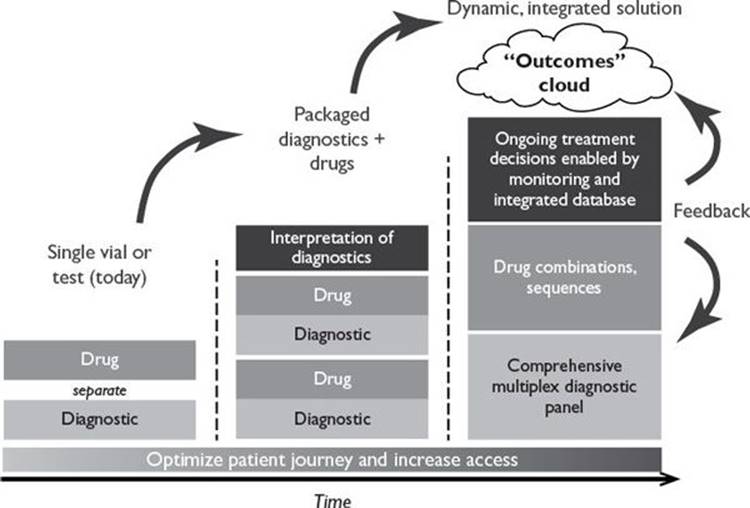
FIGURE 43.3 The future: combined diagnostics, drugs, and data into a disease solution. Diagnostic and treatment decision strategies are rapidly evolving from separate drugs and diagnostics to integrated diagnostics that are comprehensive, with clinical and continuous diagnostic information playing an important role in treatment decisions.
Moving forward, multiplex diagnostics will likely take the form of both nucleic acid platforms (e.g., next-generation sequencing of RNA and DNA), as well as IHC-based techniques. Another possibility is that, in some cases, less invasive methods might be employed, such as blood-based assessments that utilize circulating tumor cells, circulating protein, or tumor DNA, that may have utility in the prognosis, prediction, and, ultimately, even the monitoring of resistance to therapy.
Taken together, advances in the understanding of cancer biology on a molecular level, coupled with the increasing adoption of more comprehensive multiplex diagnostics and the availability of novel targeted agents, have the potential to transform the treatment of and extend the lives of patients with cancer (Fig. 43.3).
Suggested Readings
1.Albain KS, Barlow WE, Shak S, et al. Prognostic and predictive value of the 21-gene recurrence score assay in postmenopausal women with node-positive, oestrogen-receptor-positive breast cancer on chemotherapy: a retrospective analysis of a randomised trial. Lancet Oncol.2010;11(1):55-65.
2.Cancer Genome Atlas Research Network. Comprehensive genomic characterization defines human glioblastoma genes and core pathways. Nature. 2008;455(7216):1061-1068.
3.Cardarella S, Ortiz TM, Joshi VA, et al. The introduction of systematic genomic testing for patients with non-small-cell lung cancer. J Thorac Oncol. 2012;7(12):1767-1774.
4.Cheng EH, Sawyers CL. In cancer drug resistance, germline matters too. Nat Med. 2012;18(5):494-496.
5.Diaz LA Jr., Williams RT, Wu J, et al. The molecular evolution of acquired resistance to targeted EGFR blockade in colorectal cancers. Nature. 2012;486(7404):537-540.
6.Erichsen HC, Chanock SJ. SNPs in cancer research and treatment. Br J Cancer. 2004;90(4):747-751.
7.Erlander MG, Ma XJ, Kesty NC, Bao L, Salunga R, Schnabel CA. Performance and Clinical Evaluation of the 92-Gene Real-Time PCR Assay for Tumor Classification. J Mol Diagn. 2011;13:493-503.
8.Glickman MS, Sawyers CL. Converting cancer therapies into cures: lessons from infectious diseases. Cell. 2012; 148(6):1089-1098.
9.Harkin DP. Uncovering functionally relevant signaling pathways using microarray-based expression profiling. Oncologist. 2000;5(6):501-507.
10.Innocenti F, Undevia SD, Iyer L, et al. Genetic variants in the UDP-glucuronosyltransferase 1A1 gene predict the risk of severe neutropenia of irinotecan. J Clin Oncol. 2004;22(8):1382-1388.
11.Jones S, Zhang X, Parsons DW, et al. Core signaling pathways in human pancreatic cancers revealed by global genomic analyses. Science. 2008;321(5897):1801-1806.
12.Kwak EL, Bang, YJ, Camidge DR, et al. Anaplastic lymphoma kinase inhibition in non-small-cell lung cancer. N Engl J Med. 2010;363(18):1693-1703.
13.Mok T, Wu YL, Thongprasert S, et al. Gefitinib or carboplatin-paclitaxel in pulmonary adenocarcinoma. N Engl J Med. 2009;361(10):947-957.
14.Ng KP, Hillmer AM, Chuah CT, et al. A common BIM deletion polymorphism mediates intrinsic resistance and inferior responses to tyrosine kinase inhibitors in cancer. Nat Med. 2012;18(4):521-528.
15.Ocak S, Chaurand P, Massion PP. Mass spectrometry-based proteomic profiling of lung cancer. Proc Am Thorac Soc. 2009;6(2):159-170.
16.Oratz R, Kim B, Chao C, et al. Physician survey of the effect of the 21-gene recurrence score assay results on treatment recommendations for patients with lymph node-positive, estrogen receptor-positive breast cancer. J Oncol Pract. 2011;7(2):94-99.
17.Pfeifer H, Wassmann B, Pavlova A, et al. Kinase domain mutations of BCR-ABL frequently precede imatinib-based therapy and give rise to relapse in patients with de novo Philadelphia-positive acute lymphoblastic leukemia (Ph+ ALL). Blood. 2007;110(2):727-734.
18.Pinkel D, Albertson DG. Array comparative genomic hybridization and its applications in cancer. Nat Gen. 2005;37(suppl):S11-S17.
19.Schroth W, Goetz MP, Hamann U, et al. Association between CYP2D6 polymorphisms and outcomes among women with early stage breast cancer treated with tamoxifen. JAMA. 2009;302(13):1429-1436.
20.Sequist LV, Heist RS, Shaw AT, et al. Implementing multiplexed genotyping of non-small-cell lung cancers into routine clinical practice. Ann Oncol. 2011;22(12):2616-2624.
21.Shepherd FA, Pereira RJ, Ciuleanu T, et al. Erlotinib in previously treated non-small-cell lung cancer. N Engl J Med. 2005;353(2):123-132.
22.Straussman R, Morikawa T, Shee K, et al. Tumour micro-environment elicits innate resistance to RAF inhibitors through HGF secretion. Nature. 2012;487(7408):500-504.
23.Villanueva J, Vultur A, Lee JT, et al. Acquired resistance to BRAF inhibitors mediated by a RAF kinase switch in melanoma can be overcome by cotargeting MEK and IGF-1R/PI3K. Cancer Cell. 2010;18(6):683-695.
24.Visakorpi T, Hyytinen E, Koivisto P, et al. In vivo amplification of the androgen receptor gene and progression of human prostate cancer. Nat Genet. 1995;9(4):401-406.
25.Weinshilboum RM, Sladek SL. Mercaptopurine pharmacogenetics: monogenic inheritance of erythrocyte thiopurine methyltransferase activity. Am J Hum Genet. 1980;32(5):651-662.
26.Wilson TR, Fridlyand J, Yan Y, et al. Widespread potential for growth-factor-driven resistance to anticancer kinase inhibitors. Nature. 2012;487(7408):505-509.