
Midhun Malla and David P. Cosgrove
Primary liver cancers arise predominantly from the parenchymal liver cells or hepatocytes (90%) and are called hepatocellular carcinoma (HCC). The incidence of HCC continues to increase rapidly in the United States, with rates increasing fastest in men. Research on vaccinations for hepatitis B and their use have impacted the development of HCC in many regions of the world.
EPIDEMIOLOGY
■In the United States, the incidence of clinically significant metastatic carcinoma to the liver is approximately 20 times more common than primary liver cancer.
■Based on November 2011 SEER data submission, the HCC incidence for all races was 11.6 (9.9) per 100,000 men and 3.9 (3.5) per 100,000 women (http://seer.cancer.gov/statfacts/html/livibd.html).
•HCC incidence in the United States has increased during the past two decades, possibly due to a large pool of people with long-standing chronic hepatitis C, combined with a large influx of immigrants from East Asia and other geographic areas with high endemic rates of hepatitis B viral infection.
•The incidence of HCC in the United States is expected to continue to rise as a consequence of high hepatitis C infection rates between 1960 and 1990 and the average 20- to 30-year lag time between virus acquisition and the development of cirrhosis and carcinoma.
■There are approximately 20,000 patients diagnosed with HCC annually, accounting for less than 2% of all malignancies in the United States. HCC results in between 250,000 and 1 million deaths globally per annum.
■There is marked geographic variation in the incidence of HCC, with the highest incidences occurring in sub-Saharan Africa and Asia. Over 40% of all cases of HCC occur in the People’s Republic of China.
■Men are affected more than twice as often as women (mean 3.7:1). The mean age at diagnosis is between 50 and 60 years. Although not fully understood, the differences in sex distribution are thought to be due to variations in hepatitis carrier states, exposure to environmental toxins, and the trophic effect of androgens.
ETIOLOGY
■Cirrhosis is present in 80% of patients with HCC. Therefore, risk factors for cirrhosis are also risk factors for HCC.
■Hepatitis B virus (HBV) accounts for around 55% of HCC cases in the world. In HBV carriers without cirrhosis, the risk is 0.02% to 0.03% in Caucasians and 0.4% to 0.6% per year in Asians. In those with cirrhosis, the risk is 2.2% and 3.7%, respectively, in Caucasians and Asians. The risk of HCC is much greater in patients with high serum levels of HBV DNA compared with those who have low levels (<10,000 copies/mL).
■Hepatitis C virus (HCV) infection accounts for 30% to 50% of HCC in the United States. It has been estimated that HCV accounts for 27% of cirrhosis and 25% of HCC cases worldwide. In contrast to HBV infection, HCC in patients with hepatitis C occurs almost exclusively in those with cirrhosis.
■HCV-induced HCC correlates well with the degree of inflammation and necrosis and seems to be caused by inflammation rather than specific oncogene activation. In contrast, hepatitis B–related HCC does not correlate well with inflammation, and there appear to be specific oncogenes induced by the virus that result in an increased risk of HCC.
■Alcoholic cirrhosis accounts for 15% of HCC in the United States.
■Hemochromatosis (HH), hereditary tyrosinemia, and autoimmune chronic active hepatitis are other causes of cirrhosis and are associated with a significant risk for developing HCC. In all, 3% to 27% of patients with long-standing HH develop HCC.
■There is less convincing evidence for the risk of developing HCC from aflatoxin B1 (chemical product of Aspergillus), androgenic steroids, thorotrast (radiology contrast agent), oral contraceptives, and nonalcoholic fatty liver disease (NAFLD). Furthermore, they are probably not important independent etiologic factors but rather may contribute to HCC development in individuals with other risk factors.
■In patients with diabetes mellitus, HCC risk is increased by approximately 2.5 times. However, associations between diabetes and HCC should be interpreted with caution. In many cases, the onset of glucose intolerance results from the development of cirrhosis, so “diabetes” in this context may be a surrogate for cirrhosis, which increases the risk of HCC. In addition, many patients with diabetes also have NAFLD, which has also been associated with an increased risk of HCC. It is likely that NAFLD causes HCC via cirrhosis, although the exact pathogenesis has not yet been determined. One study found that HCC in NAFLD was associated with obesity, diabetes, hypertension, and male sex.
CLINICAL FEATURES
The most common symptoms or signs of HCC are as follows:
■Pain (91%)
■Weight loss (35%)
■Vomiting (8%)
■Hepatomegaly (89%)
■Abdominal swelling (43%)
■Jaundice (7% to 41%)
The physical findings in patients with HCC tend to reflect the underlying liver disease rather than be specific for the malignancy—ascites, jaundice, splenomegaly, or other manifestations of decompensated cirrhosis.
Patterns of metastatic spread—the majority of metastases in HCC remain confined to the liver. Extrahepatic spread is present in only 5% to 15% of cases at diagnosis and is typically seen in patients with advanced stage primary tumors (>5 cm, macrovascular invasion). The most common sites of extrahepatic disease include lung, bone, lymph nodes, and adrenal gland.
DIAGNOSIS
The diagnosis of HCC is often suspected in a patient with underlying liver disease (i.e., cirrhosis, chronic viral hepatitis), who develops a rising serum α-fetoprotein (AFP) level.
Recommendations for diagnosis of HCC have been issued in a guideline from the American Association for the Study of Liver Diseases (AASLD).
■Nodules found on ultrasound surveillance that are smaller than 1 cm should be followed with ultrasound at intervals of 3 to 6 months. If there has been no growth over a period of up to 2 years, one can revert to routine surveillance.
■Nodules larger than 1 cm in diameter should be evaluated with four-phase multidetector computed tomography (CT) scan or dynamic contrast-enhanced magnetic resonance imaging (MRI). If the appearances are typical of HCC (i.e., hypervascular in the arterial phase with washout in the portal venous or delayed phase), no further investigation is required. If the characteristics are not typical for HCC (and do not suggest hemangioma), one of the two strategies is acceptable: either a second study (CT or MRI, whichever was not performed) or a biopsy.
■Biopsies of small lesions should be evaluated by expert pathologists. Tissue that is not clearly HCC should be stained with all available markers, including CD34, CK7, glypican 3, HSP-70, and glutamine synthetase, to improve diagnostic accuracy.
■If the biopsy is negative for HCC, patients should be followed by ultrasound or CT scanning at 3- to 6-month intervals until the nodule disappears, enlarges, or displays diagnostic characteristics of HCC. If the lesion enlarges but remains atypical for HCC, a repeat biopsy is recommended.
Serum Markers
The most commonly used marker for HCC is the serum Alfa-fetoprotein(AFP).
It is generally accepted that serum levels greater than 400 μg/L (normal in most laboratories is between 10 and 20 μg/L) in a high-risk patient is diagnostic of HCC. However, HCC is often diagnosed at a lower AFP level in patients undergoing screening, as not all tumors secrete AFP, and serum concentrations are normal in up to 40% of small HCCs, especially where alcohol is the etiologic factor. AFP levels are normal in the majority of patients with fibrolamellar carcinoma, a variant of HCC.
Because of the limitations of serum AFP measurements, several other serologic markers (such as des-gamma-carboxy prothrombin and Lens culinaris agglutinin-reactive AFP) used alone or in combination with the serum AFP have been evaluated for diagnosis or for determining prognosis in patients with HCC.
Imaging Studies
The imaging tests most commonly used for the diagnosis of HCC are ultrasound, CT, MRI, and angiography. A classic appearance on one of these imaging modalities combined with an elevated serum AFP concentration in the appropriate clinical setting is usually sufficient for establishing the diagnosis of HCC.
The place of positron emission tomography (PET) scanning (fluorodeoxyglucose [FDG] PET) in the diagnostic and staging evaluation of HCC remains uncertain; however, PET has a greater sensitivity for detection of distant metastases than other imaging modalities, including CT scan, bone scan, and MRI. However, sensitivity is limited for lesions ≤1 cm and false-positive results are also problematic.
PATHOLOGY
■HCC is the most common type of primary liver cancer. It accounts for 80% to 90% of primary cancers of the liver. The next most common is cholangiocarcinoma (10% to 20%).
■Other much rarer causes include hepatoblastoma, hemangiosarcoma, and angiosarcoma. There are many histologic subtypes of HCC, including trabecular, pseudoglandular or acinar, compact, scirrhous, clear cell, and fibrolamellar.
■Fibrolamellar carcinoma is a histologic variant accounting for 1% of HCC. It occurs more commonly in women, is not associated with cirrhosis, and has a better prognosis than HCC.
STAGING
■The four most commonly used staging systems are the TNM system of the American Joint Committee on Cancer (AJCC), the Okuda system, the Barcelona Clinic Liver Cancer (BCLC) system, and the Cancer of the Liver Italian Program (CLIP) score. To best assess the prognosis of HCC patients, it is recommended that the staging system take into account tumor stage, liver function, and physical status. Currently, the BCLC system is the only staging system that accomplishes these aims (Fig. 7.1). The TNM staging system has been criticized because it does not evaluate the underlying liver disease, which is clearly a major prognostic factor in HCC patients, regardless of tumor stage. The T portion of the TNM system focuses on both tumor size and vascular invasion by the primary tumor, with delineation of stages I, II, and III based purely on these factors. This does reflect the natural history of HCC in which survival is often predicated on the degree of liver involvement rather than widespread extrahepatic disease, but the underlying liver function is just as critical in determining prognosis in many of these patients and is not incorporated into this anatomic system.
■The BCLC staging classification comprises four stages that are based upon the extent of the primary lesion, performance status, the presence of constitutional symptoms, vascular invasion and extrahepatic spread, and Okuda stage. It provides broad, algorithmic treatment recommendations based upon these four stages, a feature that has led to some criticism by expert groups, who feel that treatment planning should be more patient-centered. Although in at least two comparative studies the BCLC system outperformed other prognostic models in patients undergoing surgical therapy, several larger series show that other systems can outperform BCLC, and still other studies show that treatment outside of BCLC guidelines positively impacts outcomes in select patients.
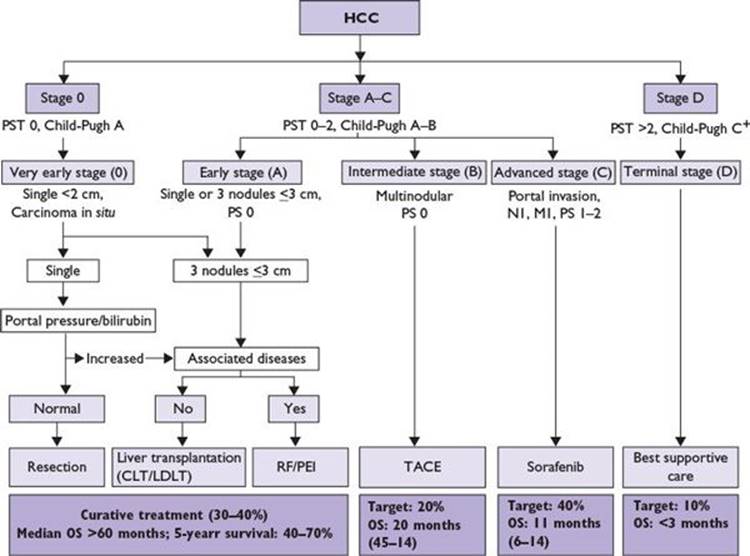
FIGURE 7.1 Barcelona Clinic Liver Cancer (BCLC) HCC staging classification. The classification includes an algorithmic treatment recommendation and outlines the approximate percentage of patients likely diagnosed within each stage in a Western population, as well as their estimated survival with the relevant treatment modalities. HCC, hepatocellular carcinoma; PST, ECOG performance status; CLT, cadaveric liver transplantation; LDLT, living donor liver transplantation; RF, radiofrequency ablation; PEI, percutaneous ethanol injection; TACE, transarterial chemoembolization; OS, overall survival. (Adapted from Bruix J, Sherman M. Management of hepatocellular carcinoma. Hepatology. 2005;42(5):1208-1236. With permission of John Wiley and Sons, Inc.)
The consensus of the American Hepato-Pancreato-Biliary Association (updated in 2010) reasserts the need to use different systems in different patients. Their consensus statement recommends the use of the TNM system to predict the outcome following resection or liver transplantation and the BCLC scheme for patients with advanced HCC who are not candidates for surgery.
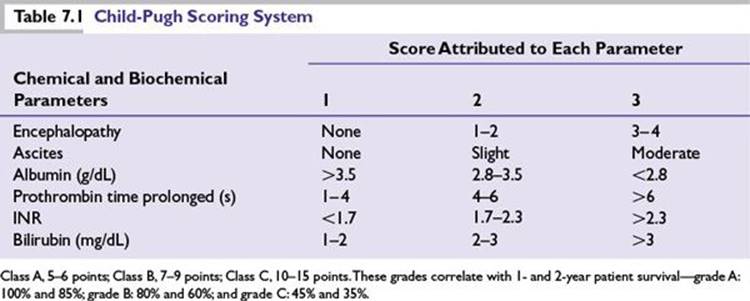
■The Child-Pugh grading system has been incorporated into the management of HCC because it evaluates the status of the underlying liver function and influences treatment (Table 7.1).
TREATMENT
Surgery
■Surgery remains the only possibility for cure in HCC, but it is applicable to only 5% of US population.
■The treatment of HCC is determined by two factors: tumor extent and the severity of the underlying hepatic parenchymal disease.
■Partial hepatectomy: Only 13% to 35% are surgical candidates. Small tumors have the best outcomes. Recurrence is most commonly seen in the remnant liver. Repeat hepatectomy is possible in 10% to 29% of patients. Operative mortality is <5%, but is higher in the presence of cirrhosis. Long-term relapse-free survival rates average 40% or better, and 5-year survival rates as high as 90% are reported in carefully selected patients.
•Postoperative morbidity and mortality are related to the extent of operative resection.
•Major postoperative complications include bile leak and pleural effusion.
■Total hepatectomy and liver transplantation: Transplantation is indicated in patients with severe cirrhosis or where extensive resection leaving minimal liver reserve is required.
■Orthotopic liver transplantation (OLT) is a suitable option for unresectable patients who have a solitary HCC ≤5 cm in diameter or up to three separate lesions none of which is larger than 3 cm, no evidence of gross vascular invasion, and no regional nodal or distant metastases (the Milan/Mazzaferro criteria). Based on these criteria, 4-year survival was reported as 75% to 85%.
■Survival outcomes may be further improved by living donor transplantation, although this remains controversial.
■Disadvantages of transplantation are the expense, the lack of specialty centers performing operations, and the lack of donor livers.
POSTTREATMENT SURVEILLANCE
Even patients who have a good response to treatment are at risk for disease recurrence and second primary HCC. Guidelines from the National Comprehensive Cancer Network (NCCN) suggest the following posttreatment surveillance after resection:
a)Imaging every 3 to 6 months for 2 years, and then annually.
b)Assay of serum AFP, if initially elevated, every 3 months for 2 years then every 6 months.
c)In addition, all patients with the underlying liver disease should be monitored and treated appropriately.
Ablative Techniques
■Local ablation is safe and effective therapy for patients who cannot undergo resection, or as a bridge to transplantation.
■Percutaneous ethanol injection (PEI) and radiofrequency ablation (RFA) are equally effective for tumors <2 cm. However, the necrotic effect of RFA is more predictable in all tumor sizes and its efficacy is clearly superior to that of ethanol injection in larger tumors. PEI is now less commonly used because it is uncomfortable and requires more treatment sessions than RFA, and in addition, it can be difficult to visualize the limits of the lesion on ultrasound because of the bubbles formed during the alcohol injection.
■The main drawbacks of RFA are its higher cost, limited efficacy in lesions adjacent to major blood vessels, and the higher rate (up to 10%) of adverse events (pleural effusion and peritoneal bleeding).
■The recurrence rate after ablation is as high as for resection. Some recurrences will occur in the vicinity of the treated nodule and are due to the presence of microscopic satellites not included in the ablation zone.
■Cryotherapy is also safe and more effective than RFA for larger tumors, but is less suited to a percutaneous approach.
■Hepatic artery chemoembolization (transarterial chemoembolization [TACE]) is based on the principle that >80% of the blood supply to tumors is from the hepatic artery, which supplies only 20% to 30% of normal liver parenchyma. Ligation or embolization of the hepatic artery can induce temporary tumor responses, and when combined with chemotherapy (TACE) may be more efficacious, although data are conflicting. The efficacy of TACE has been shown in a number of meta-analyses, revealing superior progression-free survival (PFS) when compared with best supportive care in locally advanced HCC.
■Indications of TACE:
a)Treatment of large unresectable HCCs not suitable for local ablation.
b)In patients awaiting OLT to reduce the rate of dropout because of local tumor progression.
Benefit in any of these settings is highly dependent upon case mix, including tumor-related factors and the severity of preexisting liver dysfunction.
■The best candidates for TACE are patients with unresectable lesions without vascular invasion or extrahepatic spread and preserved liver function (i.e., Child-Pugh A or B cirrhosis).
■Conventional TACE using doxorubicin (50 to 75 mg/m2) was directly compared with TACE with drug-eluting beads (DEBs) (150 mg doxorubicin per procedure) in a randomized trial of 212 patients with Child-Pugh A/B cirrhosis and unresectable HCC. The DEB group had higher rates of objective response at 6 months (52 versus 44 but the difference was not statistically significant), and significantly lower rates of serious hepatobiliary toxicity and doxorubicin-related side effects. DEBs may be preferred, although long-term outcomes using this technique are not available.
■Absolute contraindications to TACE include the complete absence of hepatopetal blood flow (portal vein thrombosis), encephalopathy, biliary obstruction, and Child-Pugh C cirrhosis.
Radiation
■HCC is a radiosensitive tumor, but it is located in an extremely radiosensitive organ. Normal liver can only tolerate about 20 Gy. The major drawbacks with radiotherapy (RT) are the poor radiation tolerance of normal liver and difficulty with tumor localization. However, safe and effective doses can be given to palliate pain.
■With the development of three-dimensional conformal radiation techniques, more precisely targeted RT (intensity-modulated RT and image-guided approaches, including stereotactic body radiotherapy [SBRT]) can be more safely delivered to the tumor-bearing parts of the liver with less liver toxicity. However, there are no studies demonstrating an impact on survival as yet.
■SBRT seems most applicable to patients with relatively small HCCs who are either inoperable or who refuse operation. It is unclear whether SBRT is a more effective or less toxic approach than RFA in these patients. Where available, proton beam irradiation may be a reasonable approach for patients with a large HCC and associated portal vein thrombus.
■Selective internal irradiation: For example, iodine-131 (131I)-labeled lipiodol or yttrium-90 (90Y)-tagged glass microspheres are delivered selectively to the tumor via the hepatic artery. Early reports suggest that this procedure is safe and induces objective responses in patients with unresectable HCC. However, there are no studies demonstrating an impact on survival and no consensus as to the optimal use of this therapy.
■There is obvious overlap with eligibility for TACE; it is not yet clear how to choose one technique over the other.
■One clinical scenario in which radioembolization may be preferred over TACE is in patients who are otherwise eligible for TACE but who have a branch/lobar portal vein thrombosis.
Chemotherapy
■Systemic therapy is appropriate for patients with advanced unresectable disease who are unsuitable for locoregional therapy. Hepatocellular cancer has been considered to be a relatively chemotherapy-refractory tumor. This may be in part due to the high rate of expression of drug resistance genes, including P-glycoprotein, glutathione-S-transferase, heat shock proteins, and mutations in p53.
■Single-agent chemotherapy has demonstrated response rates of approximately 15% to 30%, which increases to 20% to 35% with combination therapy. Cisplatin and anthracycline combinations have been studied most extensively, but there is no reference regimen for this disease. Despite objective responses that are occasionally complete, median survival in all of these studies has been short (4 to 11 months), with the exception of those in which resection/transplantation is attempted after chemotherapy.
■Interferon-α (IFN-α) and chemoimmunotherapy: Combinations of chemotherapy with IFN-α have failed to show consistent responses in three randomized controlled trials conducted so far.
■The PIAF regimen (intravenous cisplatin, recombinant IFN-α2b, doxorubicin, and 5-fluorouracil) demonstrated a 50% objective response rate in 50 patients with unresectable disease from Hong Kong, but failed to show superiority versus doxorubicin. Hence, the place of the PIAF regimen in the treatment of unresectable HCC remains uncertain.
Molecularly Targeted Therapy
■Sorafenib (a multikinase inhibitor with antiangiogenic, proapoptotic properties) was well tolerated and the first agent to demonstrate a statistically significant improvement in overall survival (OS) for patients with advanced HCC when compared with placebo/supportive care. The OS was significantly longer in the sorafenib-treated patients (10.7 versus 7.9 months; HR = 0.69; P = 0.0006), as was the time to progression (5.5 versus 2.8 months; HR = 0.58; P= 0.000007). This effect is clinically meaningful and established sorafenib as first-line treatment for patients with advanced HCC. Diarrhea and hand–foot skin reaction were the most significantly noted grade 3 or grade 4 side effects in this study.
■Sorafenib is also associated with potentially fatal liver toxicity, characterized predominantly by hepatocellular pattern of liver damage, with significant increases in liver transaminases.
■Sorafenib has also demonstrated encouraging results in combination with doxorubicin. There are ongoing clinical trials to assess this approach in terms of survival. Despite the approval of sorafenib in this disease, no other molecularly targeted agent has proven effective in subsequent studies. Agents that have been assessed in this setting include the following:
•Bevacizumab (Avastin, a monoclonal antibody [MoAb] directed against vascular endothelial growth factor) has only modest single-agent activity in HCC. Efficacy was shown in a phase 2 trial in patients with nonmetastatic HCC, but it is not considered a standard of care at this time. Bevacizumab has also been assessed in combination with a variety of chemotherapeutic agents, including gemcitabine and oxaliplatin (GEMOX), and capecitabine and oxaliplatin (CAPOX). There have been early signals of efficacy, but no phase 3 data are yet available, and use should be restricted to the context of ongoing clinical trials.
•Sunitinib is an orally active multikinase inhibitor that targets a variety of angiogenic proteins in addition to vascular endothelial growth factor receptor (VEGFR), including platelet-derived growth factor receptors, KIT, RET, and FLT3. Despite an efficacy signal in a phase 2 study, a randomized phase 3 study revealed decreased activity and increased toxicity in comparison with sorafenib in initial systemic treatment of advanced HCC.
•Brivanib is a potent and selective inhibitor of VEGFR and fibroblast growth factor. It revealed promising activity in second-line therapy for advanced HCC, but a pivotal phase 3 trial proved negative.
•Erlotinib (Tarceva), a small molecule inhibitor with specificity for EGFR, thought to be an important initiator of intracellular signaling in HCC, has shown limited activity in clinical trials so far.
•Cetuximab (Erbitux) is an MoAb that binds to EGFR, but has not evidenced any single-agent activity in HCC.
•Everolimus (Afinitor) is a mammalian target of rapamycin inhibitor, which showed promise as a single agent in a large phase 2 trial for second line therapy of advanced HCC, but the recent phase 3 registration study did not meet its endpoint of improved survival after sorafenib failure.
•Tivantinib is a selective inhibitor of the mesenchymal–epithelial transition receptor and has shown promising activity in a phase 1 study in HCC patients—late phase trials are currently accruing.
HEPATOCELLULAR CARCINOMA SCREENING
■Patients at high risk for developing HCC should be entered into surveillance programs incorporating liver ultrasonography every 6 months. The surveillance interval does not need to be shortened for patients at higher risk for HCC.
•Patients said to be at high risk are Asian male hepatitis B carriers over age 40, Asian female hepatitis B carriers over age 50, hepatitis B carriers with a family history of HCC, sub-Saharan Africans with hepatitis B, African-Americans with hepatitis B, cirrhotic hepatitis B carriers, patients with all-cause cirrhosis.
•Patients on a liver transplant waiting list should also be screened for HCC. Development of HCC beyond the Milan/Mazzaferro criteria will make these patients ineligible for liver transplant. If HCC is detected at an early stage in these patients, exception points may be awarded, resulting in an expedited liver transplant.
■IFN-α reduces the onset of liver damage and its progression to cirrhosis in 10% to 30% of patients with chronic hepatitis B.
■Statin use has been associated with a lower risk of HCC among patients with HBV. This was demonstrated in a population-based study from China that included 33,413 patients with HBV57.
REVIEW QUESTIONS
1.A 57-year-old man with a known history of hepatitis C and cirrhosis reports to the ER with progressive right upper quadrant pain, abdominal swelling, and fatigue. Ultrasound reveals a 4 cm lesion in segment 7 of the liver and ascites. Laboratory data reveal a normal bilirubin, low albumin (2.8 g/dL), low platelets (68,000/mm3), and normal creatinine (1.1 mg/dL). He is admitted for ascites management. Serum AFP is elevated at 420 ng/mL. Liver MRI is performed and reveals a hypervascular 3.9 cm solitary lesion in segment 7, with washout on the venous phase, and background cirrhosis. There is splenomegaly and radiographic evidence of portal hypertension, but no overt portal vein clot. What is the appropriate next step in management?
A.Core needle biopsy of segment 7 liver lesion
B.PET scan for further staging
C.Liver resection
D.Refer for liver transplant workup
2.A 48-year-old man with a long history of hepatitis B, but no overt cirrhosis is referred to a tertiary care hospital with a new diagnosis of HCC. He presented with multifocal, hypervascular liver masses, portal lymphadenopathy, and an adrenal lesion. Serum AFP was mildly elevated at 45 ng/mL, and a biopsy of one of the masses confirmed poorly differentiated HCC. His performance status is ECOG 1. What is the most appropriate initial therapy for this patient?
A.Refer to hospice
B.Initiate sorafenib therapy
C.Debulking surgery
D.Refer for TACE and possible liver transplant workup
3.A 52-year-old woman with a long history of diabetes mellitus, obesity, and hypercholesterolemia is diagnosed with multifocal HCC at an outside hospital. The HCC is biopsy confirmed, and her underlying liver revealed significant fatty infiltration on pathologic assessment. She is advised to undertake first-line therapy with sorafenib, but presents to your multidisciplinary clinic for a second opinion. Staging workup confirms five discrete nodules, involving both right and left lobes of the liver, with the largest measuring 6 cm in maximal diameter, and background steatohepatitis. There are no extrahepatic lesions on her imaging studies. Child-Pugh score is A on today’s assessment, and ECOG performance status is 0. What is the appropriate first-line treatment for this patient?
A.Sorafenib
B.TACE/TAE
C.Clinical trial of systemic chemotherapy
D.Liver resection
4.A 60-year-old man, with a history of hepatitis B, was recently diagnosed with a solitary 8 cm HCC in segment 7 of his liver. He had preserved liver function and minimal medical comorbidities, and so was advised to undergo liver resection after his staging workup revealed no evidence of extrahepatic disease. His surgery is successful, with final pathology revealing an 8.2 cm moderately differentiated HCC with segmental portal venous invasion. His margins are clear and three portal lymph nodes revealed no evidence on nodal disease. He comes to see you in the clinic to discuss adjuvant therapy. What would you recommend?
A.Adjuvant XRT to the tumor bed
B.Adjuvant sorafenib therapy for 1 year
C.No adjuvant therapy, surveillance only
D.Refer for liver transplant workup
Suggested Readings
1.Abou-Alfa GK, Johnson P, Knox JJ, et al. Doxorubicin plus sorafenib vs doxorubicin alone in patients with advanced hepatocellular carcinoma: a randomized trial. JAMA. 2010;304(19):2154-2160.
2.Bruix J, Sherman M. Management of hepatocellular carcinoma. Hepatology. 2005;42(5):1208-1236.
3.Camma C, Schepis F, Orlando A, et al. Transarterial chemoembolization for unresectable hepatocellular carcinoma: meta-analysis of randomized controlled trials. Radiology. 2002;224(1):47-54.
4.Chen CJ, Yang HI, Su J, et al. Risk of hepatocellular carcinoma across a biological gradient of serum hepatitis B virus DNA level. JAMA. 2006;295(1):65-73.
5.Davila JA, Morgan RO, Shaib Y, McGlynn KA, El-Serag HB. Hepatitis C infection and the increasing incidence of hepatocellular carcinoma: a population-based study. Gastroenterology. 2004;127(5):1372-1380.
6.El-Serag HB. Hepatocellular carcinoma: recent trends in the United States. Gastroenterology. 2004;127(5 Suppl 1):S27-S34.
7.Jemal A, Siegel R, Ward E, et al. Cancer statistics, 2008. CA Cancer J Clin. 2008;58(2):71-96.
8.Johnson PJ. Are there indications for chemotherapy in hepatocellular carcinoma? Surg Oncol Clin N Am. 2003;12(1):127-134.
9.Kennedy A, Coldwell D, Sangro B, Wasan H, Salem R. Radioembolization for the treatment of liver tumors general principles. Am J Clin Oncol. 2012;35(1):91-99.
10.Lammer J, Malagari K, Vogl T, et al. Prospective randomized study of doxorubicin-eluting-bead embolization in the treatment of hepatocellular carcinoma: results of the PRECISION V study. Cardiovasc Intervent Radiol. 2010;33(1):41-52.
11.Llado L, Virgili J, Figueras J, et al. A prognostic index of the survival of patients with unresectable hepatocellular carcinoma after transcatheter arterial chemoembolization. Cancer. 2000;88(1):50-57.
12.Llovet JM, Ricci S, Mazzaferro V, et al. Sorafenib in advanced hepatocellular carcinoma. N Engl J Med. 2008;359(4):378-390.
13.Mazzaferro V, Regalia E, Doci R, et al. Liver transplantation for the treatment of small hepatocellular carcinomas in patients with cirrhosis. N Engl J Med. 1996;334(11):693-699.
14.McIntosh A, Hagspiel KD, Al-Osaimi AM, et al. Accelerated treatment using intensity-modulated radiation therapy plus concurrent capecitabine for unresectable hepatocellular carcinoma. Cancer. 2009;115(21):5117-5125.
15.Nakamura S, Nouso K, Sakaguchi K, et al. Sensitivity and specificity of des-gamma-carboxy prothrombin for diagnosis of patients with hepatocellular carcinomas varies according to tumor size. Am J Gastroenterol. 2006;101(9):2038-2043.
16.Sugiyama M, Sakahara H, Torizuka T, et al. 18F-FDG PET in the detection of extrahepatic metastases from hepatocellular carcinoma. J Gastroenterol. 2004;39(10):961-968.
17.Toyoda H, Kumada T, Tada T, et al. Clinical utility of highly sensitive Lens culinaris agglutinin-reactive alpha-fetoprotein in hepatocellular carcinoma patients with alpha-fetoprotein <20 ng/mL. Cancer Sci. 2011;102(5):1025-1031.
18.Tsan YT, Lee CH, Wang JD, Chen PC. Statins and the risk of hepatocellular carcinoma in patients with hepatitis B virus infection. J Clin Oncol. 2012;20;30(6):623-630.
19.Uka K, Aikata H, Takaki S, et al. Clinical features and prognosis of patients with extrahepatic metastases from hepatocellular carcinoma. World J Gastroenterol. 2007;13(3):414-420.
20.Vauthey JN, Dixon E, Abdalla EK, et al. Pretreatment assessment of hepatocellular carcinoma: expert consensus statement. HPB (Oxford). 2010;12(5):289-299.
21.Yasui K, Hashimoto E, Komorizono Y, et al. Characteristics of patients with nonalcoholic steatohepatitis who develop hepatocellular carcinoma. Clin Gastroenterol Hepatol. 2011;9(5):428-433; quiz e450.
22.Yeo W, Mok TS, Zee B, et al. A randomized phase III study of doxorubicin versus cisplatin/interferon alpha-2b/doxorubicin/fluorouracil (PIAF) combination chemotherapy for unresectable hepatocellular carcinoma. J Natl Cancer Inst. 2005;97(20):1532-1538.