
The causes of most cancers remain unknown.
• A minority of cancers are known to be hereditary (inherited), for example, some breast cancers.
• Some people are born with a gene mutation inherited from their mother or father, increasing the risk, but they do not increase the risk for every kind of cancer; not everyone born with a gene change will develop cancer. This is referred to as hereditary cancer.
• When cancer occurs because of an inherited gene mutation risk increases: this is termed genetic susceptibility.
• Cancers not inherited are known as sporadic cancers.
• Most cancers do not have any obvious hereditary cause.
• People with an inherited gene change have a 50% chance of passing the mutation to each of their children.
Cancer is a common disease, so most families will have some members who have had cancer, but that does not mean the cancer in that family is hereditary. It is believed that most – perhaps 90% – of all cancers are sporadic. This means that even if cancer does not run in a family, a family member can still be at risk for some type of cancer in their lifetime.
Chemicals or environmental factors: carcinogens can cause normal cells to become abnormal and cancerous by damage or they initiate a mutation of a cell’s genetic material (the DNA and RNA).
• Smoking is known to increase an individual’s risk of lung cancer.
• Over-exposure to ultraviolet sunlight increases the risk of melanoma.
• Inhalation of asbestos dust can cause a cancer of the lining of the lungs (mesothelioma).
Some viruses are known to be carcinogens, for example, the human papilloma virus is associated with cancer of the cervix. Also linked with cancer incidence is radiation. Other factors may influence cancer incidence such as:
• diet
• exercise
• obesity
Oncogenes are genes present in the DNA of cells carrying out a number of normal functions, but they have the ability to turn a normal cell cancerous (they are a cancer causing gene).
 CANCER-CAUSING SUBSTANCES (CARCINOGENS)
Several agents can cause cancer in the environment: these are called carcinogens.
Smoking
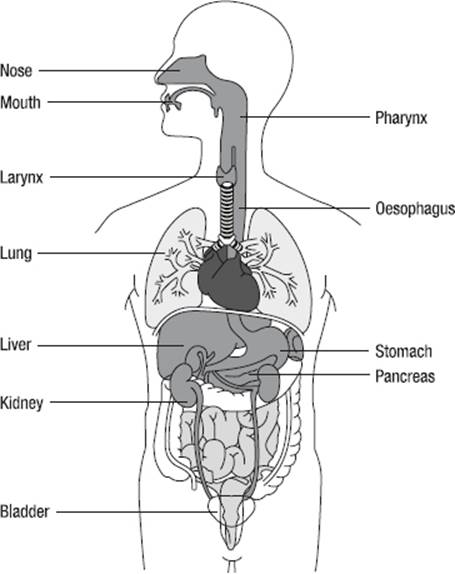
Smoking tobacco is closely associated with death caused by cancer; tobacco is a very powerful carcinogen. Worldwide, smoking is the single biggest cause of cancer. The most common cancer is lung cancer, but tobacco smoking can also be strongly associated with other types of cancer, for example:
Effects of smoking
Source: Cancer Research UK
Smoking increases the risk of developing acute myeloid leukaemia (blood cancer) and cervical cancer.
Alcohol
There is a clear link between excessive alcohol consumption and the development of cancer. Alcohol consumption increases the risk of cancers of the:
• oral cavity
• pharynx
• larynx
• oesophagus
• breast
• bowel
• liver
When a person smokes and drinks heavily this will increase the risk of cancers of the upper aerodigestive tract (the upper respiratory and upper digestive tracts).
Occupational exposure
It is often very difficult to assess the role of occupational exposures in the development of cancer as cancer is caused by complex relationships of many factors. Occupational cancer can occur as a result of working environments that involve direct exposure to a carcinogen or exposure to a carcinogen produced as part of a work process.
|
TYPE OF EXPOSURE |
INDUSTRY |
|
Arsenic |
Mining, vineyard workers, pesticide production |
|
Asbestos |
Shipbuilding, construction, mining, asbestos-producing companies |
|
Diesel |
Transportation workers/drivers, bus drivers, road maintenance, mechanics and garage workers, dockworkers |
|
Formaldehyde |
Pathologists, medical laboratory technicians, plastics, textile and plywood industry |
|
Certain metal compounds |
Iron and steel founding, house painting and paper hanging, smelting, welding |
|
Silica |
Mining, stone quarrying and granite production |
|
Ultra violet radiation |
Outdoor occupations |
|
Wood dust |
Furniture and cabinet making, construction, log and saw mill workers |
Diet
It is difficult to establish the association between cancer and diet. Diet influences the risk of many cancers. Consuming high levels of fat and in particular animal fats have been linked to cancers of the:
• colon
• breast
• oesophagus
• stomach
• prostate
Eating large amounts of beef, pork and lamb may increase a person’s chances of developing bowel or stomach cancer; consuming large amounts of processed meats can also increase risk. A healthy, balanced diet can boost defences against cancer.
Sun
Too much sun exposure causes cancer resulting in DNA damage and immunosuppression. Sun exposure is the main cause of skin cancer. Intense, intermittent sun exposures, such as the type experienced on holiday when sunbathing, present the greatest risk of malignant melanomas.
Hormones
The naturally occurring hormones can pose a risk to the person for developing a cancer when they are present in high levels; they encourage cells to grow and divide at a faster rate than usual.
Women with the highest levels of oestrogen and associated hormones have over twice the average risk of breast and uterine cancer, and higher risks of ovarian cancer. In men, it is still unclear if high levels of testosterone increase the risk of developing prostate cancer. Prostatic cancer cells are dependent upon testosterone. Excessive levels of insulin have been associated with cancers of the:
• colon
• uterus
• pancreas
• kidney