
Woet L. Gianotten1 and Yacov Reisman1
(1)
Physical Rehabilitation Sexology, Rehabilitation Centre De Trappenberg, Huizen, The Netherlands
Woet L. Gianotten (Corresponding author)
Email: woetgia@ziggo.nl
Yacov Reisman
Email: uro.amsterdam@gmail.com
Whereas the former part focused on the various treatment strategies, the focus of this part is on specific cancers.
From the wide range of different cancers, we have selected nine specific cancers (or cancer groups) that in our opinion deserve a separate chapter.
|
Chapter 15 Breast Cancer |
Chapter 20 Penis Cancer |
|
Chapter 16 Gynaecological Cancer |
Chapter 21 Colorectal Cancer (and Anal Cancer) |
|
Chapter 17 Prostate Cancer |
Chapter 22 Blood and Lymph Cancer |
|
Chapter 18 Bladder Cancer |
Chapter 23 Head and Neck Cancer |
|
Chapter 19 Testis Cancer |
One reason for this selection of “core cancers” was because those cancers or their treatment have direct consequences for the genital organs and as such for the sexual machinery. Another criterion was the knowledge that a cancer has much consequences for sexuality and intimacy.
It will be obvious that we have looked for authors from clinical centers with much specific expertise. We left it to the authors how to design their chapters but stressed to be as practical as possible with more attention for practical solutions than for definitions and without an overload of references.
In this introduction chapter we will offer two extras. We will start with some practical epidemiology. After that, attention will be paid to some sexual consequences of several of the cancers that did not get a separate chapter.
14.1 A Tiny Bit of Relevant Cancer Epidemiology
Cancer statistics can be very boring and can be very fascinating, even from a sexual health perspective. In this chapter, we will use data provided by the WHO for the European Community (“Europe 27”) for the year 2012 [1]. The non-melanoma skin cancers (NMSC) are not included in these figures.
In Table 14.1 the relative incidence in male cancers and in female cancers is shown for the European Community. In the table lung cancer and melanoma are added to the “core cancers” of this part.
Table 14.1
Relative cancer incidences in the European Community
|
Chapter |
Female |
Male |
|
15 Breast |
32.5 % |
0.2 % |
|
16 Gynaecology |
13.7 % |
|
|
17 Prostate |
23.6 % |
|
|
18 Bladder |
1.9 % |
6.5 % |
|
19 Testis |
1.6 % |
|
|
20 Penis |
0.3 % |
|
|
21 Colorectal |
11.0 % |
13.2 % |
|
22 Blood/Lymph |
6.9 % |
7.5 % |
|
23 Head & Neck |
2.0 % |
5.9 % |
|
Total |
68.0 % |
58.8 % |
|
Lung |
8.0 % |
14.8 % |
|
Melanoma |
4.0 % |
2.9 % |
|
other cancers |
20.0 % |
23.5 % |
We have to be aware that these figures are not universal. There is a lot of variety in the division of the relative percentages. That is not only outside Europe but also within Europe and within the European Union. Let’s compare some incidence figures (incidence is the amount of new cases/100.000 people) with striking differences.
Figure 14.1 compares prostate cancer and male lung cancer incidence in Romania and Sweden.
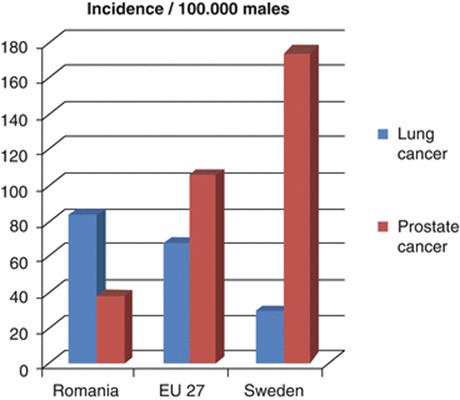
Fig. 14.1
Incidence of male lung- and prostate cancer in Romania, Sweden and the whole European Union
Figure 14.2 compares breast cancer and cervix cancer in Bulgaria and Finland.
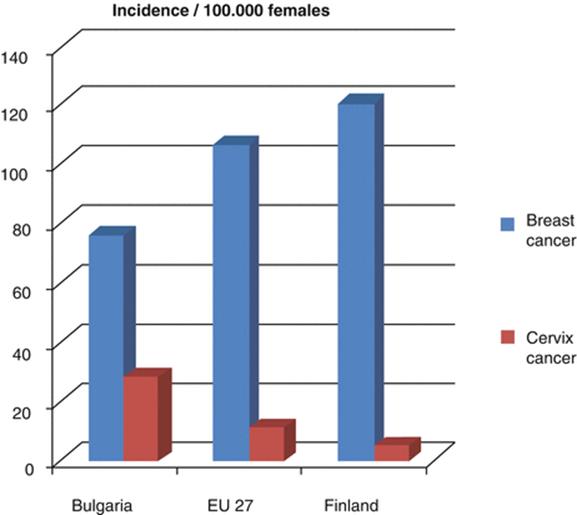
Fig. 14.2
The incidence of female breast- and cervix cancer in Bulgaria, Finland and the whole Europan Union
It will be clear that such incidence differences will have consequences for the various medical specialists. Even the total cancer incidence is not the same within the European Union. In Fig. 14.3, it can be seen that the cancer incidence in Denmark (478.3) is double the size of that in Greece (234.7). How possible?
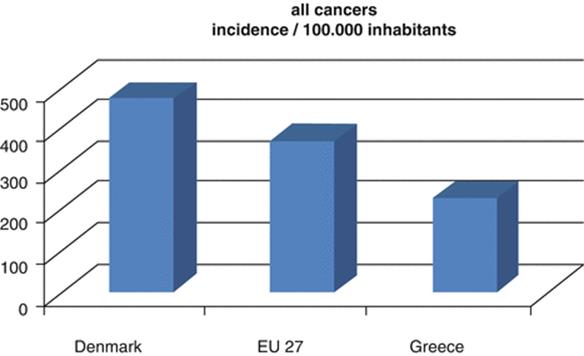
Fig. 14.3
Cancer incidence in Denmark, Greece and in the whole European Union
With cancer being especially a disease of the aged, it is tempting to explain that difference by assuming that Denmark has an older population. However, the life expectancy in Greece is higher than in Denmark!
14.2 Age
Age is a relevant topic when dealing with the sexual consequences of cancer. Not because sex is less relevant for the aged. Many aged people continue with sexual activities, but they usually succeed better to deal with “less perfect” sex. That idea of “perfect sex” is especially relevant for many young partners. Besides, at younger age the fertility damage of treatment can have much impact on sexual identity and quality of life.
Especially when one survives cancer at a young age, the long-standing sexual consequences become very relevant both for the professionals dealing with cancer and for the professionals dealing with sexual health.
Using the data of the Dutch national cancer registry, we looked at the incidence over the various age groups [2]. See Figs. 14.4, 14.5, 14.6, and 14.7. Whereas some cancers (e.g., cancer of vulva, endometrium, and bladder) clearly belong to the higher age groups, other cancers can emerge at a much younger age (e.g., cancer of the cervix, testis, and Hodgkin lymphoma).
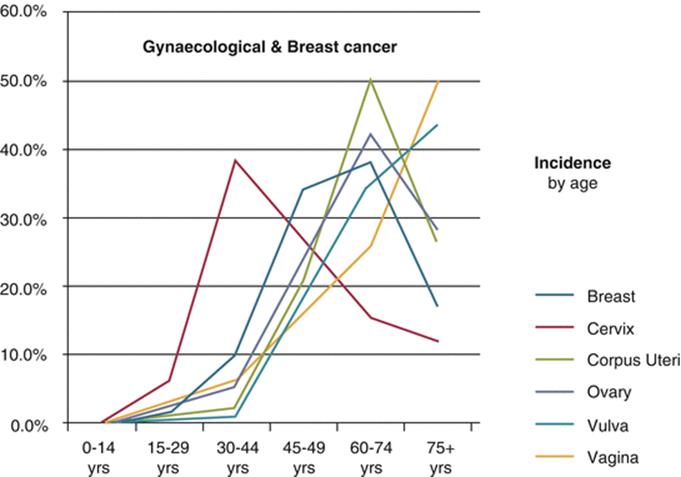
Fig. 14.4
Incidence of gynaecological cancer in the Netherlands

Fig. 14.5
Inceidence of male genital cancers in the Netherlands
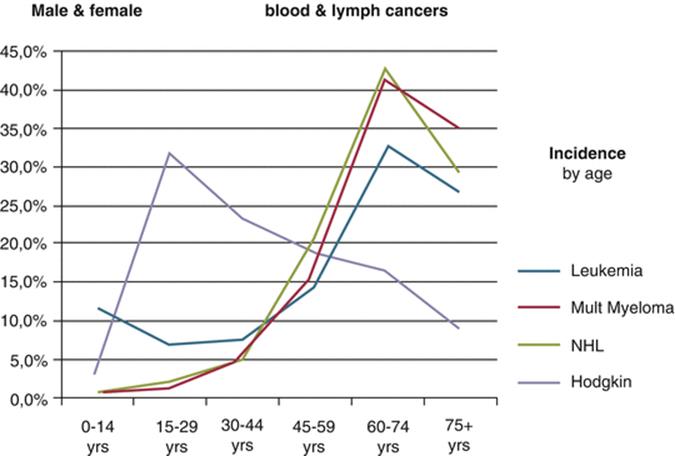
Fig. 14.6
Incidence of hematological cancers in males and females in the Netherlands
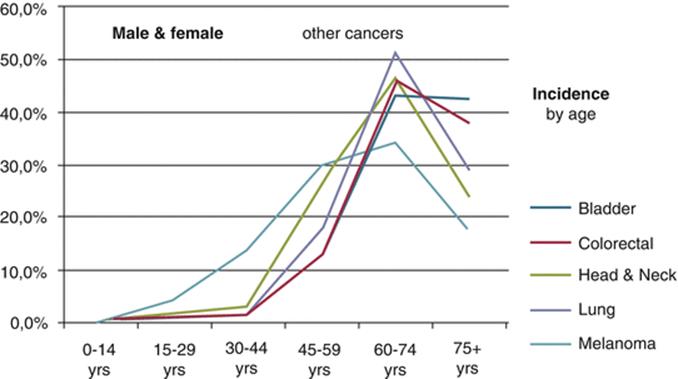
Fig. 14.7
Incidence of various cancers inmales and females in the Netherlands
14.3 Cancer Survival
Although for the majority of people the cancer diagnosis is accompanied by the fear of dying, a substantial amount of people will be completely cured. In another group of patients, the cancer process can be kept quiet for a long period of time. That is most clear in breast cancer and prostate cancer where, due to the development in various treatment strategies, we now tend to call them chronic diseases. An increasing part of these patients will live with cancer for more than two decades.
Conversely, there are the cancers where our treatment strategies clearly fail and where only a small part of the patients survive for a longer period of time. Table 14.2 is based on the Dutch figures and gives the percentages of patients that are still alive at 1, 2, and 5 years after the diagnosis [2].
Table 14.2
One, Two and Five years cancer specific survival percentages of various cancers in the Netherlands
|
Survival after |
1 year |
2 years |
5 years |
|
All cancers |
78 % |
70 % |
62 % |
|
Female breast |
97 % |
94 % |
87 % |
|
Ovaries |
74 % |
60 % |
38 % |
|
Endometrium |
93 % |
88 % |
80 % |
|
Cervix |
86 % |
77 % |
66 % |
|
Vulva |
88 % |
80 % |
71 % |
|
Prostate |
97 % |
94 % |
88 % |
|
Testis |
97 % |
95 % |
93 % |
|
Penis |
89 % |
81 % |
77 % |
|
Bladder |
76 % |
64 % |
53 % |
|
Colorectal |
83 % |
75 % |
64 % |
|
Lung |
43 % |
28 % |
17 % |
|
Melanoma |
97 % |
94 % |
89 % |
|
Hodgkin Lymphoma |
92 % |
89 % |
85 % |
|
NHL |
84 % |
78 % |
70 % |
|
AML |
39 % |
28 % |
20 % |
|
Multiple Myeloma |
82 % |
72 % |
49 % |
Although a short survival eliminates long-term sexual consequences, that doesn’t mean that sexuality and intimacy are not important. Many patients (and partners) will completely switch to the survival mode, but others need various means of sexual expression. Since the professional doesn’t know the needs of the patient or couple with cancer, addressing the topic of sexuality is good care, even in cancer with a low survival rate.
14.4 The Amount of Disturbance of Sexuality or Intimacy
This’ll be the most challenging part of this chapter.
For several reasons it is difficult to give reliable figures for the damage of sexuality and intimacy after cancer and after treatment.
Most data that are supplied by the literature are generated through research projects where a limited amount of questions is asked, usually on sexual function. Although that is important, it is at the same time a rather poor representation of the wide range of relevant areas where changes take place. Changed sexual identity, changed sexual relationship, changed erogenic zones, and changed erotic capacities form together with changed sexual function, a complex hodgepodge with a variety of outcomes. Some patients and some couples are able to deal well even with serious diminished sexual function. Others get completely lost although their physical changes (“dysfunctions”) seem only small. The amount of bother seems more important than the actual dysfunction. And the capacities of the patient or couple to adapt to changes and make the best of it are also very relevant.
After having said that, is it still necessary to give some figures?
Except in the “wait-and-see” approach, all prostate cancer treatment will damage sexuality and the same goes for penis cancer. This is also true for vulvar cancer and cervix cancer with ovarian cancer getting as well close to the 100%. For many other cancers, the amount of damage depends on the treatment strategies, the sexual experience of the couple, their sexual adaptation possibilities, etc.
What kind of take-home message does that create? When we meet the patient or the couple, it doesn’t matter very much if 20 or 80 % of that cancer or that treatment is accompanied by sexual side effects. From an oncosexological perspective, one has to address sexuality anyhow.
14.5 Sexual Consequences of Other Cancers
The fact that other cancers didn’t get a separate chapter doesn’t mean that they do not influence sexuality, intimacy, and relationship. Even when the outer appearance, the genital organs, and the hormonal balance are not damaged, sexuality and intimacy can be impaired, because of general fatigue, emotional shock, disturbed partner balance, etc. So we believe that it is useful to consider addressing (changes in) sexuality in every cancer patient. Here we’ll pay attention to some of the sexual changes experienced by patients or couples with several other cancers (together with an apology that they don’t get more attention).
14.5.1 Lung Cancer and Mesothelioma
Since the majority of lung cancer cases cannot be cured and since the period till death is rather short, the sexual consequences of lung cancer are hardly investigated. The dyspnea and fatigue will impair sexual excitement. Sometimes the partner can become very scared when the patient develops cyanosis during sexual contact (“he becomes so blue”). Then a sensible advice can be given on a less strenuous position or activities; on using a strong vibrator and sometimes even an extra amount of oxygen can be part of good care. When the lung damage is accompanied by tickling and gurgling cough with much mucus or a bad smell, this can seriously disturb intimacy. Coughing is also a sleep disruption for the spouse, and in many couples, the resulting separate bedrooms will negatively impact intimacy and sexual exchanges.
14.5.2 Brain Tumor
The consequences of a brain tumor (or extensive brain metastases) and its treatment can resemble the symptoms after a stroke/CVA. That can mean a loss of muscular function and loss of sensation in part of the body. Some patients will get epileptic seizures that can influence sexual function. When they have to take antiepileptic medication, this can impair sexual desire with also a decrease in androgen levels. In the majority of patients, sexual desire will be diminished, but a small amount of patients display an increase in sexual desire, which usually is a (brain damage-related) symptom of disturbed control over sexual impulses. This can be accompanied by other extensive personality changes. Those changes are probably the explanation behind the rather high divorce rate after a primary brain tumor.
14.5.3 Melanoma
Malignant melanoma is “the dangerous skin cancer.” When we disregard breast cancer and the typical male and female cancers, melanoma is the only cancer below age 65 with a higher incidence in females.
Whereas probably important for sexual identity, there is no research on the sexual consequences of melanoma treatment.
14.5.4 Breast Cancer in Males
Between 0.6 and 1 % of all breast cancers happen in men, usually not before the age of 60. For part of the men, the idea of living with a feminized illness is very distressing and stigmatizing.
More than 90 % of male breast cancer cases are hormone receptor positive. So hormone influencing therapy is, next to surgery, an important part of the treatment. Usually with tamoxifen, which can cause hot flashes, mood disturbance, weight gain, and diminished sexual function. Such “female identity” side effects can add to the disturbed male identity [3].
14.5.5 Sarcoma
When a malignant growth starts in the extremities, we call it sarcoma. Sarcomas can happen at all ages, and the primary treatment is surgery. When discovered too late, surgery can mean amputation of an arm or leg with extensive consequences for sexual identity. The impact on this “appearance identity” usually is bigger in heterosexual women and homosexual men. Besides, amputation can have impact on the smooth proceeding of sexual encounters.
References
1.
http://eco.iarc.fr/eucan/
2.
http://cijfersoverkanker.nl/?language=en
3.
Donovan D, Flynn F. What makes a man a man? The lived experience of male breast cancer. Cancer Nurs. 2007;30:464–70.CrossRefPubMed