
Yani Lu, Jessica Clague, and Leslie Bernstein
INTRODUCTION
Evidence showing that physical activity is associated with decreased cancer risk and that obesity is associated with increased cancer risk at certain sites is rapidly accumulating. It is not yet known whether these two factors are interrelated or independent. Physical activity may act to decrease cancer risk primarily by preventing weight gain and obesity. However, physical activity may also have independent effects on cancer risk. In this chapter, we present a summary of the current epidemiologic literature on the possible associations between physical activity and obesity and risk of cancer at several organ sites.
Physical activity is defined as any movement of the body that results in energy expenditure. In this chapter, we focus on recreational physical activity, also called leisure-time physical activity or exercise, and occupational physical activity, including household activity.1 Occupational physical activity typically occurs over a longer period of time and generally requires less energy expenditure per hour than bouts of strenuous or moderate recreational physical activity. The distinction between recreational and occupational activity is important because increasing mechanization and technologic advances have led to decreased occupational physical activity in developed areas of the world, perhaps contributing to a decrease in overall physical activity.
Obesity is defined as the condition of being extremely overweight. In epidemiologic studies, the usual, but not necessarily the best, measure of body mass in adults is Quetelet’s Index, or body mass index (BMI), which is measured as weight in kilograms (kg) divided by the square of height in meters (m2). In the year spanning 2009 to 2010, the prevalence of obesity, defined by having a BMI of 30 kg/m2 or greater, in the US population was 35.5% for adult men and 35.8% for adult women.2 Physical inactivity has likely contributed to the high prevalence of obesity in the United States; data from the 2003 to 2004 National Health and Nutritional Examination Survey, a cross-sectional study of a sample of the civilian, noninstitutionalized population of the United States, has indicated that less than 5% of US adults achieve 30 minutes per day of physical activity, and that men are more physically active than women.3
Epidemiologic evidence on the associations of physical activity and obesity with cancer come from observational studies, including cohort studies, which follow populations forward in time after collecting exposure information, and case-control studies, which optimally identify a population-based series of newly diagnosed cases and healthy control subjects, collecting information retrospectively on exposures. In both study designs, physical activity information is usually self-reported and measures vary substantially with respect to timing and level of detail. Studies have measured lifetime or long-term physical activity, activity at defined ages or time points in life, and/or current or recent activity. Ideally, a study would capture activity by type (recreational, occupational, or other, such as an activity related to transportation), duration (minutes per session), frequency (sessions per day), and intensity (low, moderate, or strenuous as defined by examples of activity types) across the lifetime. These studies have often measured height and weight by self-report at one time point, such as at the time of study entry. Some studies have collected other or more detailed anthropometric information, such as waist circumference, hip circumference, or weight at an additional time point like at age 18. Anthropometrics are directly measured by trained study personnel in only a few studies.
Epidemiologic evidence for a role of physical activity or obesity in relation to cancer risk exists for cancers of the breast, colon, endometrium, esophagus, kidney, and pancreatic cancer. Evidence is accumulating to link at least one of these “exposures” to the incidence of gallbladder cancer, non-Hodgkin lymphoma (NHL), and advanced prostate cancer. The evidence for an association between either physical activity or obesity and lung and ovarian cancer is inconclusive.
In addition to specific biologic mechanisms pertinent to physical activity or to obesity at each specific organ site, several global mechanisms have been implicated in both relationships across a number of these organ sites. The steroid hormone and insulin/insulinlike growth factor (IGF) pathways are two such global mechanisms hypothesized to be involved in the links between physical activity or obesity and cancer.4 The role of steroid hormones as a mediator in these relationships is perhaps best understood in the context of breast cancer and endometrial cancer, and will be discussed in those sections. The roles of the insulin and IGF pathways have been discussed in depth with respect to colon cancer and, thus, will be presented in that context. Other global mechanisms have been proposed that have more generalized anticancer impacts and may explain associations between physical activity and several cancer sites; these include heightening immune surveillance, reducing inflammation, increasing insulin sensitivity, controlling growth factor production and activation, decreasing obesity and central adiposity, optimizing DNA repair capacity, and reducing oxidative stress.5,6 Further, obesity has been shown to produce a proinflammatory state and, thus, inflammation may mediate the relationship between obesity and cancer risk.7 It is highly plausible that several of these mechanisms act simultaneously and that they interact synergistically to mediate the associations between physical activity, obesity, and cancer.
BREAST CANCER
Low level of physical activity is an established breast cancer risk factor among postmenopausal women and, to a lesser extent, premenopausal women.4,8,9 The evidence for an association between physical activity and breast cancer has been classified as convincing, with a 20% to 40% reduced risk among physically active women.10 Obesity appears to have a paradoxical relationship with breast cancer risk in that it is an established breast cancer risk factor among postmenopausal women, but may offer some protection for breast cancer among premenopausal women.4
The epidemiologic literature has shown with relative consistency that breast cancer risk is reduced by increasing one’s amount of physical activity.4,8,9,11–13 One of the earliest studies, a case-control study of women age 40 years or younger, showed a dramatic reduction in risk of approximately 50% among women who averaged about 4 hours of activity per week during their reproductive years.14 Similarly, among postmenopausal women, those with higher levels of recreational physical activity during their lifetimes have been shown to have lower breast cancer risk.15 A meta-analysis of 29 case-control studies and 19 cohort studies published between 1994 and 2006 provided strong evidence for an inverse association between physical activity and risk of breast cancer, citing that the evidence for an association between physical activity and premenopausal breast cancer was not as strong as that for postmenopausal breast cancer.8 The conclusion of the meta-analysis was that each additional hour of physical activity per week decreases breast cancer by approximately 6%.
Epidemiologists require that a risk factor demonstrate consistency across populations before considering it as accepted. Recently, studies have been published on the association between physical activity and breast cancer risk among Japanese,16 Chinese,17 Mexican,18 Tunisian,19 and African American women.20 All studies showed a decreased risk of breast cancer with increasing physical activity. Interestingly, both Suzuki et al.17 and Pronk et al.21 observed the strongest associations among “heavier” women (BMI ≥25 kg/m2 and 23.73 kg/m2, respectively). In the California Teachers Study (CTS), a prospective cohort study of over 133,000 female public school professionals, a variable combining strenuous and moderate long-term recreational physical activity was associated with a reduced risk of estrogen receptor (ER)-negative but not ER-positive invasive breast cancer.11 On the contrary, the Women’s Health Initiative (WHI) observed decreases in breast cancer risk associated with recreational physical activity among postmenopausal women with ER-positive breast cancer and triple negative breast cancer, with only results for ER-positive breast cancer demonstrating a 15% statistically significant reduced risk (when comparing the highest versus lowest tertile of moderate-intensity physical activity).22 Similar but not statistically significant results were observed for strenuous recreational physical activity.22 A major limitation to this and previous studies stratifying by hormone receptor status is the inability to comprehensively classify triple negative breast cancer due to missing HER2 status (unknown in 40% of cases in the WHI study). The use of hormone therapy did not alter the inverse association between recreational physical activity and invasive breast cancer in the Women’s Contraceptive and Reproductive Experiences (CARE) Study.23 Most recently, in the American Cancer Society Cancer Prevention Study II Nutrition Cohort, it was observed that postmenopausal women who engage in at least 7 hours of walking over the course of a week had a modest decreased risk of breast cancer, even in the absence of more vigorous exercise.24 Further, this association did not differ by ER status, BMI, adult weight gain, postmenopausal hormone therapy use, or time spent sitting.24
Lastly, whether physical activity reduces breast cancer risk by impacting preinvasive disease has been studied by assessing the associations with in situ breast cancer and benign breast disease. In the CTS cohort, increasing levels of long-term strenuous recreational physical activity were associated with a decreasing risk of in situ breast cancer.11 Furthermore, a report from the Nurses’ Health Study II cohort showed that lifetime recreational physical activity was associated with a decreased risk of benign breast disease and columnar cell lesions, which may be precursors to breast cancer.25
In summary, epidemiologic studies investigating the association between physical activity and breast cancer risk have produced relatively consistent results showing a reduction in breast cancer risk with increasing level of physical activity. Results to date suggest that moderate-to-strenuous activity may be required for the effect between physical activity and breast cancer risk to be clear; however, clarification of other key details, such as the importance of timing and intensity of activity or variation in effects by tumor characteristics, is pending.
Adult obesity and adult weight gain have both been associated with increased breast cancer risk among postmenopausal women, especially among women who were not current users of menopausal hormone therapy.4,26,27 Most studies among postmenopausal women show a 1.5- to 2-fold increase in risk of invasive breast cancer when comparing the most obese women or those with the largest weight gain to normal-weight women (BMI: 18.5 to 24.9 kg/m2) or those with the least weight gain.4 Paradoxically, overweight or obese premenopausal women have a slightly decreased risk of breast cancer compared with normal-weight or thinner women. Whether larger waist circumference is more important than BMI has been studied in order to separate overall weight gain from abdominal obesity (i.e., visceral fat, which is one element of metabolic syndrome); however, most studies have reported a null association between waist circumference, used as a surrogate for visceral fat, and risk of postmenopausal breast cancer after adjustment for BMI.26 In contrast to the results for postmenopausal women, waist circumference and a positive association with premenopausal breast cancer was found after adjustment for BMI.26 A recent analysis of the Nurses’ Health Study suggests that self-rated body fatness during youth and BMI at age 18 years are both inversely associated with breast cancer risk, with similar results for premenopausal and postmenopausal breast cancer.28
Hormones are central to the discussion of biologic mechanisms linking both physical activity and obesity with breast cancer risk. Physical activity can alter menstrual cycle patterns in premenopausal women, and hormone profiles in both premenopausal and postmenopausal women. Physical activity may lower body fat among children,29 which in turn may delay age at menarche.30 Later age at menarche has been associated with reduced breast cancer risk.31Physical activity may reduce the frequency of ovulatory cycles.32 Having less frequent and therefore fewer cumulative ovulatory cycles is likely to reduce the lifetime exposure of the breast to endogenous ovarian hormones,31 which are proven proliferative agents.33 Physical activity also can have a direct impact on circulating estrogen levels among postmenopausal women.34
In the postmenopausal period, adipose tissue is the primary source of endogenous hormones via aromatization of androstenedione to estrone.35 Thus, heavier postmenopausal women have higher levels of circulating estrogen than women with less adipose tissue. The involvement of estrogen in the relationship between obesity and breast cancer risk is supported by the observation that obesity does not independently increase breast cancer risk among menopausal hormone therapy users27; the obesity-related increase in estrogen over that provided by exogenous estrogens is negligible. The breast tissue of overweight or obese perimenopausal and postmenopausal women with relatively high risk of breast cancer has been shown to have cytologic abnormalities and higher epithelial cell counts than that of normal-weight women.36 In contrast, obese premenopausal women experience menstrual cycle disturbances, including anovulatory cycles and secondary amenorrhea, thereby lowering their cumulative exposure to estradiol and progesterone.31 A possible explanation for the inverse association between youth body fatness and breast cancer risk is that youth body size is inversely associated with adult IGF-1 levels.28
Other likely mechanisms that may link physical activity37,38 and obesity39,40 with breast cancer risk include aspects of immune function, inflammatory mechanisms, oxidative stress and DNA repair capability, metabolic hormones, and growth factors.
COLON AND RECTAL CANCER
An inverse association between physical activity and colon cancer risk has been consistently observed among epidemiologic studies; however, the evidence for rectal cancer remains inconclusive. Historically, comprehensive reviews have estimated that physical activity may reduce colon cancer risk by 20% to 25% when comparing individuals with the highest levels to those with the lowest levels of activity.41 Risk reductions are greater for case-control studies (24%) than for cohort studies (17%), and risk reductions for occupational activity (22%) and recreational activity (23%) are similar.41 In cohort studies, colon cancer risk reduction associated with physical activity is greater for men than for women, which may be due to the influence of hormone therapy on colon cancer risk,42 although case-control studies suggest similar benefits for men and women.43
Whether physical activity preferentially protects against proximal or distal colon cancer is of interest. A meta-analysis including 21 cohort and case-control studies that examined associations between physical activity and the risks of proximal colon and distal colon cancers produced results suggesting that physical activity is associated with a reduced risk of both proximal colon and distal colon cancers, and that the magnitude of the association does not differ by subsite.44
Although the majority of previous studies have not found an association between physical activity and rectal cancer,41 the National Institutes of Health (NIH)–AARP Diet and Health Study observed a modest reduction in rectal cancer risk for men but not for women after 6.9 years of follow-up.45 Further, in a case-control study conducted in Australia, rectal cancer risk was reduced among men but not among women who participated in vigorous recreational physical activity averaging at least 6 metabolic equivalent task (MET)-hours per week during their adult years.46
An emphasis has been made on trying to identify risk factors for colon adenomas, which are considered precursor lesions for colon cancer; these are detected and removed during colonoscopy or sigmoidoscopy. Wolin et al. conducted a meta-analysis of 20 studies published through April 2010 that investigated the association between recreational physical activity and colon adenomas.47 Adenoma risk was reduced by 19% among men and by 13% among women and, when combining men and women, the inverse association with physical activity was strongest for large/advanced polyps.
Obesity is an established risk factor for colon cancer in both men and women, although the relative risks for men have been higher than those for women.4,26 The adverse impact of being overweight or obese on colon cancer risk is stronger for distal than for proximal colon cancers. In addition, visceral adiposity appears to confer greater risk than general adiposity.26 In the European Prospective Investigation into Cancer and Nutrition (EPIC) study, abdominal obesity as well as adult weight gain were strongly associated with colon cancer risk in both men and women.48,49 No association between these adiposity measures and colon cancer risk was evident among postmenopausal women who had used menopausal hormone therapy, and no association was observed between any measure of adiposity and rectal cancer risk.48 The positive association between obesity and risk of colon cancer was further supported by the findings that both general obesity and abdominal obesity increase the risk of colon adenomas47 with one study of women indicating that the distal colon is the main target site.50
Given that a higher BMI and lack of physical activity are both risk factors for colon cancer, several statistical approaches have been employed to tease apart their joint and independent effects on colon cancer risk. In the Netherlands Cohort Study,51 colorectal cancer risk was increased at each subsite among larger women in the lowest recreational activity category (<30 minutes per day) than in smaller women in the highest recreational activity category (>90 minutes per day); however, the interaction between physical activity and body size was statistically significant only for proximal tumors. Using different fatness measures for men, the only similar finding was that men with low levels of physical activity whose trouser size was below the median of that for the cohort had an increased risk of distal colon cancer; no differences in risk were noted for other subsites or for men with larger trouser sizes.51
The mechanisms explaining the relationship between physical activity and colon cancer are not clearly established, but include the impact on insulin sensitivity and IGF profiles, and inflammation, as well as some colon-specific mechanisms. Physical activity may stimulate stool transit in the colon, thereby decreasing the exposure of colonic mucosa to carcinogens in the stool.6 Alternatively, physical activity–induced decreases in prostaglandin E2 may decrease colonic cell proliferation rates and increase colonic motility.6 In addition to steroid hormones, which have been clearly implicated as biologic modifiers of the effect of physical activity and obesity on colon cancer risk, the insulin and IGF pathways may mediate the associations between these exposures and colon cancer risk. For obesity in particular, the link can be inferred because obesity can lead to insulin resistance,52 a syndrome characterized by high circulating insulin levels. High insulin levels appear to promote cell proliferation and tumor growth in the colon7and may also suppress the expression of IGF-binding proteins 1 and 2, leading to increased bioavailable IGF-1 levels.53 Another possible mechanism is obesity-enhanced inflammation in which increases in adipose tissue macrophages lead to the secretion of inflammatory cytokines associated with colon cancer risk (e.g., tumor necrosis factor [TNF]-α, monocyte chemoattractant protein [MCP]-1, and interleukin [IL]-6).
ENDOMETRIAL CANCER
The evidence for an association between physical activity and endometrial cancer risk is accumulating4,54–58 but is not definitive. A meta-analysis of prospective cohort studies results published through 2009 indicates that recreational physical activity lowers endometrial cancer risk by 27%, and occupational activity lowers risk by 21%.59 Adjustments for BMI minimally change relative risk estimates, suggesting that physical activity is independently associated with endometrial cancer. Although physical activity is associated with a decreased risk of endometrial cancer in both normal-weight and obese women, two recent studies have suggested that this association is more pronounced for obese women.54,58
Two meta-analyses of the association between physical activity and endometrial cancer have identified some inconsistencies in dose-response relationships, indicating the importance of differences in activity type and intensity.55,56Little evidence exists on how long-term or lifetime physical activity and activity patterns during different life periods might influence endometrial cancer risk; it has been suggested that recent or long-term activity might be more important than activity at early ages.56 In the CTS, higher levels of recent (at cohort formation) strenuous recreational physical activity was associated with lower levels of endometrial cancer risk; among women exercising >3 hours per week per year, risk was approximately 25% lower than that of women exercising <0.5 hour per week per year.60 This inverse association was limited to overweight and obese women (BMI ≥25 kg/m2). Finally, sitting time has been independently associated with increased endometrial cancer risk.59
Epidemiologic studies have established a strong association between obesity and endometrial cancer risk.26 Recent studies have suggested a linear trend between increasing body weight or BMI and increasing endometrial cancer risk among postmenopausal women, whereas among premenopausal women, no trend is observed, but rather, only obese women have an increased risk.26 Furthermore, the strong association among postmenopausal women is only observed among those who are not using hormone therapy.26 Finally, BMI appears to exert an effect on the risk of endometrial cancer that is independent of physical activity.55
Physical activity and obesity are likely to influence endometrial cancer risk by altering endogenous hormone profiles.31,53 Heavier postmenopausal women have higher circulating levels of estrogen than do lighter postmenopausal women because of the aromatization of androstenedione to estrone in adipose tissue. This is pertinent to endometrial cancer risk because this aromatization occurs in the absence of progesterone, which opposes the proliferative effects of estrogen on endometrial tissue. Physical activity may counter the proliferative effects of estrogen either directly or by restricting weight gain. Some evidence also links elevated insulin levels and diabetes to endometrial cancer risk.61 Physical inactivity and obesity play a role in the development of insulin insensitivity and diabetes, providing another mechanism by which they may influence endometrial cancer risk.
ADENOCARCINOMA OF THE ESOPHAGUS
Several case-control studies62–64 and one cohort study65 have examined the association between physical activity and risk of adenocarcinoma of the esophagus. Zhang et al.62 reported a modest association between participation in recreational physical activity more than once per week and a decreased risk of all esophageal cancer (adenocarcinomas and squamous cell tumors), although the result was not statistically significant. Lagergren et al.63 reported no association between total, usual recreational and occupational physical activity and esophageal adenocarcinoma. Vigen et al.64 showed that lifetime occupational physical activity was modestly associated with a lower risk of adenocarcinoma of the esophagus: the average annual level of occupational physical activity before age 65 years was associated with an approximately 40% reduction in risk of esophageal adenocarcinoma when the highest was compared with the lowest occupational physical activity category. Results from the NIH–AARP Diet and Health Study also support the hypothesis that physical activity lowers the risk of esophageal adenocarcinoma, but no association between physical activity and the risk of squamous cell esophageal cancer was found.65
Obesity is strongly associated with an increased risk of esophageal adenocarcinoma.66,67 A pooled analysis of existing data showed that individuals with severe obesity (BMI ≥40 kg/m2) had a 4.8-fold greater risk than individuals who were not overweight (BMI <25 kg/m2), with similar risk estimates for men and women.68 Several studies have examined the effect of abdominal adiposity, which have suggested that the risk associated with obesity is driven primarily by abdominal fatness.26
It is likely that obesity impacts esophageal adenocarcinoma risk because it is associated with the risk of gastroesophageal reflux disease (GERD). GERD may cause changes in the esophageal epithelium, leading to Barrett esophagus, a well-established precancerous condition for esophageal adenocarcinoma. On the other hand, obesity is associated with a systemic inflammatory state, which includes the exposure to adipocytokines and procoagulant factors released by adipocytes in central fat, which may also contribute to the development of esophageal adenocarcinoma.67 Physical activity may influence the risk of esophageal adenocarcinoma by increasing digestive track transit time, thus reducing exposure of the esophagus to putative cancer-causing agents.
KIDNEY/RENAL CELL CANCER
Physical activity has been studied in relation to renal cell carcinoma in part because of the known deleterious effects of high BMI and hypertension on the risk of renal cell cancer; however, no association has been firmly established. A review of physical activity and risk of genitourinary cancers noted significant protective effects in 8 of 15 studies of physical activity in relation to renal cell carcinoma, with an average 8% reduction in risk when comparing individuals with the highest level of physical activity to those with the lowest level of activity.69 Reductions in risk were greater for recreational than for other forms of activity and for activity performed later in life.
Obesity, in addition to high blood pressure and diabetes, is an established risk factor for kidney cancer.26 It is still uncertain whether a gender difference exists, however. A meta-analysis has suggested a similar impact of BMI on kidney cancer risk among women and men, with an approximate 7% increase in risk per unit increase in BMI.26 The effect of obesity may differ by histology; a recent study reported an increased risk observed for clear cell and chromophobe cancers, but not papillary renal cell cancer.70
PANCREATIC CANCER
Pancreatic cancer is generally diagnosed at an advanced stage and is associated with high mortality rates. A meta-analysis of 28 studies of pancreatic cancer showed that higher total lifetime physical activity and occupational activity were associated with a lower risk.71 Nonsignificant reductions in risk were observed for recreational physical activity and transportation (walking and cycling as a form of commuting). Significant heterogeneity was present across the studies, making it difficult to find a definitive answer.
Evidence indicating that obesity is a risk factor for pancreatic cancer is convincing. Three large pooled analyses and three of four meta-analyses that encompass a range of well-designed, independent observational epidemiologic studies have demonstrated a positive association between obesity and pancreatic cancer risk.72,73 Effects were relatively consistent across studies, with an approximate 10% or greater increase in risk for every 5 kg/m2 increase in BMI. Two of the pooled analyses and one of the meta-analyses assessed measures of adiposity such as waist circumference or waist-to-hip ratio (WHR); each of the results suggested positive associations with pancreatic cancer risk.72,74,75The pooled analyses reported at least a 35% greater risk when the fourth quartile of WHR was compared to the first quartile. The meta-analysis study reported an 11% increase in risk associated with each 10-cm increase in waist circumference and a 19% increase in risk for each 0.1-unit increment in WHR.
GALLBLADDER CANCER
Gallbladder cancer occurs more frequently in women than in men, and the major risk factor is a history of gallstones,10 which has been associated with the use of exogenous estrogens.76 To date, we have found no epidemiologic literature investigating the possible association of physical activity and gallbladder cancer, although several studies have suggested a positive association between obesity and gallbladder cancer. In a meta-analysis comprised of 3,288 cases derived from eight cohort studies and three case-control studies, obesity was associated with a 66% increased risk of gallbladder cancer, and the increase in risk was larger for women than for men.77 Further, two studies found that WHR was positively associated with gallbladder cancer risk among men and women with and without a history of gallstones, suggesting that abdominal obesity may be important in the etiology of this disease.78,79
NON-HODGKIN LYMPHOMA
Studies addressing physical inactivity and obesity as potential risk factors for NHL have been mixed, in part because they have not had a sufficient number of cases to assess risk by NHL subtype. Generally, studies have shown no overall association between physical activity and NHL risk.4 The results of four cohort studies, the CTS,80 WHI,81 EPIC,82 and the American Cancer Society Prevention Study-II83 have been unconvincing, with WHI showing a nonstatistically significant positive association, whereas the other studies showed no association.
In 2008, the International Lymphoma Epidemiology Consortium (InterLymph) published a pooled analysis of 18 case-control studies with more than 10,000 cases reporting no association between BMI around the time of diagnosis and NHL risk overall, but an increased risk of diffuse NHL for severe obesity (BMI ≥40 kg/m2).84 The results from meta-analyses of cohort studies suggested a weak positive association overall and for diffuse NHL.85,86 An analysis of two cohort studies has suggested that body size in early adulthood may be more predictive of NHL risk than that later in life for all NHL and for the diffuse and follicular subtypes.87
PROSTATE CANCER
More than 20 studies have assessed the potential association between physical activity and prostate cancer.4,88,89 Regardless of the different approaches used, the populations studied, or the sample sizes of the studies, the majority of studies have suggested a modest reduction in risk with an increased level of physical activity.4 In a review of the literature, Friedenreich and Orenstein88 concluded that prostate cancer risk is reduced 10% to 30% when comparing the most active with the least active men and suggested that it may be high levels of physical activity earlier in life that are most relevant to this disease. An update to this review, based on 22 additional studies, indicates that the majority of recent research studies observed protective effects.90 Leitzmann and Rohrmann91 added that the associations with reduced risk may be most apparent for fatal prostate cancer. A current systematic review and meta-analysis, including 19 cohort and 24 case-control studies, agrees.92 A pooled 19% reduction in risk was observed for occupational physical activity, and a 5% reduction was observed for recreational physical activity comparing the most physically active men to the least active.92 An issue that somewhat reduces our confidence in these estimates is that considerable heterogeneity between studies was observed. Further, it is not yet clear whether these results reflect a true causal association or whether they are due to confounding by prostate-specific antigen testing, which may be more common among physically active men.
The early epidemiologic literature on the potential association between obesity and prostate cancer provided no consistent evidence of any relationship.4 Recent studies have suggested that obesity may have a dual effect on prostate cancer risk. One meta-analysis reported that the risk of early-stage prostate cancer decreased by 6%, whereas the risk of advanced prostate cancer increased 9% per 5-kg/m2 increase in BMI.93 Another possibility is that obesity may decrease the likelihood of diagnosis of less aggressive prostate cancer. Proposed mechanisms include the paradoxical effects of testosterone on low-grade versus more advanced prostate cancer and alterations in insulin and circulating IGF-1.94
LUNG CANCER
Physical activity may reduce lung cancer risk by 30% to 40%,88 but no definitive conclusion can be drawn because one cannot ignore potential residual confounding or effect modification due to smoking as an explanation for any observed association. Recent studies have attempted to address this issue by estimating risk within subgroups defined by smoking status. A recent review suggests an inverse relationship between heavy lifetime physical activity and lung cancer in former and current smokers that is consistent across all histologies, but is not observed among never smokers.5 A small case-control study of current and former smokers enrolled in the Cologne Smoking Study came to a similar conclusion, observing a lower risk of lung cancer among participants who were physically active compared to those who were not.95 In the large NIH–AARP Diet and Health Study, no associations were observed between occupational or recreation physical activity and lung cancer risk among those who never smoked.96
Due to sex differences in lung cancer pathology, risk factors, and prognosis, current research has also begun to investigate the association for men and women separately.97 The recent literature consists of small case-control studies,98 which lack statistical power to examine risks in subgroups defined by histology, smoking status, or sex, and which may be affected by survival bias in that rapidly fatal cases or those who are too ill to be interviewed are excluded from the study population.
Several studies have suggested the existence of an inverse association between increasing BMI and lung cancer risk.99–102 Nevertheless, this inverse effect may have been due to residual confounding by smoking because the inverse association was restricted to ever smokers. One meta-analysis showed an inverse association between BMI and lung cancer in nonsmokers103; however, caution should be exercised when interpreting the results due to concerns about heterogeneity of risk estimates across studies, the quality of the original studies, and confounding by smoking.104
OVARIAN CANCER
The literature on ovarian cancer risk in relation to physical activity and obesity has been inconclusive. More than 18 studies have assessed the impact of physical activity on ovarian cancer risk. A meta-analysis of 12 studies found an approximate 20% decrease in ovarian cancer risk associated with physical activity when the highest category of exercise was compared to the lowest.105 Four106–109 of five110additional studies found no association; the fifth study found a nonsignificant 10% to 20% reduction in ovarian cancer risk for women who participated in at least 1 hour per week of recreational aerobic activity.
The evidence for an association between obesity and increased ovarian cancer risk is weak, with few studies showing a statistically significant result.4,111 A meta-analysis of 16 studies indicated that adult obesity increases the risk for ovarian cancer; the overall pooled effect estimate was a 30% increase in ovarian cancer risk associated with adult obesity with a possible dose-response effect, but no variation in risk estimates across histologic subtypes.111 In contrast, the results from the Ovarian Cancer Association Consortium, based on original data from 15 case-control studies, suggest that obesity only increases the risk of the less common histologic subtypes of ovarian cancer; obesity does not increase risk of high-grade invasive serous cancers, the most common subtype.112 A pooled analysis of 12 cohort studies reported that BMI was not associated with ovarian cancer risk in postmenopausal women, but was positively associated with risk in premenopausal women.113 Another meta-analysis, using 47 studies, showed that the positive association between BMI and ovarian cancer was restricted to women who had never used hormone therapy; among these women, risk increased by 10% with every 5 kg/m2 increase in BMI.114
CONCLUSIONS
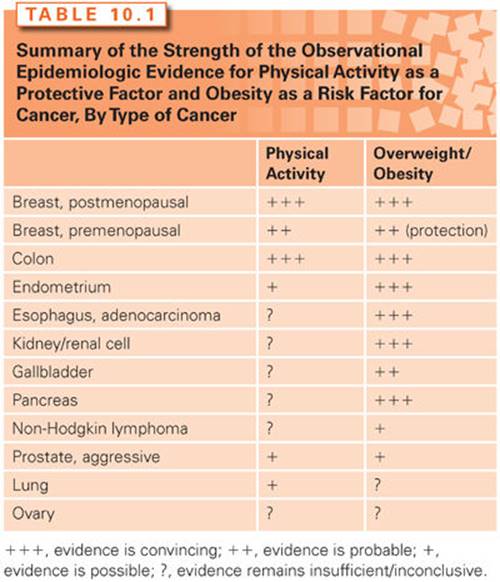
Table 10.1 illustrates the strength of evidence regarding increased physical activity as a protective factor and obesity as a risk factor for cancer. The strength of evidence for each exposure is classified as convincing (+++), probable (++), possible (+), or insufficient and inconclusive (?). Overall, for physical activity, convincing evidence exists for an association with postmenopausal breast cancer and colon cancer; for obesity, the evidence is convincing for breast, colon, endometrial, esophageal, and kidney/renal cell cancer. Evidence for associations between these exposures and several other cancer sites is accumulating. Despite some convincing evidence of the effects of physical activity and obesity on the risk of certain cancers, it is difficult to make recommendations as to appropriate changes in lifestyle that will reduce a person’s chances of developing cancer. We have no physical activity prescriptions to give at this time. Many questions remain to be answered: What are the ages at which physical activity will provide the most benefit? What types of activity should one do and at what intensity, frequency (times per week), and duration (hours per week)? Similarly, for BMI, is there some threshold below which the individual will not have excess cancer risk? Does purposeful weight loss during the adult years lower the risk associated with being overweight or obese? Finally, necessary research is ongoing to identify the biologic mechanisms that account for these effects and to determine whether all persons are affected equally. For instance, it is possible that genetically defined subgroups of the population respond to physical activity or obesity differently. Understanding mechanisms and population variation in these effects will illuminate appropriate prescriptions for lifestyle change.
REFERENCES
1. Caspersen CJ, Powell KE, Christenson GM. Physical activity, exercise, and physical fitness: definitions and distinctions for health-related research. Public Health Rep 1985;100(2):126–131.
2. Flegal KM, Carroll MD, Kit BK, et al. Prevalence of obesity and trends in the distribution of body mass index among US adults, 1999-2010. JAMA 2012;307(5):491–497.
3. Troiano RP, Berrigan D, Dodd KW, et al. Physical activity in the United States measured by accelerometer. Med Sci Sports Exerc 2008;40(1):181–188.
4. Vainio H, Bianchini F, eds. IARC Handbooks of Cancer Prevention Volume 6: Weight Control and Physical Activity. Lyon, France: IARC Press; 2000.
5. Anzuini F, Battistella A, Izzotti A. Physical activity and cancer prevention: a review of current evidence and biological mechanisms. J Prev Med Hyg 2011;52(4):174–180.
6. Hardman AE. Physical activity and cancer risk. Proc Nutr Soc 2001;60(1):107–113.
7. Gunter MJ, Leitzmann MF. Obesity and colorectal cancer: epidemiology, mechanisms and candidate genes. J Nutr Biochem 2006;17(3):145–156.
8. Monninkhof EM, Elias SG, Vlems FA, et al. Physical activity and breast cancer: a systematic review. Epidemiol 2007;18(1):137–157.
9. World Cancer Research Fund/American Institute for Cancer Research. Food, Nutrition, Physical Activity, and the Prevention of Cancer: A Global Perspective. Washington, D.C.: World Cancer Research Fund/American Institute for Cancer Research; 2007.
10. Ishiguro S, Inoue M, Kurahashi N, et al. Risk factors of biliary tract cancer in a large-scale population-based cohort study in Japan (JPHC study); with special focus on cholelithiasis, body mass index, and their effect modification. Cancer Causes Control 2008;19(1):33–41.
11. Dallal CM, Sullivan-Halley J, Ross RK, et al. Long-term recreational physical activity and risk of invasive and in situ breast cancer: The California Teachers Study. Arch Intern Med 2007;167(4):408–415.
12. Lahmann P, Friedenreich C, Schuit A, et al. Physical activity and breast cancer risk: The European Prospective Investigation into Cancer and Nutrition. Cancer Epidemiol Biomarkers Prev 2007;16(1):36–42.
13. Maruti SS, Willett WC, Feskanich D, et al. A prospective study of age-specific physical activity and premenopausal breast cancer. J Natl Cancer Inst 2008;100(10):728–737.
14. Bernstein L, Henderson BE, Hanisch R, et al. Physical exercise and reduced risk of breast cancer in young women. J Natl Cancer Inst 1994;86(18):1403–1408.
15. Carpenter CL, Ross RK, Paganini-Hill A, et al. Effect of family history, obesity and exercise on breast cancer risk among postmenopausal women. Int J Cancer 2003;106(1):96–102.
16. Iwasaki M, Tsugane S. Risk factors for breast cancer: epidemiological evidence from Japanese studies. Cancer Sci 2011;102(9):1607–1614.
17. Pronk A, Ji BT, Shu XO, et al. Physical activity and breast cancer risk in Chinese women. Br J Cancer 2011;105(9):1443–1450.
18. Sanchez-Zamorano LM, Flores-Luna L, Angeles-Llerenas A, et al. Healthy lifestyle on the risk of breast cancer. Cancer Epidemiol Biomarkers Prev 2011;20(5):912–922.
19. Awatef M, Olfa G, Rim C, et al. Physical activity reduces breast cancer risk: a case-control study in Tunisia. Cancer Epidemiol 2011;35(6):540–544.
20. Sheppard VB, Makambi K, Taylor T, et al. Physical activity reduces breast cancer risk in African American women. Ethn Dis 2011;21(4):406–411.
21. Suzuki R, Iwasaki M, Yamamoto S, et al. Leisure-time physical activity and breast cancer risk defined by estrogen and progesterone receptor status—the Japan Public Health Center-based Prospective Study. Prev Med 2011;52(3-4):227–233.
22. Phipps AI, Chlebowski RT, Prentice R, et al. Body size, physical activity, and risk of triple-negative and estrogen receptor-positive breast cancer. Cancer Epidemiol Biomarkers Prev 2011;20(3):454–463.
23. Dieli-Conwright CM, Sullivan-Halley J, Patel A, et al. Does hormone therapy counter the beneficial effects of physical activity on breast cancer risk in postmenopausal women? Cancer Causes Control 2011;22(3):515–522.
24. Hildebrand JS, Gapstur SM, Campbell PT, et al. Recreational physical activity and leisure-time sitting in relation to postmenopausal breast cancer risk. Cancer Epidemiol Biomarkers Prev 2013;22(10):1906–1912.
25. Jung MM, Colditz GA, Collins LC, et al. Lifetime physical activity and the incidence of proliferative benign breast disease. Cancer Causes Control 2011;22(9):1297–1305.
26. Boeing H. Obesity and cancer—the update 2013. Best Pract Res Clin Endocrinol Metab 2013;27(2):219–227.
27. Lahmann PH, Schulz M, Hoffmann K, et al. Long-term weight change and breast cancer risk: The European Prospective Investigation into Cancer and Nutrition (EPIC). Br J Cancer 2005;93(5):582–589.
28. Harris HR, Tamimi RM, Willett WC, et al. Body size across the life course, mammographic density, and risk of breast cancer. Am J Epidemiol 2011;174(8):909–918.
29. Goran MI. Energy metabolism and obesity. Med Clin North Am 2000;84(2):347–362.
30. Frisch R, McArthur J. Menstrual cycles: fatness as a determinant of minimum weight for height necessary for their maintenance or onset. Science 1974;185:949–951.
31. Bernstein L. Epidemiology of endocrine-related risk factors for breast cancer. J Mammary Gland Biol Neoplasia 2002;7(1):3–15.
32. Bernstein L, Ross RK, Lobo RA, et al. The effects of moderate physical activity on menstrual cycle patterns in adolescence: implications for breast cancer prevention. Br J Cancer 1987;55(6):681–685.
33. Anderson E, Clarke RB, Howell A. Estrogen responsiveness and control of normal human breast proliferation. J Mammary Gland Biol Neoplasia 1998;3(1):23–35.
34. Cauley JA, Gutai JP, Kuller LH, et al. The epidemiology of serum sex hormones in postmenopausal women. Am J Epidemiol 1989;129(6):1120–1131.
35. MacDonald PC, Edman CD, Hemsell DL, et al. Effect of obesity on conversion of plasma androstenedione to estrone in postmenopausal women with and without endometrial cancer. Am J Obstet Gynecol 1978;130(4):448–455.
36. Seewaldt FL, Goldenberg V, Jones LW, et al. Overweight and obese perimenopausal and postmenopausal women exhibit increased abnormal mammary epithelial cytology. Cancer Epidemiol Biomarkers Prev 2007;16:613–616.
37. Bernstein L. Exercise and breast cancer prevention. Curr Oncol Reports 2009;11(6):490–496.
38. Neilson HK, Friedenreich CM, Brockton NT, et al. Physical activity and postmenopausal breast cancer: proposed biologic mechanisms and areas for future research. Cancer Epidemiol Biomarkers Prev 2009;18(1):11–27.
39. Cleary MP, Grossmann ME. Obesity and breast cancer: the estrogen connection. Endocrinol 2009;150(6):2537–2542.
40. Brown KA, Simpson ER. Obesity and breast cancer: progress to understanding the relationship. Cancer Res 2010;70(1):4–7.
41. Friedenreich CM, Neilson HK, Lynch BM. State of the epidemiological evidence on physical activity and cancer prevention. Eur J Cancer 2010;46(14):2593–2604.
42. Mai PL, Sullivan-Halley J, Ursin G, et al. Physical activity and colon cancer risk among women in the California Teachers Study. Cancer Epidemiol Biomarkers Prev 2007;16(3):517–525.
43. Wolin KY, Yan Y, Colditz GA, et al. Physical activity and colon cancer prevention: a meta-analysis. Br J Cancer 2009;100(4):611–616.
44. Boyle T, Keegel T, Bull F, et al. Physical activity and risks of proximal and distal colon cancers: a systematic review and meta-analysis. J Natl Cancer Inst 2012;104(20):1548–1561.
45. Howard RA, Freedman DM, Park Y, et al. Physical activity, sedentary behavior, and the risk of colon and rectal cancer in the NIH-AARP Diet and Health Study. Cancer Causes Control 2008;19(9):939–953.
46. Boyle T, Heyworth J, Bull F, et al. Timing and intensity of recreational physical activity and the risk of subsite-specific colorectal cancer. Cancer Causes Control 2011;22(12):1647–1658.
47. Wolin KY, Yan Y, Colditz GA. Physical activity and risk of colon adenoma: a meta-analysis. Br J Cancer 2011;104(5):882–885.
48. Pischon T, Lahmann PH, Boeing H, et al. Body size and risk of colon and rectal cancer in the European Prospective Investigation Into Cancer and Nutrition (EPIC). J Natl Cancer Inst 2006;98(13):920–931.
49. Aleksandrova K, Pischon T, Buijsse B, et al. Adult weight change and risk of colorectal cancer in the European Prospective Investigation into Cancer and Nutrition. Eur J Cancer 2013;49(16):3526–3536.
50. Nimptsch K, Giovannucci E, Willett WC, et al. Body fatness during childhood and adolescence, adult height, and risk of colorectal adenoma in women. Cancer Prev Res 2011;4(10):1710–1718.
51. Hughes LA, Simons CC, van den Brandt PA, et al. Body size and colorectal cancer risk after 16.3 years of follow-up: an analysis from the Netherlands Cohort Study. Am J Epidemiol 2011;174(10):1127–1139.
52. Abate N. Insulin resistance and obesity. The role of fat distribution pattern. Diabetes Care 1996;19(3):292–294.
53. Calle EE, Kaaks R. Overweight, obesity and cancer: epidemiological evidence and proposed mechanisms. Nat Rev Cancer 2004;4(8):579–591.
54. Gierach GL, Chang SC, Brinton LA, et al. Physical activity, sedentary behavior, and endometrial cancer risk in the NIH-AARP Diet and Health Study. Int J Cancer 2009;124(9):2139–2147.
55. Voskuil DW, Monninkhof EM, Elias SG, et al. Physical activity and endometrial cancer risk, a systematic review of current evidence. Cancer Epidemiol Biomarkers Prev 2007;16(4):639–648.
56. Cust AE, Armstrong BK, Friedenreich CM, et al. Physical activity and endometrial cancer risk: a review of the current evidence, biologic mechanisms and the quality of physical activity assessment methods. Cancer Causes Control 2007;18(3):243–258.
57. Friedenreich C, Cust A, Lahmann PH, et al. Physical activity and risk of endometrial cancer: The European Prospective Investigation into Cancer and Nutrition. Int J Cancer 2007;121(2):347–355.
58. Patel AV, Feigelson HS, Talbot JT, et al. The role of body weight in the relationship between physical activity and endometrial cancer: results from a large cohort of US women. Int J Cancer 2008;123(8):1877–1882.
59. Moore SC, Gierach GL, Schatzkin A, et al. Physical activity, sedentary behaviours, and the prevention of endometrial cancer. Br J Cancer 2010;103(7):933–938.
60. Dieli-Conwright CM, Ma H, Lacey JV, Jr., et al. Long-term and baseline recreational physical activity and risk of endometrial cancer: The California Teachers Study. Br J Cancer 2013;109(3):761–768.
61. Kaaks R, Lukanova A, Kurzer MS. Obesity, endogenous hormones, and endometrial cancer risk: a synthetic review. Cancer Epidemiol Biomarkers Prev 2002;11(12):1531–1543.
62. Zhang ZF, Kurtz RC, Sun M, et al. Adenocarcinomas of the esophagus and gastric cardia: medical conditions, tobacco, alcohol, and socioeconomic factors. Cancer Epidemiol Biomarkers Prev 1996;5(10):761–768.
63. Lagergren J, Bergstrom R, Nyren O. Association between body mass and adenocarcinoma of the esophagus and gastric cardia. Ann Intern Med 1999;130(11):883–890.
64. Vigen C, Bernstein L, Wu AH. Occupational physical activity and risk of adenocarcinomas of the esophagus and stomach. Int J Cancer 2006;118(4):1004–1009.
65. Leitzmann MF, Koebnick C, Freedman ND, et al. Physical activity and esophageal and gastric carcinoma in a large prospective study. Am J Prev Med 2009;36(2):112–119.
66. Lepage C, Drouillard A, Jouve JL, et al. Epidemiology and risk factors for oesophageal adenocarcinoma. Dig Liver Dis 2013;45(8):625–629.
67. Ryan AM, Duong M, Healy L, et al. Obesity, metabolic syndrome and esophageal adenocarcinoma: epidemiology, etiology and new targets. Cancer Epidemiol 2011;35(4):309–319.
68. Hoyo C, Cook MB, Kamangar F, et al. Body mass index in relation to oesophageal and oesophagogastric junction adenocarcinomas: a pooled analysis from the International BEACON Consortium. Int J Epidemiol 2012;41(6):1706–1718.
69. Leitzmann MF. Physical activity and genitourinary cancer prevention. Recent Results Cancer Res 2011;186:43–71.
70. Purdue MP, Moore LE, Merino MJ, et al. An investigation of risk factors for renal cell carcinoma by histologic subtype in two case-control studies. Int J Cancer 2013;132(11):2640–2647.
71. O’Rorke MA, Cantwell MM, Cardwell CR, et al. Can physical activity modulate pancreatic cancer risk? A systematic review and meta-analysis. Int J Cancer 2010;126(12):2957–2968.
72. Aune D, Greenwood DC, Chan DS, et al. Body mass index, abdominal fatness and pancreatic cancer risk: a systematic review and non-linear dose-response meta-analysis of prospective studies. Ann Oncol 2012;23(4):843–852.
73. Bracci PM. Obesity and pancreatic cancer: overview of epidemiologic evidence and biologic mechanisms. Mol Carcinog 2012;51(1):53–63.
74. Arslan AA, Helzlsouer KJ, Kooperberg C, et al. Anthropometric measures, body mass index, and pancreatic cancer: a pooled analysis from the Pancreatic Cancer Cohort Consortium (PanScan). Arch Intern Med 2010;170(9):791–802.
75. Genkinger JM, Spiegelman D, Anderson KE, et al. A pooled analysis of 14 cohort studies of anthropometric factors and pancreatic cancer risk. Int J Cancer 2010;129(7):1708–1717.
76. Uhler ML, Marks JW, Judd HL. Estrogen replacement therapy and gallbladder disease in postmenopausal women. Menopause 2000;7(3):162–167.
77. Larsson SC, Wolk A. Obesity and the risk of gallbladder cancer: a meta-analysis. Br J Cancer 2007;96(9):1457–1461.
78. Hsing AW, Sakoda LC, Rashid A, et al. Body size and the risk of biliary tract cancer: a population-based study in China. Br J Cancer 2008;99(5):811–815.
79. Schlesinger S, Aleksandrova K, Pischon T, et al. Abdominal obesity, weight gain during adulthood and risk of liver and biliary tract cancer in a European cohort. Int J Cancer 2013;132(3):645–657.
80. Lu Y, Prescott J, Sullivan-Halley J, et al. Body size, recreational physical activity, and B-cell non-Hodgkin lymphoma risk among women in the California Teachers Study. Am J Epidemiol 2009;170(10):1231–1240.
81. Kabat GC, Kim MY, Jean Wactawski W, et al. Anthropometric factors, physical activity, and risk of non-Hodgkin’s lymphoma in the Women’s Health Initiative. Cancer Epidemiol 2012;36(1):52–59.
82. van Veldhoven CM, Khan AE, Teucher B, et al. Physical activity and lymphoid neoplasms in the European Prospective Investigation into Cancer and Nutrition (EPIC). Eur J Cancer 2011;47(5):748–760.
83. Teras LR, Gapstur SM, Diver WR, et al. Recreational physical activity, leisure sitting time and risk of non-Hodgkin lymphoid neoplasms in the American Cancer Society Cancer Prevention Study II Cohort. Int J Cancer 2012; 131(8):1912–1920.
84. Willett EV, Morton LM, Hartge P, et al. Non-Hodgkin lymphoma and obesity: a pooled analysis from the InterLymph Consortium. Int J Cancer 2008;122(9):2062–2070.
85. Larsson SC, Wolk A. Body mass index and risk of non-Hodgkin’s and Hodgkin’s lymphoma: a meta-analysis of prospective studies. Eur J Cancer 2011;47(16):2422–2430.
86. Larsson SC, Wolk A. Obesity and risk of non-Hodgkin’s lymphoma: a meta-analysis. Int J Cancer 2007;121(7):1564–1570.
87. Bertrand KA, Giovannucci E, Zhang SM, et al. A prospective analysis of body size during childhood, adolescence, and adulthood and risk of non-Hodgkin lymphoma. Cancer Prev Res 2013;6(8):864–873.
88. Friedenreich CM, Orenstein MR. Physical activity and cancer prevention: Etiologic evidence and biological mechanisms. J Nutr 2002;132(11 Suppl):3456S–3464S.
89. Friedenreich CM, McGregor SE, Courneya KS, et al. Case-control study of lifetime total physical activity and prostate cancer risk. Am J Epidemiol 2004;159(8):740–749.
90. Young-McCaughan S. Potential for prostate cancer prevention through physical activity. World J Urol 2012;30(2):167–179.
91. Leitzmann MF, Rohrmann S. Risk factors for the onset of prostatic cancer: age, location, and behavioral correlates. Clin Epidemiol 2012;4:1–11.
92. Liu Y, Hu F, Li D, et al. Does physical activity reduce the risk of prostate cancer? A systematic review and meta-analysis. Eur Urol 2011;60(5):1029–1044.
93. Discacciati A, Orsini N, Wolk A. Body mass index and incidence of localized and advanced prostate cancer—a dose-response meta-analysis of prospective studies. Ann Oncol 2012;23(7):1665–1671.
94. Rodriguez C, Freedland SJ, Deka A, et al. Body mass index, weight change, and risk of prostate cancer in the Cancer Prevention Study II Nutrition Cohort. Cancer Epidemiol Biomarkers Prev 2007;16(1):63–69.
95. Schmidt A, Jung J, Ernstmann N, et al. The association between active participation in a sports club, physical activity and social network on the development of lung cancer in smokers: A case-control study. BMC Res Notes 2012;5:2.
96. Lam TK, Moore SC, Brinton LA, et al. Anthropometric measures and physical activity and the risk of lung cancer in never-smokers: a prospective cohort study. PLoS One 2013;8(8):e70672.
97. Tardon A, Lee WJ, Delgado-Rodriguez M, et al. Leisure-time physical activity and lung cancer: a meta-analysis. Cancer Causes Control 2005;16(4):389–397.
98. Lin Y, Cai L. Environmental and dietary factors and lung cancer risk among Chinese women: a case-control study in Southeast China. Nutr Cancer 2012;64(4):508–514.
99. Bethea TN, Rosenberg L, Charlot M, et al. Obesity in relation to lung cancer incidence in African American women. Cancer Causes Control 2013;24(9):1695–1703.
100. Smith L, Brinton LA, Spitz MR, et al. Body mass index and risk of lung cancer among never, former, and current smokers. J Natl Cancer Inst 2012;104(10):778–789.
101. Andreotti G, Hou L, Beane Freeman LE, et al. Body mass index, agricultural pesticide use, and cancer incidence in the Agricultural Health Study cohort. Cancer Causes Control 2010;21(11):1759–1775.
102. Tarnaud C, Guida F, Papadopoulos A, et al. Body mass index and lung cancer risk: results from the ICARE Study, a large, population-based case-control study. Cancer Causes Control 2012;23(7):1113–1126.
103. Yang Y, Dong J, Sun K, et al. Obesity and incidence of lung cancer: a meta-analysis. Int J Cancer 2013;132(5):1162–1169.
104. El-Zein M, Parent ME, Rousseau MC. Comments on a recent meta-analysis: obesity and lung cancer. Int J Cancer 2012;132(8):1962–1963.
105. Olsen CM, Bain CJ, Jordan SJ, et al. Recreational physical activity and epithelial ovarian cancer: A case-control study, systematic review, and meta-analysis. Cancer Epidemiol Biomarkers Prev 2007;16(11):2321–2330.
106. Weiderpass E, Margolis KL, Sandin S, et al. Prospective study of physical activity in different periods of life and the risk of ovarian cancer. Int J Cancer 2006;118(12):3153–3160.
107. Lahmann PH, Friedenreich C, Schulz M, et al. Physical activity and ovarian cancer risk: The European Prospective Investigation into Cancer and Nutrition. Cancer Epidemiol Biomarkers Prev 2009;18(1):351–354.
108. Leitzmann MF, Koebnick C, Moore SC, et al. Prospective study of physical activity and the risk of ovarian cancer. Cancer Causes Control 2009;20(5):765–773.
109. Xiao Q, Yang HP, Wentzensen N, et al. Physical activity in different periods of life, sedentary behavior, and the risk of ovarian cancer in the NIH-AARP Diet and Health Study. Cancer Epidemiol Biomarkers Prev 2013;22(11):2000–2008.
110. Moorman PG, Jones LW, Akushevich L, et al. Recreational physical activity and ovarian cancer risk and survival. Ann Epidemiol 2011;21(3):178–187.
111. Olsen CM, Green AC, Whiteman DC, et al. Obesity and the risk of epithelial ovarian cancer: a systematic review and meta-analysis. Eur J Cancer 2007;43(4):690–709.
112. Olsen CM, Nagle CM, Whiteman DC, et al. Obesity and risk of ovarian cancer subtypes: evidence from the Ovarian Cancer Association Consortium. Endocr Relat Cancer 2013;20(2):251–262.
113. Schouten LJ, Rivera C, Hunter DJ, et al. Height, body mass index, and ovarian cancer: a pooled analysis of 12 cohort studies. Cancer Epidemiol Biomarkers Prev 2008;17(4):902–912.
114. Collaborative Group on Epidemiological Studies of Ovarian Cancer. Ovarian cancer and body size: individual participant meta-analysis including 25,157 women with ovarian cancer from 47 epidemiological studies. PLoS Med 2012;9(4):e1001200.