
Stephen M. Carpenter, Fabrizio Vianello, Mark C. Poznansky
INTRODUCTION
Immune-compromised state refers to a change of the host defense systems that confer an increased susceptibility to infection. Neutropenia remains the major defect of the defense systems predisposing to severe infections. Fever in a neutropenic patient should be considered a medical emergency as it has been demonstrated that a delay in specific therapy is associated with up to a 70% mortality rate (1). In this chapter, we present the medical approach to fever in neutropenic patients by analyzing the predisposing factors, pathogenesis, diagnosis, and treatment.
DEFINITION
Fever in a neutropenic patient is usually defined as a single temperature of >38.3°C (101.3°F), or a sustained temperature >38°C (100.4°F) for more than 1 h. It has to be considered that neutropenic patients may experience clinical deterioration in the absence of fever and that concomitant steroid treatment may also conceal a fever.
Among neutropenic patients, two factors are associated with the increased risk of infection:
• Neutrophil count. The risk increases when the neutrophil count is below 1 × 10⁹/l. The risk of infection increases further in patients with neutrophil counts of less than 0.1 × 10⁹/l neutrophils.
• Duration of neutropenia. A low-neutrophil count and a protracted neutropenia (0.5 × 10⁹/l for 10 days) are major risk factors for infection. A duration of neutropenia of more than 5 weeks is associated with an incidence of infection close to 100%.
Despite this, neutropenic patients remain a heterogeneous population that needs additional parameters that help to define the real risk of infection and tailor a more specific approach for each patient in this category. The risk factors for infection associated with neutropenia include advanced age, poor performance or nutritional status, low baseline and first-cycle nadir blood cell counts, and high-dose chemotherapy. Significant predictors for death, bacteremia, and length of hospital stay include advanced age, hematologic malignancies, disease burden, high fever, and low blood pressure on admission, pneumonia, and single or multiorgan dysfunction.
PATHOGENESIS
A number of predisposing factors other than neutropenia play a role in increasing the risk of infections in neutropenic patients with fever:
• Chemotherapy
• Intravenous or implanted devices
• Hypogammaglobulinemia (i.e., chronic lymphocytic leukemia, multiple myeloma, splenectomy)
• Defects in cell-mediated immunity (ALL, NHL, HD, therapy with fludarabine or alemtuzumab)
• Glucocorticoid therapy
• Disruption of normal anatomic structures
Chemotherapy not only affects the number of neutrophils but also impairs chemotaxis and phagocytosis. Either chemotherapy or radiotherapy-associated mucositis may affect the normal mucosal barrier, predisposing to bacteremia.
The existence of an impairment in neutrophil function preceding chemotherapy as in patients with myelodysplastic syndromes or in the presence of bone marrow failure due to tumor cell invasion predisposes to severe infection or death after chemotherapy (2).
Indwelling catheters and implanted devices pose a significant risk as they can allow access of skin flora directly into blood or subcutaneous tissues or represent a foreign body that bacteria can successfully colonize and infect. Immune defects associated with specific primary cancers may further impair the defense system as in hypogammaglobulinemia associated with CLL or multiple myeloma. Splenectomy predisposes to infection with encapsulated organisms such as Pneumococcus or Meningococcus.
An increased risk of infection has been observed in patients with Hodgkin’s disease as the result of a defect in cell-mediated immunity. Patients with ALL, patients with central nervous system tumors, and patients treated with glucocorticoids are also at increased risk of infections.
ETIOLOGY OF INFECTIONS IN FEBRILE NEUTROPENIA ASSOCIATED PATHOGENS
 BACTERIA
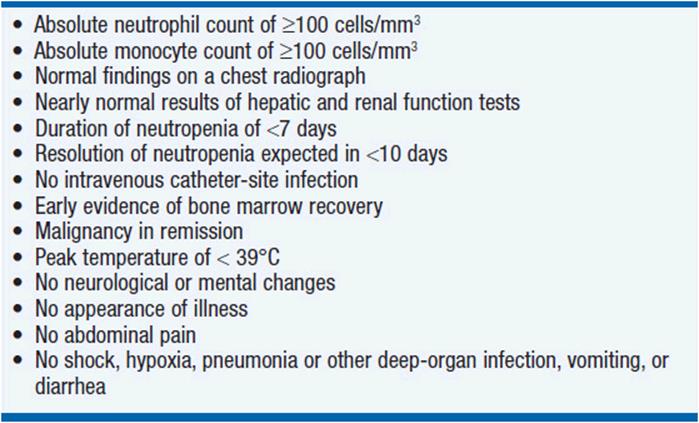
About 65% of neutropenic patients with fever have infection (Table 17-1). In this group of patients, aerobic gram-negative bacilli represented the most frequent isolates (3). In the past Pseudomonas aeruginosa was the most frequent isolate responsible for septic shock and severe pneumonia, and empirical therapy regimens were designed to include antipseudomonal antibiotics. Since the 1980s, gram-positive bacteria have become the most frequent pathogens isolated from patients with febrile neutropenia. More aggressive chemotherapeutic regimens, widespread use of indwelling catheters, and antibiotic prophylaxis have contributed to the trend toward gram-positive infections (4). Coagulase-negative staphylococci are the most common isolates (2), although drug-resistant gram-negative bacteria are causing an increasing number of infections (3).
TABLE 17-1 FACTORS THAT FAVOR A LOW RISK FOR SEVERE INFECTION AMONG PATIENTS WITH NEUTROPENIA
FUNGI
It has been demonstrated that up to 20% of patients with neutropenia may experience an invasive mycosis, and this risk is further increased in patients with hematologic malignancies (3) (Table 17-1). Fungi are rarely the cause of fever early during neutropenia, but invasive fungal disease is usually encountered after prolonged neutropenia while on emperic antibiotics.
Risk factors for fungal superinfection include:
• greater than 7 days of profound neutropenia.
• use of quinolones as antibacterial prophylaxis.
• presence of a central venous catheter.
• persistence of fever after 3 days of antibiotic therapy (5).
Superficial and invasive candidiasis and invasive aspergillosis represent the most common infections. Candida albicans represents the most common fungal isolate in neutropenic patients followed by C. tropicalis, C. glabrata, and C. parapsilosis. The use of fluconazole as prophylactic therapy has been associated with an increased frequency of C. krusei.
Invasive aspergillosis may be due to Aspergillus fumigatus, A. terreus, A. flavus, and A. niger. Invasive aspergillosis is associated with a mortality rate approaching 80% in bone marrow transplantation patients with febrile neutropenia (6). The two most common sites of invasive disease are the lungs and the sinuses. Prolonged fever and nodular pulmonary infiltrates resistant to antibiotic therapy often represent the only clues to the diagnosis of invasive aspergillosis. A finding of nodular lesions surrounded by a low-attenuation area (“halo sign”) may be evident at a chest CT scan. Isolation from culture or histological detection of Aspergillus establishes the definitive diagnosis.
Fusariosis, Trichosporon beigelii, Blastoschizomyces capitatus, Saccharomyces cerevisiae, and Malassenzia furfur represent other emerging fungi.
EVALUATION
The initial evaluation of a febrile and neutropenic patient should include a detailed history and physical examination. Symptoms and signs of inflammation may be minimal or even absent in patients with severe neutropenia. A thorough physical examination should be performed, with particular attention to the skin, mucus membranes, sinuses, oropharynx, lung, abdomen, perirectal area, surgical sites, and intravenous lines. In the neutropenic patient, the response to bacterial infection may be misleading, with only minimal erythema and rash, and often without signs associated with cellulitis or abscess formation. All indwelling catheters should be carefully inspected. Lines should also be assessed for any malfunction as poor flow may be a sign of an infected clot.
The examination should include inspection of the perianal area. A digital rectal examination (and rectal temperatures) should generally be avoided. Stool softeners should also be given to patients to avoid hard stools or impaction. Patients should be reassessed daily as new sites of infection can become apparent even 72 h after the initial therapy. In addition, as the neutrophil count rebounds, symptoms and signs of an infection may become evident.
LABORATORY STUDIES
A basic evaluation should include a complete blood cell count with differential measurement of serum levels of creatinine, urea nitrogen, SGOT, SGPT, bilirubin, and electrolytes. Specimens should be obtained immediately for the microbiology laboratory, including two or more blood cultures from the device lumen and from a peripheral vein. Blood cultures should be repeated for persistent fevers.
A sample of sputum may be included in the microbiologic evaluation if the patient can produce it. Culture of urine samples is indicated if signs of symptoms of urinary tract infection do exist, in the presence of urinary catheter or if urinalysis is abnormal.
Lumbar puncture is not recommended as a routine procedure but should be considered if symptoms suggest a CNS infection.
Chest radiographs should be performed even in the absence of pulmonary infection. Even more likely to yield a diagnosis of pneumonia in the neutropenic patient is the high-resolution CT scan, as it frequently reveals pneumonia even in the presence of a normal chest radiography.
If localizing signs or symptoms are present, other tests should be considered, such as skin aspiration or biopsy for culture, stool for culture, and imaging of the CNS, sinuses, and abdomen.
TREATMENT
Treatment for patients with febrile neutropenia include antimicrobial agents and granulocyte-colony stimulating factor (G-CSF). Antibiotics are always administered empirically, ideally within 2 h of recognition (7), and should include appropriate coverage for suspected or known infections (Figure 17-1).

FIGURE 17-1 Practical approach to fever and neutropenia.
EMPIRICAL THERAPY
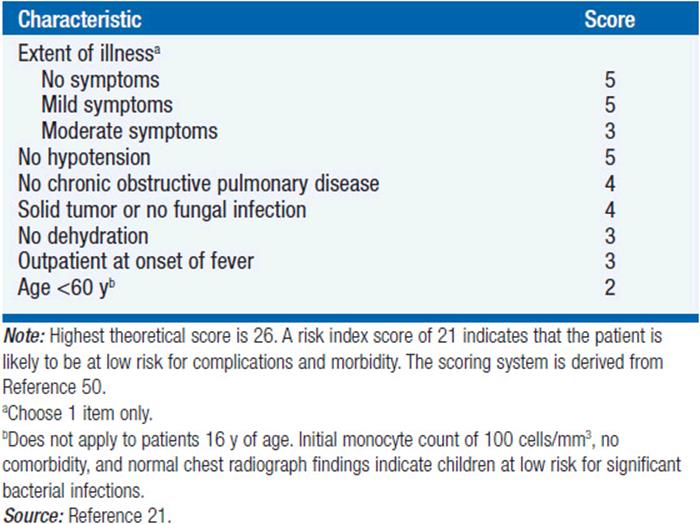
Initial management requires evaluation of the patient to define low or high risk of severe infections (Table 17-2). In high-risk patients, several antibiotic regimens have been proposed as initial empirical therapy in febrile neutropenia, but none has demonstrated a clear superiority (8). All regimens have been designed to provide coverage against gram-negative bacilli, especially P. aeruginosa.
TABLE 17-2 SCORING INDEX FOR IDENTIFICATION OF LOW-RISK FEBRILE NEUTROPENIC PATIENTS AT TIME OF PRESENTATION WITH FEVER
SINGLE-DRUG THERAPY
• Extended-spectrum cephalosporins: ceftazidime or cefepime
• Antipseudomonal penicillin/beta-lactamase combination: pipericillin-tazobactam
• Carbapenem: imipenem or meropenem
TWO-DRUG THERAPY
• Antipseudomonal penicillin plus an aminoglycoside: piperacillin or ticarcillin or mezlocillin plus gentamycin or tobramycin or amikacin
• Antipseudomonal penicillin plus a fluoroquinolone: piperacillin or ticarcillin or mezlocillin plus ciprofloxacin
TWO-DRUG THERAPY (ABOvE) PLUs GLYCOPEPTIDEs
• Vancomycin, in selected patients:
• Catheter-related infections
• Colonization with penicillin and cephalosporin-resistant pneumococci or MRSA
• Growth of gram-positive cocci pending final identification
• Hemodynamic instability
Linezolid or daptomycin should be considered for select resistant gram-positive infections or if vancomycin is not indicated.
A large number of clinical trials performed over the past 30 years have failed to prove the superiority of one antibiotic regimen over others in the management of febrile neutropenia. A patient’s risk factors and history, clinical evaluation, the hypothetical source of infection, and the local frequency of specific pathogens should drive the decision.
The antibiotic regimen should still provide broad empirical coverage for the possibility of other pathogens unlike the treatment strategy in most immunocompetent hosts.
Aminoglycosides such as gentamicin and antipseudomonal penicillins represented the conventional therapy for neutropenic patients prior to the advent of fluoroquinolones and third-generation cephalosporins. The advantages of dual therapy over single-drug treatment include synergy against aerobic gram-negative bacilli and reduced risk of resistant strain selection. Nephrotoxicity and ototoxicity associated with aminoglycoside therapy represent the major concern. Toxicity can be minimized by careful monitoring of serum levels and by administering aminoglycoside once a day.
Quinolone-based combinations with beta-lactams represent an option for empirical therapy in patients not treated prophylactically with quinolones (8). However, as low-risk outpatients are being treated empirically with regimens that include fluoroquinolones, resistance is rising, precluding their use in many high-risk inpatients with fever and neutropenia (9).
The next stage corresponds to the development of third- and fourth-generation cephalosporins. In particular, antipseudomonal cephalosporins including ceftazidime and cefepime have potent activity against aerobic gram-negative bacilli including P. aeruginosa, and have activity against gram-positive cocci. The effectiveness of ceftazidime led to the introduction of a modified monotherapy in which an aminoglycoside was given for the first 72 h and then discontinued if cultures were negative for aerobic gram-negative bacilli (10).
Monotherapy with a carbamenem is particularly effective in febrile neutropenia of unknown origin in patients who had received prophylactic antibiotics (7, 8). In subgroup analyses, meropenem also appeared to be superior to ceftazidime in patients with severe neutropenia (ANC 100 cells/μ1) and in bone marrow transplant recipients (11).
One concern about monotherapy is the possibility that an alarming increase in the frequency of antibiotic-resistant pathogens would be predicted to occur and may eventually reduce the efficacy of this strategy (12).
VANCOMYCIN IN EMPIRICAL THERAPY
There is no clear evidence that addition of vancomycin to empirical therapy affects morbidity or mortality. Addition of vancomycin should be considered in patients suffering from hypotension, mucositis, skin or catheter site infection, or have a history of MRSA colonization, or have recent quinolone prophylaxis (Figure 17-1) (13, 14). When vancomycin is added to empirical therapy at the initiation of treatment, subsequent discontinuation of the antibiotic should be considered in the presence of negative blood cultures. The risk of acquiring VRE is cited as another reason for avoiding empirical vancomycin use.
THERAPY IN LOW-RISK PATIENTS WITH NEUTROPENIA
Prospective studies have identified patients with fever and neutropenia at low risk for medical complications. These patients have solid tumors, no underlying immunocompromise, and an expected short duration of neutropenia of 5 days or less: in these patients it appears safe to use an oral rather than parenteral therapy (15) (Table 17-2). Comparison of the oral regimen consisting of ciprofloxacin and amoxicillin-clavulanate against intravenous ceftriaxone plus amikacin demonstrated equal efficacy in patients with microbiologically documented infections (16). Oral antibiotic therapy requires very accurate selection of neutropenic patients with a low-risk profile.
EMPIRICAL ANTIFUNGAL THERAPY IN FEBRILE NEUTROPENIA
In view of the finding that up to one-third of patients with fever and neutropenia persisting for more than 7 days develop systemic Candida or Aspergillus infection, empirical treatment with an antifungal drug can be considered, in particular when neutropenia is not expected to resolve within a few days. Diagnostic steps, including fungal isolator blood cultures, fungal cell wall markers including serum β-(1, 3)-D glucan and galactomannan assays, as well as chest CT, should precede the commencement of antifungal therapy.
Antifungal therapeutic options include amphotericin B, lipid formulations of amphotericin B, fluconazole, itraconazole, voriconazole, and the echinocandins: micafungin, caspofungin, or anidulafungin. Amphotericin B has historically been the standard of antifungal therapy in febrile neutropenia with the broadest spectrum of antifungal activity.
When used as lipid formulation, amphotericin causes a lesser incidence of infusion-related fever, chills or rigors, and nephrotoxicity (17). Among azoles, fluconazole has limited activity against Aspergillusspecies and some nonalbicans Candida species, and it is generally not recommended for empirical therapy. Intravenous followed by oral itraconazole was found to be as effective as amphotericin B in febrile neutropenic patients (18). Itraconazole should not be used in patients with an estimated creatinine clearance below 30 ml/min and this azole should not be administered for more than 14 days.
Results of three clinical trials assessing the activity of voriconazole and caspofungin have demonstrated their efficacy in the treatment of invasive fungal infections. In one study, voriconazole was superior to liposomal amphotericin B only with respect to documented breakthrough fungal infections, infusion-related toxicity, and nephrotoxicity (19). In another trial, the efficacy of caspofungin in the prevention of breakthrough infections and resolution of fever was superior to liposomal amphotericin B (20). Caspofungin also cured more documented baseline fungal infections than did liposomal amphotericin B. Considering the available evidence, voriconazole and caspofungin both appear to be suitable, and perhaps preferable, alternatives to conventional liposomal amphotericin B as empirical antifungal therapy in patients with persistent fever and neutropenia.
HEMATOPOIETIC GROWTH FACTOR (HGF)
Both the Infectious Diseases Society of America and the American Society of Clinical Oncology do not support the routine use of growth factors in febrile neutropenic patients. G-CSF has been reported to decrease the duration of neutropenia, fever, and hospitalization but without significant impact on mortality (21). These agents can be considered in high-risk patients whose risk of fever and neutropenia exceeds 20%. Therapy with G-CSF may be considered to be appropriate in critically ill patients with prolonged neutropenia.
ANTIBACTERIAL AND ANTIFUNGAL PROPHYLAXIS
There is no consensus to recommend antimicrobial prophylaxis for all afebrile neutropenic patients. A prophylactic strategy should diminish the attack rate and delay the time to the onset of an infectious complication, but it does not eliminate the risk of infection. The goal would be to provide protection during the period of neutropenia and mucositis. In general, the use of prophylactic antibiotic therapy is not routinely recommended for cancer patients undergoing chemotherapy, although fluoroquinolones can be considered in patients with expected prolonged durations of profound neutropenia. Prophylaxis against Candida infection should be considered in patients with a substantial risk of invasive disease, such as stem cell transplants and intensive induction or salvage chemotherapy regimens (21). Vigorous infection-control practices and careful monitoring for the emergence of resistant organisms should accompany any prophylactic program.
REFERENCES
1. Rubin RH, Ferraro MJ. Understanding and diagnosing infectious complications in the immunocompromised host. Current issues and trends. Hematol Oncol Clin North Am. 1993; 7: 795–812.
2. Bodey G, Bueltmann B, Duguid W, et al. Fungal infections in cancer patients: an international autopsy survey. Eur J Clin Microbiol Infect Dis. 1992; 11: 99–109.
3. Ramphal R. Changes in the etiology of bacteremia in febrile neutropenic patients and the susceptibilities of the currently isolated pathogens. Clin Infect Dis. 2004; 39: S25–S31.
4. Cattaneo C, Quaresmini G, Casari S, et al. Recent changes in bacterial epidemiology and the emergence of fluoroquinolone-resistant Escherichia coli among patients with haematological malignancies: results of a prospective study on 823 patients at a single institution. J Antimicrob Chemother. 2008; 61:721–728.
5. Nucci M, Colombo AL, Spector N, et al. Breakthrough candidemia in neutropenic patients. Clin Infect Dis. 1997; 24: 275–276.
6. Marr KA, Patterson T, Denning D. Aspergillosis. Pathogenesis, clinical manifestations, and therapy. Infect Dis Clin North Am. 2002; 16: 875–894, vi.
7. Zuckermann J, Moreira LB, Stoll P, et al. Compliance with a critical pathway for the management of febrile neutropenia and impact on clinical outcomes. Ann Hematol. 2008; 87:139–145.
8. Bliziotis IA, Michalopoulos A, Kasiakou SK, et al. Ciprofloxacin vs an aminoglycoside in combination with a beta–lactam for the treatment of febrile neutropenia: a meta–analysis of randomized controlled trials. Mayo Clin Proc. 2005; 80: 1146–1156.
9. Bow EJ. Fluoroquinolones, antimicrobial resistance and neutropenic cancer patients. Curr Opin Infect Dis. 2011; 24, 545–553.
10. Donowitz GR, Maki DG, Crnich CJ, et al. Infections in the neutropenic patient—new views of an old problem. Hematology (Am Soc Hematol Educ Program). 2001; 113–139.
11. Freifeld AG, Walsh T, Marshall D, et al. Monotherapy for fever and neutropenia in cancer patients: a randomized comparison of ceftazidime versus imipenem. J Clin Oncol. 1995; 13: 165–176.
12. Raad, II, Escalante C, Hachem RY, et al. Treatment of febrile neutropenic patients with cancer who require hospitalization: a prospective randomized study comparing imipenem and cefepime. Cancer. 2003; 98: 1039–1047.
13. Paul M, Borok S, Fraser A, Vidal L, Leibovici L. Empirical antibiotics against gram-positive infections for febrile neutropenia: systematic review and meta-analysis of randomized controlled trials. J Antimicrob Chemother. 2005; 55: 436–444.
14. Vardakas KZ, Samonis G, Chrysanthopoulou SA, et al. Role of glycopeptides as part of initial empirical treatment of febrile neutropenic patients: a meta-analysis of randomised controlled trials. Lancet Infect Dis. 2005; 5: 431–439.
15. Koh A, Pizzo PA. Empirical oral antibiotic therapy for low risk febrile cancer patients with neutropenia. Cancer Invest. 2002; 20: 420–433.
16. Kern WV, Cometta A, De Bock R, et al. Oral versus intravenous empirical antimicrobial therapy for fever in patients with granulocytopenia who are receiving cancer chemotherapy. International Antimicrobial Therapy Cooperative Group of the European Organization for Research and Treatment of Cancer. N Engl J Med. 1999; 341: 312–318.
17. Walsh TJ, Finberg RW, Arndt C, et al. Liposomal amphotericin B for empirical therapy in patients with persistent fever and neutropenia. National Institute of Allergy and Infectious Diseases Mycoses Study Group. N Engl J Med. 1999; 340: 764–771.
18. Boogaerts M, Winston DJ, Bow EJ, et al. Intravenous and oral itraconazole versus intravenous amphotericin B deoxycholate as empirical antifungal therapy for persistent fever in neutropenic patients with cancer who are receiving broad-spectrum antibacterial therapy. A randomized, controlled trial. Ann Intern Med. 2001; 135: 412–422.
19. Walsh TJ, Pappas P, Winston DJ, et al. Voriconazole compared with liposomal amphotericin B for empirical antifungal therapy in patients with neutropenia and persistent fever. N Engl J Med. 2002; 346: 225–234.
20. Walsh TJ, Teppler H, Donowitz GR, et al. Caspofungin versus liposomal amphotericin B for empirical antifungal therapy in patients with persistent fever and neutropenia. N Engl J Med. 2004; 351: 1391–1402.
21. Freifeld AG, Bow EJ, Sepkowitz KA, et al. Clinical practice guideline for the use of antimicrobial agents in neutropenic patients with cancer: 2010 Update by the Infectious Diseases Society of America. Clin Infect Dis. 2011; 52: 427–431.