
Bruce A. Chabner
Most anticancer drugs are small synthetic molecules designed to inhibit enzymes or to interact with DNA. Newer drugs may also be proteins, such as monoclonal antibodies or cytokines (interferon, IL-2) that interact with cell surface receptors. L-asparaginase (L-ASP) is unique as a bacterial enzyme that hydrolyzes an essential amino acid, L-asparagine, and through that action, kills tumor cells. Its efficacy is based on the observation that some lymphoid malignancies are unable to synthesize asparagine and must derive it from the blood stream. Enzyme purified from Escherichia coli (1) is now an essential component of the regimen for remission induction and consolidation for childhood acute lymphocytic leukemia (ALL). While enzymatic activity is highly specific for asparagine hydrolysis, asparagine depletion not only kills tumor cells but also leads to a broad range of toxicities resulting from inhibition of the synthesis of clotting factors, insulin, and other essential proteins.
L-ASP is a 144,000 tetrameric protein that catalyzes the deamination of the circulating blood pool of L-asparagine. Enzyme from E. coli and an alternative protein from Erwinia chrysanthemi are highly specific for L-asparagine but retain minor cleaving activity against glutamine. The two enzymes lack immunologic cross-reactivity; therefore, the Erwinia enzyme may be used with relative safety in patients hypersensitive to E. coli enzyme, but because of its short plasma half-life of 16 h, must be administered in higher doses to produce prolonged asparagine depletion. A third form of L-ASP, the E. coli enzyme conjugated to polyethylene glycol (pegaspargase—PEG L-ASP), has a much long plasma t1/2 of 6 days, is less immunogenic than native L-ASP, and is particularly useful in patients hypersensitive to the unconjugated enzymes, 70% of whom will not react to the pegylated enzyme (2). PEG L-ASP is as effective as native E. coli enzyme in first-line use. A recombinant E. coli L-ASP, which is free of the immunogenic oligomers of the native bacterial enzyme preparation, is undergoing clinical evaluation and may prove to be a superior product (2).
CLINICAL PHARMACOLOGY
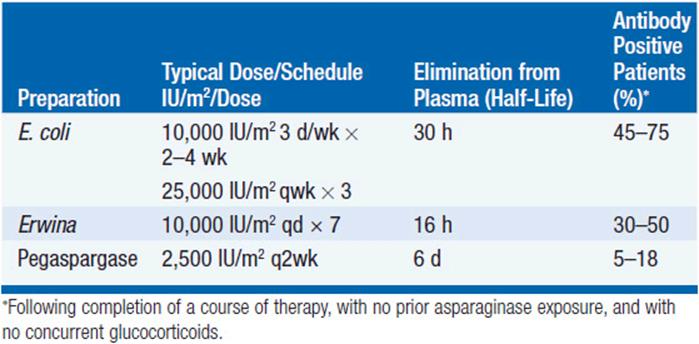
A comparison of the primary features of the three drugs is shown in Table 8-1. No single dosing schedule of the various L-ASP preparations has been established. The native L-ASP drug is primarily administered by intramuscular injection, a route associated with a lesser risk of anaphylaxis, although PEG L-ASP appears safe by the intravenous route (3). Higher doses are associated with more complete and prolonged asparagine depletion, but cause a higher incidence of side effects, particularly thrombotic events, and more frequent hypersensitivity responses. In general, most regimens strive to maintain a trough level of enzyme activity in plasma of 0.1 units/ml for the duration of therapy (for 7–21 days). This level is associated with total asparagine depletion in plasma but not in the cerebrospinal fluid.
TABLE 8-1 COMPARISON OF THE PRIMARY FEATURES OF THREE DRUGS
Clinical effectiveness of L-ASP requires the continuous depletion of asparagine during a cycle of treatment, but its activity is compromised by the development of neutralizing antibodies and side effects. Cellular resistance to L-ASP arises by induction of asparagine synthetase in tumor cells.
TOXICITY
Anaphylaxis occurs in less than 5% of patients. In ALL patients, antibodies are detected in up to 50% of patients receiving single agent L-ASP, but in only 20% of patients receiving L-ASP with immunosuppressive drugs, such as methotrexate, 6-mercaptopurine, or glucocorticoids. About half of patients with neutralizing antibodies will have clinical evidence of hypersensitivity, but some asymptomatic patients will have “silent inactivation,” more rapid clearance of L-ASP, and incomplete depletion of asparagine in plasma, and will be at increased risk of leukemic relapse (4). Monitoring of L-ASP levels during therapy is recommended to assure achievement of trough levels. In relapsed patients, PEG L-ASP may be less effective than native enzyme in depleting asparagine, a finding that prompts the use of higher and more frequent doses (3500 IU/m2 weekly) of PEG L-ASP in these patients (5). Other toxicities of L-ASP include its effects on coagulation and protein synthesis. It depletes both antithrombotic (protein C and protein S, antithrombin III) and procoagulant (prothrombin) factors, and is associated with a significant risk of stroke related to cortical sinus thrombosis. The risk of thrombosis seems highest in adolescent and adult patients, in patients receiving concomitant glucocorticoids, and in those with underlying inherited defects in anticoagulant factors, such as homocystinemia, factor V Leiden deficiency, or prothrombin mutations (6). Low-molecular-weight heparin reduces the incidence of venous thrombosis in high-risk individuals. Protein synthesis inhibition may cause extreme hypertriglyceridemia (levels of 5000 mg/dl or greater) and pancreatitis due to lipoprotein lipase deficiency, as well as hypoalbuminemia, hyperglycemia (insulin deficiency), and, infrequently, hemorrhage (prothrombin, factor IX, and factor X deficiency). The same spectrum of side effects occurs in patients receiving PEG L-ASP, although the frequency of hypersensitivity reactions is significantly reduced.
Considerable uncertainty remains regarding the best regimen, including dose and schedule (Table 8-1), for treating ALL, and the best use of the various L-ASP preparations. Alternative regimens employing higher doses, more extended periods of treatments, and new drug combinations are undergoing clinical evaluation for childhood ALL.
REFERENCES
1. Cooney DA, Handschumacher RE. L-asparaginase and L-asparaginase metabolism. Annu Rev Pharmacol. 1970; 10: 421–440.
2. Peters R, Appel I, Kuehnel H-J, et al. Pharmacokinetics, pharmacodynamics, efficacy and safety of a new recombinant asparaginase preparation in children with previously untreated acute lymphoblastic leukemia: a randomized phase 2 clinical trial. Blood. 2008; 112: 4832–4838.
3. Silverman LB, Supko JG, Stevenson KE, et al. Intravenous PEG-asparaginase during remission induction in children and adolescents with newly diagnosed acute lymphoblastic leukemia. Blood. 2010; 115: 1351–1353.
4. Panetta JC, Gajjar A, Hak LJ, et al. Comparison of Native E. coli and PEG asparaginase pharmacokinetics in pediatric acute lymphoblastic leukemia. Clin Pharmacol Therap. 2009; 86: 651–658.
5. Rytting M. Peg-asparaginase for acute lymphoblastic leukemia. Expert Opin Biol Ther. 2010; 10: 833–839.
6. Nowak-Gottl U, Wermes C, Junker R, et al. Prospective evaluation of the thrombotic risk in children with acute lymphoblastic leukemia carrying the MTHFR TT 677 genotype, the prothrombocin G20210A variant, and further prothrombotic risk factors. Blood. 1999; 93: 1595–1599.