
Elizabeth Won and Thomas J. Kaley
Definition
• 1° brain tumors arising from oligodendrocytes
• Oligodendrocytes form myelin & provide support for axons
Epidemiology
• Incidence 3 per 1000000 in US
• Rare subtype, 6–10% of all 1° CNS tumors
• Typically seen in fourth to fifth decades; low-grade tumors occur at earlier age
Etiology and Clinical Manifestations
• IR exposure, FHx of brain tumors, epilepsy/seizures, mutagen senility,
• A/w genetic syndrome: Neurofibromatosis-1, tuberous sclerosis, RB1, Li–Fraumeni, & Turcot syndrome
• S/S: Depend on extent & location of tumor. Seizures are frequently a/w oligodendroglioma. Median duration of onset of sx to dx is 6–17 mos.
Pathology
• Morphology:
Low-grade tumors: “Fried egg” appearance seen on paraffin but not frozen section
High grade (anaplastic oligodendroglioma): High cell density, mitosis, nuclear atypia, microvascular proliferation, & necrosis
• Molecular biology:
1p/19q codeletion seen in 60–70% classical oligodendrogliomas, help to distinguish from other types of gliomas. A/w better response to Rx & improved survival in both low-grade & anaplastic tumors. 1p/19q testing recommended in all pts w/oligodendrogliomas.(J Natl Canc Inst 1998;90:1473)
Chromosome 10q loss: A/w poorer response to tx & shortened survival
MGMT overexpression: A/w better response to tx
IDH1 Mt: Good prognostic factor equally as strong as 1p/19q codeletion. IDH1 Mt are found in tumors w/& w/o1p/19q.
Workup and Evaluation
• MRI brain & spine w/contrast:
Low-grade tumors show ↑ signal on T2 images w/o enhancement. On CT, these tumors appear as low density masses w/o enhancement. Calcifications are suggestive but not specific for oligodendrogliomas.
Anaplastic oligodendrogliomas: Typically characterized by contrast enhancement, but absence does not exclude anaplastic tumor.
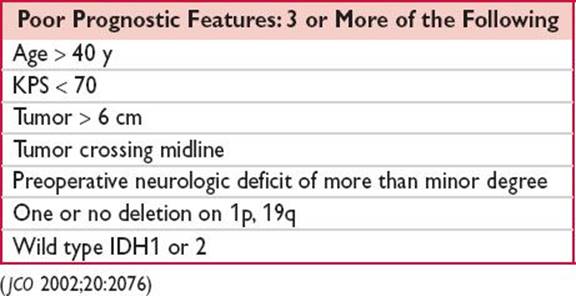
Initial Treatment for Oligodendrogliomas
• Optimal management is controversial for low-grade oligodendrogliomas, w/c can be very indolent tumors.
• Surgery: When possible, maximal safe resection is recommended. Surgical resection appears to confer survival benefit based on available retrospective data & may delay malignant progression & recurrence. No randomized data comparing surgery vs. conservative approach of delayed surgery after POD in low-grade tumors.
Extent of resection should be documented w/a T2-weighted or FLAIR MRI scan w/in 72 h of surgery
• Adjuvant Radiation: No consensus on timing of postoperative EBRT. RT is often reserved for tx of recurrent disease. EORTC 22845 trial randomized pts w/low-grade gliomas to either 54-Gy postoperative radiation or no immediate Rx. 5-y DFS was better w/immediate post-op radiation (44 vs. 37%, p = 0.02); however OS was similar. Long-term follow-up showed no OS benefit, but seizures were better controlled in pts receiving immediate post-op RT (EORTC 22845, Int J Radiat Oncol Biol Phys 2002;52:316 & Lancet 2005;366:985)
Radiation dose: No benefit for higher dose RT, standard is 45–54 Gy.
• Adjuvant Chemotherapy: Temozolomide or Procarbazine, lomustine, & vincristine (PCV)
RTOG 9802 suggested PCV + RT in low-grade glioma improves PFS & OS benefit in pts surviving beyond 2 y (JCO 2012;30:3065). Data is controversial, no way of selecting the pts who will survive beyond 2 y. Majority have not adopted as standard adjuvant chemotherapy.
EORTC 26951 & RTOG 9402 showed chemotherapy + RT improves OS vs. RT alone (42 vs. 30 mos) in pts w/anaplastic oligodendroglioma w/codeletion 1p/19q (JCO 2012;30; JCO 2006;24:2707)
Management of Recurrent or Progressive Disease
• Surgery is recommended (if resectable) followed by radiation or chemotherapy if pt already received RT.
• Radiation for recurrence if not used in adjuvant setting.
• Reirradiation to be considered if recurrence > 2 y after prior RT, new lesion outside of prior RT field, or small lesion
• Chemotherapy: Active agents include temozolomide, nitrosourea, PCV, platinum-based Rx. Both PCV & temozolomide have activity in pts who failed initial regimen.
Surveillance after Treatment
• For low-grade oligodendrogliomas, MRI q3–6 mos for 5 y & then annually
• For anaplastic oligodendrogliomas, MRI 2–4 wks after RT Rx, then q2–4 mos for 2–3 y, then less frequently
Prognosis
• Pure low-grade oligodendrogliomas: Median survival 10 y.
• Anaplastic oligodendrogliomas: Median survival is only 3–5 y, despite chemo-Sn of tumors