
Raajit Rampal
Epidemiology
• Median age of onset mid-60s
• Includes PMF as well as post-PV & post-ET MF
Signs and Symptoms
• Systemic sx: Include fatigue, fevers, night sweats, wt loss, pruritus
• Organomegaly: Hepatomegaly & splenomegaly (may be massive)
Physical and Laboratory Findings
• WBC: Leucopenia or leukocytosis may be seen
• Hgb: Anemia due to several causes present in almost half of pts
• Plt: Thrombocytosis or thrombocytopenia (more common w/disease progression) may be seen
• Other: ↑ LDH, A, & UA may be seen
• Blood smear: May demonstrate leukoerythroblastosis (nucleated RBCs, tear drop RBCs, left shift in myeloid series).
Differential Diagnosis
• Other causes of BM fibrosis: Other myeloid neoplasm, lymphoid neoplasm, met malignancy, infxn, CTD such as Lupus
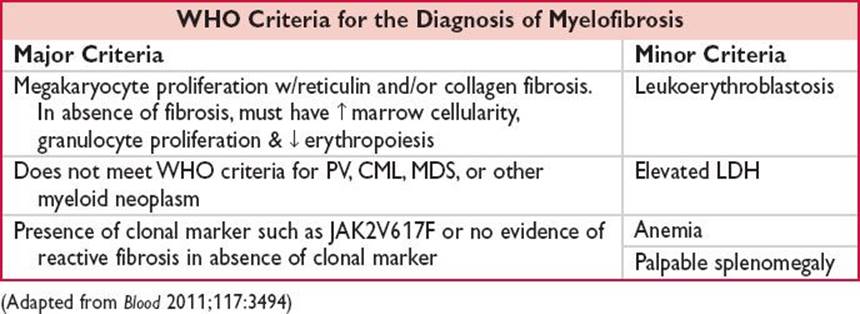
• WHO criteria: Requires meeting all three major criteria & at least 2 minor criteria
Genetics
• JAK/STAT pathway Mt: Comprise majority of Mt. JAK2V617F (approx 50% of pts), MPL, LNK
• Other Mt: Mt in TET2, ASXL1, IDH, IKZF1, CBL, & EZH2 occur at variable frequency as well. Contribution to pathogenesis unclear.
• Leukemic transformation: Similar Mt are seen at leukemic transformation. TP53 Mt frequency ↑ at transformation. High frequency of Mt in splicing factor SRSF2 at transformation (a/w worsened OS).
Disease Sequelae
• Transformation to acute leukemia: Carries extremely poor prognosis w/median survival of 2.7 mos. Factors a/w transformation include: Blasts ≥ 3%, plt < 100000, unfavorable karyotype
• Extramedullary hematopoiesis: Can occur outside of liver & spleen, in areas such as near vertebral column, lymph nodes, & other areas. May result in organomegaly, effusions, cord compression.
• Thrombotic events: ↑ risk of both arterial & venous thrombotic events
• Bone & joint alterations: May include osteosclerosis, gouty arthritis, (due to UA overproduction) & other phenomena
Prognostication
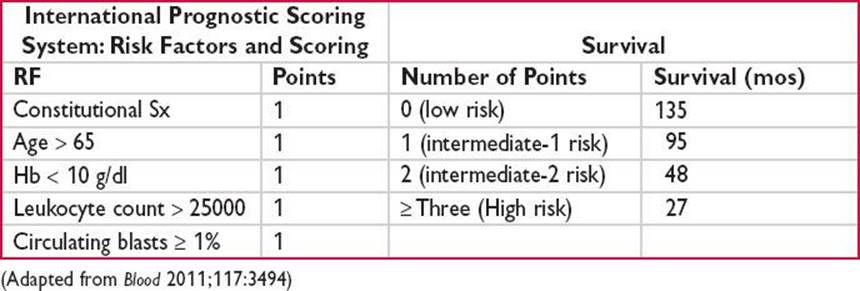
• International Prognostic Scoring System (IPSS): Estimates survival from time of dx (Table 2) (Blood 2009;115:392)
• DIPSS: Can be used at anytime during disease course. Same factors as IPSS, but 2 points given for Hgb < 10 g/dL (Blood 2010;115:1703).
• Dynamic IPSS (DIPSS) plus: Adds karyotype, transfusion needs, & thrombocytopenia as prognostic factors (J Clin Oncol 2011;29:392)
• Lille system: Based on Hb levels & presence of leukopenia or leukocytosis
Treatments and Indications
• Allogeneic SCT: Only curative intervention currently. Has been performed w/both myeloablative & reduced-intensity conditioning regimens. Effect of splenectomy prior to transplant not clear.
• JAK inhibitors: Ruxolitinib (JAK1/2 inhibitor) approved for tx of intermediate & high-risk & MF based on two phase III randomized trials: COMFORT I (Ruxolitinib vs. placebo: NEJM 2012;366:799) & COMFORT II (Ruxolitinib vs. best available Rx: NEJM 2012;366:787). Trial demonstrated significant reduction in spleen size & sx scores. No reversal of marrow fibrosis demonstrated nor molecular remission obtained. S/e include anemia & thrombocytopenia. Withdrawal of drug can cause flare of sx & induce a systemic inflammatory-type response; therefore must taper dose.
• Hydrea: Can be used to control thrombocytosis, leukocytosis, & has some effect on constitutional sx
• Splenectomy: Can be considered to reduce symptomatic splenomegaly, or relieve other associated sequelae of splenomegaly such as thrombocytopenia, & portal HTN
• Androgens: Combination of androgens & prednisone, or androgens alone can be used to treat anemia in a palliative manner.
• Interferon alpha: May reduce thrombocytosis, leukocytosis, or spleen size.
• Radiation: Focal radiation of spleen to treat splenomegaly or to sites of extramedullary hematopoiesis can be used to control disease sx.
• Immune modulators: Use of Thalidomide plus prednisone or Lenolidamide ± prednisone can induce responses in anemia, thrombocytopenia, & reduction in spleen size in some pts. Lenolidamide particularly effective for pts w/MF & cytogenetics demonstrating 5q–.