
Amanda L. Olson and Craig Sauter
Description
• HDC/radiation followed by infusion of autologous multipotent hematopoietic stem cells.
• Tx of hematologic malignancies using HDC/radiation followed by ASCR to reconstitute the BM.
Indications
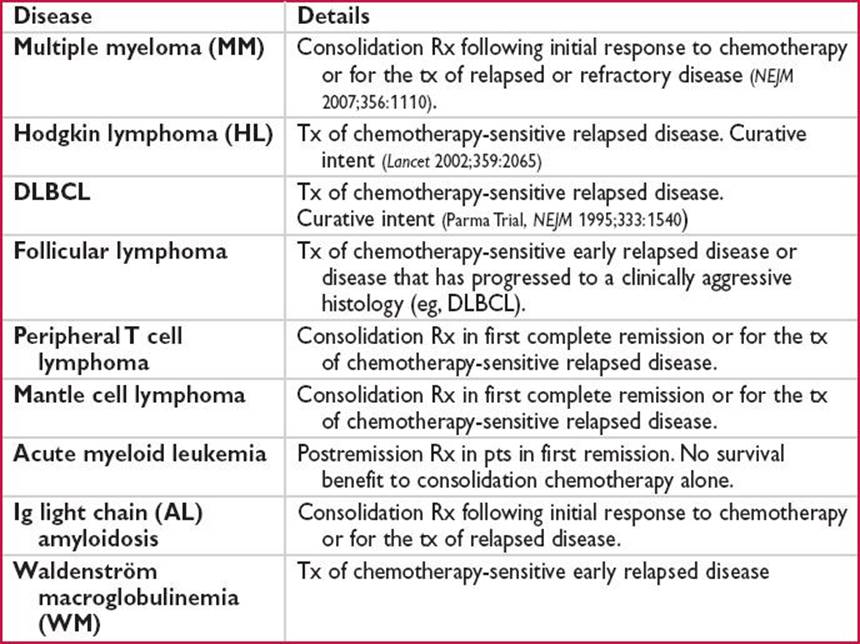
Pretransplant Evaluation
To establish extent of disease & assess pt comorbidities, includes the following.
• Hx: PS, prior Rx, drug allergies, prior infxn, & social support
• Physical exam: Oral cavity/skin for nidus for infxn, CNS exam, & assessment of lymphadenopathy
• Labs: CBC, chemistries w/liver & renal function, 24-h urine collection for measurement of Cr clearance
• CXR or CT chest
• ECG & a study of cardiac function (ECHO or MUGA)
• PFT including DLCO
• Disease-specific restaging studies including
BM aspiration/bx
CT or combined CT/PET in pts w/certain lymphomas
SPEP & UPEP w/immunofixation, serum FLC assay & skeletal assessment in pts w/myeloma
Stem Cell Source
• Stem cells should be collected prior to exposure to an alkylating agent such as oral melphalan, nitrogen mustard or purine analog & fludarabine as these agents are stem cell toxic
• Collection may be done by BM harvesting or peripheral blood stem cell apheresis following tx w/G-CSF
• Harvested cells are cryopreserved until time of transplant
Conditioning Regimens
• Chemotherapy or radiation given prior to transplant to eradicate disease.
• All conditioning regimens are ablative, as the therapeutic response following ASCT depends on the HDC/radiation.
• Melphalan-based regimens are commonly used for the tx of plasma cell dyscrasias & lymphoma (commonly treated w/BEAM: BCNU, Etoposide, Ara-C, Melphalan).
Engraftment
• Expansion of the HSC in the BM w/c results in normalization of blood counts & immune recovery
• Time to engraftment varies based on conditioning regimen, stem cell graft, & characteristics
• BM graft & lower cell dose generally result in longer time for engraftment
Transplant Complications and Outcomes
• Major complications are tox from preparative regimen, infxn, VOD, mucositis, development of new malignancies, & relapse
• Cardiac & pulm tox are most common

• Relapse: In addition to close clinical & lab follow-up BM aspiration/bx is generally at routine intervals post-transplant to r/o relapsed disease
Post-Transplant Maintenance Therapy
• Post-transplant maintenance chemotherapy or radiation may be given for selected diseases eg, lenalidomide or bortezomib for MM
• Post-transplant maintenance rituximab does not show benefit based on randomized phase III data (CORAL, Ann Oncol 2006;Suppl 4:iv31)
Prognosis
• Prognosis varies & is dependent upon a number of factors including
disease type
stage
stem cell source
HLA-matched status
conditioning regimen
• Mortality for SCT can be estimated using the HCT-CI