
Dmitriy Zamarin and Jedd D. Wolchok
Background
• Activation of T cells
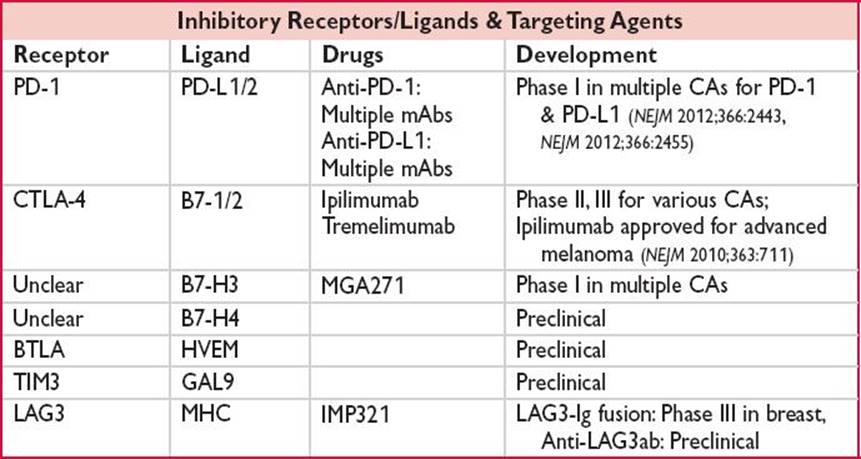
Requires two signals: Signal 1: TCR-MHC, Signal 2: CD28-B7-1/B7-2. Interaction of additional receptors & ligands provides either inhibitory (checkpoint) or stimulatory signals regulating T cells activation (Figure 6-1).
• Role in CA
Immune checkpoint proteins can be dysregulated in tumors as a resistance mechanism. Targeting of the T-cell activating receptors w/stimulatory Ab/ligands or inhibitory receptors w/blocking Ab can lead to antitumor immunity.

Figure 6-1 T-cell activation is regulated by multiple activating (light red) & inhibitory (red) signals.
Immunoregulatory Proteins & Targeting Agents

Combination Therapies
• Currently under evaluation to improve responses
• Chemotherapy/targeted Rx & ipilimumab(NEJM 2011;364:2517)
• Radiation & ipilimumab(NEJM 2012;366:925)
• Vaccines & ipilimumab
• Anti-PD-1 & ipilimumab
Immune-related Adverse Events (irAEs)
• Anti-CTLA-4: Rash, diarrhea, colitis, hepatitis, vitiligo, hypophysitis (overall grade 3–4 in 15%)
• Anti-PD-1: Pneumonitis (rare), vitiligo, colitis, hepatitis, hypophysitis, & thyroiditis (overall grade 3–4 in 14%)
• Anti-PD-L1: Rash, hypothyroidism, hepatitis (overall grade 3–4 in 9%)
• Anti-4-1BB: Fatigue, ↑ LFT’s, neutropenia, rash, diarrhea, grade 4 hepatitis
• Anti-CD-40: Cytokine release syndrome (grade 1–2), transient pancytopenia, fatigue, HA, pyrexia, chills, nausea, & HoTN
Management of irAEs
• General guidelines: Serum electrolyte panel, LFT’s, & TFT’s before starting tx w/ipilimumab & prior to each dose
• Rash: Grade 1–2: Topical glucocorticoids, antihistamines; grade 3: Withhold a dose, 4-wk prednisone taper starting w/1 mg/kg; grade 4: Stop Rx, prednisone taper starting w/2 mg/kg
• Diarrhea/colitis: Grade 1: Symptomatic management; grade 2: R/o infectious causes, sigmoidoscopy/colonoscopy to r/o colitis, oral steroids w/confirmed colitis; grade 3 or 4: Permanently stop Rx, start IV methylprednisolone 125 mg (2 mg/kg), followed by oral prednisone or dexamethasone w/at least a 4-wk taper. If no improvement w/in 72 h, start infliximab 5 mg/kg, can be repeated in 2 wks & taper steroids.
• Hepatotoxicity: R/o progressive met disease & viral causes; grade 3–4: Permanently d/c Rx, high-dose IV glucocorticoids for 24–48 h, followed by oral steroid taper for at least 3 wks. If no ↓LFT’s w/in 48 h, consider oral MMF 500 mg every 12 h (can ↑ to 1 g BID), avoid infliximab due to potential hepatotoxicity.
• Hypophysitis: R/o new brain mets w/brain MRI, check serum electrolytes, morning cortisol, ACTH, free T3/T4, TSH, testosterone in males; FSH, LH, & PRL in females. For grade 3–4 & symptomatic panhypopituitarism: Hold Rx, give initial dose of 1–2 mg/kg IV methylprednisolone, followed by prednisone 1–2 mg/kg daily for 3-wk taper & replacement of other hormones as necessary. For adrenal crisis, r/o sepsis, start IV methylprednisolone. W/appropriate hormone replacement, tx can be restarted.
• Pancreatitis: Typically asymptomatic. Permanently d/c Rx for grade 3–4, initiate 3-wk oral steroid taper
• Episcleritis/uveitis: Grade 1–2: Topical steroids; grade 3–4: Permanently d/c Rx, initiate 3-wk oral steroid taper
• Pneumonitis: R/o infectious causes, consider empiric abx; grade 1: Hold Rx, consider steroids; grade 2: Hold Rx, initiate steroid taper; grade 3–4: D/c Rx, hospitalize, high-dose IV steroids, additional immunosuppressive medications if no response to steroids
Evaluation of Response
• RECIST is inadequate due to different response kinetics
• irRC (Clin Cancer Res 2009;15:7412)
Allow for 25% progression of total tumor burden from baseline
Allow for appearance of new lesions
Progression if the burden of target & new lesions summed is ↑ by >25%
Predictive Biomarkers in Development
• CTLA-4 Rx
ALC: ↑ after 2 doses correlates w/survival (Cancer 2010;116:1767)
ICOS: Sustained ICOS upregulation on CD4 T cells correlates w/survival (Clin Cancer Res 2010:16:2861)
• PD-1 Rx
Tumor tissue PD-L1 expression correlates w/response (Sci Transl Med 2012;4:127ra37, NEJM 2012;366:2443)