
Alexander N. Shoushtari
Hypercalcemia: Overview
• Epidemiology: At least 20% of all pts w/malignancy; both solid (eg, breast, lung) or hematologic malignancies (eg, MM, NHL, HL, leukemia).
• Definition: Corrected Caserum = Caserum + 0.8 (4 − Albuminserum) − mild = elevated but <12; mod. = 12–14, sev. >14
• Pathogenesis: Osteolytic bone lesions, Humorally mediated via PTHrP; rarely ectopic calcitriol or PTH production
• S/s: Intravascular volume depletion, AKI, lethargy, confusion, rarely coma/seizures; ECG changes (↓ QTc), ↑ risk of digoxin tox; ↑ mortality (Ann Int Med 1990;112:499)
• W/u: H/P (bone pain, Rx changes, volume status); check CMP (Ca, Cr, Alb), ICa, PTH; if unclear source → PTHrp, Vit D, skeletal imaging
Hypercalcemia: Humoral Mechanisms
• Epidemiology: ∼80% of all hyperCa of malignancy
• Pathogenesis: PTHrp (less commonly calcitriol) release by tumor → ↑ bone turnover, ↑ renal Ca reabsorption.
• Most Common Tumors: Squamous cell carcinoma (SCC) of lung, head/neck; renal, bladder, NHL, leukemias, HL (calcitriol)
Hypercalcemia: Osteolytic Bone Lesions
• Epidemiology: ∼20% of all hyperCa of malignancy
• Pathogenesis: Tumor mets to bone → express PTHrp locally → activate osteoclasts via RANKL–RANK interaction → bone resorption releases Ca
• Most Common Tumors: Breast, Lung, MM, Renal; NOT prostate (blastic)
Treatment
• Review & d/c supplemental Ca (TPN, Vitamin D, thiazides)
• Tx underlying malignancy—other measures are temporizing
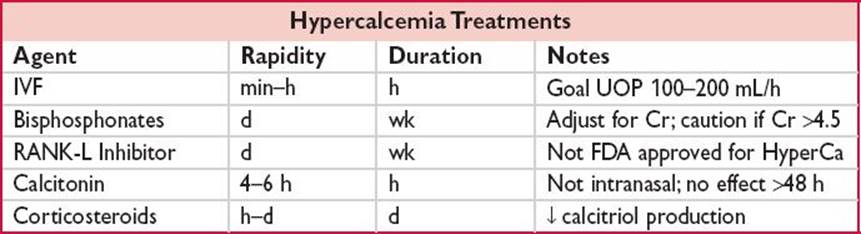
• IVFs are mainstay—correct hypovolemia & ameliorate AKI exacerbating Ca retention
• Osteoclast Inhibition—modern cornerstone of tx
Bisphosphonates: Onset d, lasts 1–2 wks. Zoledronic acid may be superior to pamidronate (JCO 2001;19:558) but either acceptable; zoledronic acid has more risk of worsened AKI than pamidronate. Both have ↑ risk of hypoCa.
RANK-L inhibitor: Not FDA approved for hyperCa tx, but denosumab may be useful in sev. renal failure (Ann Int Med 2012;156:96); ↑↑ risk of hypoCa, esp if recent bisphosphonate use or prostate CA w/blastic lesions.
• Loop diuretics—unnecessary unless renal or HF; no RCTs to support utility (Ann Int Med 2008;149:259). Largely historical use.
• Calcitonin—rapid, temporary reduction in Ca for sev. hyperCa
• HD—particularly if above fail → AKI progresses → sev. hypervolemia

Hyponatremia
• Etiology: Almost always hypotonic, often multifactorial—↓ PO intake, SIADH, renal loss (esp cisplatin-induced), GI loss. Rarely: Atrial natriuretic peptide secretion, cerebral salt-wasting. R/O pseudo-hypoNa w/↑↑ TGs, ↑↑ protein (MM) & hypertonic hypoNa w/↑↑ serum glu, mannitol.
• Clinical Manifestations: Varies based on magnitude & rapidity of decline; Asx → anorexia, nausea, weakness → cerebral edema, confusion, AMS → seizures, coma, death
• W/o: H&P (PO intake, volume status); Serum & urine Osm; Urine Na:Cr; Urine urea (if taking diuretic); TSH, cortisol. See below.

Figure 9-1 Focused Ddx of Hyponatremia in Oncology Patients
FENa, FEUrea = fractional excretion = (Ux/Plasmax)/(UCr/PlasmaCr) × 100
Principles of Treatment
• Chronic Hyponatremia → Brain cells adapt → overly rapid correction → Brain cells swell → osmotic demyelination syndrome (formerly central pontine myelinolysis)
• If onset of hyponatremia unknown, gradually correct: (eg, Na = 115 on Dec 1)
After 24 h: 10 mEQ total increase (eg, Na goal <125 on Dec 2)
After 48 h: 18 mEQ total increase (eg, Na goal <133 on Dec 3)
• Sx of sev. AMS or seizures—3% saline for rapid correction until sx abate regardless of chronicity
Syndrome of Inappropriate Antidiuretic Hormone Secretion (SIADH)
• Etiology: Various.
Ectopic production by tumor—15% of all SCLC, 3% of head/neck, rarer in hematologic malignancies or NSCLC
Chemotherapy Induced—Alkylators (cyclophosphamide, ifosfamide); Vinca alkaloids; platinum agents; bortezomib.
Drug Induced—eg, TCAs, AEDs (carbamazepine, valproic acid, oxcarbazepine); antipsychotics
Other Triggers—infxn, esp PNA; nausea, pain
• Clinical Manifestations: Euvolemic on exam, urine inappropriately concentrated w/o evidence of thyroid or adrenocortical dysfunction
• Tx:
1st line: Free water restriction
2nd line: V2 antagonists: Tolvaptan or conivaptan—directly inhibit water reabsorption in collecting duct → dilutes urine; demeclocycline mainly of historical interest (causes nephrogenic DI).
Lactic Acidosis with Normal Tissue Perfusion
• Etiology: Often seen w/liver mets or rapidly dividing heme malignancies (eg, leukemias, Burkitt Lymphoma)
• Tx: Directed toward underlying malignancy & aggressive hemodynamic support
• High mortality despite aggressive tx