
Rebecca T. Armendariz and Stacy M. Stabler
What is Palliative Care?
• Definition: Palliative medicine is a specialized medical care for people w/serious or life-threatening illnesses. It improves the QoL of pts & their families by focusing on tx of pain & other physical sx as well as relief of the psychosocial & spiritual distress that comes w/a dx of a serious illness.
• The palliative care IDT includes physicians, nurse practitioners, nurses, pharmacists, social workers, case managers, psychiatrists, psychologists, & spiritual care counselors who work together w/the pt’s 1° doctor(s) to provide an extra layer of support
• Palliative care is appropriate at any age & at any stage of a serious illness & can be provided along w/curative or palliative tx in an outpatient clinic, hospital, nursing home, skilled facility, or at a pt’s home
• Hospice care is a delivery system that provides palliative care to terminally ill pts (usu <6 mos life expectancy) in the home, nursing home, or inpt facility
The Palliative Care Consult
• Request a palliative care consult for assistance w/pain & sx management, advance directives, capacity assessment, establishing GOC, breaking bad news, prognostication, withdrawal of life-sustaining tx, disposition planning, addressing end-of-life nutritional support, initiating family meetings, identifying existential distress, addressing spiritual & cross-cultural issues, making appropriate hospice referrals & evaluation for bereavement care
Core Principles for End-of-Life Care
• Assessment is focused on what the pt feels are the most important sx/issues that they need assistance w/
• Respect for the dignity of both the pt & caregivers
• Use of the most appropriate tx c/w pt choice
• Alleviation of pain & other physical sx
• Assess & manage the psychological, social, & spiritual difficulties
• Provide access to therapies that may realistically improve the pt’s QoL, including alternative or nontraditional tx
• Respect the pt’s right to refuse tx
• Respect physician’s professional responsibility to d/c tx when appropriate
• Offer continuity of care (ie, pt should be able to be cared for by his or her 1° care and/or specialist provider)
• Promote clinical & evidence-based research on providing care at the end of life
• Provide access to palliative care & hospice care
Palliative Care Family Meeting
• The main purpose of a family meeting is to improve communication & address any conflicting goals & values between the clinicians, pt, & families. It is a key instrument in sharing medical info, disclosing prognosis, establishing GOC based on the pt’s desires, discussing advance directives & disposition planning in conjunction w/what is medically feasible. This serves as an extra layer of support for the pt, the family, & the medical team.
• Please see “SPIKES” model for breaking bad news

Palliative Care Prognostication
• Physicians tend to be optimistic when determining prognosis & can overestimate by a factor of five (BMJ 2000;320(7233):469–472)
• Pts & physicians make different care decisions based on prognosis so it is essential that it is as accurate as possible
• There are certain common s/s typical indicative of end-stage illnesses (Am J Soc 1992;93:663, Cancer 1984;53:2002)
- Evidence of disease progression
- Multiple emergency depart visits or hospitalizations in last 6 mos
- Involuntary wt loss of >10% of BW in previous 6 mos
- Karnofsky PS of <50%
- Dependence in at least 3 of 6 ADLs

PAIN MEDICATIONS
Lara A. Dunn and Natalie Moryl
Types of Pain
• Nociceptive pain
Somatic pain: Due to nociceptors activation in body surface or musculoskeletal tissues (ie, met bone disease, soft tissue tumors)
Visceral pain: Due to activation of receptors from compression, obstruction, infiltration, ischemia, stretching, or inflammation of the thoracic, abdominal, or pelvic viscera; not well localized (ie, bowel obstruction, bulky liver mets, urinary retention)
• Neuropathic pain: Due to direct injury or dysfunction of peripheral or CNS tissues (ie, compression radiculopathy, postmastectomy & postthoracotomy pain, postherpetic neuralgia)
• Pain emergency: Pain crisis, spinal cord compression, bone fracture, bowel obstruction, & sev. mucositis
Pain Management at the End of Life is a moral obligation to alleviate pain and unnecessary suffering and is not euthanasia. U.S. Supreme Court Chief Justice Rehnquist, “It is widely recognized that the provision of pain medication is ethically & professionally acceptable even when the tx may hasten the pt’s death if the medication is intended to alleviate pain & sev. discomfort, not to cause death.”
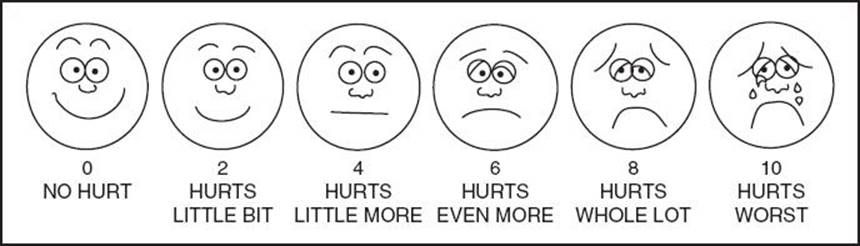
Pain Assessment Scales
• The pt, not the observer, should complete the scale
• Measure pain w/a numeric pain intensity scale of 0–10, verbal rating scale, or a visual analog scale can be used for children or adults
The World Health Organization (WHO) Analgesia Ladder
• Step 1: For mild pain, use acetaminophen, NSAIDs, or another adjuvant analgesic
• Step 2: For mild-to-mod. pain, or persistent pain, add a lower potency opioid (codeine) or a low dose of a stronger opioid (morphine)
• Step 3: For mod. -to-sev. pain, or worsening pain, use strong opioids (morphine, hydromorphone, or fentanyl) (World Health Organization. Cancer Pain Relief with a Guide to Opioid Availability, 2nd ed. Geneva, Switzerland: World Health Organization; 1996)
Opioids Treatment Guidelines
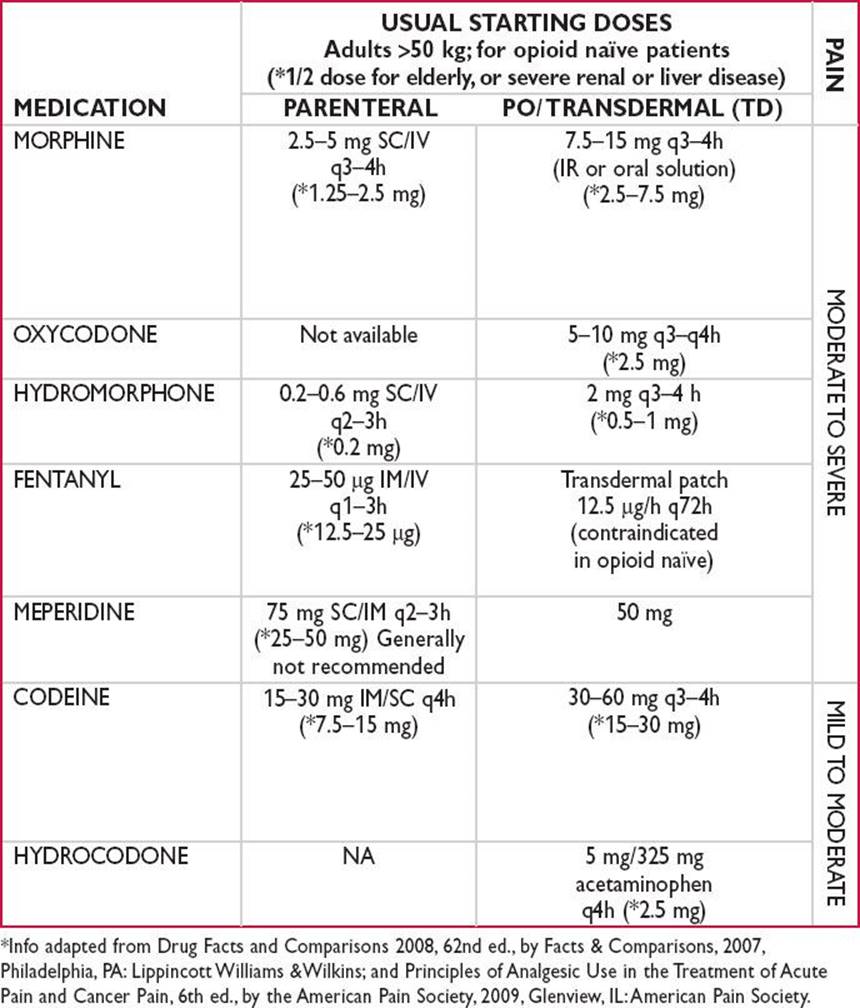
• For mod.-to-sev. pain (w/close supervision):
1. In opioid naïve, start w/prn IV morphine 2.5–5 mg (or an equivalent); in opioid-tolerant, start w/20% of the daily dose IV every 15 min–2h prn
2. After determining the effective & tolerated daily dose (sum of all doses given w/in the last 24 h), give the opioid around the clock & 10–20% total daily dose q1–2h prn
3. Adjust baseline upward daily based on total amount of prn
• For chronic use oral route is preferable, then transcutaneous > SC > IV
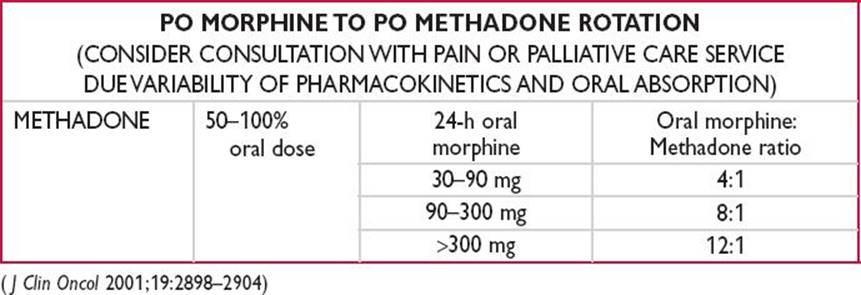
• When converting from one opioid to another, reduce the equianalgesic dose by 1/3–1/2 (see table for rotation to methadone)
• In elderly pts, or those w/sev. liver or renal disease, start 1/2 the usual dose (NCCN Clinical and Practical Guidelines in Oncology. Adult Cancer Pain)
Pain Management in a Patient with Addiction
• Consider multidisciplinary team approach & a consultation w/an addiction specialist
Opioid Adverse Side Effects
• Constipation (no tolerance), N/V (tolerance develops in 3–7 d), urinary retention, hypogonadism, sedation, respiratory depression (only after the onset of sedation), myoclonus, delirium, seizures, respiratory arrest & death
Opioid Overdose
• Manifestations: Respirations <6/min, myoclonic twitching, constricted pupils, skeletal muscle flaccidity, cold or clammy skin
• Stop administering opioids, wait for the medication to wear off, stimulate pt
• Naloxone—0.4 mg diluted in 10 mL NS, give 1 mL q5min to reverse respiratory depression or sev. sedation; may need an infusion to counteract the effect of LA methadone or fentanyl patch

Adjuvant Analgesics
• Antidepressants (TCA, SSRI, etc.): For visceral & neuropathic pain, time to effect 3 d after reaching therapeutic level (ie,: For amitriptyline 75–125 mg/d)
• Anticonvulsants (gabapentin, pregabalin, etc.): For neuropathic pain, time to analgesia 3–7 d after reaching therapeutic levels (gabapentin 2400–3600 mg/d)
• NSAIDS: For bone pain or for opioid-sparing agents; s/e: GI & renal tox, HTN, leg swelling
• Steroids: For pain from ↑ ICP or bone pain; s/e: GI tox, osteoporosis, insomnia, wt gain, infxn
• Ketamine: Can be analgesic at subanesthetic doses (start w/2 mg/h, titrate up by 2 mg every few h, time to analgesia—min to h); min. s/e at low doses (below 12–15 mg/h)