
Elizabeth Won and Matthew J. Matasar
Overview
• W/improvement in dx & tx of CA, there are millions of CA survivors, w/the number increasing
• Pts experience the nl issues of aging, w/c are compounded by the long-term effects of CA & CA tx
• CA survivors are at ↑ risk of developing morbidity & illnesses at younger age than general population due to their CA tx
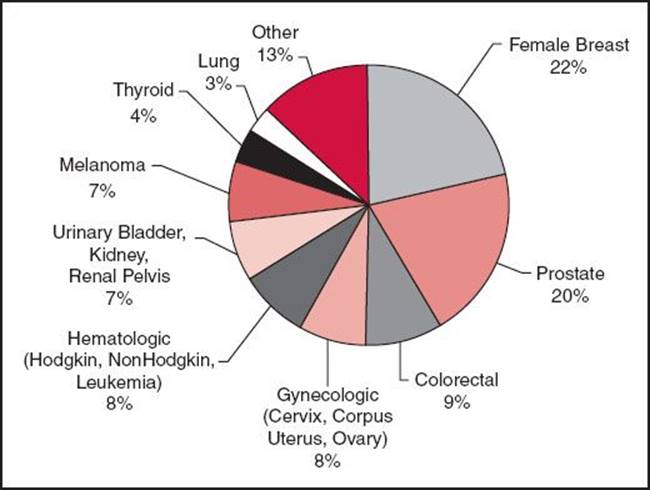
Figure 11-1 Cancer Survivors in United States by Cancer Type
Data source: Mariotto AB, Yabroff KR, Shao Y, et al. Projections of the cost of cancer care in the United States: 2010–2020. J Natl Cancer Inst. 2011;103(2): 117–128. Epub 2011 Jan 12.
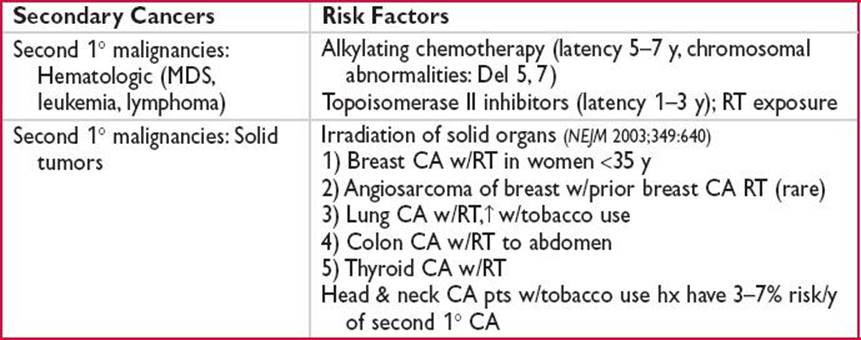
Secondary Cancer Risks of Treatment
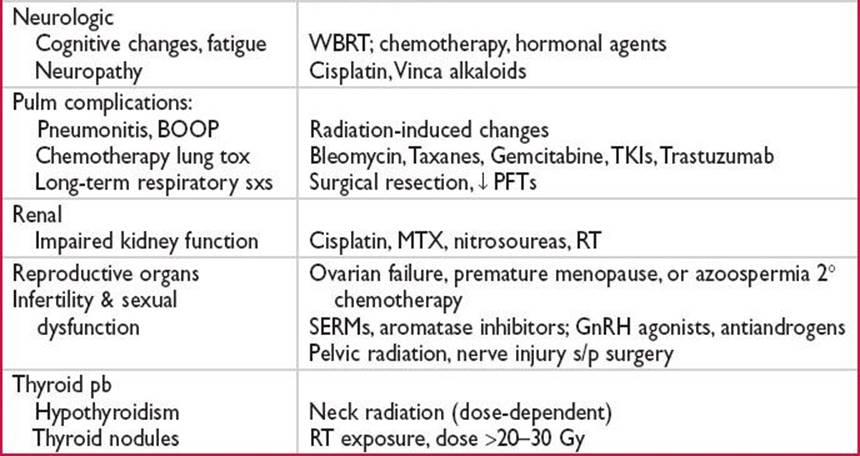
Long-term Medical Complications of Cancer Treatment

Key Components of Survivorship Care
1. Surveillance for recurrence
2. Prev & detection of new CAs
3. Interventions for consequences of CA & its tx
4. Coordination between specialists & 1° care providers
5. Promotion of health behaviors: Smoking cessation, ↑ physical activity, healthy low-fat diet
6. Addressing concerns related to psychological distress, employment, insurance, disability
Survivorship Care Plan
• Comprehensive care summary & clear follow-up plan should be completed after 1º tx for all pts
• Tx summary should include the following.
CA type
Tumor characteristics (site, pathology, stage, grade)
Tx received: Surgery, chemotherapy, biologic, hormonal Rx, transplant, radiation (include agents, dose, sites, dates)
Care provider & institution contact info
• Survivorship Care plan should include the following.
Timing & type of surveillance recommended; recommendations for preventive practices & monitoring of potential consequences of tx; address potential psychosocial concerns