
Eric L. Smith
Biochemical Recurrence
• By PSA After Definitive RT
Dfn: Post RT rising PSA by 2 ng/mL or more above the nadir PSA
W/U options include: Eval for local/distant disease: Bone scan, CT/MRI/US, prostate bx
Candidate for salvage surgery if original T1–T2, NX or N0, life expectancy >10 y, current PSA <10
No distant mets identified, prostate bx pos, candidate for salvage as above
Local tx options: RP, cryosurgery, brachytherapy ± ADT
No distant mets identified, prostate bx neg, or not candidate for salvage
Observation vs. ADT (see below) Consider intermittent ADT
• By PSA After Definitive RP
Dfn: Undetectable PSA after RP w/subsequent detectable PSA >0.2 ng/ml that is confirmed on subsequent determination
W/U options include: bone scan, CT/MRI/US, bx prostate bed if suggested by imaging
No distant mets identified Observation vs. Salvage RT ± ADT vs. ADT alone, consider intermittent ADT
• Distant mets identified See below
Initial Treatment for Metastatic Castration Sensitive Disease
• Dfn: Prostate Ca that responds to lowering testosterone to castrate levels (conventionally defined as <50 ng/dl)
• N1 RT + long-term neoadj/concurrent/adj ADT (2–3 y) or ADT alone
• M1 ADT or dual ADT + anti-androgen
Androgen Deprivation Therapy
• GnRH agonists such as leuprolide as daily or depot inj ± anti-androgen such as bicalutamide for at least 7 d to prevent flare
• GnRH agonist + anti-androgen (eg, bicalutamide, nilandron)
• Degarelix (pure GnRH antagonist, thus avoiding initial disease flare)
• Rarely/historically: Orchiectomy
• S/e: Hot flashes, vasomotor instability, osteoporosis, fractures, obesity, diabetes, HLD, CAD, decreased libido, mood lability S/e increase w/duration of tx
Treatment for Castration Resistant Disease
• Dfn Progressive disease despite castrate levels of testosterone
• Maintain castrate levels of testosterone w/GnRH agonist
• 2nd hormone Rx: Anti-androgens as above, anti-androgen withdrawal, abiraterone, ketoconazole
Treatment for Castration Resistant Disease Continued
• Docetaxel Taxane (NEJM 2004;351:1502; JCO 2008;26:242)
• Sipuleucel-T DC leukapheresed & exposed to prostatic acid phosphatase Ag fused to GM-CSF ex vivo, & re-introduced; OS benefit but no change in PSA or tumor burden, appropriate only if asx, ECOG 0–1, no visceral mets, not on: Steroids, RT, chemo, or immunotx, & life expectancy >6 mos (NEJM 2010;363:411)
• Cabazitaxel Taxane derivative, only used post docetaxel (Lancet 2010;376:1147)
• Abiraterone Acetate Inhibits cytochrome P450 c17 (lyase, hydroxylase) reduces testosterone/dihydrotestosterone from adrenal, testis, & tumor sources, approved for pts both pre & post docetaxel (NEJM2010;364:1995; NEJM 2013; 368:138)
• Enzalutamide Inhibits nuclear translocation, DNA binding, & coactivator recruitment of/by androgen receptor, post docetaxel (NEJM 2012;367:1187)
Notes: Above are the only 5 systemic agents that have shown increased OS in this setting.
• Mitoxantrone for Pts who are not candidates for docetaxel
All agents above except enzalutamide & sipuleucel are given in combination w/prednisone.
Mechanism of Action of Anti-Androgen Therapies
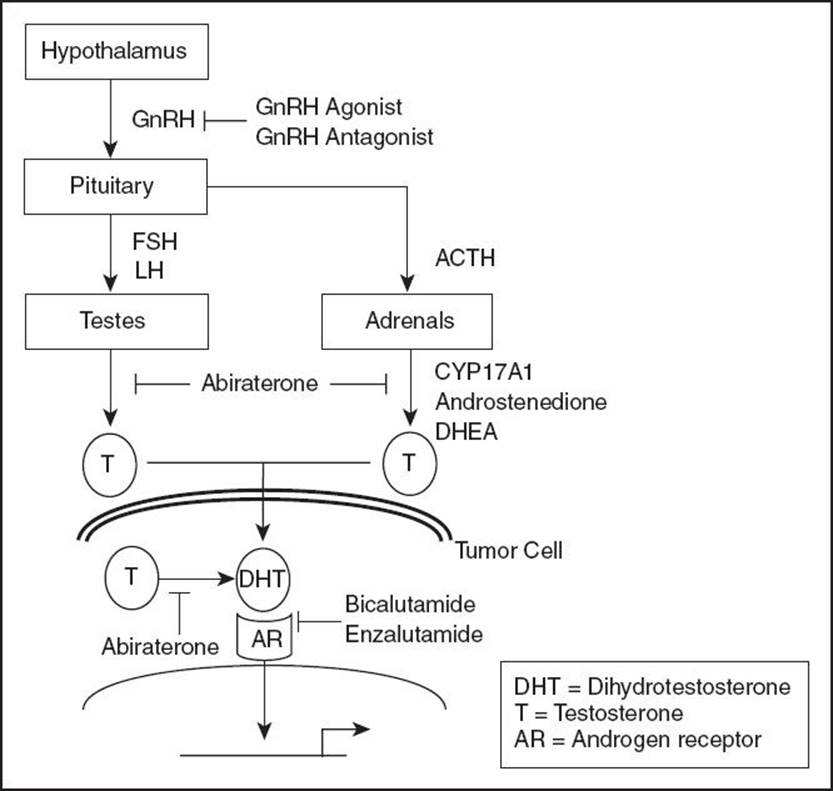
Clinical Use Algorithm
• Castration-resistant mets before docetaxel
Maintain castrate levels of testosterone w/LHRH agonist
Further options include:
Abiraterone
Sipuleucel-T (if meets requirements above)
Docetaxel
Palliative RT
Bone-seeking radiopharmaceuticals
• POD Post-Docetaxel Rx
Maintain castrate levels of testosterone w/LHRH agonist
Further options include:
Abiraterone
Enzalutamide
Cabazitaxel
Docetaxel rechallenge if previously sensitive
Mitoxantrone
Sipuleucel-T (if meets requirements above)
• Special Consideration for Bone Mets
In addition to above:
Denosumab or Zoledronic acid to lower risk of SREs in castration-resistant disease
If symptomatic: Palliative RT or radionuclide (β emitters)
Small Cell
• Distant mets identified on imaging
Consider bx if suspect small cell
• Small cell pos on bx treat similar to SCLC
Cis/Etoposide
Carbo/Etoposide
Docetaxel-based regimens
Monitoring
• After N1 or M1 Physical exam & PSA q3mos,