
Dmitriy Zamarin and Leonard Saltz
Epidemiology
• See colon cancer
Risk Factors
• See colon cancer
Genetics
• See colon cancer
Pathology
• See colon cancer
Clinical Presentation
• See colon cancer
Screening
• See colon cancer
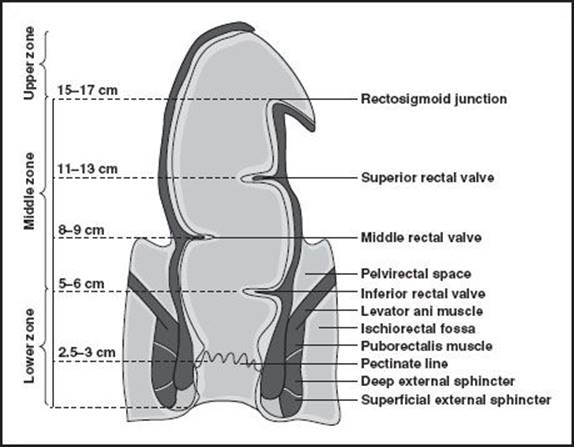
Figure 15-3 Anatomy of rectum
General Diagnostic Evaluation
• Colonoscopy
• CT of chest abdomen & pelvis
• LFTs, CEA
• KRAS Mt status in pts w/met disease
• MSI testing or IHC for MMR proteins in pts <50
Diagnostic Evaluation for Localized Staging
• Transrectal ultrasound (TRUS): 80–95% accuracy of distinction between T1/2 vs. T3 tumors. Operator dependent. Inadequate for deeply invasive tumors or evaluation of distant iliac adenopathy
• MRI: High degree of accuracy for prediction of circumferential resection margin or CRM (MERCURY BMJ 2006;333:779), less operator dependent, allows for study of stenotic tumors & pelvic adenopathy
• Both modalities may provide complementary info
• CT: Helpful for staging distant met spread, limited for local tumor & nodal staging
• PET: Offers no additional significant info for locoregional staging but can be useful for localizing tumor in RT planning
Clinical Staging & Treatment
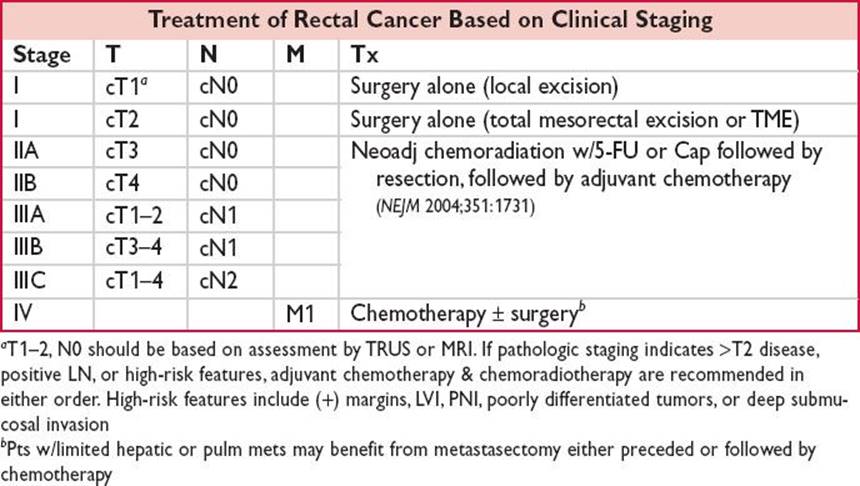
Principles of Surgical Resection:
• Total mesorectal excision (TME): Removal of the perirectal areolar tissue & includes the lateral & circumferential margins of the mesorectal envelope. Improved local control & ↑ survival rates (Lancet1993;341:457)
• Regional LND: Dissection of mesorectum & the regional LN (>12 LN)
Surgical Procedures & Criteria
• Local excision: Transanal, trans-sphincteric, or posterior parasacral approach
Criteria
T1 CAs
No radiographic evidence of LN involvement
Mid- to distal rectal location
Tumors <3 cm in diameter & <30% circumference of bowel
Clear margin
No high-risk features (poorly differentiated, LVI, PNI)
Reliable postoperative surveillance
• Sphincter-sparing resection (eg, low anterior resection, coloanal resection): Removes sigmoid colon & rectum to the level of clear distant margin
Criteria
Invasive rectal CAs beyond the submucosa
Histologically proven negative distal margin
• Abdominoperineal resection (APR): Involves resection of the sigmoid colon, rectum, & anus, w/construction of permanent colostomy
Criteria
Negative distal margin of resection cannot be achieved w/sphincter-sparing procedures
Salvage procedure for local recurrence or locally adv rectal CA
Principles of Radiation & Chemoradiation
• Adjuvant RT reduces local recurrence, but has no OS benefit
• Adjuvant chemoradiation is superior to adjuvant RT alone w/OS benefit (NEJM 1994;331:502)
• Neoadj chemoradiotherapy is superior to adjuvant chemoradiotherapy w/↓ local relapse rate & ↑ tolerance, but no OS benefit (NEJM 2004;351:1731)
• Neoadj chemoradiotherapy w/infusional 5-FU is superior to radiation alone w/improved response & local control (NEJM 2006;355:1114)
• No benefit of addition of OX or irinotecan to 5-FU during radiation
• Neoadj chemoradiation w/Cap is equivalent w/chemoradiation w/infusional 5-FU (Lancet Oncol 2012;13:579)
• Current guidelines: 45–50 Gy in 25–28 fractions to the pelvis concurrent w/infusional 5-FU or Cap in the neoadj setting
Principles of Adjuvant Chemotherapy in Early Stage Disease
• No direct evidence for benefit of adjuvant chemotherapy after preoperative chemoradiation, but FOLFOX/CapeOX are recommended as extrapolation from colon CA data (MOSAIC NEJM 2004;350:2343)
• Postoperative Rx is indicated in all pts who receive preoperative Rx regardless of pathology results from resection
Surveillance After Initial Therapy
• Hx & physical every 6 mos for 5 y
• CEA every 6 mos for 5 y
• CT of chest/abdomen/pelvis annually for 5 y
• Colonoscopy in 1 y; if no adv adenoma repeat in 3 y, then every 5 y
• Endoscopic evaluation of anastomosis site every 6 mos for pts post LAR
Chemotherapy in Advanced & Metastatic Disease
• See colon cancer