
David B. Page and William D. Tap
Epidemiology
• 16% of 2890 1° bone CA in 2012 in US
• 70% in <20 y, incidence 2.9/m among <20 y; 9:1 White:Black
• 65–90% present w/localized disease (55% 5-y OS); 10–35% p/w mets (22% OS) (EICESS J Clin Oncol 2000;18:3108)

Etiology and Clinical Manifestations
• ESFTs are small round cell neoplasms thought to originate from neural crest cells w/shared genetic alterations
• Bone pain/swelling, constitutional sx, leukocytosis
• Met sites: Lungs, bones, BM
• Poor prognostic factors: Mets, pelvic bone involvement, adult age, large tumor
• Favorable prognostic factors: Distal 1°, nl LDH, localized, tx response
Molecular Biology
• EWS/ETS t(11;22): EWS gene (22q12) encodes a potent transcriptional activator & fuses w/ETS family of genes
• ETS family: EWS/FLI1 most frequent (85% of ESFTs), others include ERG, ETV1, ETV4, or FEV
• EWS/WT1: Diagnostic of desmoplastic small round cell tumor
• FUS/ETS: Rare ESFTs will exhibit fusion of FUS instead of EWS
• CIC/DUX4: Identified in some EWS-negative primitive round cell tumors
• Fusion subtype does not affect prognosis or tx recommendation
• MIC2(CD99): Glycoprotein strongly expressed in many ESFTs; can be used to histologically support dx
Workup and Staging
• Staging systems are not often clinically utilized given poor prognostic performance
• AJCC 7th ed. TNM 2010 staging
• Stage IA: Tumor ≤8 cm (T1) + N0, Stage IB: Tumor >8 cm (T2) or discontinuous tumors (T3) + N0 + well-mod diff (G1–2) Stage IIA: T1N0 + poorly diff–undiff (G3–4); Stage IIB: T2N0 & G3–4, Stage III: T3N0 + G3 Stage IVA: N0 + lung mets (M1a); Stage IVB: Involved nodes (N1) or nonlung mets (M1b)
• Surgical Staging System (SSS)
• Stage IA: Low grade (G1) + intracompartmental (T1); Stage IB: G1 & extracompartmental (T2); Stage IIA: High grade (G2) + T1; Stage IIB: G2 + T2; Stage III: Regional or distant mets
• Bx: Core needle or open, send for cytogenetic/FISH analysis, avoid FNA; bx tract must be resected at time of surgery given high risk of seeding
• Staging w/u: BM bx, CT chest, XR, & CT/MR of 1°, PET or bone scan; whole-body MRI may be of utility in pediatric pts
• Fertility consultation should be offered prior to chemo
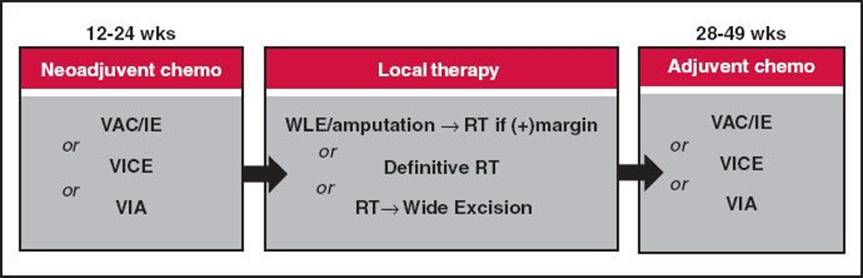
Figure 16-3
Management: Nonmetastatic Disease
• Accepted paradigm is neoadjuvent chemo followed by restaging, local Rx, then adjuvant chemo (see above)
• Neoadj multiagent chemo: Downstages tumor (↑ probability of complete resection), treats micrometastatic disease, allows for assessment of response prior to local Rx
• Neoadj regimens: 12–24 wks tx w/G-CSF
• VAC/IE: Vincristine + doxorubicin + cyclophosphamide alternating w/ifosfamide + etoposide q3wks (q2wks if <18 yo) (N Engl J Med 2003;348:694)
• VIDE: Vincristine + ifosfamide + doxorubicin + etoposide (J Clin Oncol 2008;26:4385)
• VAI: Vincristine + doxorubicin + ifosfamide (J Clin Oncol 2008;26:4385)
• Interval-compressed tx (q2wks chemo) may improve efficacy
• Restaging: MR of 1° & CXR, or PET/bone scan. If stable or response → proceed to local Rx & chemo; if no response → RT ± surgery followed by 2nd-line chemotherapy (below)
• Local Rx: Either pre-op RT + surgery, or surgery + post-op RT (if (+) margin), or definitive RT
• Surgery: Limb-sparing resection preferred if limb functionality can be retained, alternative is amputation. Physiatry consultation recommended
• Adjuvant Chemo: 28–49 wks add’l chemo (same regimens as above)
• Surveillance: PEX, chest imaging, & 1° site imaging q3mos, ↑ interval after 24 mos, annually after 5 y; monitor for tx-related malignancies
Management: Primary Metastatic Disease
• Multiagent chemo: Preferred regimen is VAC: Vincristine + doxorubicin + cyclophosphamide (J Clin Oncol 2004;22:2873)
• Neoadjuvent regimens (above) are accepted alternatives
• If clinical response, consider surgical resection/RT of residual disease
Management: Relapsed and Primary Refractory Disease
• 30–40% pts recur; portends poor prognosis (50% 5-y OS if local recurrence; 14% if distant recurrence)
• Late relapse (≥2 y): 50% 5-y OS, re-treat w/original regimen, resection if possible
• Early relapse (<2 y): 8% 5-y OS, clinical trial preferred, or 2nd-line chemo
• 2nd-line chemo: Cyclophosphamide + topotecan, temozolomide + irinotecan, ifosfamide + etoposide ± carboplatin, docetaxel + GEM (vincristine may be added to any of these regimens)
• Isolated pulmonary mets: ↑ Prognosis; tx w/serial resection + chemo ± RT (whole lung RT in peds; controversial in adults)
Management: CNS PNET
• Paradigm is surgical resection followed by adjuvant RT then chemo
• Surgery: Maximal surgical resection if possible, o/w a partial resection at referral center. 2nd-look surgery may be necessary to remove residual tumors. Consider neoadjuvent chemotherapy to downstage
• Adjuvant tx: Radiation benefit is dose dependent & stereotactic techniques are being investigated to reduce tox; enrollment in adjuvant clinical trial is preferred for chemotherapy (multiple regimens are utilized)
• Craniospinal axis radiation is used for pts w/spinal dissemination
• Post-surgical w/u: Contrast-enhanced MRI brain & spine; LP w/CSF analysis for cytology 2+ wks after surgery