
Eric L. Smith and Alan L. Ho
Definition
• Malignant tumors such as mucoepidermoid carcinoma and adenoid cystic carcinoma, arising from the major salivary glands include the following.
Parotid (85%)
submandibular
sublingual
• Minor salivary glands (many of w/c are on the hard palate)
• Less frequent: Adenocarcinoma, acinic, malignant myoepithelial tumors, SCC, & others
Epidemiology
• 6–8% of H&N CA
• 2000–2500 cases/y in US
Risk Factors
• Radiation, Smoking (Warthin Tumor, benign), HIV, EBV (lymphoepithelial carcinoma)
Poor Prognostic Factors
• High histologic grade, large tumor size, local invasion including PNI & LVI
Genetics
• MEC: t(11;19): MECT1-MAML2 fusion; EGFR overexpression
• ACC: t(6;9): MYB-NFIB fusion leading to overexpression of many c-myb targets including VEGFA, KIT, FGF2, & BCL2 all of w/c are potential therapeutic targets (PNAS 2009;106:18740). Also commonly expressed are NCAM, NGF, & TrkA w/c may explain its proclivity for PNI.
Historical Clinical Subtypes
MEC:
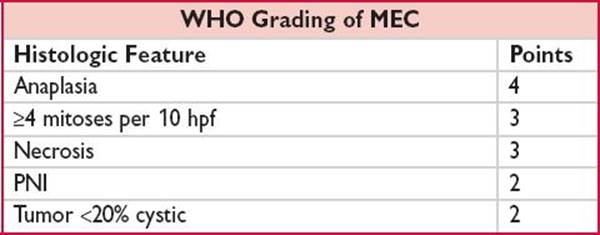

ACC: Tubular (grade 1), cribriform (grade 2), solid (>30% solid = grade 3)
Diagnosis
• H&P inc fiberoptic exam
• CT/MRI base of skull to clavicle in adv CA
• Chest imaging w/CXR or CT
• FNA
General Staging
• Stage I: ≤2 cm w/o extraparenchymal extension
• Stage II: 2–4 cm w/o extraparenchymal extension
• Stage III: >4 cm and/or extraparenchymal extension and/or + LN <6 cm
• Stage IV: Invades skin, mandible, ear canal, facial nerve, skull base, encases carotid art, and/or LN >6 cm, and/or distant met (stage IVC)
Localized Disease (Stage I–IVB) Management
• Complete surgical resection if possible For parotid tumors, w/preservation of facial nerve as goal if it is not directly involved in the tumor
• Consider post-op RT: While there is no prospective data this is often done if intermediate-high grade, or low grade plus any 1 of: PNI, pos margins, or tumor spillage, or any ACC
Locoregional Recurrence Management
• If resectable: Salvage w/surgery, although outcomes are disappointing
• If not resectable: RT for selected pts, although re-recurrence is common
• If pt is not appropriate for surgery or RT: Treat as met disease
Metastatic Disease (Stage IVC) Management
• Most commonly to lung, liver, & bone (bone signifies more aggressive disease)
• While there is a wide range, median survival for ACC is 3 y
• Unclear if chemo alters course of disease, use mainly for palliation of disease-related sx
• Recommendations are based on small phase I–II trials
• ACC: Potentially active single agent tx w/anthracycline, vinorelbine, or cisplatin. Combination tx can potentially result in higher RR, but unclear if there is any overall advantage over single agent Rx. Value of second-line Rx is unproven (Lancet Oncol 2011;12:815)
• MEC: Cyclophosphamide, doxorubicin, & cisplatin (CAP) ± 5-FU combination Rx is most widely studied w/ORR of 40–50%, mostly stabilization of disease lasting 3–7mos (Cancer 1987;60:2869). Single agent choices: Those mentioned for ACC above or paclitaxel
Molecular Targeted Therapy
• KIT targeted by Imatinib, no objective responses (Oral Oncol 2007; 43:33)
• EGFR targeted by Cetuximab, no objective responses, 67% stabilization for median 6 mos; & Gefitinib no objective responses (JCO 2006;24:2673)
• EGFR/HER2 targeted by Lapatinib no objective responses, 36% stabilization of >6 mos (JCO 2007;25:3978)
• VEGFR, PDGFR, MYB, AKT are all rational targets under active investigation for ACC.