
Jane L. Meisel and Monica Girotra
PHEOCHROMOCYTOMA/PARAGANGLIOMA
Diagnosis
• Classic triad of sx: (HA, diaphoresis, tachycardia); refractory or paroxysmal HTN/“spells”; other = palpitations, tremor, pallor, SOB
• Screen w/24 h-urinary fractionated metanephrines + catechols in lower-risk pts; plasma fract metanephrines in pts w/high pretest prob of disease); if screen nl, no further testing needed but if metanephs ↑ ↑, then CT AP or MRI; if neg scan but suspicion still ↑, consider MIBG, PET, octreotide scan
• Catecholamine-secreting tumors in adrenal = pheochromocytoma; extra-adrenal catechol-secreting tumors = paragangliomas
• Pts at ↑ risk for pheo (MEN2, VHL), previously surgically cured pheos or paragangliomas), screen w/plasma fract metanephs → if mildly ↑ normetanephrine, perform 24 h-urinary fract metanephs, catechols, & imaging.
Treatment
• Surgery: Pre-op medical tx → control HTN, prevent HTN crisis, volume expansion
• Pre-op a-adrenergic blockade (phenoxybenzamine) 10–14 d pre-op to normalize BP/expand contracted blood volume, then low-dose b-blockade (propranolol) after adequate α-blockade (∼2–3 d pre-op)
• Never start βB first b/c unopposed α activity can further ↑ BP.
• Start ↑ -Na diet on 2nd/3rd d of α-blockade to counteract catechol-induced volume contraction & orthostasis a/w α-blockade (note: May be contraindicated in CHF/renal insuff); Ca channel blockers also can be used
• Metyrosine (inhibits catechol synthesis) when other agents ineffective or contraindicated or w/prior marked tumor manipulation (ie, RFA of mets)
• Sporadic adrenal pheo- entire gland should be removed; Familial pheo (ie, MEN2, VHL)- ↑ incidence of b/l disease. If b/l adrenalectomy planned, pt should receive stress dose steroids
• Malignant pheo (10%): No difference from benign pheo histo or biochemically; mets or local invasion often only clue, necessitating long-term f/u for all
• Tx of malignant pheo:
• Resect w/intent to cure (entering capsule predisposes to recurrence)
• External XRT or cryoablation in pts w/painful skeletal mets; tumor irradiation w/131I-MIBG may be helpful; RFA of hepatic or bone mets
• Chemo w/cyclophosphamide, vincristine, & dacarbazine (CVD) if tumor aggressive or low QOL; early evidence suggests TKIs may be useful (J Clin Endocrinol Metab 2009;94(5):386).
MEN
• MENs = hereditary tumor syn w/distinct patterns of organ involvement
• Mt in MEN1 gene → type 1 multiple endocrine neoplasia (MEN1), Mt in RET proto-oncogene → type 2 multiple endocrine neoplasia (MEN2)
MEN1
• MEN 1= autosomal dominant predisposition to tumors of parathyroid, anterior pituitary, & enteropancreatic cells
Clinical Presentation
• Multiple parathyroid adenomas → 1° HPT is often 1st manifestation, w/almost 100% penetrance by 40–50 y (J Clin Endocrinol Metab 2001;86:5658); most pts asx & picked up by ↑ Ca w/in approp ↑ serum PTH
• Pituitary adenomas → prolactinoma most common; other types occur (ie, somatotroph, corticotroph, co-secreting, nonfunctional pituitary tumors); larger & more aggressive than those in non-MEN pts
• Pancreatic islet cell/GI tumors (1/3 of pts) → Zollinger–Ellison most common; also insulinoma, somatostatinoma, glucagonoma, VIPoma, clinically nonfunctioning tumors
• Other tumors → Carcinoid; cutaneous, adrenal tumors; pheo, ependymoma
Diagnosis and Treatment
• Dx: Based on presence of 2 of 3 main MEN-associated tumor types (1 of 3 in family member of known MEN1 pt). DNA testing for MEN1 gene Mt is commercially available; screening of family members w/serum Ca (given high presence of 1° hyperpara) can also be considered
• Tx: Subtotal parathyroidectomy (removal of 3.5 glands or removal of all 4 w/auto transplantation of parathyroid tissue) if sx ↑ Ca, nephrolithiasis, evidence of bone disease (↓ bone density, fracture); pituitary adenomas should be treated in the same way as sporadic pituitary adenomas (see section on Pituitary Adenomas); PPIs for gastrinoma (if well controlled w/PPI, role for duodenal/pancreatic surgery to prevent met disease unclear); surgery for insulinoma (usu local excision of tumor in pancreas head + distal subtotal pancreatectomy); medical mgmt of hormonal hypersecretion
• Monitoring (in established MEN1 pts, known Mt carriers, & at-risk family members): Look for sx of MEN1-assoc tumors (nephrolithiasis, amenorrhea, galactorrhea, erectile dysfunction, peptic ulcers, diarrhea, sx of hypoglycemia); √ annual serum Ca to detect asx hyperpara that might require surgery; addt’l surveillance w/further biochemical & imaging modalities can be considered
MEN 2
• Subclassified into MEN2A, MEN2B, & FMTC
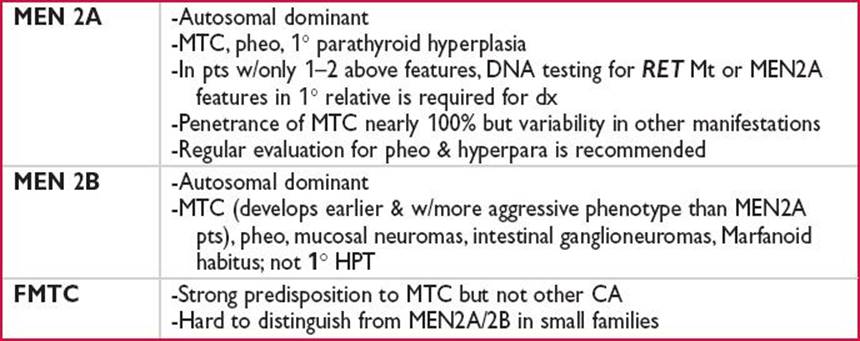
• In contrast to MEN1, early dx by genetic screening of “at-risk” family members in MEN2 important → presence of specific RET Mt predicts age of onset, aggressiveness of MTC, & likelihood of other endocrine neoplasms
• In an MEN2 family, a sample from a known affected pt should be tested to determine specific RET Mt for that family. When germline RET Mt found, family members of unknown status should be definitively genotyped
• Timing of ppx thyroidectomy, initiation of screening for pheo & 1° hyperpara depends on specific DNA Mt in the RET proto-oncogene
• Initial mgmt of MTC in suspected MEN pts:
• Eval for pheo prior to thyroidectomy & if found, remove pheo first
• Limited local disease or limited local mets: Total thyroidectomy + proph central neck dissection; if LNs seen in lateral neck + no/limited distant mets: Also do lateral neck dissection; in presence of adv local or distant disease, less aggressive neck surgery can be considered
• Postoperative monitoring for recurrent MTC (Kloos RT, et al. Thyroid 2009;19:565)

• Persistent/met MTC: XRT to neck/upper mediastinum in pts w/extrathyroidal disease/nodal mets (if curative dissection impossible)
• Systemic tx for progressive met disease: Oral TKIs (vandetanib, cabozantinib have good phase III data to support their use in this setting) (J Clin Oncol 2012;30(2):134; J Clin Oncol 2012;30(suppl; abstr 5508); dacarbazine-based chemo if disease progresses despite multiple TKIs; immunotherapy & radiolabeled octreotide (investigational)