
Douglas H. Thamm
Key Points
· Cancer is a disease we can sometimes cure.
· The four most dangerous words in cancer treatment are “Let’s just watch it.”
· Obtaining a diagnosis prior to surgery is important.
· Often, the part of the tumor that we can see and feel is only the “tip of the iceberg.”
· Pets experience chemotherapy differently from humans.
· Fewer and less severe side effects
· Most dogs and cats do not lose a lot of hair from chemotherapy
· The sooner we start chemotherapy, the better chance the drugs have to do their job.
· Radiation therapy is a form of local therapy.
· Side effects like nausea, fatigue, or bone marrow suppression do not occur.
· Pets are not radioactive after treatment.
Introduction
There is a great stigma attached to a diagnosis of cancer. It is natural for owners of pets with cancer to relate cancer treatment in animals with the experiences they have had with their own treatments, that of their friends, or their family members. Understanding how cancer treatment in animals differs from cancer treatment in humans is critical when informing owners about cancer and discussing treatment options. Pet owners want to make an informed decision when selecting treatment for their dogs or cats with cancer, and the veterinary technician is often called upon to help answer these questions for the owners.
This chapter describes many of the common questions that owners have about animal cancer and its treatment, and some ideas on how to answer those questions. It is presented in a “question-and-answer” format, with explanations and additional information following the answers.
General Information, Pretreatment Diagnostics, and Staging
Client: Is cancer really a problem in animals?
Technician: Unfortunately, yes. It is the leading “natural” cause of death in adult dogs and the second or third leading cause in cats. Up to 50% of dogs and 30% of cats will be affected by some type of tumor in their lifetime.
Client: Why does it seem like there is so much more cancer in pets these days?
Technician: Better health care = longer life. Cancer is an old-age disease, and more pets are living long enough to get old-age-related illnesses.
Explanation
We are getting so good at managing other husbandry-related conditions in our pets (nutrition, infection, parasites, keeping pets indoors and on leashes) that they are now living long enough to develop more old-age conditions, such as heart disease, kidney disease, endocrine disease, and cancer. Furthermore, now that there are more cancer specialists and options for treating cancer in pets, it is being reported more frequently.
Client: Did something in the environment play a role in Sparky’s cancer? Was I feeding the wrong food?
Technician: For most forms of cancer, we don’t know of any specific causes.
Explanation
There have been some relationships suggested between certain types of cancer and the environment. For instance, some suggest a relationship between canine lymphoma and certain farm chemicals or living in urban areas. Canine mesothelioma has been linked to asbestos. Second-hand smoke has been a suggested contributor to feline gastrointestinal lymphoma. But in most cases, such associations do not hold up to further investigation. Thus, based on what we currently know, food additives, lawn chemicals, pesticides, or cosmic rays do not seem to significantly increase a pet’s risk of most cancers.
Client: What is the difference between “cancer” and “tumor”?
Technician: There is no practical difference. Both refer to abnormal masses in the body that occur as a result of cell growth that has become disorganized and no longer responds to the normal signals telling them to stop growing.
Client: What is the difference between “benign” and “malignant”?
Technician: Malignant tumors are those that have the ability to invade surrounding tissues deeply and/or spread to other parts of the body. Benign tumors do not spread and do not invade very deeply. Small surgery is much more likely to permanently fix a benign tumor than it is to fix a malignant tumor.
Client: Why should I treat my dog’s cancer?
Technician: Cancer is a disease that we can sometimes cure. Diseases like heart disease, diabetes, and other endocrine diseases, as well as cancer, can all be thought of as chronic diseases. We treat many animals with chronic diseases that are never cured. Even in cases where cure is unlikely, there are many ways we can extend a pet’s excellent quality of life with treatment.
Client: Why can’t we just watch the mass and see what happens?
Technician: The four most dangerous words in cancer treatment are “Let’s just watch it.” The sooner we know what this is, the sooner we can begin appropriate treatment.
Explanation
Owners may question why a fine needle aspiration or biopsy of a mass needs to be performed, rather than simply monitoring the mass for change. In general, delay in diagnosis only increases the difficulty of treatment because delay allows the tumor to grow. This may mean a larger, more complicated, more risky, or more expensive surgery. Larger tumor size is associated with worse outcomes for several important veterinary cancers. The lump you are dealing with may be benign, but if it is malignant, the time to find that out is now.
Client: Doesn’t performing a fine needle aspiration or biopsy make the tumor “angry” and increase the risk of spread?
Technician: NO. There is no risk of increased spread from a fine needle aspiration or biopsy.
Explanation
Exceptions to this rule are the following:
(1) Some mast cell tumors may become “inflamed” following a fine needle aspiration due to histamine release, although this does not, in any way, increase the spread. This is rarely serious and can be treated or prevented with an antihistamine, such as diphenhydramine.
(2) Needle aspiration/needle core biopsy of splenic and bladder masses is not recommended due to the risk of local tumor dissemination in the abdomen and/or seeding of the biopsy tract. In these situations, tumor cells can seed either the abdominal cavity after bleeding (spleen) or the body wall as tumor cells are dragged through it by the needle (bladder). Cytocentesis for urine collection in patients suspected or known to have bladder cancer should likewise be avoided.
(3) It is important that needle aspirations and biopsies of cutaneous/subcutaneous masses are planned so that the biopsy tract can be removed when the tumor is removed. This will prevent regrowth along the tract.
Client: Why don’t we just take the tumor off? Why do we need to do a fine needle aspiration or biopsy first?
Technician: Knowing what we are dealing with before surgery lets us know how big a surgery we need to perform, and whether there are any tests that should be performed beforehand.
Explanation
Obtaining a diagnosis prior to surgery lets the veterinarian know whether additional tests are indicated prior to surgery and helps to plan the surgical approach. This helps avoid situations like “Why didn’t you take X-rays before surgery?” and “Why should I have to pay for a second surgery if you ‘didn’t get it all’ the first time?” If surgery is used to obtain a diagnosis, it is important that the owner understands that it may only be another diagnostic test. Based on what is learned from a diagnostic surgery, more tests or treatments might be necessary.
Client: We already did surgery. Isn’t that enough? Why can’t we just wait and see if it grows back?
Technician: If a malignant tumor has been incompletely removed (the so-called dirty cut), the likelihood of regrowth may be high. Tumors that grow back can be much harder to treat.
Explanation
Additional treatment, such as more surgery or radiation therapy, is often recommended if a tumor has been incompletely removed. Locally recurrent tumors (tumors that grow back after surgery) are associated with a worse prognosis in certain diseases, such as canine mast cell tumor and oral melanoma, and are suspected of being worse in others. For this reason, if a tumor is incompletely removed, the time to be aggressive is the very first time the tumor occurs.
Client: Why can’t we wait and see if it spreads, instead of treating now?
Technician: The sooner we start chemotherapy, the better chance the drugs have to do their job. Chemotherapy drugs can kill microscopic tumor cells in the lungs or lymph nodes, and can delay the appearance of spread. It is much harder for these drugs to shrink big tumors than it is for them to kill microscopic tumor cells.
Explanation
In general, the goal of chemotherapy treatment of cancer at high risk for spread is to improve and prolong a pet’s quality of life. Chemotherapy works best against microscopic tumor cells. For example, the average survival time for dogs with osteosarcoma that had an amputation and began chemotherapy right away, is twice as long compared with those that had an amputation and then waited until the tumor has spread to receive chemotherapy.
Cancer Surgery
Client: Why do you have to do such a big surgery for such a little lump?
Technician: Often, the part of the tumor that we can see and feel is only the “tip of the iceberg.”
Explanation
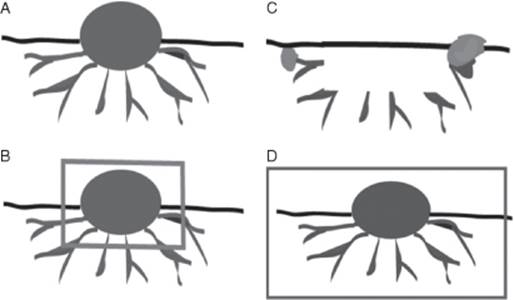
Many malignant tumors are able to extend microscopic “fingers” of the tumor away from the main tumor mass (Figure 1.1). If a small surgery is performed to remove only the visible or palpable tumor mass, these fingers are left behind to regrow. Taking not only the main tumor mass but also a generous margin of normal-appearing tissue all around the tumor (including underneath) increases the likelihood that all of the tumor cells will be removed. This minimizes the likelihood of tumor regrowth.
Figure 1.1 Diagram of growth of a malignant tumor. Drawing a figure such as this for owners considering cancer surgery can be very helpful to explain the need to remove a wide margin of normal-appearing tissue. (A) Away from the main tumor mass, which can be seen and felt, “fingers” of microscopic tumor tissue can grow. If a small surgery is performed that only removes the part that can be seen and felt (shown in B), the fingers on the edges have the potential to regrow over time (shown in C). If a large surgery is performed, which includes a large margin of normal-appearing tissue around the tumor and underneath as well, the chances of removing all tumor tissue, including the microscopic fingers, is maximized. This approach is shown in D.
Client: Why should I pay for histopathology? Why don’t you just take it off and throw it away?
Technician: If we don’t know what we removed, then we wouldn’t know the prognosis. We don’t know how likely the tumor is to grow back or spread, or whether we should be thinking about additional tests or treatments right now.
Explanation
If it’s worth removing, it’s worth submitting for microscopic evaluation. See “just wait and see” (above) for problems with the “we’ll submit it for histopathology if it recurs” approach. Similarly, it is important to submit the entire mass that was removed rather than just parts or a section of a mass. This doubles the useful information you’ll receive from the pathology report because surgical margins can be interpreted.
Chemotherapy
Client: My great-aunt Harriet had chemotherapy, and she felt miserable all the time—I’d never do that to my dog!
Technician: The drugs we use to treat cancer in animals are mostly the same drugs that humans receive. However, animals get much lower doses and fewer combinations of drugs at the same time, to minimize the risk of side effects.
Explanation
Less than one third of animal patients experience unpleasant side effects with the chemotherapy protocols in common use today. Less than 5% experience a severe side effect. The risk of a serious side effect is even less in cats than it is in dogs. If a side effect requires the pet to be hospitalized, it is usually home and feeling better in 24–72 hours. When unpleasant side effects do occur, doses can be reduced, drugs can be substituted, and additional medications can be dispensed to prevent them from happening again. These changes in a patient’s chemotherapy protocol are effective 90% of the time. The likelihood of a chemotherapy-related death is less than 1 in 200 patients. See Chapter 7 for additional information about chemotherapy side effects.
Client: OK, suppose my pet is the one that has a side effect? What kind of things are we likely to see?
Technician: It’s variable, but the most common side effect to see at home would be a few days of digestive upset—some decreased appetite, mild nausea/vomiting, or loose stool. Some animals can develop problems related to a decrease in the white blood cell count. We check this often to make sure that it does not get dangerously low.
Explanation
The likelihood and type of side effects seen varies by drug. In general, the most common side effect is related to the digestive tract. By way of comparison, it’s usually similar to what you might see with an animal that got into the garbage. Animals experiencing this might need to eat bland food for a few days or take antinausea or antidiarrhea pills at home. Usually, this doesn’t last for more than 3–5 days. A few patients may develop very severe vomiting/diarrhea (can’t keep anything down, getting weak/dehydrated). Some patients have the potential to develop a low white blood cell count. We check this quite frequently, and most of the time, it is not low enough to be dangerous. A dangerous decrease of the white blood cell count puts pets at an increased risk for bacterial infections. In some cases, a patient might need to take oral antibiotics at home. A chemotherapy treatment might be delayed for a few days so the white blood cells can recover. See Chapter 7 for more information about chemotherapy side effects.
Client: I don’t want Fluffy to go bald!
Technician: Fortunately, most dogs and cats do not lose a lot of hair from chemotherapy.
Explanation
It is true that some dog breeds can lose large amounts of hair from chemotherapy. The breeds that usually lose hair are those that have continuously growing hair coats and require regular grooming (poodles, schnauzers, etc.). The hair loss is rarely total. Most other breeds experience little or no hair loss. That being said, owners may find more hair around the house, and long-haired breeds have the potential for excessive matting. Regular brushing helps to prevent this. Cats can lose whiskers as well as the long, stiff guard hairs from their coats. In dogs and cats, areas that are shaved may regrow hair more slowly than expected. Hair loss from chemotherapy is a purely cosmetic change and is not itchy or painful. Hair that is lost will typically begin to regrow about a month following the completion of therapy.
Client: I don’t want Tiger’s last weeks/months/years to be in and out of the hospital, like they were with Uncle Mac when he had cancer.
Technician: Almost all veterinary chemotherapy treatments are done in an outpatient setting, and the whole visit only takes a few hours. Most treatments involve quick injections or short infusions rather than long infusions (there are exceptions). Overnight stays are almost never necessary. Many protocols involve a series of treatments, followed by careful observation. Giving chemotherapy forever is not usually the plan.
Client: Will my family/guests/house/other pets be contaminated?
Technician: Urine and feces pose little risk to owners. Few drugs are excreted for longer than 48–72 hours. Common sense is usually sufficient protection for your household. Accidents in the house during the first 48–72 hours should be thoroughly cleaned using detergent and water. Wear gloves when cleaning the urine or feces, and flush the excreta down the toilet. Normal daily activities are very important in maintaining your pet’s good quality of life. Interactions such as grooming, playing, petting, or handling food and water bowls pose no real risk.
Client: Sam loves to swim in the pond by our house. Can he still do that if he is getting chemotherapy?
Technician: Absolutely. There are no restrictions on activity while pets are receiving chemotherapy. They can swim, hike, jog, go to dog parks, and so on. We want our pets to still be able to do all the things that make their quality of life good!
Client: I have chemotherapy pills to give at home. Is there anything special I need to do?
Technician: It is important to wear gloves when handling oral chemotherapy medications, and chemotherapy pills should never be crushed or split, nor capsules be opened. Similarly, oral chemotherapy should never be administered in liquid form. All of these things increase your risk of exposure to the drugs.
Client: But what about her age? Isn’t she too old for treatment?
Technician: Most of the patients with cancer that we treat are older dogs. Everything we know about effectiveness, survival, and tolerability of cancer therapy is from treating older patients.
Explanation
Age is not a disease! Far more important than age in years are the patients’ general health (e.g., heart, liver, kidneys) and how they are feeling. We often spend extra time and money to check the overall health of our cancer patients (blood tests, chest X-rays, etc.). This is partly to make sure that there are no other age-related diseases present that could complicate cancer therapy or be more of a problem to the patient than the treatment of the cancer.
Client: Is there any special food we should be feeding Rusty?
Technician: We usually recommend that you keep feeding the same food that he has always been getting. Diet changes may increase the chances for stomach upset.
Explanation
There are no diets that are known to be better for cancer patients. Occasionally, we may suggest a food that is higher in calories for a patient that has been losing weight over time. Raw meat diets should be avoided in patients receiving chemotherapy. While the risk of sickness from bacterial contamination of raw meat is thought to be low (but not zero) in normal animals, it may be considerably higher in an animal receiving chemotherapy.
Client: So what are our choices? We either do chemotherapy or put him to sleep?
Technician: There are usually a lot of different choices for treatment. Some may be more complicated or more expensive than others, but there isn’t one thing that works for every pet or every owner.
Explanation
Cancer therapy, in general, is usually not a single, “all-or-nothing” proposition. For many tumor types, a number of treatment options are available, depending on the patient’s overall health, family travel concerns, finances, and risks of side effects. For example, treatment choices for canine lymphoma include prednisone alone; prednisone plus doxorubicin; a combination of cyclophosphamide, vincristine, and prednisone; or a multiagent injectable protocol such as the University of Wisconsin (UW)-Madison protocol. All differ in cost, risks of side effects, and number of visits required for treatment. They also differ in how effective they are.
Radiation Therapy
Client: What about radiation therapy for my dog’s tumor?
Technician: Radiation therapy is a local treatment. We can use it to treat local diseases when the spread is unlikely. This includes tumors that cannot be removed, or tumors that have not been completely removed and are likely to grow back. We can also use radiation to improve quality of life in some types of painful tumors.
Explanation
Radiation therapy can be very useful for certain tumors. It is a localized treatment used most often to treat a local disease. Local disease means tumors with a high likelihood of aggressive local infiltration and regrowth, but has a low risk of spreading to other parts of the body. There are four main ways that radiation therapy can be used:
(1) after surgery for tumors that have been incompletely removed. Examples include low- or intermediate-grade mast cell tumors; soft-tissue sarcomas, including feline vaccine-associated sarcoma; some oral tumors; and perianal tumors;
(2) before surgery in certain cases to make a tumor that is very large or invasive easier to remove;
(3) as the main therapy for certain tumors, such as nasal and brain tumors;
(4) to improve quality of life in some highly metastatic tumors, such as osteosarcoma and malignant melanoma, where pain, swelling, or difficulty eating and drinking can be life limiting.
Client: So how does radiation therapy work?
Technician: Radiation therapy is usually like a super-high-energy diagnostic radiograph. The radiation beam is created by electricity and aimed specifically at the tumor. In many cases, a large number of small radiation doses needs to be used to give the normal tissues in the area a chance to heal while doing as much damage as possible to the tumor tissue.
Explanation
Most “definitive” or “full-course” radiation therapy protocols involve a series of 10–25 treatments, given either Monday through Friday, or 3 days per week for several weeks. Although these treatments can be done on an outpatient basis, many animals will spend some of the time in the hospital for travel-related reasons. Most “palliative” or “coarsely fractionated” radiation therapy protocols will involve one to six weekly treatments, given on an outpatient basis.
Client: But won’t she be horribly sick from radiation?
Technician: Radiation therapy is a form of local therapy. The radiation is only delivered to the site of the disease. Thus, side effects like nausea, fatigue, or bone marrow suppression generally do not occur. However, each treatment does require a very short anesthesia or heavy sedation to make sure that the radiation is delivered to the correct spot. There could be adverse systemic effects as a result of the anesthesia, but they are very rare in an otherwise healthy patient.
Client: What about radiation burns?
Technician: It’s true that animals receiving radiation therapy can develop a sunburn-like reaction at the radiation site but this is temporary. These “acute effects” usually do not start until the second or third week of treatment and are gone 2–4 weeks after radiation therapy is finished.
Explanation
The local side effects from radiation can range from mild redness and itchiness to moist, oozing, painful, or ulcerated skin. Many animals need to wear an Elizabethan collar to prevent self-trauma. They may also receive oral antibiotics and/or pain medications during this period. After completion of the course of radiation, the radiated skin may be permanently hairless or the hair may only partially grow back. Also, the hair in the radiated area may simply turn white. Long-term side effects of radiation are rare, with the exception of the eyes of animals receiving radiation therapy for nasal, oral, or brain tumors. Eyes in the radiation field may develop cataracts, keratoconjunctivitis sicca (dry eyes), or both.
Client: Will Lucky be radioactive when he comes home?
Technician: No, dogs pose no risk to their owners when they come home.
Explanation
The standard form of radiation therapy in animals is external beam, which means radiation is shined down from an external source, not that different from a diagnostic X-ray. The radiation beam is created by electricity. When the machine is turned off, there is no radiation left behind. Animals undergoing radiation therapy pose no health risks to their owners. They are not radioactive.
Summary
It is natural for owners to have many questions about treatment for their pets with cancer. Having a discussion about animal cancer and its treatment can be a very important way to help owners make decisions about how to best treat their pets. Many owners will need to know that the treatments discussed are not going to be “too hard” on their companions. Sometimes, pet owners will ask technicians more questions, or different questions, than they will to their veterinarians. Being able to educate owners about cancer and its treatment will help increase the likelihood that pets receive the treatment that they need to remain happy and healthy for as long as possible.
Additional Reading
Chun R, Garrett L, MacEwen EG. 2001. Cancer chemotherapy. In: Withrow SJ, MacEwen EG (eds.), Small Animal Clinical Oncology (3rd Ed.). Philadelphia: Saunders, pp. 92–118.
Harvey A, Butler C, Lagoni L, Durrance D, Withrow SJ. 2001. A bond-centered practice approach to diagnosis, treatment and euthanasia. In: Withrow SJ, MacEwen EG (eds.), Small Animal Clinical Oncology (3rd Ed.). Philadelphia: Saunders, pp. 672–82.
Moore AS. 2002. Radiation therapy for the treatment of tumours in small companion animals. Vet J 164(3):176–87.
Thamm DH, Vail DM. 2007. Aftershocks of cancer chemotherapy: Managing adverse effects. J Am Anim Hosp Assoc 43:1–7.
Thrall DE. 1997. Biologic basis of radiation therapy. Vet Clin North Am Small Anim Pract 27(1):21–3.
Withrow SJ. 2001. Why worry about cancer in pets? In: Withrow SJ, MacEwen EG (eds.), Small Animal Clinical Oncology (3rd Ed.). Philadelphia: Saunders, pp. 1–3.