Tina Scheufele,
Elias Reichel,
Michael A. Sandberg
As a group, heredofamilial macular disorders constitute a significant cause of visual loss in children and young adults. These conditions usually progress to legal blindness. Symptoms frequently begin in childhood or early adolescence and visual deficits may hamper learning in school. Young adults may fail vision tests for driving and thereby be forced to adjust not only their vocational aspirations but also their lifestyles in general around public conveyance or the assistance of family and friends. Loss of visual acuity may prevent performance in occupations that depend on fie distance vision. Many of these patients are extremely sensitive to bright lights or outdoor illumination, for reasons that are not yet clear, and fid it necessary to wear sunglasses in many situations. In addition, the knowledge that these conditions may be passed on to children and future generations can lead to emotional problems with long-term consequences.
This chapter presents these disorders according to their pattern of inheritance, first considering autosomal dominant and then autosomal recessive forms. X-linked retinoschisis and X-linked cone dysfunction syndromes that can affect the macula are discussed in Chapters 177 and 178. Although grouping hereditary macular degenerations based on their inheritance pattern is a logical way to organize this chapter, it should be mentioned that some of these disorders have several inheritance patterns and that the phenotypic expression can vary between individuals, even within the same family. For each condition, funduscopic appearance, electrophysiologic characteristics, prognosis for retaining central vision, histopathologic descriptions, and current genetic understanding are reviewed. The chapter concludes with some comments on our approach to patients with these diseases.
Until recently, all of the heredomacular degenerations were thought to have normal full-field electroretinograms (ERGs), consistent with a loss of only macular function; this was the basis of their original classification. Now it is recognized that some of these degenerations may affect the peripheral retina as well. Many patients referred with conditional diagnoses of macular degeneration, based on funduscopic abnormalities that are limited to the posterior pole (e.g., central geographic atrophy or bull's-eye maculopathy), are found to have generalized cone or cone and rod degeneration based on abnormal full-field cone or cone and rod ERGs, respectively. In fact, one can make the generalization that most macular dystrophies without the pathognomonic fundus features that are described in this chapter (e.g., flecks, drusen, or myopia on fundus examination or a widespread blocked choroidal fluorescence on fluorescein angiography) are cone or cone and rod degenerations until proved otherwise by full-field ERG testing. New information regarding chromosomal location and genetic defects has been added to update this fascinating clinical area.
DOMINANTLY INHERITED MACULAR DEGENERATIONS
CYSTOID MACULAR EDEMA
An autosomal dominant form of cystoid macular edema has been described.[1-3] These patients show cystoid macular edema at a young age and invariably are hyperopic because of elevation of the macula. They have no fidings or underlying features that predispose to cystoid macular edema (e.g., uveitis). Ophthalmoscopically, these patients show typical cystoid macular edema, which is characterized by thickening of the macula with multiple cystic macular changes; later, they may experience macular atrophy and pigmentary changes. Fluorescein angiography shows cystoid macular edema with leaking perifoveal capillaries and retinal pigment epithelial (RPE) window defects. Full-field ERGs are normal; however, there appears to be a subnormal ratio of the light-peak:dark-trough voltage in the electrooculogram (EOG),[3] as would occur with a disturbance of the RPE. The abnormality in the light peak becomes more significant in older patients and in female patients, suggesting that female hormones may affect capillary permeability.[4] Affected patients show a gradual progressive decrease of visual acuity starting anywhere from the first to the fourth decades of life. Visual acuity declines to less than the 20/100 level in more than 50% of patients by the fourth decade of life. An acquired red-green dyschromatopsia can be seen as well.[3] No histopathologic studies of this condition have yet been reported. One group has linked the gene to the short arm of chromosome 7[5].
AUTOSOMAL DOMINANT STARGARDT-LIKE MACULAR DYSTROPHY (PROGRESSIVE FOVEAL DYSTROPHY)
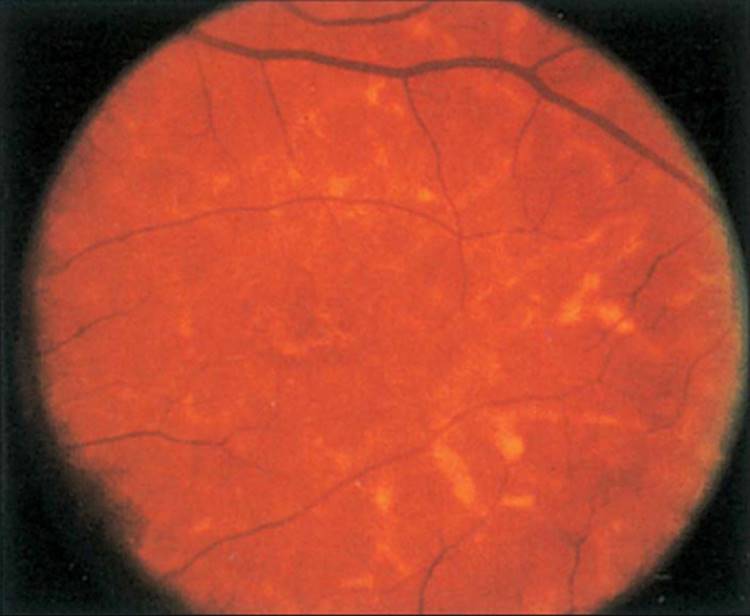
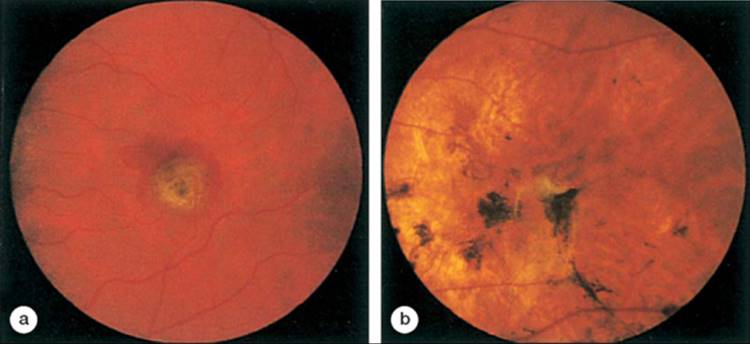
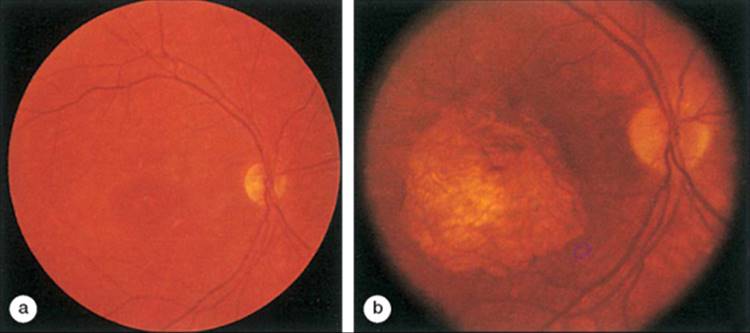
Autosomal dominant Stargardt-like macular dystrophy is characterized by progressive RPE changes and atrophy in the macula along with white flecks in the posterior pole. Drusen are not present (Fig. 179.1). The degeneration has a similar clinical appearance to autosomal recessive Stargardt's. However, the dark choroid (blockage of the choroidal fluorescence on fluorescein angiogram), pathognomonic of autosomal recessive Stargardt's, is absent in the autosomal dominant form.[6] The mean age of onset of visual loss is between 14 and 20 years, but can range from 3 to 50 years.[6, 7] Visual acuity usually declines to the 20/200 level by age 22-30, and often continues to decline slowly thereafter.[6, 7]
|
|
|
|
FIGURE 179.1 Fundus photograph of a 10-year-old girl with dominant Stargardt's disease. Visual acuity was 20/200 in both eyes (O.U.). |
Color vision is not prominently affected.[6] Electrophysiologic testing shows normal full-field cone and rod ERG responses, and a normal EOG. There is one reported histopathologic study of eyes from an individual affected by a dominant form of Stargardt's disease.[7] This study revealed aggregates of enlarged RPE cells with apices distended with lipofuscin and melanolipofuscin. These results are similar to those found in individuals with the recessive form of the condition (see further on). Recently, the gene has been mapped to three different loci, on chromosomes 6q, 13q, and 4p.[6, 8, 9] The mutation on chromosome 6 affects the ELOVL4 (elongation of very long chain fatty acids-4) gene, which encodes a transmembrane protein within the photoreceptors, resulting in altered cellular trafficking.[10]
BEST'S DISEASE
Best's disease (vitelliform macular dystrophy) is seen in individuals of European, African, and Hispanic ancestry and has variable penetrance and expressivity.[11] Patients can present with blurred vision, diminished visual acuity, or metamorphopsia. Although the onset of fundus fidings or visual complaints is usually in childhood or early adulthood, the disease may not present until middle-age in some patients.
Best's disease has been described as going through four phases based on fundus examination.[12, 13] The first, the previtelliform stage, is characterized by a normal fundus appearance. The second stage, the vitelliform stage, usually occurs in early childhood and is characterized by a well-circumscribed 0.5-2-disk-diameter yellow lesion that looks like the yolk of an egg and appears to be located under the pigment epithelium. This is usually 0.5-2 optic disk diameters in size. Acuity is usually normal or slightly reduced. The lesion may be unilateral, and a yellowish change may be noted in the RPE throughout the fundus. During the teenage years, or thereafter, the yellow lesion can break through the RPE into the subretinal space, and the yellow material can accumulate inferiorly in the macula in the subretinal space to form pseudohypopyon (the third stage). A scrambled-egg appearance to the fundus then follows, with yellow deposits scattered throughout the posterior pole (the fourth stage). Usually, patients are hyperopic, and visual acuity is in the 20/40 range at this point, in the evolution of the disease. Atrophy, choroidal neovascularization, serous detachment of the retina, and disciform scarring can occur in patients with Best's disease.[14, 15] Several case reports have described the association of macular hole and rhegmatogenous retinal detachment in patients with Best's disease.[16-19] Fluorescein angiography in patients with Best's disease reveals blockage of choroidal fluorescence by the vitelliform lesion.[20] After breakup of the vitelliform lesion, there may be depigmentation and staining of atrophic RPE.
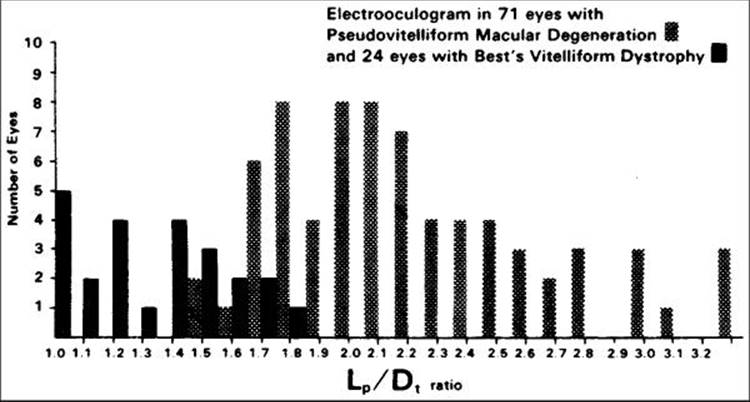
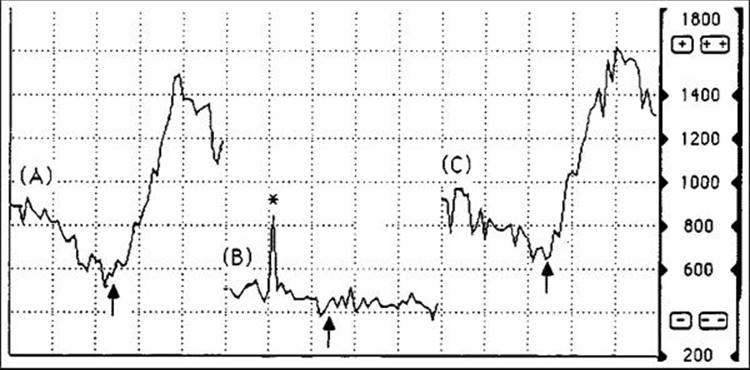
The EOG is diagnostic for this dominantly inherited condition (Fig. 179.2). It generally shows a markedly reduced or nondetectable light-peak:dark-trough ratio (Arden ratio) in affected patients.[21-23] In a minority of cases, however, the Arden ratio is only slightly reduced (Fig. 179.2)[24] or normal, so that a normal EOG cannot exclude Best's disease.[25, 26] A study of 27 patients (54 eyes) with Best's disease revealed no correlation between the Arden ratio and the visual acuity, the disease stage, or the patient's age.[25] Whereas, in the past, the diagnosis of Best's disease required one of the four characteristic fundus stages associated with an EOG ratio <1.5 (normal > 1.8) (Fig. 179.3), it is now recognized that patients with Best's dystrophy may have a normal EOG.[26] Obligate carriers of this condition, who may be asymptomatic and lack visible fundus abnormalities, often have an abnormal EOG.[23] However, the presence of a normal EOG in a patient thought to be a carrier does not exclude Best's disease.[27]
|
|
|
|
FIGURE 179.2 Frequency histogram of EOG light-peak (Lp):dark-trough (Dt) ratios in 24 eyes with Best's vitelliform macular dystrophy and 71 eyes with pseudovitelliform macular degeneration. |
|
|
|
|
FIGURE 179.3 EOG amplitudes versus time for a normal subject (a), a 19-year-old patient with Best's vitelliform macular dystrophy and visual acuity of 20/25 (b), and a 38-year-old patient with pseudovitelliform macular degeneration and visual acuity of 20/30 (c), all of whom were tested with a Ganzfeld dome. Vertical dotted lines designate 5-min intervals; horizontal dotted lines designate 200-?V intervals; arrows indicate the onset of background illumination; asterisk denotes the transient change in resistance between electrodes. The patient with Best's disease showed no increase in amplitude in the light, whereas the patient with pseudovitelliform macular degeneration showed a normal increase. |
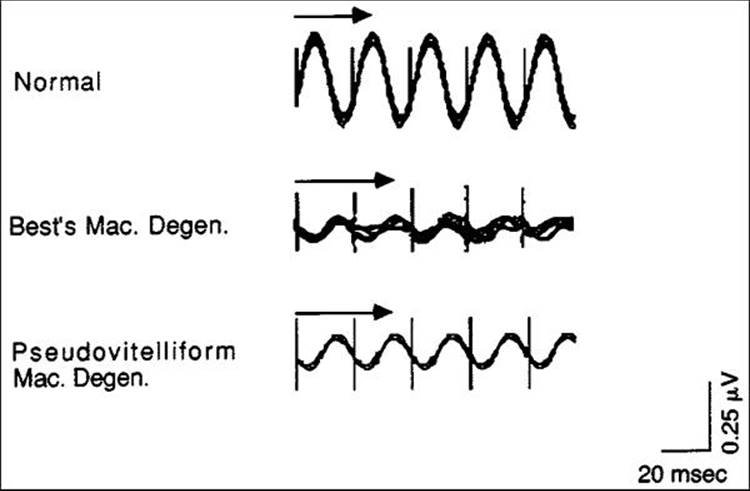
The full-field ERG is typically normal,[21, 22] whereas the foveal (or multifocal) ERG may be abnormal, even when visual acuity is preserved (Fig. 179.4). The prognosis is good for retaining useful vision in at least one eye throughout life in patients with Best's disease.[28] Eighty-eight percent of patients will have one eye with better than 20/40 vision. Only 4% of patients will have vision less than 20/200 in their better-seeing eye.
|
|
|
|
FIGURE 179.4 Foveal cone ERGs from a normal subject, a 27-year-old patient with Best's disease and visual acuity of 20/25, and a 50-year-old patient with pseudovitelliform macular degeneration and visual acuity of 20/30 obtained with a stimulator-ophthalmoscope. Two or more consecutive computer summations are superimposed. Arrows designate b-wave implicit times. Both patients had subnormal and delayed responses. |
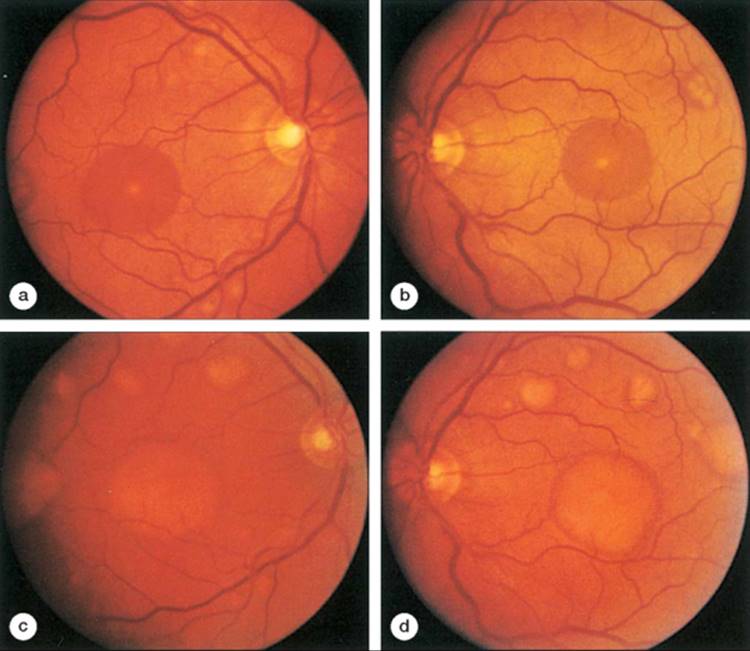
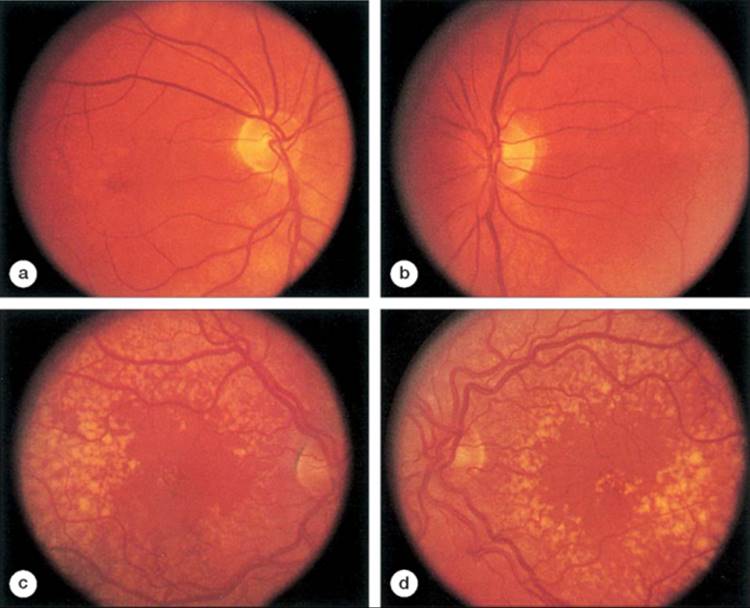
A variant of Best's disease has multifocal lesions throughout the posterior pole (Fig. 179.5).[29] The patients whom we have observed with this condition tend to be older than those with the unifocal form of Best's disease. It is important, therefore, to consider the possibility that this variant represents multifocal pigment epithelial detachments that are filled with chronic serous exudates.[30, 31] Autofluorescence may help differentiate these diagnoses, as the lipofuscin-laden RPE cells in Best's disease autofluoresce, whereas serous RPE detachments do not.[27]
|
|
|
|
FIGURE 179.5 (a and b) Fundus photographs of a 62-year-old man with Best's disease show multifocal lesions. He presented with what appeared to be a serous elevation of the macula in both eyes. Follow-up examination revealed multiple small foci of yellowish material throughout the posterior pole. EOG showed a light-peak:dark-trough ratio of 1.0 in both eyes. Visual acuity was 20/20 at this time. (c and d) Examination 8 months later revealed a typical vitelliform lesion in both eyes associated with multiple deposits of lipofuscin throughout the posterior pole. Best-corrected visual acuity was 20/20 O.U. |
Studies of eyes from patients with Best's disease show RPE cells with excessive amounts of lipofuscin-like material, particularly in the fovea.[28, 29, 32] Material derived from deteriorating RPE cells located between Bruch's membrane and the pigment epithelium in the fovea was considered to represent a previtelliform lesion. There appears to be a secondary loss of photoreceptor cells as well as collections of outer segment debris. Molecular genetic studies have mapped the Best's disease gene to a 1.4-Mb region on chromosome 11q12-q13.1.[33] This region codes for the VMD2 gene, which encodes the protein bestrophin. The mutated VMD2 gene alters the voltage across the RPE by affecting the Ca[2+] channels, explaining the reduction in light-peak amplitudes observed on the EOG.[34] However, some patients with the VMD2 gene mutation have a normal EOG.[27]
ADULT VITELLIFORM (PSEUDOVITELLIFORM) MACULAR DYSTROPHY
Affected individuals have a small (500 ?m to one disk diameter), slightly elevated, yellow subretinal lesion, usually centered at the fovea, and may have small yellow flecks (drusen) parafoveally (Fig. 179.6). The lesion can easily be confused with small serous detachments that can be seen in central serous retinopathy or solar retinopathy. Fluorescein angiography shows early hypofluorescence of the lesion, with or without late staining.[36, 35] In the absence of CNV, there should be no leakage.[37]
|
|
|
|
FIGURE 179.6 (a and b) Fundus photographs of a 30-year-old man with adult-onset foveomacular dystrophy. Visual acuity was 20/15 in the right eye (O.D.) and 20/40 in the left eye (O.S.). The left eye shows a typical pseudovitelliform lesion. EOG testing showed a light-peak:dark-trough ratio of 2.1 O.D. and 2.4 O.S. Full-field ERGs were normal. |
As in Best's disease, full-field ERGs are normal, whereas focal ERGs may be abnormal (see Fig. 179.4). The EOG Arden ratio may be decreased between 1.5 and 1.8 (see Fig. 179.2) but may also be within the normal range (see Fig. 179.3). These patients may present with mild loss of acuity and metamorphopsia in one or both eyes, usually between the ages of 30 and 50 years, but as late as 70.[24, 38-41] The prognosis for retaining good central vision in one eye is usually good, even until late adulthood, unless complications develop.[24, 42] As in Best's disease, choroidal neovascularization or, rarely, a full-thickness macular hole may develop.[43, 44]
According to one study, pseudovitelliform macular degeneration can be differentiated from Best's disease based on its late age of onset, typically normal EOG reading, negative family history, slow course, and fial atrophic scar.[24] Although some have shown an autosomal dominant pattern of inheritance, most cases are believed to be sporadic.[36, 45]
Gass studied one eye with adult-onset vitelliform macular dystrophy using histopathologic techniques.[46] He found focal loss of photoreceptors, atrophy of the RPE in the fovea, and pigment-laden cells and extracellular melanin between the retina and Bruch's membrane. Gass observed no abnormal amount of lipofuscin within the RPE cells. Since then, other histologic studies have suggested that the vitelliform lesion is composed of lipofuscin that is deposited either within the RPE or between the RPE and the photoreceptor layer.[48, 47] Optical coherence tomography (OCT) demonstrates the subretinal location of this hyper-reflective material; however, it cannot determine with certainty, whether this material is within the RPE cells or above them.[49-51] OCT also shows preservation of the photoreceptor layer until late in the disease course.[51] A mutation in the retinal degeneration slow gene (pro 210 arg) has been identified in one individual with adult vitelliform macular dystrophy,[52] and several families have been identified with mutations in the peripherin/RDS gene.[53, 54]
PATTERN DYSTROPHIES OF THE RPE
This group of conditions is named for the pattern-like deposition of pigment in the RPE of the macula. In some individuals, this pigmentation displays a butterfly shape; other patterns have been described as well.[52, 55-58] Some include adult-onset vitelliform macular dystrophy as a type of pattern dystrophy, but this is covered separately in this chapter.[59] These patients usually have normal to slightly subnormal visual acuity most of their lives; with aging, some patients may develop extensive macular atrophy, resulting in significant loss of vision.[60] Full-field ERGs are normal, and the EOG is usually normal.[61] This is a very slowly progressive condition. Visual prognosis is good for retaining vision in at least one eye until late adulthood. Color vision may be slightly affected when visual acuity begins to decline. Choroidal neovascularization can occur in any of the pattern dystrophies, particularly in those with the butterfly pattern.[62] In some individuals, a vitelliform lesion has also been seen; these patients have subnormal EOGs as well, suggesting a continuum between vitelliform macular dystrophy and butterfly-shaped dystrophy at least in some pedigrees.[59, 63] Fluorescein angiography shows blockage of fluorescence by the darkly pigmented lesion, which is often surrounded by a rim of hyperfluorescence. A histopathologic study of an 81-year-old woman with butterfly pattern dystrophy demonstrated lipofuscin accumulation within the RPE adjacent to areas of RPE and photoreceptor atrophy.[64] Several different mutations in the peripherin/RDS gene have been identified in families with pattern dystrophy.[64, 65] One of these mutations (a Tyr-141-Cys substitution) was present in all affected members of three separate families who demonstrated either butterfly pattern dystrophy or adult-onset vitelliform macular dystrophy.[66] Other families have been studied that do not have peripherin/RDS mutations, and in many of these, the gene mutation has not been found.[67] A pattern dystrophy has been identified in two families affected with maternally inherited diabetes and deafness. A mitochondrial mutation at position 3243 has been identified in these families.[68] The genetic heterogeneity of patients with pattern dystrophy may account for their phenotypic differences.
CENTRAL AREOLAR DYSTROPHIES CHOROIDAL DYSTROPHY
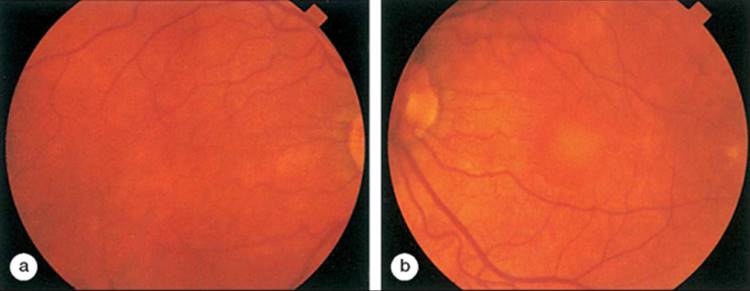
Central areolar choroidal dystrophy (CACD) is characterized by the gradual development of symmetric, well-defied areas of geographic atrophy of the RPE not associated with myopia, serous, or hemorrhagic detachment of the RPE, or inflammation of the choroid (Fig. 179.7).[69-71] It is usually inherited in an autosomal dominant fashion, although sporadic cases have been documented.[72]Examination of the fundus may show RPE granularity in the fovea early in the disease, when visual acuity and visual fields are normal. In the fourth or fifth decade, atrophy of the RPE and choriocapillaris may lead to a slow decline in vision or paracentral scotomata. One can readily see choroidal vessels within the area of RPE atrophy. The area of atrophy expands slowly, and visual acuity can eventually fall to the counting-figers range, often when patients are in their 60s.[73] Some families with autosomal dominant central areolar choroidal dystrophy (CACD) have associated drusen.[72] Fluorescein angiography shows hyperfluorescence corresponding to the areas of pigment epithelial atrophy. Hyperfluorescence can be detected at the edges of the lesions, indicating leakage of dye from intact choriocapillaris. If atrophy of the choriocapillaris is prominent, this background choroidal fluorescence may be lost. Larger choroidal vessels fill prominently with fluorescein. Full-field ERGs can be subnormal, often later in the disease course.[74, 75] We have observed in patients with symmetric geographic atrophy without drusen or myopia that the full-field cone ERG and rod ERG are reduced, suggesting that this condition affects more than just the posterior pole.[76] Multifocal ERGs also show that retinal function is affected over a larger area than apparent ophthalmoscopically and angiographically.[77]
|
|
|
|
FIGURE 179.7 Right (a) and left fundus (b) of a 59-year-old woman with CACD O.U. Visual acuity was 20/50 O.D. and at the counting-figers level O.S. Full-field cone and rod ERGs were reduced 60% below normal O.U. Cone ERG implicit time was slightly delayed. Dark adaptation was normal. The patient was hypermetropic and had no signs of drusen or other stigmata of AMD. |
Histologic studies showed a well-demarcated central avascular zone in the macula that was atrophic and fibrotic.[78] The retinal vessels, larger choroidal vessels, and posterior ciliary arteries were normal. The outer retinal layers and the RPE, were absent in areas with underlying choroidal atrophy. Bruch's membrane appeared to be normal.
Several mutations in the peripherin/RDS gene on chromosome 6 have been identified in patients with autosomal dominant CACD.[73] The visual prognosis seems to be poorest with the Arg172Trp mutation, with most patients legally blind by the time they reach the age of sixty.[73] Most CACD patients carrying the Arg142Trp mutation have dominant drusen as well.[72] Other less severe phenotypes are associated with Arg172Gln and Arg195Leu mutations.[73] Linkage to chromosome 17p has been shown in other families.[79]
Some individuals characterize benign concentric annular macular dystrophy and fenestrated sheen macular dystrophy as forms of geographic atrophy or bull's-eye maculopathy that primarily affect the macula.[80-82] Both are autosomal dominant conditions. Benign concentric annular macular dystrophy is characterized by a bull's-eye pattern of geographic atrophy of the RPE around the fovea. Visual acuity begins to decrease slowly in the fourth or fifth decades.[81] Nyctalopia is often present earlier in some patients.[81] In a long-term follow-up of individuals with benign concentric macular dystrophy, most showed worsening ERGs (both cone and rod systems), and some developed bone spicule pigment changes in their fundus.[80] Both the bone-spicule fundus changes and the presence of nyctalopia in some patients is evidence of rod photoreceptor dysfunction. Benign concentric annular macular dystrophy has been linked to chromosome 6, region p12.3-q16, but a gene mutation has not yet been identified.[81]Fenestrated sheen macular dystrophy is characterized by small red fenestrations in the macula associated with a golden sheen. The macula in this condition typically has a tapetal reflex. The peripheral retina may have a granular appearance as well. Involvement of the peripheral retina is also evident by the abnormal ERG rod and cone responses seen in some patients.[83] Patients appear to retain good central visual acuity. No long-term follow-up is available. Because of the ERG abnormalities in these patients, we prefer to classify benign concentric annular macular dystrophy and fenestrated sheen macular dystrophy as degenerations involving the cone and rod photoreceptors. Relatively little is yet known about these two conditions and their long-term prognosis for central and peripheral vision.
NORTH CAROLINA MACULAR DYSTROPHY
This dystrophy was named for the original pedigree of 545 affected family members from North Carolina, but since then has been described in related and unrelated families of Caucasian, Mayan Indian, African-American, French, British, German, and American descent.[84-87] Severely affected individuals may phenotypically resemble individuals with advanced CACD, prompting some to suggest grouping them together.[88] However, there are important distinctions between these two distrophies, such as the age of onset and visual prognosis. North Carolina dystrophy appears early in life and is generally considered nonprogressive, whereas CACD begins later in life and vision loss can be progressive.
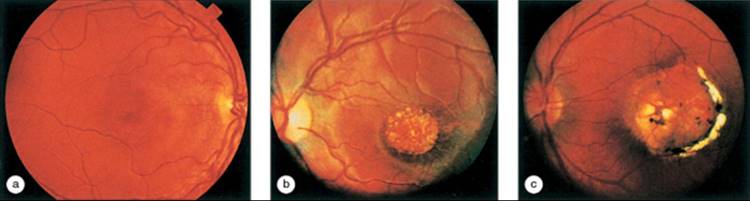
North Carolina macular dystrophy is an autosomal dominant congenital macular dystrophy with variable expressivity that is generally considered nonprogressive.[85, 89] Although the average age of onset is not clear, patients are thought to be affected early in life. The fundus changes have been observed in patients as young as 3 months of age, and are variable even between individuals in the same family.[85, 90] In the mildest phenotype (grade I), the macula has scattered drusen and pigmentary changes and visual acuity is 20/25 or better. Moderately affected individuals (grade II) have confluent macular drusen with 20/40 or better vision. Severely affected individuals (grade III) have colobomatous lesions with choroidal atrophy or disciform lesions and visual acuity is 20/40 to 20/800 (Fig. 179.8).[85, 90] Choroidal neovascular membranes can occur in these patients. Staphylomas with outpouching of the area of atrophy have also been observed in patients with this condition. The ERG and EOG are normal, indicating that the peripheral retina is spared.[86, 87]
|
|
|
|
FIGURE 179.8 Fundus photographs of three individuals from one family with North Carolina macular dystrophy. (a) Left eye of a 22-year-old woman with 20/20 vision (grade I fundus). (b) Right eye of a 7-year-old girl with 20/30 visual acuity (grade II fundus). (c) Right eye of a 29-year-old man with 20/40 visual acuity and grade III fundus. Seventeen affected members of this family were observed over a 10-year period, and only one patient showed a progressive loss of vision with development of a disciform lesion. |
Histopathology of a grade II fundus showed focal loss of the photoreceptors and the RPE, thinning of Bruch's membrane, and atrophy of the underlying choriocapillaris.[91] Lipofuscin was present in the RPE adjacent to the macular lesion, but absent in the periphery.[91]
North Carolina macular dystrophy has been mapped to the MCDR1 locus on chromosome 6q14-16.s[86-88, 90] Recently, eight individuals of one British family were identified who had a phenotype similar to North Carolina macular dystrophy, but also experienced progressive sensorineural deafness.[92] They did not have the MCDR1 locus; instead, the disease locus was mapped to chromosome 14q.[92] Genetic analysis of another British family with a similar phenotype linked their disease to chromosome 5p13.1-p15.33.[93] The 13 affected members of this family also demonstrated mild color vision deficits.[93]
DOMINANTLY INHERITED DRUSEN
The spectrum of disease caused by dominantly inherited drusen has been given a wide variety of names: Doyne's honeycomb dystrophy, Hutchinson-Tay choroiditis, malattia léventinese, Holthouse-Batten superficial chorioretinitis, and guttate choroiditis. Some of these different names may refer to different phenotypic expressions of the same condition. Doyne described the occurrence of colloid bodies (drusen) above Bruch's membrane in certain families who lived in Oxford, England. These drusen tended to merge together and eventually became confluent, resembling a honeycomb; hence, the name Doyne's honeycomb choroiditis (Fig. 179.9). Vogt and Klainguti described a family with a macular dystrophy similar to Doyne's that lived in the valley of the Leventine in the Canton of Tessin in Switzerland.[94]Doyne's honeycomb dystrophy and malattia leventinese have now been mapped to the same chromosome locus (2p16-21), and are both associated with a mutation in EGF-containing fibrillin-like extracellular matrix protein 1 (EFEMP1).[95] Other genes associated with dominant drusen have been identified as well. For example, recently, a family from Pennsylvania with autosomal dominant drusen has been shown to have a genetic defect mapped to chromosome 6q14.[96] These examples show how our knowledge of the genetic transmission of drusen and macular degeneration continues to expand as new genes are identified.
|
|
|
|
FIGURE 179.9 Fundus photographs of a 37-year-old man who has the diagnosis of Doyne's honeycomb macular dystrophy with visual acuity of 20/20 O.D. and 20/100 O.S. (a) Right eye. (b) Left eye. Fundus examination revealed the typical honeycomb appearance of multiple, confluent drusen with associated pigmentary changes. Full-field and focal ERGs were normal. |
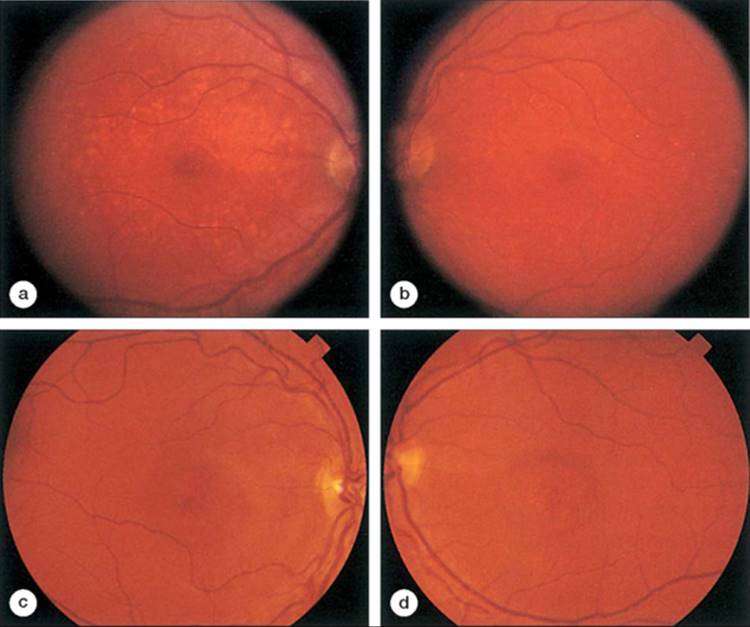
We reserve the diagnosis of dominant drusen for individuals who present with drusen at an early age (second to third decades of life) and have a clear family history of the condition affecting several generations (Fig. 179.10). Usually, there is a halo of drusen surrounding the foveola and symmetric changes in both eyes. These drusen are distributed mainly in the macula and around the optic nerve head, often with a nasal predominance. Some have suggested that the location of drusen nasal to the disk is pathognomonic of familial drusen.[97, 98]
|
|
|
|
FIGURE 179.10 (a and b) Fundus photographs of a 21-year-old woman with dominant drusen O.U. Visual acuity was 20/50 O.D. and 20/40 O.S. (c and d) Her 57-year-old mother had 20/20 vision O.U. There were drusen in the posterior poles O.U. Her 81-year-old maternal grandfather's vision was at the counting-figers level O.D. and 20/40 O.S. Drusen and depigmentation of the retinal pigment epithelium were observed on funduscopic examination. |
Some individuals present with funduscopic evidence of dominant drusen as early as childhood, and their visual acuity is usually normal or near normal.[99] However, there is great variability in phenotypic expression, even among members of the same family. These patients are generally asymptomatic; if they have symptoms, they usually complain of difficulty with central vision, particularly under dim lighting conditions or when driving at night. Fluorescein angiography shows well-defied hyperfluorescent areas beginning in the early arterial phase that correspond to the drusen. The hyperfluorescence is due to RPE window defects that overlie the drusen. If choroidal neovascularization occurs, there can be a sudden reduction in visual acuity or new or worsening metamorphopsia. Fluorescein angiography and OCT are useful diagnostic tests when a choroidal neovascular membrane is suspected. Full-field ERGs and EOGs, in our experience, have been normal in patients with dominant drusen (and age-related macular degeneration (AMD)). When performing such studies, it is important to compare these results with those of normal age-matched controls.
There are only a few histopathologic studies of dominant drusen in the literature. From these few published cases, it appears that dominant drusen are histopathologically similar, if not identical, to the drusen found in AMD.[100] Both may have basal laminar deposits, membranous and amorphous focal deposits (in soft drusen), diffuse changes in Bruch's membrane, and atrophy of the RPE and photoreceptors.[100]In a histopathologic study comparing an eye from a patient with dominant drusen to one from a patient with AMD many similarities were apparent.[101]
The drusen in both patients were composed of sialic acid and cerebrosides. The RPE above the drusen showed an abnormal distribution of pigment granules throughout the cytoplasm. The mitochondria showed marked degeneration, and there was an increase in lysosomes. A fibrillar material was found in the plasma membrane's infoldings, and there were also deposits of this material on Bruch's membrane. One histologic difference in this study was that while the RPE changes in the patient with familial drusen were widespread, the patient with AMD showed only focal RPE changes that were confied to areas above the drusen.
SORSBY'S PSEUDOINFLAMMATORY MACULAR DYSTROPHY
Sorsby's pseudoinflammatory macular dystrophy, or autosomal dominant hemorrhagic macular dystrophy, was studied initially in five families whose members developed choroidal neovascular membranes, subretinal hemorrhages, and changes consistent with disciform degeneration (Fig. 179.11).[102-105] Loss of central vision generally occurs in the fifth decade of life because of these exudative changes, and there is a progressive loss of peripheral vision due to chorioretinal atrophy. Patients with Sorsby's pseudoinflammatory macular dystrophy have been identified who have abnormal rhodopsin kinetics.[106-108]When areas with the abnormal yellow subretinal material were tested, there were delays in both psychophysical dark adaptation and rhodopsin regeneration. In areas without the subretinal material, dark adaptation and rhodopsin regeneration were normal. It was proposed that the abnormal rhodopsin kinetics represented a reduced metabolic exchange across a thickened Bruch's membrane.[107] Full-field ERGs and EOGs are normal in patients with this condition.
|
|
|
|
FIGURE 179.11 Fundus photograph of a 40-year-old man with autosomal dominant hemorrhagic macular dystrophy (Sorsby's pseudoinflammatory dystrophy). (a) Choroidal neovascular membrane (CNVM) is seen O.S. Twelve months later, a CNVM developed O.D. (b) His 63-year-old mother currently shows extensive retinal scarring and loss of retinal pigment epithelium and choriocapillaris. She suffered an acute loss of vision O.S. at the age of 50 years, and laser surgery at that time failed to stem the CNVM. |
The histologic studies performed to date indicate that the yellow subretinal deposits are composed of collagens, elastin, glycosaminoglycans, lipids, and calcium.[109, 110] These sub-RPE deposits are within the inner collagenous layer of Bruch's membrane and may be up to 30 mm thick.[109, 111] Areas of atrophy can exhibit thinning of the inner nuclear layer, photoreceptor loss, RPE loss, and choroidal atrophy, sometimes with complete loss of the choriocapillaris.[109]
Sorsby's fundus dystrophy is considered a single-gene disorder, linked to mutations in the tissue inhibitor of metalloproteinases 3 (TIMP3) gene on chromosome 22q12-q13.[112, 113] TIMP-3 is normally present in Bruch's membrane, the nonpigmented ciliary epithelium, and choroidal vessels. In patients with Sorsby's dystrophy, TIMP-3 is present more extensively, and is also found in the sub-RPE deposits and in deposits in the ciliary body.[109] The mutations in TIMP-3 in Sorsby's dystrophy lead to formation of TIMP-3 dimers, which accumulate in the eye in the aforementioned locations.[114, 115] This increased deposition of TIMP-3 may lead to retinal degeneration by decreasing the exchange of materials across the thickened Bruch's membrane.[109, 116] This theory is supported by the fiding that early in the course of the disease, vitamin A supplementation may reverse nyctalopia.[116] Presumably, a higher concentration of vitamin A in the choroid allows more to penetrate the thickened Bruch's membrane to reach the photoreceptors.[116]
OCCULT MACULAR DYSTROPHY
In 1989, a dominantly inherited macular dystrophy was described in three family members spanning two generations presenting with normal fundi, normal fluorescein angiograms, but progressive bilateral declines in visual acuity.[117] Although their full-field ERGs were normal, all three patients had abnormal focal macular ERGs, indicative of a macular degeneration.[117] This entity was called occult because there were no visible abnormalities by ophthalmoscopy or angiography. Since that publication, many other individuals have been identified with occult macular dystrophy (OMD).[118-121] One case report describes a patient with both normal tension glaucoma and OMD.[122] An interesting fiding in another family with three affected individuals was the appearance of a bull's-eye maculopathy in the oldest examined member (age 65 years).[119] To our knowledge, no other macular degenerations have been found in the family members of patients with OMD and no other ocular associations have been reported.
The age of presentation for OMD varies from 11 to 74 years, but is usually around middle-age.[120] Patients complain of a reduction in central vision bilaterally. Funduscopic examination and fluoroscein angiography appear normal. The full-field ERG is normal, but the macular ERG has a reduced amplitude. The abnormal focal macular ERG suggests involvement of either the macular cones alone, or both the macular cones and rods.[119] Multifocal ERGs recorded in five unrelated patients (ages 24-66 years) with OMD show that the reduction in the foveal cone ERG amplitudes recorded from five unrelated patients (ages 24-66 years) with this condition are not apparently related to or do not correlate with the visual-acuity reduction.[118] In patients A, B, and C, parafoveal cone ERGs were recorded in one eye and had normal amplitudes, suggesting that the abnormality is limited to the fovea.[118] OCT shows a reduction in the mean foveal thickness in OMD patients when compared to age-matched controls.[121] The foveal thickness in one published case series was not significantly correlated with the age of onset, duration of symptoms, or visual acuity.[121] To date, there are no histopathologic reports of OMD in the literature.
The diagnosis of OMD should be entertained whenever a patient with a normal funduscopic and angiographic appearance but decreased foveal thickness on OCT presents with gradual vision loss bilaterally. An optic neuropathy should be ruled out. The classic ERG fiding is a normal full-field ERG and an abnormal focal macular ERG.
AUTOSOMAL RECESSIVE MACULAR DEGENERATIONS
FAMILIAL FOVEAL RETINOSCHISIS
This uncommon juvenile foveal retinoschisis resembles X-linked retinoschisis, but the peripheral fundus and the full-field ERG are normal.[123, 124] An autosomal recessive inheritance has been proposed.[123, 124]
STARGARDT'S DISEASE (AND FUNDUS FLAVIMACULATUS)
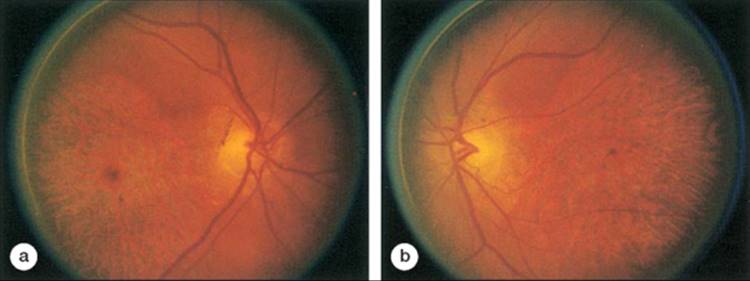
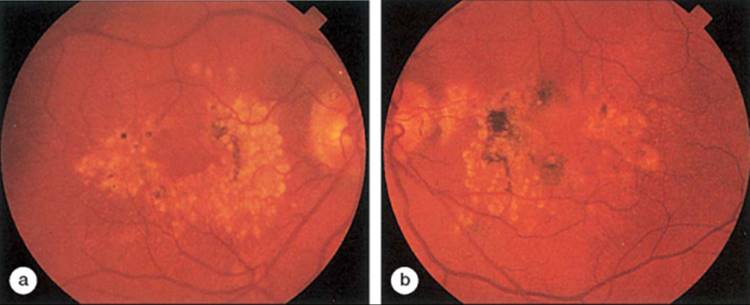
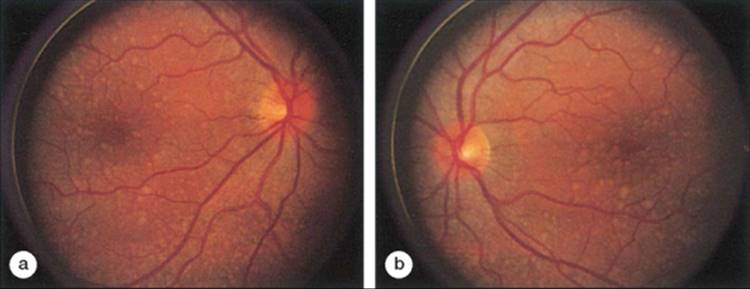
Stargardt's disease is perhaps the most common heredomacular degeneration. It is most often inherited as an autosomal recessive condition, although autosomal dominant forms exist as well, as discussed earlier in this chapter. A history of parental consanguinity can often be obtained. Fundus flavimaculatus is a related condition first described by Franceschetti and Francois in 1965.[125, 126] Some authors favor classifying Stargardt's disease and fundus flavimaculatus together; others disagree on the basis of their funduscopic differences. These differences may result from variable phenotypic expressions of a gene mutation or slightly different mutations of the same gene.[127-132] In Stargardt's disease, the fundus often appears normal early in the disease course, even as visual acuity begins to decline. Later, a pigmentary maculopathy of the fovea, which may be accompanied by perifoveal flecks or yellow dots, becomes apparent. The flecks are generally confied to the macula. Fundus flavimaculatus is characterized by yellow-white, irregularly shaped flecks at the level of the RPE (Figs 179.12 to 179.14).[131] The flecks are always present in the posterior pole and can extend as far as the equator of the eye. Macular pigmentary changes may be present or can develop years later as the disease progresses, but are not a requirement for the diagnosis of fundus flavimaculatus.[125]
|
|
|
|
FIGURE 179.12 Fundus photographs of two sisters with Stargardt's disease. (a and b) The older sister, aged 17 years, had 20/200 visual acuity O.U. and showed white flecks at the level of the retinal pigment epithelium. The fovea showed granular retinal pigment epithelium changes. (c and d) Her 10-year-old sister had 20/200 visual acuity O.U. with granular retinal pigment epithelium changes in the fovea. No white deposits were seen, illustrating intrafamilial variability. |
|
|
|
|
FIGURE 179.13 Progression of macular changes in a patient with Stargardt's disease. (a) Flecks can be seen throughout the posterior pole with retinal pigment epithelium changes noted in the fovea and parafovea at age 16 years. Visual acuity was 20/200 at this time. (b) Eleven years later, the visual acuity is unchanged; however, there is a large area of retinal pigment epithelium and choriocapillaris dropout in the posterior pole. |
|
|
|
|
FIGURE 179.14 Fundus photographs of a 29-year-old woman with fundus flavimaculatus. Visual acuity was 20/20 O.U. Multiple white, round, and pisiform flecks are seen throughout the posterior pole spanning a 30-degree radius throughout the fundus. Full-field ERGs were normal. The patient was seen 5 years later with no change in acuity or funduscopic examination. Focal ERG testing at that time was normal. |
Funduscopically, the yellow flecks can be round, similar to drusen, or may have a pisciform (fishlike) shape. Fluorescein angiography is useful in distinguishing flecks from drusen. Drusen often hyperfluoresce early and fade late, but sometimes may stain late as well. In contrast, the flecks of Stargardt's disease often do not fluoresce; when hyperfluorescent flecks are seen angiographically, these usually do not correspond to the funduscopically visible flecks.[125, 133-135] The hyperfluorescent areas are likely areas of RPE atrophy, whereas the funduscopically visible flecks are thought to represent deposits of lipofuscin within the RPE that block choroidal fluorescence. Another characteristic fiding in Stargardt's disease is a 'silent' choroid in which lipofuscin deposits throughout the fundus obscure the choroidal fluorescence.[125, 133-135] As Stargardt's disease progresses, RPE atrophy in the macula may lead to a beaten-metal appearance, or a bull's-eye pattern of hyperfluorescence.[131] Another use for fluorescein angiography is in evaluating a patient for choroidal neovascularization, which can occur in fundus flavimaculatus.[136, 137]
Some authors have classified the fundus appearance of Stargardt's disease into many different stages, ranging from a normal-appearing fundus to atrophy of the macula with or without flecks to flecks with or without atrophy of the macula.[129, 131] Using such a categorization is arbitrary, since the fundus appearance may change with time. For instance, patients who only have foveal changes may later develop perifoveal flecks.[131] More importantly, visual acuity does not correlate with the fundus appearance and may be affected early in the disease when there are no visible fundus abnormalities.
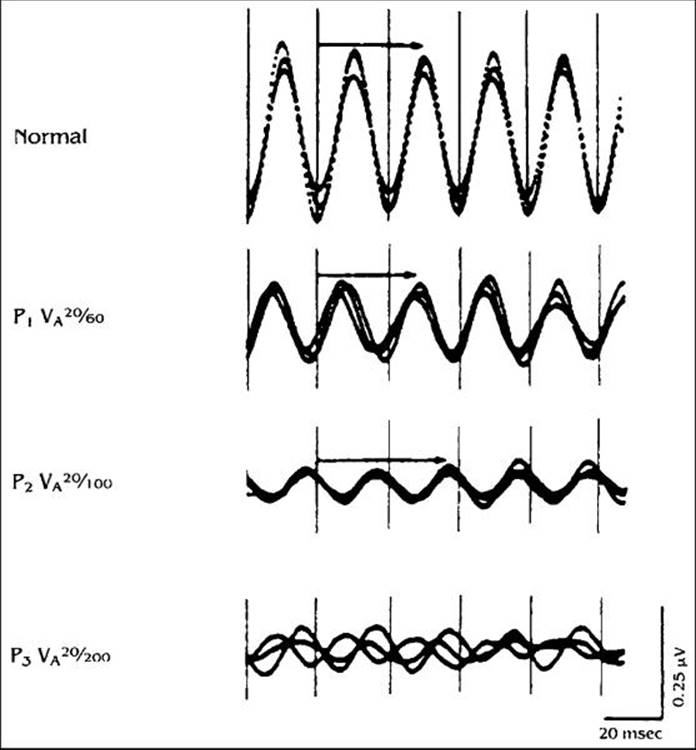
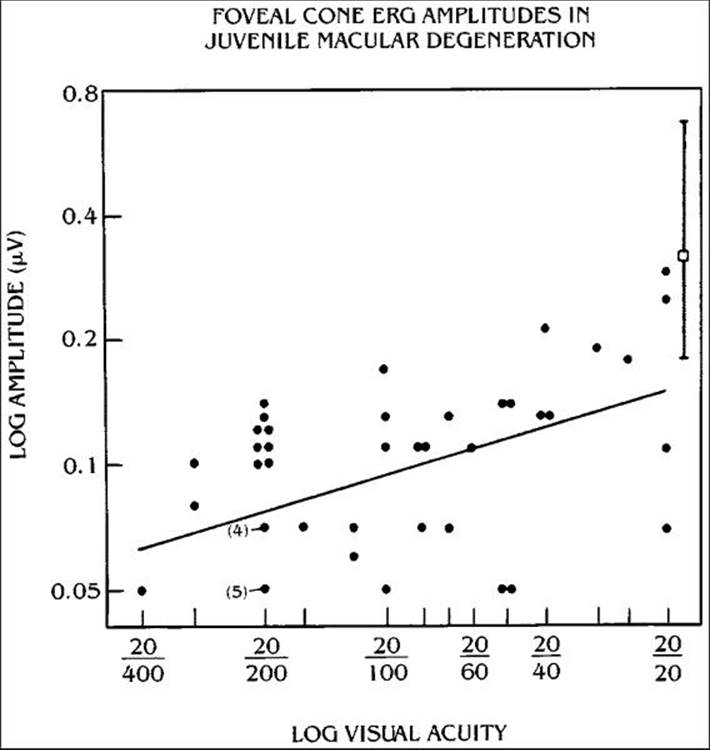
Patients with Stargardt's disease usually present by their teenage years with bilateral diminution of vision.[130, 138] Sometimes these patients may be accused of malingering, since visual deficits often appear prior to any fundus changes. In some of these patients, previous vision screens or ophthalmic exams document that the visual acuity was normal in the past. In patients who initially present with 20/40 or better vision, the visual acuity usually falls to 20/100 or worse within 5 years and fially stabilizes around 20/200.[125] Visual-field testing can show a relative central scotoma that later progresses to an absolute central scotoma. An acquired red-green dyschromatopsia may occur. Dark adaptation of the rods is normal or may be mildly delayed.[139] Full-field ERGs are typically normal, but both the scotopic and photopic ERG may be decreased in as many as 20-33% of patients with fundus flavimaculatus, according to one study. This study showed the presence of ERG abnormalities. Foveal ERGs in both conditions are often abnormal, even in patients with nearly normal visual acuity.140,141 Foveal ERGs may be subnormal in amplitude or delayed in peak time, or both (Fig. 179.15).142 Both changes were correlated with visual acuity (e.g., Fig. 179.16). The EOG has been reported to be subnormal in many patients who have been examined, but especially in patients with fundus flavimaculatus.125 This test is difficult to perform in patients who have diminished visual acuity (<20/200).
|
|
|
|
FIGURE 179.15 Foveal cone ERGs from a normal subject and three patients with Stargardt's disease obtained with a stimulator-ophthalmoscope. Three consecutive computer summations are shown. Arrows designate b-wave implicit times for detectable responses. Responses for the patients are subnormal (P1), subnormal and delayed (P2), and nondetectable (P3). |
|
|
|
|
FIGURE 179.16 A double logarithmic plot of foveal cone ERG amplitude versus Snellen visual acuity based on one eye of each of 46 patients with Stargardt's disease (filled circles). Numbers in parentheses denote multiple values. For statistical purposes, nondetectable responses (<0.05 ?V) were set equal to 0.05 ?V. The solid line is the best-fitting linear regression line, loge y = 0.29 loge x ?1.89, where y is ERG amplitude in microvolts and x is decimal visual acuity; the correlation coefficient (r) is 0.51, p < .001. The median (open square) and range (vertical bars) for foveal ERG amplitudes elicited from 67 normal observers are shown for an average normal visual acuity of 20/18. |
Recently, ultrahigh resolution optical coherence tomography (UHR-OCT) has been used to image the structural retinal changes in patients with Stargardt's disease and fundus flavimaculatus.[143, 144] Patients with central macular atrophy demonstrated atrophic changes of all retinal layers, but especially the inner and outer photoreceptor layers and the outer nuclear layer.[143, 144] Their central foveal thickness was severely decreased, and the amount of thinning correlated with the degree of visual loss.[144] Patients who had flecks but no central atrophy had normal central foveal thickness and retinal architecture but demonstrated parafoveal photoreceptor loss on OCT.[144]
Autosomal recessive Stargardt's disease is caused by mutations in the ABCA4 (formerly called ABCR) gene onchromosome 1p13-p21.[145] To date, 19 different mutations have been identified.[145] These mutations affect the rim protein (RmP), a transporter in the rod outer segments, leading to accumulation of an autofluorescent, constituent of lipofuscin, N-retinylidene-N-retinylethoanolamine (A2E), within the RPE cells.[146] A2E deposition may be accelerated during periods of light exposure and is toxic to the RPE cells.[147, 148] Histopathologic studies in humans with Stargardt's disease have confirmed the accumulation of lipofuscin within the RPE cells.[131, 148] Scanning electron microscopy has revealed RPE cells that were engorged up to 10 times their normal size with this material.[149]
SJÖGREN'S RETICULAR DYSTROPHY OF THE RPE
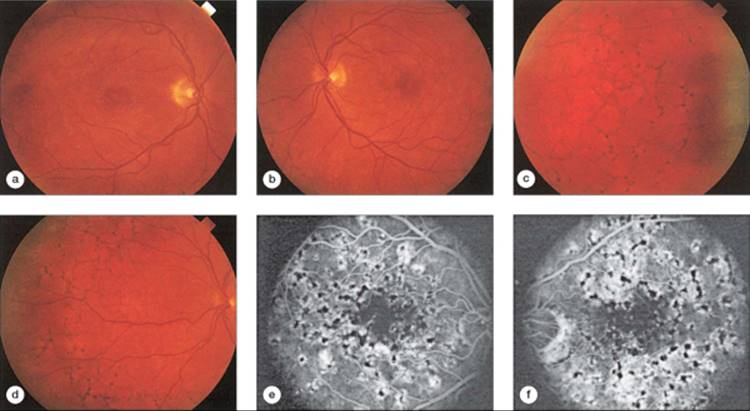
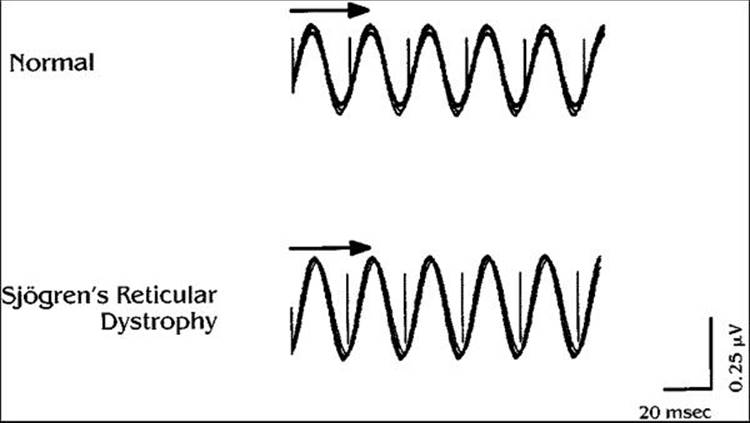
This is a rare, usually autosomal recessive, condition characterized by an accumulation of dark pigment in a meshwork or fishnet-like pattern.[150-152] The network starts centrally and then extends toward the mid-periphery in later stages of the disease, but spares the far periphery. Eventually, the pigment disappears. This pigment is thought to reside at the level of the RPE. On fluorescein angiography, as one might expect, there is hyperfluorescence between the hyperpigmented meshwork. The pigmented network blocks the choroidal fluorescence (Fig. 179.17). Visual acuity is minimally affected. Tests of retinal function are normal. We recorded normal full-field and foveal ERGs from one patient with this condition (e.g., Fig. 179.18). Choroidal neovascularization has been reported in a few patients.[153, 154] No treatment was administered, and their vision either remained stable or improved.[153, 154] No histopathologic information is available for this condition.
|
|
|
|
FIGURE 179.17 Fundus photographs and fluorescein angiograms of a 32-year-old man with Sjögren's reticular dystrophy of the retinal pigment epithelium. Visual acuity was 20/20 O.U. (a-d) Fundus photography shows a fishnet-like pattern of pigmentation in the posterior pole and the midperiphery. (e and f) Fluorescein angiography shows blockage of dye in the areas of hyperpigmentation and hyperfluorescence along the reticulated pattern corresponding to retinal pigment epithelium loss. Full-field and foveal ERGs were normal. |
|
|
|
|
FIGURE 179.18 Foveal cone ERGs from a normal subject and a 32-year-old patient with Sjögren's reticular dystrophy and visual acuity 20/20 obtained with a stimulator-ophthalmoscope. Three consecutive computer summations are superimposed. Arrows designate b-wave implicit times. The patient with Sjögren's reticular dystrophy had normal responses. |
APPROACH TO THE PATIENT
Patients, especially children and young adults, who present with subnormal visual acuity, with or without associated macular changes, should receive a careful evaluation for heredofamilial macular conditions. Exclusion of optic nerve disorders (e.g., optic neuritis) and acquired conditions (e.g., solar maculopathy) by a careful history and examination is crucial in establishing the diagnosis. Many of these conditions have typical fundus features that make diagnosis easy. Conversely, many conditions that have a similar fundus appearance may display different functional (ERG) abnormalities. Full-field ERG testing is therefore useful in evaluating whether only the cone or both the cone and the rod systems are involved. Not only is this useful for diagnostic purposes, but it also can help determine whether peripheral visual loss may occur in a patient who only has visible changes in the macula. Focal ERG evaluates the function of the foveal photoreceptors and can be helpful in distinguishing amblyopia and optic nerve disorders from macular malfunction. EOG testing is useful in evaluating patients who are thought to have Best's disease, but a normal EOG does not exclude Best's disease. Fluorescein angiography is useful for diagnostic purposes and for determining the evaluation and treatment of choroidal neovascular membranes.
Following the diagnosis of a heredofamilial macular degeneration, the patient's needs for visual aids should be assessed. Affected children should sit in the front of the classroom and may need telescopic aids. They may also benefit from vocational counseling geared to their visual deficit. Magnifiers and high-add glasses for near use have been found useful for reading. Devices for enlarging reading material have also been helpful. Patients with disease that solely affects the macula should be encouraged that they will maintain the use of their peripheral vision for the rest of their lives. Many patients benefit from the use of a hand-held pocket telescope for use at ball games or the theater and for other activities that require fie distance acuity. We encourage our patients who are sensitive to bright light to wear sunglasses. Patients are reevaluated every 1-2 years to assess their visual function and reassess their need for visual aids.
If a heredofamilial condition is thought to exist, the individual is counseled regarding the possibility of having other affected family members, and if a mode of inheritance is established, she or he is told about the possibility of having affected children.
REFERENCES
1. Deutman AF, Pinckers AJLG, Van de Kerk AL: Dominantly inherited cystoid macular edema. Am J Ophthalmol 1976; 82:540.
2. Notting JGA, Pinckers AJLG: Dominant cystoid macular dystrophy. Am J Ophthalmol 1977; 83:234.
3. Pinckers A, Deutman AF, Notting JG: Retinal function in dominant cystoid macular dystrophy. Arch Ophthalmol 1976; 94:579.
4. Pinckers A, Cuypers MH, Aandekerk AL: The EOG in Best's disease and dominant cystoid macular dystrophy (DCMD). Ophthalmic Genet 1996; 17:103-108.
5. Kremer H, Pinckers A, van den Helm B, et al: Localization of the gene for dominant cystoid macular dystrophy on chromosome 7p. Hum Mol Genet 1994; 3:299.
6. Edwards AO, Miedziak A, Vrabec T, et al: Autosomal dominant Stargardt-like macular dystrophy: I. Clinical characterization, longitudinal follow-up, and evidence for a common ancestry in families linked to chromosome 6q14. Am J Ophthalmol 1999; 127:426-435.
7. Lopez PF, Maumenee IH, de la Cruz Z, et al: Autosomal dominant fundus flavimaculatus. Ophthalmology 1990; 97:798.
8. Vrabec TR, Tantri A, Edwards A, et al: Autosomal dominant Stargardt-like macular dystrophy: identification of a new family with a mutation in the ELOVL4 gene. Am J Ophthalmol 2003; 136:542-545.
9. Kniazeva M, Chiang MF, Morgan B, et al: A new locus for autosomal dominant Stargardt-like disease maps to chromosome 4. Am J Hum Genet 1999; 64:1394.
10. Vasireddy V, Vijayasarathy C, Huang J, et al: Stargardt-like macular dystrophy protein ELOVL4 exerts a dominant negative effect by recruiting wild-type protein into aggresomes. Mol Vision 2005; 11:665.
11. Maloney W, Robertson D, Duboff S: Hereditary vitelliform macular degeneration. Arch Ophthalmol 1977; 95:979.
12. Barricks M: Vitelliform lesions developing in normal fundi. Am J Ophthalmol 1977; 83:324.
13. Kraushar M, Margolis S, Morse P, et al: Pseudohypopyon in Best's vitelliform macular dystrophy. Am J Ophthalmol 1982; 94:30.
14. Miller SA, Bresnick GH, Chandra SR: Choroidal neovascular membrane in Best's vitelliform macular dystrophy. Am J Ophthalmol 1976; 82:252.
15. Benson WE, Kilker AE, Enoch JM, et al: Best's vitelliform macular dystrophy. Am J Ophthalmol 1975; 79:59.
16. Schachat AP, de la Cruz Z, Green WR: Macular hole and retinal detachment in Best's disease. Retina 1985; 5:22.
17. Mehta M, Katsumi O, Tetsuka S, et al: Best's macular dystrophy with a macular hole. Acta Ophthalmol 1991; 69:131.
18. Glacet-Bernard A, Coscas G: Full-thickness macular hole and retinal detachment complicating Best's disease. Eur J Ophthalmol 1993; 3:53.
19. Thu T, Chan WM, Dung D, et al: A large macular hole in a young patient with Best's disease. Clin Experiment Ophthalmol 2003; 31:539.
20. Curry Jr H, Moorman L: Fluorescein photography of vitelliform macular degeneration. Arch Ophthalmol 1968; 79:705.
21. Krill AE, Morse PA, Potts AM, et al: Hereditary vitelliruptive macular degeneration. Am J Ophthalmol 1966; 61:1405.
22. Franois J, De Rouck A, Fernandez-Sasso D: Electro-oculography in vitelliform degeneration of the macula. Arch Ophthalmol 1967; 77:726.
23. Deutman AF: Electro-oculography in families with vitelliform dystrophy of the fovea: detection of the carrier state. Arch Ophthalmol 1969; 81:305.
24. Sabates R, Pruett RC, Hirose T: Pseudovitelliform macular degeneration. Retina 1982; 2:197.
25. Wajima R, Chater SB, Katsumi O, et al: Correlating visual acuity and electrooculogram recordings in Best's disease. Ophthalmologica 1993; 207:174.
26. Pollack K, Kreuz FR, Pillunat LE: Best's disease with normal EOG. Case report of familial macular dystrophy. Ophthalmologe 2005; 102:891.
27. Renner AB, Tillack H, Kraus H, et al: Late onset is common in Best macular dystrophy associated with VMD2 gene mutations. Ophthalmology 2005; 112:586.
28. Mohler CW, Fine SL: Long-term evaluation of patients with Best's vitelliform dystrophy. Ophthalmology 1981; 88:688.
29. Miller SA: Multifocal Best's vitelliform dystrophy. Arch Ophthalmol 1977; 95:984.
30. Noble K, Levitzky M, Carr R: Detachments of the retinal pigment epithelium at the posterior pole. Am J Ophthalmol 1976; 82:296.
31. Burgess D, Olk R, Uniat L: Macular disease resembling adult foveomacular dystrophy in older adults. Ophthalmology 1987; 94:1987.
32. Frangieh GT, Green WR, Fine SL: A histopathologic study of Best's vitelliform dystrophy. Arch Ophthalmol 1982; 100:1115.
33. Stohr H, Marquardt A, Rivera A, et al: A gene map of the Best's vitelliform macular dystrophy region in chromosome 11q12-q13.1. Genome Res 1998; 8:48.
34. Rosenthal R, Bakall B, Kinnick T, et al: Expression of bestrophin-1, the product of the VMD2 gene, modulates voltage-dependent Ca2+ channels in retinal pigment epithelial cells. FASEB J 2006; 20:178.Epub 10 Nov 2005.
35. Gass JDM: A clinicopathologic study of a peculiar foveomacular dystrophy. Trans Am Ophthalmol Soc 1974; 72:139.
36. Vine AK, Schatz H: Adult-onset foveomacular pigment epithelial dystrophy. Am J Ophthalmol 1980; 89:680.
37. O'Gorman S, Flaherty WA, Fishman GA, et al: Histopathologic findings in Best's vitelliform macular dystrophy. Arch Ophthalmol 1988; 106:1261.
38. Bloom LH, Swanson DE, Bird AC: Adult vitelliform macular degeneration. Br J Ophthalmol 1981; 65:800.
39. Fishman GA, Trimble S, Rabb MF, et al: Pseudovitelliform macular degeneration. Arch Ophthalmol 1977; 95:73.
40. Wiznia R, Perina B, Noble K: Vitelliform macular dystrophy of late onset. Br J Ophthalmol 1981; 65:866.
41. Hodes B, Feiner L, Sherman S, et al: Progression of pseudovitelliform macular dystrophy. Arch Ophthalmol 1984; 102:381.
42. Epstein G, Rabb M: Adult vitelliform macular degeneration: diagnosis and natural history. Br J Ophthalmol 1980; 64:733.
43. Noble KG, Chang S: Adult vitelliform degeneration progressing to full-thickness macular hole. Arch Ophthalmol 1991; 109:325.
44. Soliman MM: Vitelliform macular dystrophy: a cause of macular holes with retinal detachments. Eye 1994; 3:484.
45. Brecher R, Bird AC: Adult vitelliform macular dystrophy. Eye 1990; 4:210.
46. Gass JDM: A clinicopathologic study of a peculiar foveomacular dystrophy. Trans Am Ophthalmol Soc 1974; 72:139.
47. Patrinely JR, Lewis RA, Font R: Foveomacular vitelliform dystrophy, adult type: a clinicopathologic study including electron microscopic observations. Ophthalmology 1985; 92:1712.
48. Dubovy SR, Hairston RJ, Schatz H, et al: Adult-onset foveomacular pigment epithelial dystrophy: clinicopathologic correlation of three cases. Retina 2000; 20:638.
49. Benhamou N, Souied EH, Zolf R, et al: Adult-onset foveomacular vitelliform dystrophy: a study by optical coherence tomography. Am J Ophthalmol 2003; 135:362.
50. Benhamou N, Messas-Kaplan A, Cohen Y, et al: Adult-onset foveomacular vitelliform dystrophy with OCT 3. Am J Ophthalmol 2004; 138:294.
51. Wirtitsch MG, Ergun E, Hermann B, et al: Ultrahigh resolution optical coherence tomography in macular dystrophy. Am J Ophthalmol 2005; 140:976.
52. Feist RM, White MF, Skalka H, et al: Choroidal neovascularization in a patient with adult foveomacular dystrophy and a mutation in the retinal degeneration slow gene (pro 210 arg). Am J Ophthalmol 1994; 118:259.
53. Yang Z, Li Y, Jiang L, Karan G, et al: A novel RDS/peripherin gene mutation associated with diverse macular phenotypes. Ophthalmic Genet 2004; 25:133.
54. Yang Z, Lin W, Moshfeghi DM, et al: A novel mutation in the RDS/Peripherin gene causes adult-onset foveomacular dystrophy. Am J Ophthalmol 2003; 135:213.
55. Hsieh RC, Fine BS, Lyons JS: Patterned dystrophies of the retinal pigment epithelium. Arch Ophthalmol 1977; 95:429.
56. Marmor M, Byers B: Pattern dystrophy of the pigment epithelium. Am J Ophthalmol 1977; 84:32.
57. O'Donnell FE, Schatz H, Reid P, et al: Autosomal dominant dystrophy of the retinal pigment epithelium. Arch Ophthalmol 1979; 97:680.
58. Prensky JG, Bresnick GH: Butterfly-shaped macular dystrophy in four generations. Arch Ophthalmol 1983; 101:1198.
59. Giuffre G: Autosomal dominant pattern dystrophy of the retinal pigment epithelium: intrafamilial variability. Retina 1988; 8:169.
60. Zhang K, Garibaldi DC, Li Y, et al: Butterfly-shaped pattern dystrophy: a genetic, clinical, and histopathological report. Arch Ophthalmol 2002; 120:485.
61. Theischen M, Schilling H, Steinhorst UH: EOG in adult vitelliform macular degeneration, butterfly-shaped pattern dystrophy and Best disease. Ophthalmologe 1997; 94:230.
62. Burgess D: Subretinal neovascularization in a pattern dystrophy of the retinal pigment epithelium. Retina 1981; 1:151.
63. Gutman I, Walsh JB, Henkind P: Vitelliform macular dystrophy and butterfly-shaped epithelial dystrophy: A continuum?. Br J Ophthalmol 1982; 66:170.
64. Zhang K, Garibaldi DC, Li Y: Butterfly-shaped pattern dystrophy: a genetic, clinical, and histopathological report. Arch Ophthalmol 2002; 120:485.
65. Nichols BE, Sheffield VC, Vandenburgh K, et al: Butterfly-shaped pigment dystrophy of the fovea caused by a point mutation in codon 167 of the RDS gene. Nat Genet 1993; 3:191.
66. Yang Z, Li Y, Jiang L, et al: A novel RDS/peripherin gene mutation associated with diverse macular phenotypes. Ophthalmic Genet 2004; 25:133.
67. Daniele S, Restagno G, Daniele C, et al: Analysis of the rhodopsin and peripherin/RDS gene in two families with pattern dystrophy of the retinal pigment epithelium. Eur J Ophthalmol 1996; 6:197.
68. Massin P, Guillausseau PJ, Vialettes B, et al: Macular pattern dystrophy associated with a mutation of mitochondrial DNA. Am J Ophthalmol 1995; 120:247.
69. Ferry AP, Llovera I, Shafer DM: Central areolar choroidal dystrophy. Arch Ophthalmol 1972; 88:39.
70. Sandvig K: Familial, central, areolar, choroidal atrophy of autosomal dominant inheritance. Acta Ophthalmol 1955; 33:1.
71. Sorsby A, Crick RP: Central areolar choroidal sclerosis. Br J Ophthalmol 1953; 37:129.
72. Klevering BJ, van Driel M, van Hogerwou AJM, et al: Central areolar choroidal dystrophy associated with dominantly inherited drusen. Br J Ophthalmol 2002; 86:91.
73. Yanagihashi S, Nakazawa M, Kurotaki J, et al: Autosomal dominant central areolar choroidal dystrophy and a novel Arg195Leu mutation in the peripherin/RDS gene. Arch Ophthalmol 2003; 121:1458.
74. Rothman RJ: Photoreceptor dysfunction in central areolar choroidal dystrophy. Ann Ophthalmol 1994; 36:25.
75. Keithahn MAZ, Huang M, Keltner JL, et al: The variable expressivity of a family with central areolar pigment epithelial dystrophy. Ophthalmology 1996; 103:406.
76. Reichel E, Berson EL: Abnormal full-field cone electroretinograms in central areolar choroidal dystrophy. Invest Ophthalmol Vis Sci 1990; 31(Suppl):496.
77. Nagasaka K, Horiguchi M, Shimada Y, Yuzawa M: Multifocal electroretinograms in cases of central areolar choroidal dystrophy. Invest Ophthalmol Vis Sci 2003; 44:1673.
78. Ashton N: Central areolar choroidal sclerosis: A histo-pathological study. Br J Ophthalmol 1953; 37:140.
79. Lichanska AM, McGibbon D, Silvestri G, Hughes AE: A physical and expression map of the D17S1810-D17S1353 region spanning the central areolar choroidal dystrophy locus. Cytogenet Cell Genet 2001; 93:43.
80. Biesen P, Deutman A, Pinckers A: Evolution of benign concentric annular macular dystrophy. Am J Ophthalmol 1985; 100:73.
81. van Lith-Verhoeven JC, Hoyng CB, van den Helm B, et al: The benign concentric annular macular dystrophy locus maps to 6p12.3-q16. Invest Ophthalmol Vis Sci 2004; 45:30.
82. O'Donnell FE Jr, Welch RB: Fenestrated sheen macular dystrophy: a new autosomal dominant maculopathy. Arch Ophthalmol 1979; 97:1292.
83. Sneed SR, Sieving PA: Fenestrated sheen macular dystrophy. Am J Ophthalmol 1991; 112:1.
84. Frank HR, Landers MB Jr, Williams RJ, et al: A new dominant progressive foveal dystrophy. Am J Ophthalmol 1974; 78:903.
85. Small KW, Killian J, McLean WC: North Carolina's dominant progressive foveal dystrophy: how progressive is it?. Br J Ophthalmol 1991; 75:401.
86. Small KW: North Carolina macular dystrophy: clinical features, genealogy, and genetic linkage analysis. Trans Am Ophthalmol Soc 1998; 96:925.
87. Small KW, Puech B, Mullen L, Yelchits S: North Carolina macular dystrophy phenotype in France maps to the MCDR1 locus. Mol Vis 1997; 3:1.
88. Small KW, Hermsen V, Gurney N, et al: North Carolina macular dystrophy and central areolar pigment epithelial dystrophy. One family, one disease. Arch Ophthalmol 1991; 110:515.
89. Schworm HD, Ulbig MW, Hoops J, et al: North Carolina macular dystrophy. Hereditary macular disease with good functional prognosis. Ophthalmologe 1998; 95:13.
90. Small KW, Udar N, Yelchits S, et al: North Carolina macular dystrophy (MCDR1) locus: a fine resolution genetic map and haplotype analysis. Mol Vis 1999; 5:38.
91. Voo I, Glasgow BJ, Flannery J, et al: North Carolina macular dystrophy: clinicopathologic correlation. Am J Ophthalmol 2001; 132:933.
92. Francis PJ, Johnson S, Edmunds B, et al: Genetic linkage analysis of a novel syndrome comprising North Carolina-like macular dystrophy and progressive sensorineural hearing loss. Br J Ophthalmol 2003; 87:893.
93. Michaelides M, Johnson S, Tekriwal AK, et al: An early-onset autosomal dominant macular dystrophy (MCDR3) resembling North Carolina macular dystrophy maps to chromosome 5. Invest Ophthalmol Vis Sci 2003; 44:2178.
94. Duke-Elder S: The tapeto-retinal dystrophies. In: Duke-Elder S, ed. System of ophthalmology, St Louis: CV Mosby; 1967.
95. Stone EM, Lotery AJ, Munier FL, et al: A single EFEMP1 mutation associated with both Malattia Leventinese and Doyne honeycomb retinal dystrophy. Nature Genet 1999; 22:199.
96. Stefko ST, Zhang K, Gorin MB, Traboulsi EI: Clinical spectrum of chromosome 6-linked autosomal dominant drusen and macular degeneration. Am J Ophthalmol 2000; 130:203.
97. Deutman A, Jansen LMAA: Dominant drusen of Bruch's membrane. In: Deutman A, ed. The hereditary dystrophies of the posterior pole of the eye, Assen, The Netherlands: van Gorcum; 1971.
98. Pearce WG: Doyne's honeycomb retinal degeneration: clinical and genetic features. Br J Ophthalmol 1968; 52:73.
99. Deutman AF, Jansen LMAA: Dominantly inherited drusen of Bruch's membrane. Br J Ophthalmol 1970; 54:373.
100. Holz FG, Owens SL, Marks J, et al: Ultrastructural findings in autosomal dominant drusen. Arch Ophthalmol 1997; 115:788.
101. Farkas TG, Krill AE: Familial and secondary drusen: histologic and functional correlations. Trans Am Acad Ophthalmol Otolaryngol 1971; 75:333.
102. Fraser HB, Wallace DC: Sorsby's familial pseudoinflammatory macular dystrophy. Am J Ophthalmol 1971; 71:1216.
103. Sorsby A, Mason MEJ, Gardener N: A fundus dystrophy with unusual features. Br J Ophthalmol 1949; 33:67.
104. Carr RE, Noble KG, Nasaduke I: hereditary hemorrhagic macular dystrophy. Am J Ophthalmol 1978; 85:318.
105. Carr RE, Noble KG: Pseudoinflammatory macular dystrophy. Trans Am Ophthalmol Soc 1977; 75:255.
106. Steinmetz RD, Polkinghorne D, Fitzke F, et al: Abnormal dark adaptation and rhodopsin kinetics in Sorsby's fundus dystrophy. Invest Ophthalmol Vis Sci 1990; 31(Suppl):413.
107. Steinmetz RL, Polkinghorne PC, Fitzke FW, et al: Abnormal dark adaptation and rhodopsin kinetics in Sorsby's fundus dystrophy. Invest Ophthalmol Vis Sci 1992; 33:1633.
108. Sieving PA, Boskovich S, Bingham E, Pawar H: Sorsby's fundus dystrophy in a family with Ser-181-Cys mutation in the TIMP-3 gene: poor outcome after laser photocoagulation. Trans Am Ophthalmol Soc 1996; 94:275.
109. Chong NHV, Alexander RA, Gin T: TIMP-3, collagen, and elastin immunohistochemistry and histopathology of Sorsby's fundus dystrophy. Invest Ophthalmol Vis Sci 2000; 41:898.
110. Ashton N, Sorsby A: A fundus dystrophy with unusual features: a histological study. Br J Ophthalmol 1951; 35:751.
111. Capon MR, Marshall J, Krafft JI: Sorsby's fundus dystrophy. A light and electron microscopic study. Ophthalmology 1989; 96:1769.
112. Li Z, Clarke MP, Barker MD, McKie N: TIMP3 mutation in Sorsby's fundus dystrophy: molecular insights. Expert Rev in Mol Med 2005; 7:1.
113. Weber BHF, Vogt G, Pruett RC, et al: Mutations in the tissue inhibitor of metalloproteinase-3 (TIMP3) in patients with Sorsby's fundus dystrophy. Nat Genet 1994; 8:352.
114. Langton KP, McKie N, Smith BM, et al: Sorsby's fundus dystrophy mutations impair turnover of TIMP-3 by retinal pigment epithelial cells. Hum Mol Genet 2005; 14:3579.
115. Langton KP, McKie N, Curtis A, et al: A novel tissue inhibitor of metalloproteinases-3 mutation reveals a common molecular phenotype in Sorsby's fundus dystrophy. J Biol Chem 2000; 275:27027.
116. Jacobson SG, Cideciyan AV, Regunath G, et al: Night blindness in Sorsby's fundus dystrophy reversed by vitamin A. Nat Genet 1995; 11:27.
117. Miyake Y, Ichikawa K, Shiose Y, Kawase K: Hereditary macular dystrophy without visible fundus abnormality. Am J Ophthalmol 1989; 108:292.
118. Matthews GP, Sandberg MA, Berson EL: Foveal cone electroretinograms in patients with central visual loss of unexplained etiology. Arch Ophthalmol 1992; 110:1568.
119. Miyake Y, Horiguchi M, Tomita N, et al: Occult macular dystrophy. Am J Ophthalmol 1996; 122:644.
120. Kondo M, Ueno S, Piao C-H, et al: Occult macular dystrophy in an 11 year old boy. Br J Ophthalmol 2004; 88:1602.
121. Kondo M, Ito Y, Ueno S, et al: Foveal thickness in occult macular dystrophy. Am J Ophthalmol 2003; 135:725.
122. Nakamura M, Kanamori A, Seya R, et al: A case of occult macular dystrophy accompanying normal-tension glaucoma. Am J Ophthalmol 2003; 135:715.
123. Lewis RA, Lee GB, Martonyi CL, et al: Familial foveal retinoschisis. Arch Ophthalmol 1977; 95:1190.
124. Perez Alvarez MJ, Clement Fernandez F: No X-chromosome linked juvenile foveal retinoschisis. Arch Soc Esp Oftalmol 2002; 77:443.
125. Armstrong JD, Meyer D, Xu S, Elfervig JL: Long-term follow-up of stargardt's disease and fundus flavimaculatus. Ophthalmology 1998; 105:448.
126. Franceschetti A, Franois J: Fundus flavimaculatus. Arch Ophtalmol (Paris) 1965; 25:505.
127. Hadden OB, Gass JDM: Fundus flavimaculatus and Stargardt's disease. Am J Ophthalmol 1976; 82:527.
128. Carr RE: Fundus flavimaculatus. Arch Ophthalmol 1965; 74:163.
129. Fishman GA: Fundus flavimaculatus: a clinical classification. Arch Ophthalmol 1976; 94:2061.
130. Klien BA, Krill AE: Fundus flavimaculatus: clinical, functional and histopathologic observations. Am J Ophthalmol 1967; 64:3.
131. Noble KG, Carr RE: Stargardt's disease and fundus flavimaculatus. Arch Ophthalmol 1979; 97:1281.
132. Klevering BJ, Maugeri A, Wagner A, et al: Three families displaying the combination of Stargardt's disease with cone-rod dystrophy or retinitis pigmentosa. Ophthalmol 2004; 111:546.
133. Ernest JT, Krill AE: Fluorescein studies in fundus flavimaculatus and drusen. Am J Ophthalmol 1966; 62:1.
134. Gass JDM: Stereoscopic atlas of macular diseases, St Louis, CV Mosby, 1987.
135. Aaberg T: Stargardt's disease and fundus flavimaculatus: evaluation of morphologic progression of intrafamilial co-existence. Trans Am Ophthalmol Soc 1986; 84:453.
136. Klein RR, Lewis R, Meyers S, et al: Subretinal neovascularization associated with fundus flavimaculatus. Arch Ophthalmol 1978; 96:2054.
137. Souied EH, Pawlak D, Algan M, et al: Photodynamic therapy for choroidal neovascularization on late-onset fundus flavimaculatus. Am J Ophthalmol 2005; 140:312.
138. Moloney JBM, Mooney DJ, O'Connor MA: Retinal function in Stargardt's disease and fundus flavimaculatus. Am J Ophthalmol 1983; 96:57.
139. Fishman GA, Farbman JS, Alexander KR: Delayed rod dark adaptation in patients with Stargardt's disease. Ophthalmology 1991; 98:957.
140. Sandberg MA, Jacobson SG, Berson EL: Focal cone electroretinograms in retinitis pigmentosa and juvenile macular degenerations. Am J Ophthalmol 1979; 88:702.
141. Gerth C, Andrassi-Darida M, Bock M, et al: Phenotypes of 16 Stargardt macular dystrophy/fundus flavimaculatus patients with known ABCA4 mutationa and evaluation of genotype-phenotype correlation. Graefe's Arch Clin Exp Ophthalmol 2002; 240:638.
142. Sandberg MA, Hanson AH, Berson EL: Foveal and parafoveal cone electroretinogram in juvenile macular degeneration. Ophthalmic Paediatr Genet 1983; 3:83.
143. Wirtitsch MG, Ergun E, Hermann B, et al: Ultrahigh resolution optical coherence tomography in macular dystrophy. Am J Ophthalmol 2005; 140:976.
144. Ergun E, Hermann B, Wirtitsch MG, et al: Assessment of central visual function in Stargardt's disease/fundus flavimaculatus with ultrahigh-resolution optical coherence tomography. Invest Ophthal Vis Sci 2005; 46:310.
145. Allikmets R, Singh N, Sun H, et al: A photoreceptor cell-specific ATP-binding transporter gene (ABCR) is mutated in recessive Stargardt macular dystrophy. Nat Genet 1997; 15:236.
146. Mata NL, Weng J, Travis GH: Biosynthesis of a major lipofuscin fluorophore in mice and humans with ABCR-mediated retinal and macular degeneration. Proc Natl Acad Sci USA 2000; 97:7154.
147. Mata NL, Tzekov RT, Liu X, et al: Delayed dark-adaptation and lipofuscin accumulation in abcr+/? mice: implications for involvement of ABCR in age-related macular degeneration. Invest Ophthalmol Vis Sci 2001; 42:1685.
148. Radu RA, Mata NL, Bagla A, Travis GH: Light exposure stimulates formation of A2E oxiranes in a mouse model of Stargardt's macular degeneration. Proc Natl Acad Sci USA 2004; 101:5928.
149. Eagle RC, Lucier AC, Bernardino Jr VB, et al: Retinal pigment epithelial abnormalities in fundus flavimaculatus: a light and electron microscope study. Ophthalmology 1980; 87:1189.
150. Chopdar A: Reticular dystrophy of the retina. Br J Ophthalmol 1976; 60:342.
151. Fishman GA, Woolf MB, Goldberg MF, et al: Reticular tapeto-retinal dystrophy: a possible late stage of Sjögren's reticular dystrophy. Br J Ophthalmol 1976; 60:35.
152. Kingham JD, Fenzi RE, Willerson D, Aaberg TM: Reticular dystrophy of the retinal pigment epithelium. Arch Ophthalmol 1978; 96:1177.
153. Marano F, Deutman AF, Pinckers AJ, et al: Reticular dystrophy of the retinal pigment epithelium and choroidal neovascularization. A fluorescein and ICGV study. Acta Ophthalmol Scand 1997; 75:22.
154. Zeldovich A, Beaumont P, Chang A, Kang K: Indocyanine green angiographic interpretation of reticular dystrophy of the retinal pigment epithelium complicated by choroidal neovascularization. Clin Experiment Ophthalmol 2002; 30:383.