
Otitis externa is commonly known as swimmer’s ear, and is an infection of the ear canal. The most common cause is retained water in the ear canal, while other causes include irritating the ear canal with a cotton bud or similar object, badly fitting hearing aids, excess ear wax, sweating in dirty and dusty conditions, and dermatitis in the ear canal.
Bacteria normally live in the outer ear, but if the canal remains constantly wet, the bacteria can invade tissue to cause an infection. If a fungus is the cause it is called otomycosis or tropical ear. These infections are more common in children because their narrower ear canals retain water easily, but they can be prevented by using drying drops in the ear after each period of swimming, or inserting ear plugs before swimming. Sea water is less likely to be a problem than fresh water.
The outer ear canal and the outer surface of the eardrum become excruciatingly painful. The onset is often very rapid, and as the infection progresses a discharge from the ear usually develops. The infection can injure the eardrum and repeated attacks may cause permanent damage. Untreated infections can spread through the eardrum and cause a more serious middle ear infection (otitis media).
In most cases, no investigations are necessary, but if the infection is persistent, swabs may be taken so that the responsible bacteria and fungi can be identified. Treatment involves cleaning the ear of any wax or debris that may be present in the canal, and inserting antibiotic drops or ointment. In difficult cases a wick (piece of light material) soaked in antibiotic ointment or drops may be put in the ear. Tropical ear is more difficult to cure and a prolonged course of antifungal drops or ointment and antifungal tablets is necessary.
See also EARACHE; OTITIS MEDIA
Otitis media is a bacterial infection of the middle ear.
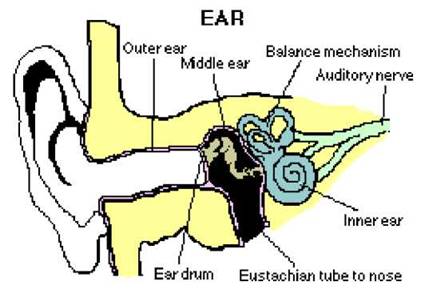
The middle ear is a cavity that contains three tiny bones that transmit the vibrations of the eardrum to the hearing mechanism in the inner ear. There is a small tube (the Eustachian tube) connecting the middle ear to the back of the nose, and infection can enter the middle ear from there. Infection can also spread from the outer ear to the middle ear. Children are more commonly affected than adults.
Patients experience a sudden onset of severe pain, often at night, and a fever. Pressure on the outside of the ear causes additional pain and relative deafness. Antibiotics and medications are prescribed to dry up phlegm, but it is sometimes necessary to perform a small operation on the eardrum to relieve the pressure. If left untreated or there is rapid worsening of the infection, the bulging eardrum may burst, and blood and pus will ooze out of the ear canal. The pain may be relieved by rupture of the eardrum, but treatment with antibiotics is essential to ensure that the eardrum repairs itself. If the hole in the eardrum fails to heal after several months, it may be necessary to have an operation to repair it. Rarer complications include a spread of the infection into the surrounding bone (mastoiditis), or into the bloodstream or brain.
Patients get very good results with appropriate treatment, and a ruptured eardrum usually heals in one or two weeks.
See also EARACHE; GLUE EAR; OTITIS EXTERNA