
Elissa Jones-Hua
A child’s acquisition of developmental milestones is a dynamic process, and early identification of infants and children with developmental delays is an important facet of primary care practice. Appropriate data collection, consideration of alternative diagnoses, and development of an individualized plan of care are important components, just as with management of diseases. Early identification of at-risk infants and children should lead to early intervention; delays may harm the child. The problem for the provider is deciding when early gaps in developmental progress merit added attention and perhaps referral versus patience with hope for gains that will keep the child within normal limits.
Educational Objectives
1. List the five categories of developmental milestones.
2. Identify at least three risk factors that contribute to developmental delays.
3. Identify abnormal persistence of primitive reflexes.
4. Describe the management of an infant with a motor delay.
Case Presentation and Discussion
Maya Conteh is a 9-month-old African female who comes to your outreach clinic for an initial evaluation. She is accompanied by her mother who speaks Arabic and English. The mother is concerned that Maya is not developing like other children her age. The family emigrated from Sudan one year ago and now lives in low-income student housing because the father is in graduate school. This is their first child. The maternal grandparents are also temporarily living in the household and help out with Maya.
What questions will you ask Maya’s mother related to her concerns? 
Your review of Maya’s birth history reveals the following information: Maya was born 11 weeks early and weighed only 2½ pounds. According to the mother, the doctors were surprised to see what a strong and active girl she was. However, when Maya was just a few days old, she stopped breathing and was put on a ventilator. After 24 hours she was able to breathe on her own. According to the mother, the doctors ran a myriad of tests to find out what had happened, but they couldn’t find anything wrong. The remainder of Maya’s time in the hospital was uneventful and she went home after 2 months.
Once at home, Maya’s mother noticed that she drooled and choked easily when she drank from her bottle. As months went by, Maya’s mother noticed other things that were odd. Maya couldn’t hold her head up straight, roll, or sit with support. In fact, she still can’t do these things. She cries a lot and becomes stiff with rage.
What other questions do you need to ask?
Before answering this question, here is some more information about child development and acquisition of developmental milestones that you need to consider.
Development of Infants
Development is divided into five categories: gross motor, fine motor, language, cognition, and social/emotional growth. Refer to Table 2-1 for a summary of infant developmental milestones by age in months.
Gross Motor Development
Gross motor skills occur in a typical sequence. The three general patterns of physical development are development occurs in a head to foot progression, strength and coordination of the limbs begin close to the body and move outward, and motor responses proceed from general to specific (Deloian & Berry, 2009).
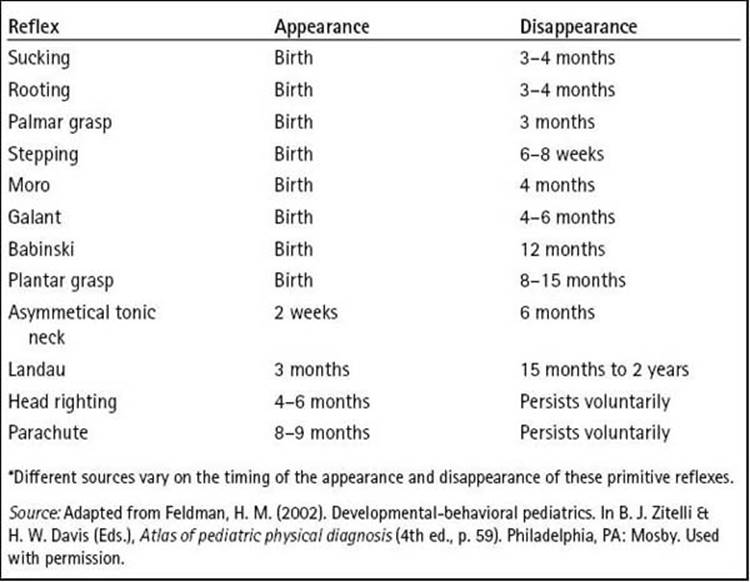
Reflexes govern much of an infant’s behavior during the first 3 months of life. As the newborn reflexes fade, more purposeful movements replace them. Gaining strength and coordination in their muscles allows infants to explore and manipulate objects in their environment. A typical infant follows a known developmental progression, which starts at birth. A summary of primitive reflexes is found in Table 2-2.
Gross motor skills require large muscles or groups of muscles in order to carry out activities. When performing a task, these muscles should act in a coordinated way to accomplish a movement. An important element to consider when assessing gross motor skills is posture. Poor posture makes purposeful movements more difficult to perform. Examples of gross motor tasks in infancy are head control, sitting, rolling over, standing, crawling, and walking.
Tone is an important element in motor skills development. Muscular tone is the basic and constant ongoing contraction or muscular activity in the muscles. The three categories of tone are normal, hypotonic (decreased muscle tone), and hypertonic (increased muscle tone). Infants and children who are hypotonic appear floppy, similar to a rag doll. Hypotonic infants have difficulty maintaining posture against gravity. They often prefer to sit, lie on the floor, or lean against something. In contrast, infants and children with hypertonia appear stiff and do not move in a smooth, natural manner. An abnormality in muscular tone is a component of impaired motor skills. Infants and children with abnormal tone expend an enormous amount of energy to carry out movements and maintain postures (Alderman, 2001).
Table 2–1 Developmental Milestones for Infants (Birth–12 months)
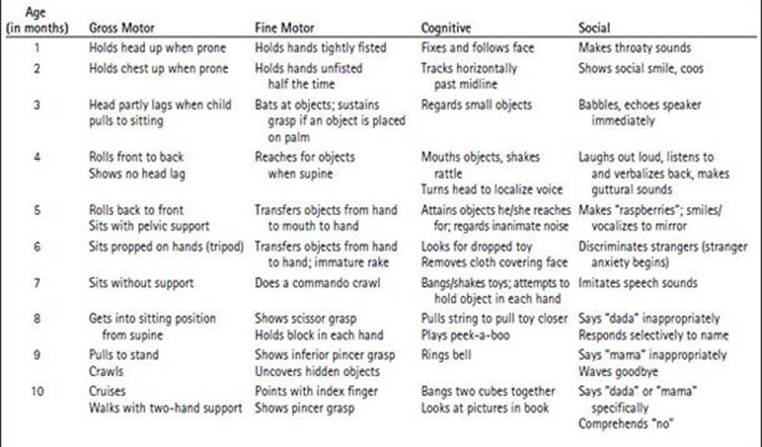

Table 2–2 Primitive Reflexes
Some causes of gross motor delays include the following conditions: birth trauma, chromosomal abnormalities, inborn errors of metabolism, mitochondrial disorders, brain tumor, hypothyroidism, muscular dystrophies, abuse or neglect, sensory deprivation, shaken baby syndrome, sepsis, malnutrition or starvation, fetal alcohol syndrome, Werdnig-Hoffman disease, and lead or mercury poisoning.
Oro-Motor Development
Oro-motor development sometimes is considered a part of fine motor development because it requires the use of small muscles in a delicately coordinated fashion. Children with problems of drooling, choking, chewing, swallowing, and speech generally have neurological impairments in the area of the brain that controls these functions.
Developmental Delays
Multiple studies have established typical chronological ages at which specific milestones are reached, though with wide ranges. Influences from the social environment, nutrition, disease, and psychologic factors all interact with genetic factors to determine the speed and pattern of development. Individual differences in development are also strongly affected by opportunities to observe and practice specific movements. When children have not reached developmental milestones by the expected time period, they are considered to be developmentally delayed.
Motor delays in children are recognized when the child has a 25% delay in one area of typical development, such as gross motor (Wilson Jones, Morgan, Shelton, & Thorogood, 2007); for example, at 8 months the infant fails to do what a 6-month-old can do. Delays can occur in all five areas of development or may occur in one or two areas. Early motor delays are often a sign of neurological dysfunction.
Epidemiology
At least 8% of all preschool children from birth to 6 years have developmental problems and demonstrate delays in one or more developmental areas (Tervo, 2003).
Prematurity Effects on Development
Infants who are born prematurely are at increased risk for growth problems, developmental delays, and complicated medical problems. Recently, survival rates and outcomes for premature infants have improved. In 2006, nearly 13% of all live births in the United States resulted in infants being born prematurely (U.S. National Center for Health Statistics, 2009). When caring for a preterm child in a primary care setting it is important to account for prematurity by monitoring growth and development according to adjusted age (chronologic age minus weeks premature equals corrected gestational age) (LaHood & Bryant, 2007).
From the above review, some other information you should obtain includes the following:
• Prenatal and neonatal history:
 Current obstetric history including access to prenatal care, infections or illnesses during pregnancy, and alcohol, cigarette, or drug use during pregnancy
Birth history: gestational age, birth weight, length, head circumference, delivery type, APGAR scores, length of stay in hospital
Maternal/fetal conditions
Complications of labor and delivery
Significant neonatal diagnoses
• Past medical history:
Hospitalizations, surgeries, injuries/illnesses; any MRI, chromosomal, or urine genetic diagnostic tests performed
Source of medical care since birth
Current medications: over-the-counter, prescribed, supplements, or herbal remedies
Immunization status
• Family history:
Parents’ ages, number of children, medical illness, developmental or psychiatric disabilities, ages and health of siblings, paternal and maternal family history of diseases
• Social history:
Insurance coverage, because it may determine where healthcare services can be accessed for developmental problems; educational background; financial and emotional support; dietary considerations
Values and beliefs
• Developmental history:
At what ages were milestones met: fine motor, gross motor, language, cognitive, and social skills
• Functional health history:
Feeding history: breastmilk or formula; introduction of solids; difficulties with eating or drinking; problems with choking, gagging, coughing, or swallowing while eating or drinking
• Any frequent bouts of upper respiratory infections, pneumonias, or chronic upper airway congestion, which could indicate possible penetration and/or aspiration and feeding dysfunction
• Elimination: any problems with urination (retention), having an adequate number of wet diapers, frequency of stooling, problems with constipation
• Sleep: nighttime arousals, snoring, number and length of daytime naps
• Daycare attendance
• Activities the child enjoys
The mother responds that she had limited access to prenatal care. She denies use of alcohol, cigarettes, or drugs. The pregnancy progressed normally with the exception of onset of premature labor and rupture of membranes. Maya spent 2 months in the NICU. Since discharge Maya has not had any hospitalizations, surgeries, or injuries. Maya is frequently congested and easily becomes ill with respiratory infections. The family history of diseases is unremarkable.
The infant is not currently taking any medications. She is behind in her immunizations because Maya has not received her 6-month series. She previously received immunizations at a local health department but medical care has been sporadic because the family moved shortly after Maya came home from the NICU. The family has limited resources and has been unable to locate a primary care physician. Interim care has been obtained at multiple urgent visit clinics or emergency departments.
The mother gives Maya baby formula (20 cal/oz) and offers baby food two to three times daily. She believes that Maya doesn’t like the baby food because she frequently pushes it out with her tongue. Maya is difficult to feed because she frequently coughs while eating and/or drinking and drools a lot. As for elimination, the mother reports five wet diapers per day with a bowel movement consisting of balls of stool every other day. Maya’s sleep has improved although she continues to wake during the night, crying and arching her back. The mother notes that her legs become stiff.
Developmentally, Maya has a social smile, makes a few vocalizations, and enjoys being held. She is able to pick up small objects with her hands but does not transfer them. The mother feels she makes good eye contact and tracks objects. Her motor and oromotor skills were described earlier.
Maya is cared for by her mother or grandparents during the day. The mother has a few neighbors with children of similar ages but does not share babysitting time or interact socially with them.
What parts of the physical examination will be particularly important for this child?
Physical examination. Upon physical examination, you find a thin, normocephalic female infant in no acute distress. Corrected gestational age is noted to be 6 months and 1 week old. Length is between the third and fifth percentile with weight below the third percentile. Ophthalmoscopic examination reveals strabismus. Examination of the oropharynx reveals an intact palate with a positive gag reflex. Drooling is evident. The abdomen is rounded and palpation reveals stool. You focus special attention on the neurological examination. Muscle tone is greater in the lower extremities than the upper extremities, with clonus at the ankles. At times she exhibits hyperextension and adduction (scissoring) of the lower extremities. Deep tendon reflexes are brisk. She exhibits head lag when pulled from sitting and has poor trunk control. Primitive reflexes (asymmetric tonic neck reflex and Moro reflex) are present. The remainder of the physical examination is within normal limits.
Does Maya have developmental delays for a 6-month corrected age infant? If so, in what areas?
Considering the milestones for normal children at 6 months of age, Maya has not achieved full head control (4-month skill), rolling (5-month skill), or sitting propped (6-month skill). She also has significant oro-motor problems with her choking, drooling, and tongue thrusting. Although she has some beginning fine motor skills with picking up objects, she is not yet transferring them hand to mouth (5-month skill). Her decreased trunk tone and increased lower extremity tone with ankle clonus are also worrisome observations. The presence of asymmetric tonic neck and Moro reflexes, which should all have been assimilated into more mature movements by 4 to 6 months, is also abnormal.
Are there some laboratory or radiological studies that would be helpful to you at this point in your decision making? 
Diagnostic Studies
Based on the above history and physical examination, further diagnostic studies are warranted. Maya has problems with feeding, constipation, gross motor skills, and strabismus. Laboratory tests including a complete blood count (rule out infection, anemia), complete metabolic panel (evaluate electrolytes, nutritional status), thyroid-stimulating hormone (thyroid disorder), and lead level (high levels can cause developmental delay) would provide a quick clinical snapshot.
An abdominal X-ray would evaluate stool burden because chronic constipation can cause diminished desire to eat. If there is suspicion of aspiration, the child should be referred for a modified barium swallow or video swallow. Decreased oral motor skills, resulting in prolonged feeding time and ineffective swallowing patterns leading to aspiration, are common and lead to malnutrition or inadequate growth (Wilson Jones, Morgan, & Shelton, 2007).
Due to the abnormal neurologic examination, a computed tomography (CAT scan) or magnetic resonance imaging (MRI) would be indicated to rule out brain damage. In addition, the finding of strabismus would indicate a need for referral to an ophthalmologist. Chromosomal and other genetic studies may be obtained later if needed.
Making the Diagnosis
The neurodevelopmental examination, history and physical, and the child’s developmental profile should be combined to formulate a neurodevelopmental diagnosis. Maya’s history and physical examination findings are consistent with an upper motor neuron lesion, such as in cerebral palsy. Indications of an upper motor neuron lesion include increased tone, muscle weakness, exaggerated reflexes, and continued primitive reflexes. Atrophy and fasciculations are indicative of a lower motor neuron lesion, although mild atrophy may develop in children with upper motor neuron lesions due to disuse of muscles.
Social isolation and limited economic resources are other factors to consider in providing this family with care.
Cerebral Palsy Information
Pathophysiology
Cerebral palsy (CP) is an umbrella term encompassing a group of nonprogressive disorders of posture and movement caused by a defect or insult to the central nervous system (Wilson Jones, Morgan, Shelton, & Thorogood, 2007). In premature infants (< 32 weeks or < 2,500 g), the most likely cause of CP is injury to the periventricular white matter of the brain, which results in intraventricular hemorrhage or periventricular leukomalacia. The motor tracts in the developing brain of a premature infant between 24 and 32 weeks gestation are vulnerable to injury. Postnatal risk factors associated with cerebral palsy include asphyxia, seizures (within 48 hours of birth), cerebral infarction, hyperbilirubinemia, sepsis, respiratory distress syndrome/chronic lung disease, meningitis, postnatal steroids, intraventricular hemorrhage, periventricular leukomalacia, shaken baby syndrome, and head injury (Wilson Jones et al., 2007).
Some infants are born with CP whereas others acquire it after they are born. Early signs of CP usually appear before 3 months of age. On average, a child with cerebral palsy is not diagnosed until approximately 12 months of age or later. Identifying the predominant motor characteristics is one method of classifying CP. Motor characteristics include the following: spastic, hypotonic, athetotic, dystonic, and/or ataxic movements. In addition, it is important to describe the pattern of limb involvement including monoplegia, diplegia, triplegia, hemiplegia, or quadriplegia (Wilson Jones, Morgan, Shelton, & Thorogood, 2007).
When making the diagnosis, the healthcare provider must be cautious of the child who is losing developmental milestones, because this may indicate a degenerative process (spinal muscular atrophy or mitochondrial myopathy) and not CP. A diagnosis of CP is often easier if there is known brain damage, which is documented by CAT scan or MRI. Although CAT scans identify brain malformations, structures and abnormalities that are closer to bony structures can be visualized more clearly with an MRI (Blosser & Reider-Demer, 2009). If a metabolic syndrome or genetic disorder is suspected, high resolution chromosomes or biochemical studies would be needed. Therefore, a referral to a developmental pediatrician for a definitive diagnosis is indicated.
Epidemiology
Many studies have shown that cerebral palsy occurs in 1 in 3,000 live births.
Cultural and Ethnic Factors
Maya’s family is at a disadvantage when facing the prospect of significant health care for their infant girl, as are many immigrant families. They may have different understandings of healthcare conditions as well as limited experience with the U.S. healthcare system as compared with the system for health care in their country of origin. Culture colors one’s views of causation of illness and appropriate treatment regimens. Communication is also difficult, not only because of language differences, but also due to different ways of interacting, expressing one’s feelings and thoughts, and being socially appropriate. Finally, economic resources can create barriers to healthcare services. Thus, utilization of medical services by immigrant families is often episodic and frequently occurs in settings such as emergency departments.
Extended families play a prominent role in many immigrant cultures. They are an important source of strength, but they may also create conflicts with use of health services and adaptation to U.S. healthcare customs (American Academy of Pediatrics, 1997). You need to take into account these common issues for immigrants and individualize care for this particular family.
Management
How do you plan to treat this child with probable cerebral palsy?
Once a developmental delay has been identified, it is imperative not to adopt a wait-and-see approach. Immediate referral for an initial evaluation and treatment at a multidisciplinary clinic is required. Multidisciplinary clinics use a team approach to provide care for children with multiple medical needs. The team includes developmental pediatricians, orthopedists, physiatrists (rehabilitation), neurologists, nurses, speech pathologists, physical and occupational therapists, and social workers. Services from an ophthalmologist, dentist, geneticist, and registered dietician may be recommended based on the needs of the child. Specialized therapists are often required to educate the family in the use of adaptive equipment such as splints, wheelchairs, walkers, and augmentative communication devises (Blosser & Reider-Demer, 2009; Wilson Jones, Morgan, & Shelton, 2007).
It is essential that the primary care provider coordinate the child’s care with the other members of the healthcare team. The multidisciplinary clinic does not replace the role of the primary care provider in providing well or sick child care.
Therapeutic plan: What needs to be done therapeutically?
Interventions are aimed at increasing functionality, improving capabilities, and sustaining health in terms of fostering locomotion, cognitive development, social interaction, and independence. The goal of CP management is not to cure or to achieve normalcy (Krigger, 2006), but rather, to help maximize and coordinate movement, minimize discomfort and pain, and prevent long-term complications. The effects of CP can often be reduced with early and ongoing treatment. Children younger than 3 years old can greatly benefit from early intervention services, which is a system of services generally coordinated through educational service districts that support infants and toddlers with disabilities and their families. Referrals can be made by the primary care provider or concerned family members. The referral should be initiated while waiting for an appointment for an initial evaluation in a multidisciplinary clinic.
Associated problems with CP include mental retardation, seizures, vision difficulties, limb shortening and scoliosis, feeding difficulties, dental problems, hearing loss, joint problems, and problems with spatial awareness. The primary care provider, as well as the developmental team, should be involved in surveillance activities of the child and schedule routine assessments to manage emerging comorbidities as early as possible.
Treatment Options
CP is a lifelong condition for which there is no cure. Treatment is focused on improving capabilities. CP doesn’t always cause profound disabilities. The earlier treatment begins the better chance children have of overcoming developmental disabilities or learning new ways to accomplish personally challenging tasks. The type and amount of treatment depends on how many problems the child has and the level of severity. Early intervention services (physical, occupational, speech, and developmental therapy) that focus on mobilization, stretching, relaxation, positioning, and bracing are the primary management techniques for spasticity.
Medication management is also a more recent mainstay of treatment. The goal of drug therapy is to reduce the effects of CP and prevent complications by altering muscle tone and/or abnormal movements. Medications may include anticholinergics (trihexyphenidyl, benztropine), oral diazepam (Valium), baclofen (Lioresal), tizanidine (Zanaflex), and dantrolene (Dantrium). Injections of botulinum toxin (Botox) directly into spastic muscles may provide a temporary reduction in spasticity and thus facilitate physical therapy. If the child has a seizure disorder, anticonvulsants will also be prescribed and monitored by a neurologist (Blosser & Reimer-Demer, 2009).
Baclofen is a medication that is used to lessen spasticity. Intrathecal baclofen pump therapy uses an implantable device to deliver a liquid form of baclofen directly to the cerebrospinal fluid surrounding the spinal cord. By delivering baclofen directly to the intrathecal space, an effective level of the medication can be achieved with much smaller doses than with oral administration, thereby reducing the incidence of adverse effects.
Surgical treatment may include soft tissue release to relieve flexion deformities, tendon transfers to optimize functional use of the extremities, and osteotomies to correct deformities. Surgery may also be used to sever overactivated nerves (called a selective dorsal root rhizotomy).
In Maya’s case, it would be appropriate to make a referral for early intervention services as well as a consult by a developmental pediatrician through a multidisciplinary clinic. You may also make a recommendation for a swallow study to evaluate for safety of oral feedings. Additionally, you prescribe Miralax for constipation and recommend dietary modification including increasing fluids. You suggest bringing a person from the local Sudanese community with more experience in the U.S. healthcare system if the family is uncomfortable going to the multidisciplinary clinic alone.
Valium may be prescribed for leg spasms but should not be used in infants less than 6 months of age or in children who do not have spasmodic episodes.
Further treatment options will be recommended by the multidisciplinary team. Based on parental report, Maya will need her 6-month immunizations today.
Educational plan: What will you do to educate the family about gross motor delays and suspected CP?
Points to make through discussion include:
• Share concerns with parents when you become suspicious of cerebral palsy. Parents may understand and cope better with the eventual diagnosis of cerebral palsy if they feel involved in the diagnostic process from the beginning.
• Explain the possible diagnoses and pathophysiology.
• Learn from the family about their understanding of cerebral palsy or similar conditions in their country, what causes it, and how it is treated. Incorporate their expectations into the plan of care as possible and explain differences in approaches from one country to the other.
• Discuss what to expect from the initial evaluation from early intervention services as well as the developmental pediatrician in the multidisciplinary clinic.
• Explain the reasons behind the recommendation for a swallow study. Discuss causes and symptoms of possible feeding dysfunction.
• Provide informational handouts on newly prescribed medications, such as Miralax and Valium, and discuss directions for administration.
• Provide clear instructions about how to access early intervention services and a developmental multidisciplinary clinic in your area.
• Answer the family’s questions.
When do you want to see this patient back again?
First, you will need to follow up on the results of the swallow study and determine appropriate interventions based on the findings. Second, you will need to follow up on the developmental team evaluation. The length of time it takes to get a new patient into a multidisciplinary clinic varies and may take several months; however, once the patient is seen, the developmental pediatrician and team will dictate a letter to the provider with further recommendations and follow-up. Based on the above information, it would be feasible to have the patient return to your clinic in 3 to 4 weeks to check on weight and feeding issues, or sooner depending on the results of the swallow study. You may need to adjust the level of care based on the needs of the patient and family. Of course, you will need to make appointments for well child visits and to monitor the child’s weight, nutrition, and constipation issues.
Maya’s mother verbalizes an understanding of the information and asks appropriate questions. The grandparents are available to provide emotional support. The mother is concerned about conveying the correct information to her husband and asks if it would be alright for him to call with questions. The family does not express any opinions at this point about the cause and management of children with conditions such as cerebral palsy in their country. You happily agree to meet with him if they have additional questions, knowing that the perceptions of disease causation and treatment vary from culture to culture and should be addressed with the family again.
What long-term issues do you need to be aware of for children with cerebral palsy or similar motor disorders? What complications may arise?
Children with CP who receive no interventions have poorer functional abilities. Developmentally they make less progress and are at increased risk for contractures and deformities (Blosser & Reider-Demer, 2009). A common secondary complication of CP is hip subluxation. Increased tone causes muscular forces to be unbalanced, which can lead to structural straightening of the femoral neck (Alderman, 2001).
The prognosis of CP is uncertain in nearly all children at the time of diagnosis, particularly with respect to specific outcomes such as functional ability, language, or cognitive ability. CP does not become worse or better over time; however, it poses different kinds of problems at different stages of life. Treatments have to be changed and adjusted as the person grows older. Ongoing medical care is indicated at every stage of the disorder.
CP itself is generally not a cause of death; however, it can shorten a person’s life span for other, related reasons. Lung infections that can lead to pneumonia and other diseases are more common among people with CP. Poor nutrition can also contribute to the incidence of infections in this population.
The intellectual potential of a child born with CP often will not be known until the child starts school. People with CP are more likely to have some type of learning disability. The ability to live independently with CP also varies widely depending on the severity of the disability. Some individuals with CP will require assistance for all activities of daily living whereas others can live semi-independently, needing support only for certain activities. Still others can live in complete independence.
Is cerebral palsy preventable?
Preventive measures are aimed at improving prenatal care by routinely testing pregnant women for Rh factor in order to prevent blood incompatibility. Additionally, newborn jaundice is being treated by photo therapy in order to prevent severe brain damage from kernicterus. Other preventive programs are focused on preventing prematurity, reducing exposure of pregnant women to infections, and reducing unnecessary exposure to X-rays. Measures also are being taken to control maternal diabetes, anemia, and other nutritional deficiencies.
What resources are available for healthcare providers and families?
Parents whose child has been diagnosed with CP often ask questions that involve concern and anxiety about their child’s future. Families face many challenging demands, including both emotional and physical. Meeting the challenges of a disability requires families to rely upon their inner strength and the support of others. Equally important are the support and services the family and child receive from educational and other social service agencies.
Services for children with disabilities are now mandated from birth to 21 years under the Individuals with Disabilities Education Act (IDEA). IDEA requires that families be involved with the planning, development, and implementation of services throughout a child’s life. IDEA helps families in the development of an individualized family services plan (IFSP). Starting at age 3, an individualized education program (IEP) should be developed for children who previously had an IFSP. The IEP focuses on long-term goals and objectives for educating the child. Children with disabilities (including infants and toddlers) are entitled to receive special education and related services based on their individual needs, which are determined by an assessment and evaluation. Gross motor delays alone may grant eligibility for Supplemental Security Income, which, in turn, may (in most states) provide Medicaid eligibility (United Cerebral Palsy, 2008). The financial resources available for this family, which is only in the country temporarily, is less positive. What support might be available through the home country is an area the family could explore.
Key Points from the Case
1. Recognize delays early through periodic developmental screening.
2. Hear and interpret parental concerns.
3. Coordinate the family’s access to services and additional referrals for specialty care and treatment.
4. Be aware of cultural beliefs and practices in regards to treatment.
5. Advocate for the patient and family and offer ongoing emotional support
REFERENCES
Alderman, A. (2001). The physically challenged child. In C. Green-Hernandez, J. K. Singleton, & D. Z. Aronson (Eds.), Primary care pediatrics (pp. 217–228). Philadelphia, PA: Lippincott, Williams & Wilkins.
American Academy of Pediatrics. (1997). Committee on community health services. Health care for children of immigrant families. Pediatrics, 100(1), 153–156.
Blosser, C. G., & Reider-Demer, M. (2009). Neurologic disorders. In C. Burns, A. Dunn, M. Brady, N. Starr, & C. G. Blosser (Eds.), Pediatric primary care (pp. 634–672). St. Louis, MO: Elsevier.
Deloian, B., & Berry, A. (2009). Developmental management in pediatric primary care. In C. Burns, A. Dunn, M. Brady, N. Starr, & C. G. Blosser (Eds.), Pediatric primary care (pp. 53–70). St. Louis, MO: Elsevier.
Feldman, H. M. (2002). Developmental-behavioral pediatrics. In B. J. Zitelli & H. W. Davis (Eds.), Atlas of pediatric physical diagnosis (4th ed., pp. 58–86). Philadelphia, PA: Mosby.
Kimball, R. D. (2001). Healthy growth and development of the newborn/infant. In C. Green-Hernandez, J. K. Singleton, & D. Z. Aronson (Eds.), Primary care pediatrics (p. 93–128). Philadelphia, PA: Lippincott Williams & Wilkins.
Krigger, K. W. (2006). Cerebral palsy: An overview. American Family Physician, 73(1), 91–100.
LaHood, A., & Bryant, C. (2007). Outpatient care of the premature infant. American Family Physician, 76(8), 1159–1164.
Tervo, R. (2003). Identifying patterns of developmental delays can help diagnose neurodevelopmental disorders. A Pediatric Perspective, 12(3), 1–6.
United Cerebral Palsy. (2008). Cerebral palsy—facts & figures. Retrieved October 19, 2008, from http://www.ucp.org/ucp_channeldoc.cfm/1/11/10427/10427/447
U.S. National Center for Health Statistics. (2009). Births: Final data for 2006. National Vital Statistics Reports 57 (7), 1-101. Retrieved March 18, 2009, from www.cdc.gov/nchs/data/nvsr/nvsr57/nvsr57_07.pdf
Wilson Jones, M., Morgan, E., & Shelton, J. (2007). Primary care of the child with cerebral palsy: A review of systems (Part II). Journal of Pediatric Health Care, 21(4), 226–237.
Wilson Jones, M., Morgan, E., Shelton, J., & Thorogood, C. (2007). Cerebral palsy: Introduction and diagnosis (Part I). Journal of Pediatric Health Care, 21(3), 146–152.