
Definition
• Fever >101°F ≥8 d w/o clear etiology after H&P and basic lab eval; definitions vary
Etiology (Feigen et al. cTextbook of Pediatric Infectious Disease. 4th ed. p. 820)
• Most often uncommon presentation of a common disease (Pediatrics 1975;55:468)
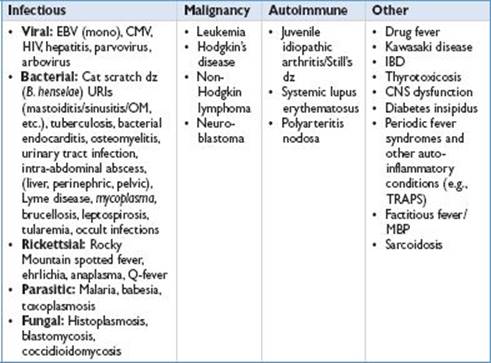
Arch Pediatr 1999;6:330; Acta Paediatr 2006;95:463; Clin Infect Dis 1998;26:80.
Diagnostic Studies
• Hx (fever pattern, assoc sx, ethnicity, ingestion, travel, animal and insect exposure, meds, FHx); complete exam (including accessible LNs, HSM, scalp and skin, MSK, and GU); review meds
• Labs: CMP, U/A, ESR and CRP, CBC w/ diff and periph smear, PPD (purified protein derivative) +/− IGRA (interferon-gamma release assays) (especially in children older than 5 s/p BCG immunization), HIV, Bld and U cx
• Additional testing (based on H&P, sx); stool cx and O and P, viral serologies, ANA, immunoglobulin levels (if h/o recurrent infections), toxoplasmosis serologies, Lyme serologies, ehrlichia/anaplasma serologies, or PCR
• Imaging: CXR, abd CT (if ↑ inflammatory markers or other concern for IBD), consider chest CT, CT sinuses, cardiac echo
Management
• Generally avoid empiric Abx or corticosteroids until potential dx available
• Empiric broad-spectrum antibiotics may decrease diagnostic yield
Complications
• Mortality previously reported at <10%; less in more recent cohorts (Pediatrics 1975;55:468; Acta Paediatr 2006;95:463)