
Epidemiology
Worldwide incidence 9 million cases and 1.4 million TB-related deaths annually
• In US, btw 1985–1994 ↑ TB incidence in children by 33%
• Main risk factors: +TB contacts, +immigration from high prevalence country, +HIV, other immunodeficiencies, malnutrition, low SES
Pathophysiology
Mycobacterium tuberculosis bacillus is usually inhaled in droplets
• Early infxn → localized alveolitis, regional LAD, and either spont resolution (latent TB), or spread via hematolymphatics → disseminated TB (military or meningitis)
• Risk of progression: Infants and young children (<4 yo), immunocompromise (HIV, immunosuppressive drugs, Hodgkin disease, lymphoma, diabetes mellitus, chronic renal failure, and malnutrition)
• Reactivation TB is much less common in children than in adults
Screening (Arch Dis Child Educ Pract Ed 2007;92:27, AAP Red Book 2012)
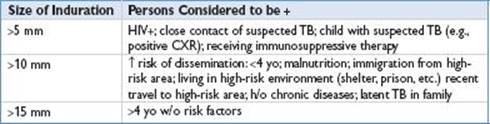
• Technique: PPD, 0.1 mL, intradermal wheal on forearm, Eval btw 48–72 hr, determine diameter of induration, not erythema
• TST relatively nonspecific & insensitive in invasive Tb
• Serum IGRA measure ex vivo interferon-gamma production from T cells in resp to stim specific for M. tuberculosis complex
• Similar sensitivity to Mantoux skin test, higher specificity
• Recs for use: Immune-competent children ≥ 5 yo; to confirm active case or LTBI and likely will yield fewer false-positive test results (i.e., BCG-vaccinated children)
• Generally, interpretation of TST results in BCG recipients is the same as for people who have not received BCG vaccine
• Who should be screened: Known TB contact, immigration from high prevalence country, HIV (yearly), incarceration, radiographic findings suggestive of TB
Clinical Manifestations (Arch Dis Child 2000;83:342)
• Cough, constitutional sx (fever, night sweats, weight loss), FTT, lymphadenopathy
• Extrapulmonary dz more common in kids, esp <5 yo; up to 
• Scrofula → TB adenitis, bony involv →TB osteomyelitis (in spine = Pott dz), pericarditis, meningitis, hepatitis, adrenal dz, cutaneous dz
• HIV coinfection is major risk factor for active TB and predicts more severe course
Diagnostic Studies
• More difficult to dx than in adults because children often have paucibacillary disease
• Induced sputum in younger children, and AM gastric aspirates in children <5 yo
• Acid fast bacillus (AFB) smear: Rapid diagnosis, but not sensitive
• Culture: Takes weeks, allows for drug sensitivity testing (DST)
• PCR: More sensitive than smear
• CXR: Look for consolidation, pleural effusion, LAD, cavitary lesions, “millet seed” opacities in disseminated or “miliary” TB
• If your suspicion is high, then no diagnostic test will definitively rule out TB
Preventive Therapy for Latent TB (Red Book 2009, CDC.gov Treatment options for latent TB 12/2011)
• R/o active dz w/ CXR in all pts w/ +PPD, and further w/u in pts who have any sx
• If CXR neg, and no sx, preventive Rx w/ INH (isoniazid) can ↓ chances of reactivation
• INH + Vit B6 (pyridoxine) ×6–9 mo (should monitor carefully for hepatitis); >12 yr and not on HAART: INH and Rifapentine × 3 mo; INH-resistance: Rifampin QD × 6 mo
Treatment of Active TB
• AFB+, culture+, or high level of suspicion
• Isolate pt (test family and close contacts/prophylaxes as needed)
• 1st-line regimen is 4 drug Rx (usually HREZ – see later) ×2 mo, then HR ×4 mo
• Do not give fewer than 3 drugs to prevent resistance
• If TB meningitis: HRZ (+/− ethionamide 20 mg/kg/d) × 2 mo and prednisone 1–2 mg/kg/d taper over 3 wk, then HR ×9–10 mo
• In developing countries, WHO recommends directly observed therapy (DOT) to increase compliance/cure and decrease resistance
• Multidrug-resistant (MDR) TB: Worldwide prevalence in 2007 ∼5%, definition → resistant to at least HR → refer to ID for Rx; also XDR-TB (extremely resistant)
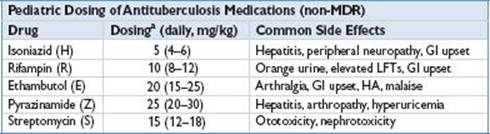
aMight utilize higher doses in invasive disease and meningitis. In some cases, serum drug level testing might be appropriate.
Adapted from WHO “Hospital Care for Children” 2005: 352.