
Definition (Int J Biochem Cell Biol 2005;37:1151)
• Metabolic acidosis 2/2 impaired renal acid excretion
Clinical Manifestations (Int J Biochem Cell Biol 2005;37:1151)
• Often p/w hyperchloremic metab acidosis w/ nml/near-nml AG & w/o diarrhea
• Can also present with hypokalemia, medullary nephrocalcinosis, recurrent calcium phosphate stone disease, growth retardation/rickets
Classification/Etiology (Int J Biochem Cell Biol 2005;37:1151)
• Isolated tubular defects can be due to drugs, autoimmune disease, obstructive nephropathy, or any cause of medullary nephrocalcinosis
• Can be genetic, associated with deafness, osteopetrosis, or ocular abnormalities
• Distal (Type 1 RTA) 2/2 impaired distal acid excretion. Acidosis may not be
present. HypoK can occur. Bone dz and nephrocalcinosis can occur w/ hypercalciuria
• Type 1 RTA can be acquired; 2/2 autoimmune dz (Sjögren syndrome or SLE)
• Proximal (Type 2 RTA) leads to bicarb wasting and high urine pH; eventually more acidic as plasma HCO3− levels ↓ and less filtered. ↑ frac excretion of HCO3− (>15%) characteristic. Osmotic effect of HCO3− can lead to loss of K as well
• Type 2 RTA can be part of generalized tubular defect, (i.e., Fanconi syndrome [proximal cell dysfxn]: Prox renal tubular acidosis (bicarb wasting), hypophos (phos wasting), polyuria (Na wasting), glucosuria, and aminoaciduria)
• Type 2 RTA can occur in cystinosis, hereditary fructose intolerance, and Wilson disease, or can be caused by ifosfamide, acetazolamide
• Type 4 RTA also a distal RTA assoc w/ hyperK instead of hypoK (effective hypoaldo), and can be 2/2 sickle-cell dz, urinary tract obstruct, amyloidosis, xplnt
• Can be 2/2 drugs: Aldosterone inhibitor diuretics such as spironolactone, ACE-I/ARBs, trimethoprim, heparin, pentamidine, NSAIDs
Diagnosis & Rx (Rose & Post. Clinical Physiology of Acid-Base and Electrolyte Disorders; 5th ed., McGraw-Hill; 2001)
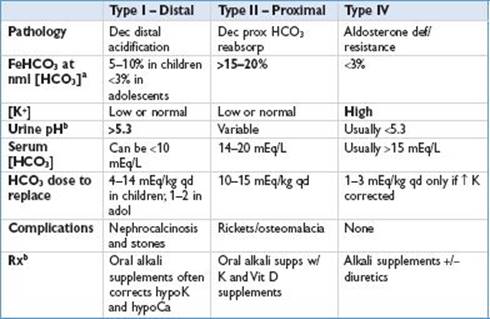
aMeasured at normalized serum [HCO3].
bMeasured while patient is acidemic.
Adapted from Int J Biochem Cell Biol 2005;37:1151.