
Noninvasive Methods
• CPAP: Continuous PEEP. Useful for hypoxemia (atelectasis, edema, OSA, HMD)
• BiPAP: Pt-triggered PIP + CPAP. Useful for hypoventilation (CF, NM disease)
Invasive Methods
• Support (PS/VS): Spont breaths assisted to reach goal pressure (P) or volume (V)
• No set rate, pt must initiate breaths. Pt determines I time. Less efficient if ETT leak
• Assist/Control (AC): Vent delivers minimum # supported breaths (synch to pt effort) with add’l pt-initiated breaths getting full assist to reach goal P or V w/ controlled l time
• Downside: Uncomfortable, dyssynchrony and auto-PEEP (breath stacking)
• SIMV: Vent delivers minimum # supported breaths (sync to pt effort) but add’I
pt-initiated breaths get no assist. May add PS to assist spont breaths (SIMV + PS)
• Downside: Inc resp effort (pt must overcome circuit resistance during spont breaths)
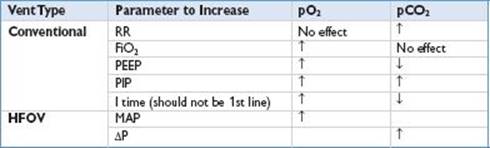
• HFOV: Rapid oscillatory breaths given at set frequency (Hz); manipulate MAP and ΔP
• Downside: Can easily hypervent. Vent Δ may take longer to equilibrate on blood gas
• Used when conventional ventilation fails
• Initial trials supporting HFOV over conventional vent strategies were done before ARDSNet low TV protocols, which appear to have the same mortality. They are likely equal, but HFOV may be an easier way to obtain the same result (Crit Care 2005;9:177)
Troubleshooting
• Acute desaturation in pts w/ artificial airway on mechanical ventilator: Think DOPE
• Dislodgement (ETT); Obstruction (mucus plug); Pneumothorax; Equipment failure
• Oxygenation depends on mean airway pressure (MAP)
• Ventilation depends on minute ventilation and dead space
Extubation Readiness Criteria (Ped Crit Care Med 2009;10:1)
• Pt awake w/ intact airway reflexes (cough, gag), hemodynamically stable, manageable secretions, acceptable gas exchange, O2 requirement <40%
• Air leak: Used to predict upper airway obstruction (swelling) after extubation
• Presence of audible leak around ETT @ <25 cm H2O
• Consider steroids if no leak (role unclear; may decrease risk re-intubation)
• Decadron 0.5 mg/kg q6h × 6, 12 hr prior to extubate (Crit Care Med 1996;24:1666)
• Negative inspiratory force: Strength of resp muscles in pts w/ neuromusc weakness
• NIF > 30 mm Hg (not validated in children, unreliable)
• Spontaneous breathing triap (CPAP or PS + PEEP) prior to extubation