
Definition (Pediatr Rev 2008;6:183)
• Reverse peristalsis 2/2 activation of vomiting center (VC) in medulla or chemoreceptor trigger zone (CTZ) in area postrema (floor IVth ventricle)
Etiology (Pediatr Rev 2008;6:183)
See chart on next page.
Clinical Manifestations
• Assess for dehydration; Mod (5–10% BW) w/ irritability, cool ext, dry mucous membranes, sunken eyes, dec skin turgor (1–2 sec skin pinch), Severe (>10% BW) w/ lethargy, >2 sec skin pinch, cold ext, deep acidotic breathing, HoTN, tachycardia
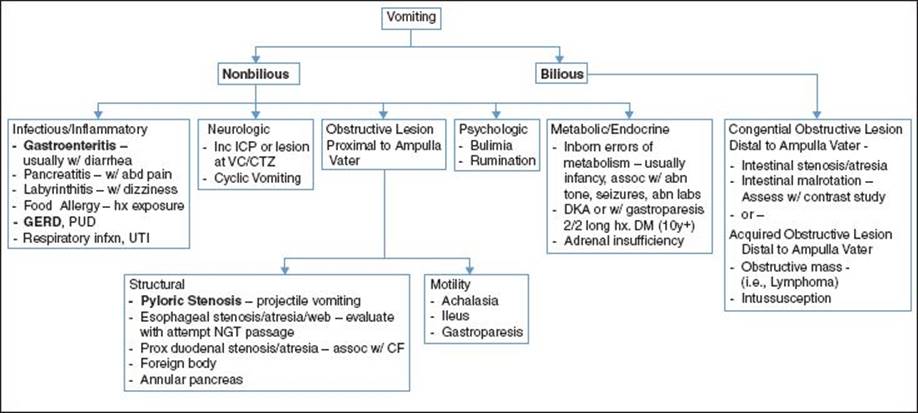
Diagnosis & Treatment (Am Fam Physician 2000;61:2791; J Pediatr
Gastroenterol Nutr 2001;32:S12; Pediatr Rev 2008;6:183)
• Definitive management as well as diagnostic testing depends on underlying etiology
• Nonbilious emesis: Generally less concerning; some emergencies, pyloric stenosis
• Bilious emesis is almost always concerning sx warranting further evaluation
• NGT placement for decompression if obstruction suspected
• Diagnostic evaluation varies but generally includes KUB and/or UGI
• W/ neonate, bilious emesis can indicate surgical disease
• Duodenal atresia: Congenital obstruction of 2nd part of duodenum, 2/2 failure to recanalize in utero, vomiting w/i hrs; pregnancy often w/ polyhydramnios
• 1 in 5,000–10,000 and M > F, seen in 1/4 Down’s syndrome pts, 20% w/ CDH
• Membranous or interrupted lesion at papilla of Vater (PV), 80% w/ PV open to proximal duodenum resulting in bilious emesis.
• KUB w/ “double bubble”: Gastric air bubble and distended prox duodenum
• Surgery necessary but not urgent (<48 hr) if decompressed w/ NGT and IVFs
• Midgut malrotation and volvulus: Midgut rotated clockwise around SMA/V, can cause obstruction/ischemia/infarction
• Usually p/w volvulus in 1st 3–7 d w/ bilious emesis +/– abd distention; majority w/i 1st yr of life but can present at older age (recurrent abd pain)
• Imaging; U/S w/ jejunal “spiral” or UGI w/ malpositioned SMA/V or ligament of Treitz (normally to L of spine)
• Needs urgent surgery (separation of Ladd band); if early, excellent prognosis
• Complications: 2/2 gut ischemia → resection and short gut syndrome
• Jejunoileal atresia: Mesenteric vascular accident in utero → segmental infarct
• 4 types of abnormalities: Membranous, interrupted, apple peel, and multiple
• All w/ same sx; abd distention and bilious emesis w/i 1st 24 hr
• Abdominal films w/ air-fluid levels proximal to obstruction
• Can be complicated by meconium peritonitis; intense inflammation resulting in calcifications, vascular fibrous proliferation, and cyst formation
• Meconium ileus: 90–95% have CF, but only 15% CF pts have hx of mec ileus
• KUB w/ distended loops, thickened wall, filled w/ “ground glass”
• Can rx w/ Gastrografin (successful in 16–50%)
• Treatment of nausea: Based on etiology (N Engl J Med 2005;352:817)
• GI tract irritation or distention: Via vagal and/or glossopharyngeal afferents (i.e., 2/2 constipation, NSAIDs, mucositis 2/2 chemo), stimulated via 5HT3R; rx with ondansetron, (5HT3R blocker) steroids to dec inflammation (mucositis)
• Vestibular tract irritation (i.e., labyrinthitis): Stimulated via H1R and muscarinic receptors; rx w/ antihistamine or anticholinergics
• CTZ; sampling blood for emetogens (BBB absent here): Stimulated via D2R
• Emetogens can be endogenous (tumor, azotemia, HoNa) or exogenous (opioids, chemo); rx w/ haloperidol > phenothiazines (compazine)
• Higher CNS center involvement: Can activate or suppress; rx anxiolytics
• All stimulate VC (final common pathway): Stimulated by parasymp and H1R, acts via parasymp and motor efferents