
Definition (Pediatr Rev 2005;26:314; Pediatr Rev 2011;32:14)
• Crohn’s dz (CD): Transmural inflam anywhere w/i alimentary tract mouth to anus
• Ulcerative colitis (UC): Consists of contiguous mucosal inflammation of the colon
• Indeterminate colitis (IC): Unique subset of patients who tend to present with aggressive disease limited to the colon, w/ rapid progression to pancolitis
• Not uncommon for these distinct dzs to present diagnostic dilemma
Pathophysiology
• Onset and progression likely involve inherited susceptibility to aberrant immune response (excess Th1 in CD, excess Th2 in UC) to various intraluminal antigens
• Multiple susceptibility loci (NOD2/CARD15, IBD5, IBD3, DLG5, IL23R, ATG16L1)
• CD w/ “skip lesions,” transmural extension of inflam & architectural distortion, cryptitis, edema, and noncaseating granulomas (pathognomonic, seen <25% biopsies)
• UC w/ rectal inflam that spreads proximally and may involve entire colon (10% ulcerative proctitis; 50% pancolitis), accumulation of PMNs in colonic crypts (cryptitis), concomitant ulceration, edema, and hemorrhage
Epidemiology (Gastroenterology 2004;126:1550; J Pediatr 2005;146:35)
• ∼20–25% of pts w/ IBD present <18 yo, M = F. (Slight male preponderance in CD)
• In CD,  s tend to more severe dz;
  ↑ chance of growth failure (Pediatrics 2007;120:e1418; Pediatr Rev 2011;32:14)
• #1 risk factor is having a 1st-degree relative with IBD (∼25% of pts; w/ 10–13× ↑ risk)
• Incidence 5 to 11 per 100,000 children w/ mean age of dx in US of 12.5 yo
• Highest incidence in Ashkenazi Jews, ↑ingly dx’d in blacks, ↓ in Asians; recent pediatric studies show no differences in rates of IBD due to ethnicity (J Pediatr 2003;143:525)
• Smoking positively correlated with CD and can worsen dz activity
• Smoking, hx of appendectomy (N Engl J Med 2001;344:808) negatively correlated w/ UC
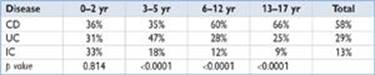
Adapted from the Pediatric IBD Consortium Registry (1/1/00 – 11/1/02) [n = 1370].
Clinical Manifestation
• UC: Bloody diarrhea, peri-defecatory abdominal pain, tenesmus, N/V
• CD: Abd pain, diarrhea, weight loss, N/V, oral & perianal dz (fistulae, abscesses)
• Growth failure may be presenting symptom (5%); impaired linear growth in >35%
• Extraintestinal manifestations may precede GI symptoms by yrs in 1/3 of patients
• Const: Fever (CD >> UC), weight loss, growth retardation, delayed puberty
• HEENT: Uveitis, scleritis, episcleritis, keratitis, retinal vascular dz, aphthous ulcers, glossitis (B12 deficiency)
• CV: Pericarditis, myocarditis, heart block, thrombophlebitis, vasculitis (including arteritis and arterial occlusion)
• Pulmonary: Bronchitis, pulmonary fibrosis, abnormal PFTs
• GI: Fatty liver dz, primary sclerosing cholangitis → cholangiocarcinoma (UC >> CD), chronic autoimmune hepatitis, portal fibrosis, cirrhosis, cholelithiasis, Budd–Chiari syndrome, pancreatitis, anal fissures, and fistulae
• Renal: Nephrolithiasis (oxalate stones in ileal dz), enterovesical or enteroureteral fistulae (CD), immune complex GN, renal tubular dz
• Musculoskeletal: Arthralgias, arthritis, ankylosing spondylitis, sacroiliitis, hypertrophic osteoarthropathy, osteopenia, osteoporosis, AVN, polymyositis
• Hematologic: Anemia (iron, B12, folate def, or AIH), leukocytosis, TTP, thrombocytosis/thrombocytopenia, hypercoag, and portal vein thrombosis
• Neurologic: Peripheral neuropathy, myelopathy, myasthenia gravis, cerebrovascular disorders (venous sinus thrombosis)
• Skin: Erythema nodosum (CD > UC), pyoderma gangrenosum (<5% UC), acrodermatitis enteropathica, purpura, hair loss, brittle nails
Diagnostic Studies
• Dx rests on clinical, radiologic, endoscopic, serologic, and histologic data
• Lab eval w/ CBC, LFTs, amylase, lipase, ESR, CRP (10–15% w/ nml ESR, CRP), nutrition studies (albumin, total protein, Fe panel, Ca/Mg/Phos, Zn, AP, folate, B12), stool studies (fecal α1-AT, leukocytes, culture, O&P, C. diff)
• Nml ESR or CRP do not r/o IBD; however, abn ESR, albumin, platelets, Hgb, or blood in stool 94% sensitive (Pediatrics 2007;119:1113)
• In CD, abnormal studies do not correlate with extent of dz
• In UC, direct correlation btw severity, extent bowel inflam, # abn labs (Pediatrics 2007;119:1113); severity score like PUCAI may predict response to Rx (Gastroenterology 2010;138:2282)
• Serological studies w/ poor sens, but good spec. May help distinguish CD vs. UC. ASCA highly spec for CD, pANCA more suggestive UC (vs. colon-limited CD)
• Imaging; abd plain films, UGI w/ SBFT, contrast abd CT, CT colo, WBC scan, DEXA
• MRI w/ ↑ing role (no radiation) w/ sens & spec >90% for small intestine CD
• Endoscopic studies include EGD, colonoscopy, capsule endoscopy, double-balloon enteroscopy. EGD should be considered even in absence of UGI symptoms
• Mucosal biopsies provide invaluable information, often needed to clinch dx
Treatment (Pediatr Rev 2000;21:291)
• Involves nutrition, pharmacotherapy, psychological therapy, surgery, and surveillance
• Dietary manipulation is a cornerstone to sx management (highly variable; some may need to avoid lactose, caffeine, fatty foods, fresh fruits and vegetables, nuts, seeds)
• Screen and treat growth failure and malnutrition, including micronutrient deficiencies—
esp Fe, folate (methotrexate, mesalamine), B12 (gastric, ileal dz), zinc, vit D
• Complementary/unconventional therapies with positive or mixed data include fish oil/omega-3 fatty acids, probiotics, fecal bacteriotherapy, helminthic therapy
Therapy for Active Disease (See Table on next page)
• Medical approach includes induction (see chart below) and maintenance therapy, take into consideration disease severity, location, and previous therapies
• Some favor early aggressive rx (early use of biologics) w/ subseq “step-down,” (theory that critical window exists before irreversible damage and perpetuating inflammatory cascade). Risks of aggressive rx weighed against dz severity
• Rx w/ evidence of effective maintenance in CD; 6-MP/AZA, MTX, and anti-TNF
• Rx w/ evidence of effective maintenance in UC; oral or topical 5-ASA, 6-MP, AZA
• Surgery may be curative in UC, weigh risks of early surgery against those of increasingly potent immunosuppressive agents
• Surgery not curative for CD; reserve for refractory cases or dz complications (stricture, abscess). Continue maintenance therapy postop
• Colitis requires initiation of surveillance colonoscopy 8–10 yr after dx
Prognosis
• CD is a chronic, incurable disease, characterized by recurrent exacerbations and remissions. Postsurgical recurrence is the rule
• UC w/ recurrent exacerb. Surgery curative, but postop pouchitis in up to 50%
• Small, but increased mortality risk for patients with IBD (related to primary dz complications, carcinoma, thromboembolic dz)
• Risk for colon CA assoc w/ duration of dz (esp >10 yr) and extent involved
Therapy for Active Disease (Pediatr Rev 2011;32:14)
