
STEPHEN LUDWIG
BRANDON C. KU
DEFINITION
Poor weight gain, growth failure, and failure to thrive (FTT) are conditions that involve a vast array of potential causes. The root of the problem may involve (1) inadequate caloric intake, (2) decreased ability to metabolize the ingested food, (3) increased caloric expenditure, or (4) abnormal caloric requirement. Whatever be the cause, a child’s weight is a sensitive indicator of his or her general health. In the case of weight gain, health must be broadly defined and includes family, psychosocial, and socioeconomic causes as well as possible diseases and disorders.
Many cases of growth failure are diagnostically solved in the outpatient setting without the need for hospitalization. However, in some extreme cases, either because the growth delay is so significant or because the child is at a vulnerable age for long-term development, hospitalization is required. At times, the indication for hospitalization (Table 6-1) is a complex and/or obscure problem that requires a more intensive diagnostic evaluation.
TABLE 6-1. Indications of hospitalization of children with failure to thrive.
Infants younger than 6 months of age
Below birth weight at 6 weeks
Head circumference falling below normal growth curve before 6 months of age
Signs of abuse
Signs of gross physical neglect
Persistent poor weight gain despite outpatient therapy
Underlying disease process being evaluated
Unsafe home environment
Caretaker deemed inappropriate
CAUSE AND FREQUENCY
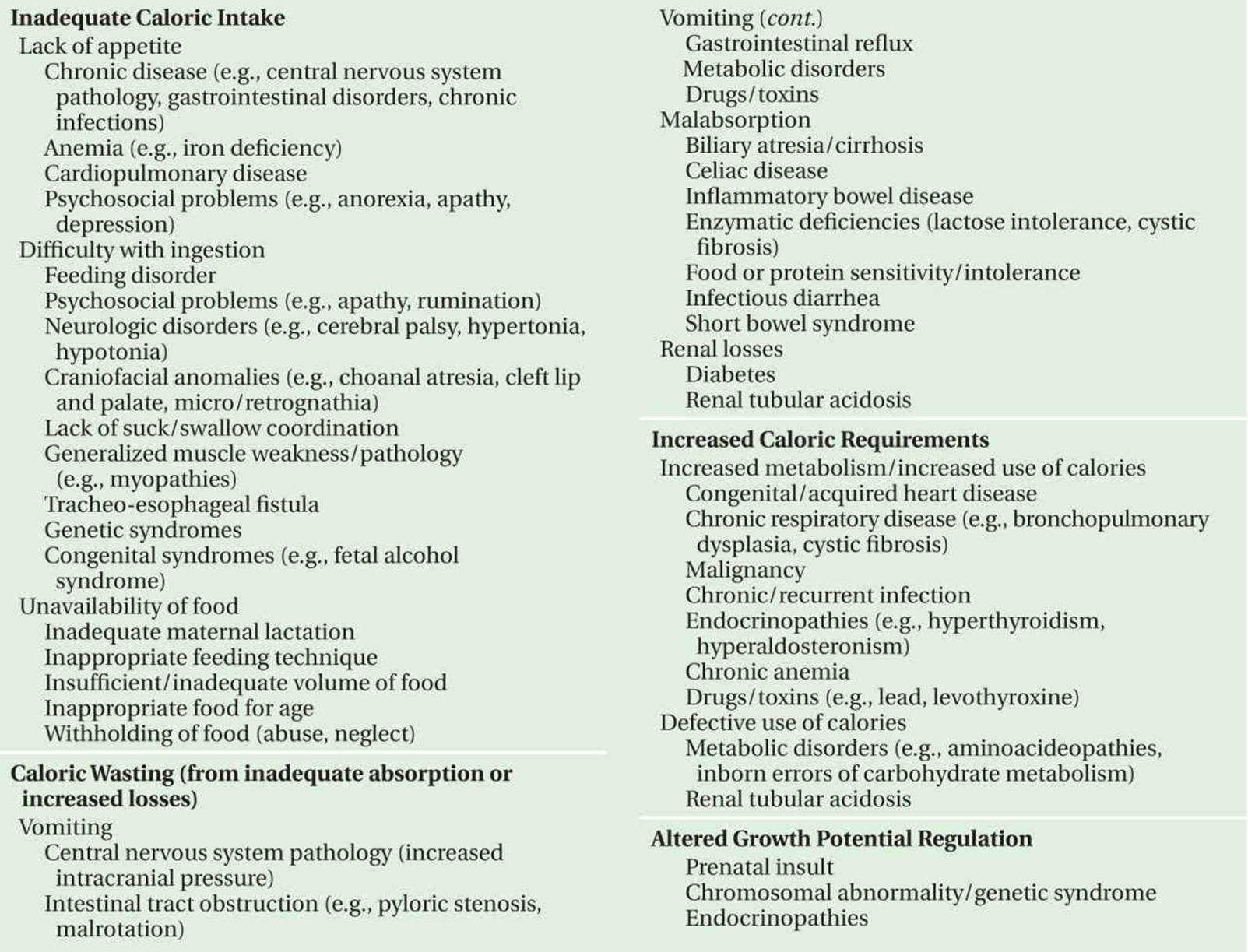
Growth failure is not a diagnosis on its own as it is a symptom of an underlying cause that must be identified to implement the appropriate intervention. The causes can be divided into broad categories of inadequate caloric intake, increased caloric wasting, increased caloric expenditure, and altered growth potential regulation (Table 6-2).
TABLE 6-2. Causes of inadequate weight gain by etiology.
QUESTIONS TO ASK AND WHY
• What is the child’s pattern of growth over time?
—This question helps establish timing of poor weight gain and whether it has existed for weeks or months. Reviewing past medical records including growth charts from the primary pediatrician can lead one to think about acute or chronic conditions.
• What aspects of growth have been affected?
—A comparison of weight, length, and head circumference may provide clues to the etiology as the sequence of events helps differentiate potential causes. With acquired conditions, the weight is affected first and most severely, followed by the length, and finally the head circumference. With congenital, genetic, or endocrine conditions, growth failure may be more symmetric across all three domains or have a recognizable pattern.
• Has the child developed any symptoms?
—Are there symptoms of gastrointestinal losses such as vomiting or diarrhea, indicating loss of nutritional intake? Are there symptoms of increased metabolic consumption such as cardiac or pulmonary disease, indicating increased caloric requirement? The history of such symptoms is vital in determining the etiology of growth failure and is often more revealing than laboratory tests.
• What has the child’s diet and eating pattern been?
—A developmental sequence exists for the types of foods given to children and the manner in which they are presented. For example, children may be picky-eaters and may continually refuse food presented to them. Or they may want to eat table food and to manipulate food in their own mouths as they grow older. Parents who insist on offering the same types and amount of food instead of adapting to their children’s development and changing needs may find their child resistant and failing to gain weight. In these situations, it may be beneficial to observe a meal to understand the process and identify any barriers that may exist.
• What is the state of the family unit and their lifestyle?
—This question explores the possible psychosocial and socioeconomic causes of growth failure? Is this family functioning in other ways? Are there support systems for the parents? Does the family have financial resources to purchase appropriate amounts of food for their growing children? Ascertaining a family’s home environment assists the health-care professional in identifying causes that are not intrinsic to the patient.
SUGGESTED READINGS
1. Miller LA, Grunwald GK, Johnson SL, et al. Disease severity at time of referral for pediatric failure to thrive and obesity: time for a paradigm shift? J Pediatr. 2002;141:121-124.
2. Schwartz ID. Failure to thrive: an old nemesis in the new millennium. Pediatr Rev. 2000;21:257-264.
3. Shah MD. Failure to thrive in children. J Clin Gastroenterology. 2002;35:371-374.
4. Homer C, Ludwig S. Categorization of etiology for failure to thrive. Amer J Dis Child. 1981;135:848-851.
5. Zenel JA. Failure to thrive: a general pediatrician’s perspective. Pediatr Rev. 1997;18:371-378.
6. Jaffe AC. Failure to thrive: current clinical concepts. Pediatr Rev. 2011;32:100-108.