
Objectives
After completing this chapter, you will be able to:
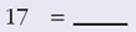
1. Express Arabic numbers as Roman numerals.
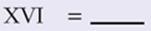
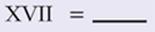
2. Express Roman numerals as Arabic numbers.
3. Identify the numerator and denominator in a fraction.
4. Multiply and divide fractions.
5. Multiply and divide decimals.
6. Convert fractions to decimals.
 ARABIC NUMBERS AND ROMAN NUMERALS
Most medication dosages are ordered by the physician or the nurse practitioner in the metric and household systems for weights and measures using the Arabic number system with symbols called digits (ie, 1, 2, 3, 4, 5). Occasionally, orders are received in the apothecary system of weights and measures using the Roman numeral system with numbers represented by symbols (ie, I, V, X). The Roman numeral system uses seven basic symbols, and various combinations of these symbols represent all numbers in the Arabic number system.
Table 1.1 includes the seven basic Roman numerals and the corresponding Arabic numbers.
The combination of Roman numeral symbols is based on three specific principles:
1. Symbols are used to construct a number, but no symbol may be used more than three times. The exception is the symbol for five (V), which is used only once because there is a symbol for 10 (X) and a combination of symbols for 15 (XV).
2. When symbols of lesser value follow symbols of greater value, they are added to construct a number.
|
TABLE 1.1 Seven Basic Roman Numerals |
||||||||||||||||
|
3. When symbols of greater value follow symbols of lesser value, those of lesser value are subtracted from those of higher value to construct a number.
 PREVENTING MEDICATION ERRORS
Correctly identifying Roman numerals will assist in preventing medication errors. Some medication orders may include a Roman numeral.
Example: Administer X gr of aspirin, which is correctly interpreted as administer 10 gr of aspirin.
EXAMPLE 1.1
III = (1 + 1 + 1) = 3
XXX = (10 + 10 + 10) = 30
EXAMPLE 1.2
VIII = (5 + 3) = 8
XVII = (10 + 5 + 1 + 1) = 17
EXAMPLE 1.3
IV = (5 - 1) = 4
IX = (10 - 1) = 9
Exercise 1.1 Arabic Numbers and Roman Numerals (See page 21 for answers)
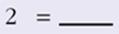
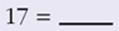
Express the following Arabic numbers as Roman numerals.
1.

View Answer
2.
View Answer
3.

View Answer
4.

View Answer
5.

View Answer
6.

View Answer
7.

View Answer
8.

View Answer
9.

View Answer
10.

View Answer
11.

View Answer
12.

View Answer
13.

View Answer
14.

View Answer
15.

View Answer
16.

View Answer
17.
View Answer
18.

View Answer
19.

View Answer
20.

View Answer
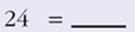
Although medication orders rarely involve Roman numerals higher than 20, for additional practice, express the following Arabic numbers as Roman numerals.
21.

View Answer
22.
View Answer
23.

View Answer
24.

View Answer
25.

View Answer
26.

View Answer
27.

View Answer
28.

View Answer
29.

View Answer
30.

View Answer
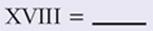
Express the following Roman numerals as Arabic numbers.
31.

View Answer
32.

View Answer
33.

View Answer
34.

View Answer
35.

View Answer
36.

View Answer
37.

View Answer
38.
View Answer
39.

View Answer
40.

View Answer
41.

View Answer
42.

View Answer
43.

View Answer
44.

View Answer
45.

View Answer
46.

View Answer
47.
View Answer
48.

View Answer
49.
View Answer
50.

View Answer
To increase your abilities to use either system, convert the following Arabic numbers or Roman numerals.
51.

View Answer
52.

View Answer
53.

View Answer
54.

View Answer
55.

View Answer
56.

View Answer
57.

View Answer
58.

View Answer
59.

View Answer
60.

View Answer
61.

View Answer
62.

View Answer
63.

View Answer
64.

View Answer
65.

View Answer
66.

View Answer
67.

View Answer
68.

View Answer
69.

View Answer
70.
View Answer
FRACTIONS
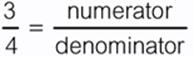
Medication dosages with fractions are occasionally ordered by the physician or used by the pharmaceutical manufacturer on the drug label. A fraction is a number that represents part of a whole number and contains three parts:
1. Numerator—the number on the top portion of the fraction that represents the number of parts of the whole fraction.
2. Dividing line—the line separating the top portion of the fraction from the bottom portion of the fraction.
3. Denominator—the number on the bottom portion of the fraction that represents the number of parts into which the whole is divided.
 PREVENTING MEDICATION ERRORS
Understanding fractions will assist in preventing medication errors. A medication order may include a fraction.
Example: Administer 1/150 gr of nitroglycerin.
To solve medication dosage calculation problems using dimensional analysis, you must be able to identify the numerator and denominator portion of the problem. You also must be able to multiply and divide numbers, fractions, and decimals.
Multiplying Fractions
The three steps for multiplying fractions are:
1. Multiply the numerators.
2. Multiply the denominators.
3. Reduce the product to the lowest possible fraction.
EXAMPLE 1.4
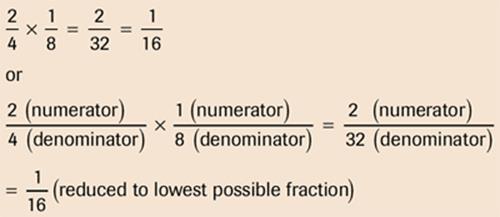
EXAMPLE 1.5

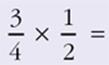
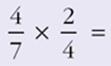
Exercise 1.2 Multiplying Fractions (See pages 21–22 for answers)
To increase your abilities when working with fractions, multiply the following fractions and reduce to the lowest fractional term.
1.

View Answer
2.

View Answer
3.

View Answer
4.
View Answer
5.

View Answer
6.

View Answer
7.

View Answer
8.
View Answer
9.

View Answer
10.

View Answer
Dividing Fractions
The four steps for dividing fractions are:
1. Invert (turn upside down) the divisor portion of the problem (the second fraction in the problem).
2. Multiply the two numerators.
3. Multiply the two denominators.
4. Reduce answer to lowest term (fraction or whole number).
EXAMPLE 1.6

EXAMPLE 1.7

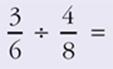
Exercise 1.3 Dividing Fractions (See page 22 for answers)
To increase your abilities when working with fractions, divide the following fractions and reduce to the lowest fractional term.
1.

View Answer
2.

View Answer
3.

View Answer
4.

View Answer
5.
View Answer
6.

View Answer
7.
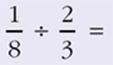
View Answer
8.
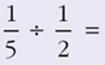
View Answer
9.
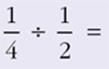
View Answer
10.

View Answer
DECIMALS
Medication orders are often written using decimals, and pharmaceutical manufacturers may use decimals when labeling medications. Therefore, you must understand the learning principles involving decimals and be able to multiply and divide decimals.
· A decimal point is preceded by a zero if not preceded by a number to decrease the chance of an error if the decimal point is missed.
· A decimal point may be preceded by a number and followed by a number.
· Numbers to the left of the decimal point are units, tens, hundreds, thousands, and ten-thousands.
· Numbers to the right of the decimal point are tenths, hundredths, thousandths, and ten-thousandths.
EXAMPLE 1.8
0.25
EXAMPLE 1.9
1.25
EXAMPLE 1.10
0.2 = 2 tenths
0.05 = 5 hundredths
0.25 = 25 hundredths
1.25 = 1 unit and 25 hundredths
110.25 = 110 units and 25 hundredths
 PREVENTING MEDICATION ERRORS
Understanding the importance of a decimal point will assist in preventing medication errors. An improper placement of a decimal point can result in a serious medication error.
Example: Administer 0.125 mg of Lanoxin.
If the “zero†is not placed in front of the decimal point the order could be misread.
Example: Administer 125 mg of Lanoxin.
Rounding Decimals
· Decimals may be rounded off. If the number to the right of the decimal is greater than or equal to 5 (≼5), round up to the next number.
· If the number to the right of the decimal is less than 5 (<5), delete the remaining numbers.
EXAMPLE 1.11
0.78 → 0.8
0.213 → 0.2
Exercise 1.4 Rounding Decimals (See page 22 for answers)
Practice rounding off the following decimals to the tenth.
1.

View Answer
2.

View Answer
3.

View Answer
4.

View Answer
5.

View Answer
6.

View Answer
7.

View Answer
8.

View Answer
9.

View Answer
10.

View Answer
Multiplying Decimals
When multiplying with decimals, the principles of multiplication still apply. The numbers are multiplied in columns, but the number of decimal points are counted and placed in the answer, counting places from right to left.
EXAMPLE 1.12

 THINKING IT THROUGH
The answer to the problem before adding decimal points is 345 but when decimal points are correctly added (two decimal points are added to the answer, counting two places from the right to the left) then 3.45 becomes the correct answer.
Exercise 1.5 Multiplying Decimals (See pages 22–23 for answers)
Practice multiplying the following decimals.
1.

View Answer
2.

View Answer
3.

View Answer
4.

View Answer
5.

View Answer
6.

View Answer
7.

View Answer
8.

View Answer
9.

View Answer
10.

View Answer
Dividing Decimals
When dividing with decimals, the principles of division still apply, except that the dividing number is changed to a whole number by moving the decimal point to the right. The number being divided also changes by accepting the same number of decimal point moves.
EXAMPLE 1.13

Exercise 1.6 Dividing Decimals (See pages 23–24 for answers)
Practice dividing the following decimals and rounding the answers to the tenth.
1.

View Answer
2.

View Answer
3.

View Answer
4.

View Answer
5.

View Answer
6.

View Answer
7.

View Answer
8.

View Answer
9.

View Answer
10.

View Answer
CONVERTING FRACTIONS TO DECIMALS
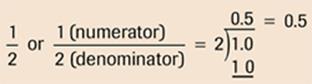
When problem solving with dimensional analysis, medication dosage calculation problems may frequently contain both fractions and decimals. Some of you may have fraction phobia and prefer to convert fractions to decimals when solving problems. To convert a fraction to a decimal, divide the numerator portion of the fraction by the denominator portion of the fraction.
When dividing fractions, remember to add a decimal point and a zero if the numerator cannot be divided by the denominator.
EXAMPLE 1.14
 PREVENTING MEDICATION ERRORS
Understanding the importance of converting fractions to decimals will assist in preventing medication errors. Many medication errors occur because of a simple arithmetic error with dividing. Every nurse should have a calculator to recheck answers for accuracy.
EXAMPLE 1.15

Exercise 1.7 Converting Fractions to Decimals (See pages 24–25 for answers)
To decrease fraction phobia, practice converting the following fractions to decimals. Remember to follow the rules of rounding.
1.

View Answer
2.

View Answer
3.

View Answer
4.

View Answer
5.

View Answer
6.

View Answer
7.

View Answer
8.

View Answer
9.

View Answer
10.

View Answer
SUMMARY
This chapter has reviewed basic arithmetic that will assist you to successfully implement dimensional analysis as a problem-solving method for medication dosage calculations. To assess your understanding and retention, complete the following practice problems.
Practice Problems for Chapter 1: Arithmetic Review (See pages 25–27 for answers)
Change the following Arabic numbers to Roman numerals.
1.

View Answer
2.

View Answer
3.

View Answer
4.

View Answer
5.

View Answer
Change the following Roman numerals to Arabic numbers.
6.

View Answer
7.

View Answer
8.

View Answer
9.

View Answer
10.

View Answer
Multiply the following fractions and reduce the answer to the lowest fractional term.
11.

View Answer
12.

View Answer
13.
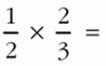
View Answer
14.

View Answer
15.

View Answer
Divide the following fractions and reduce the answer to the lowest fractional term.
16.

View Answer
17.

View Answer
18.

View Answer
19.

View Answer
20.

View Answer
Multiply the following decimals.
21.

View Answer
22.

View Answer
23.

View Answer
24.

View Answer
25.

View Answer
Divide the following decimals.
26.

View Answer
27.

View Answer
28.
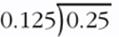
View Answer
29.

View Answer
30.

View Answer
Convert the following fractions to decimals and round to the tenth.
31.

View Answer
32.

View Answer
33.

View Answer
34.

View Answer
35.

View Answer
Chapter 1 Post-Test: Arithmetic Review
Name _________________________________________________ DATE___________________________
Converting Between Arabic Numbers and Roman Numerals
· 1.

· 2.

· 3.

· 4.

Multiplying and Dividing Fractions
· 5.

· 6.
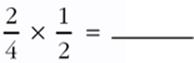
· 7.
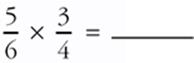
· 8.

· 9.

· 10.

Converting Fractions to Decimals
· 11.

· 12.

· 13.
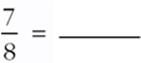
· 14.

Multiplying and Dividing Decimals
· 15.

· 16.

· 17.

· 18.

· 19.

· 20.

ANSWER KEY FOR CHAPTER 1: ARITHMETIC REVIEW
|
Figure. No caption available |

 page1
page1
page2

 page2
page2
page3

 page3
page3
page4

 page4
page4
page5

 page5
page5
page6

 page6
page6
page7
