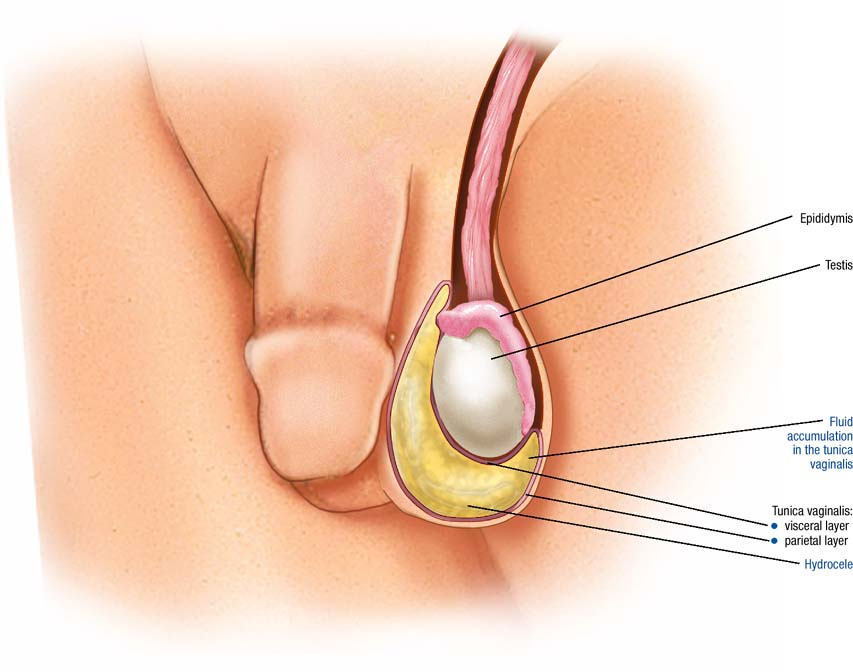
A hydrocele is a collection of fluid between the visceral and parietal layers of the tunica vaginalis of the testicle or along the spermatic cord. It's the most common cause of scrotal swelling.
 Age Alert
Congenital hydrocele commonly resolves spontaneously during the first year of life. Usually, no treatment is indicated.
Causes
· Congenital malformation (infants)
· Trauma to the testes or epididymis
· Infection of the testes or epididymis
· Testicular tumor
Pathophysiology
Congenital hydrocele occurs when an opening between the scrotal sac and the peritoneal cavity allows peritoneal fluids to collect in the scrotum. The exact mechanism is unknown.
In adults, the fluid accumulation may be caused by infection, trauma, tumor, an imbalance between the secreting and absorptive capacities of scrotal tissue, or an obstruction of lymphatic or venous drainage in the spermatic cord. Consequent swelling obstructs blood flow to the testes.
Signs and symptoms
· Scrotal swelling and feeling of heaviness
· Inguinal hernia (commonly accompanies congenital hydrocele)
· Fluid collection, presenting as flaccid or tense mass
· Pain with acute epididymal infection or testicular torsion
· Scrotal tenderness due to severe swelling
Diagnostic test results
· Transillumination distinguishes fluid-filled from solid mass; tumor doesn't transilluminate.
· Ultrasonography visualizes the testes and the presence of fluid.
· Tissue biopsy differentiates between normal cells and malignancy.
Treatment
· Inguinal hernia with bowel present in the sac: surgical repair
· Tense hydrocele that impedes blood circulation or causes pain: aspiration of fluid and injection of sclerosing drug
· Recurrent hydroceles: excision of tunica vaginalis
· Testicular tumor detected by ultrasound: suprainguinal excision
P.323
HYDROCELE
|
|
|
|