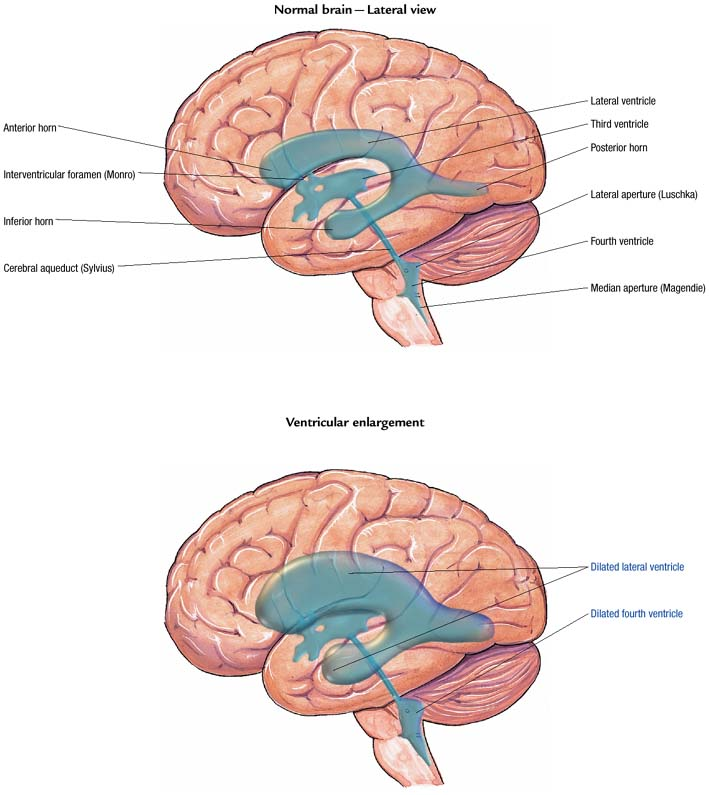
Hydrocephalus is a condition that results from an excessive accumulation of cerebrospinal fluid (CSF) in the brain. It results in an increase in intracranial pressure (ICP) with corresponding enlargement of the ventricular system. The condition is congenital or acquired, and communicating or noncommunicating (obstructive).
 Age Alert
Hydrocephalus occurs most commonly in children but may also occur in adults and elderly people.
Causes
· Genetic inheritance (aqueductal stenosis)
· Developmental disorders such as those associated with neural tube defects, including spina bifida and encephalocele
· Complications of premature birth such as intraventricular hemorrhage
· Diseases (such as meningitis), tumors, traumatic head injury, or subarachnoid hemorrhage blocking the exit from the ventricles to the cisterns, thereby eliminating the cisterns
Pathophysiology
Ventricular dilation produces an increase in CSF pressure and volume, resulting in an increase in ICP. Compression of adjacent brain structures and cerebral blood vessels may lead to ischemia and, eventually, cell death.
Signs and symptoms
In infants
· Rapid increase in head circumference or an unusually large head size
· Vomiting
· Sleepiness
· Irritability
· Downward deviation of the eyes (also called “sunsetting”)
· Seizures
In older children and adults
· Headache
· Vomiting
· Nausea
· Papilledema (swelling of the optic disk that's part of the optic nerve)
· Blurred vision
· Diplopia (double vision)
· Sunsetting of the eyes
· Problems with balance
· Poor coordination
· Gait disturbance
· Urinary incontinence
· Slowing or loss of development
· Lethargy
· Drowsiness
· Irritability
· Other changes in personality or cognition, including memory loss
Diagnostic test results
· Skull X-rays show thinning of the skull with separation of the sutures and widening of the fontanels.
· Angiography shows vessel abnormalities due to stretching.
· Computed tomography scan and magnetic resonance imaging reveal variations in tissue density and fluid in the ventricular system.
· Lumbar puncture reveals increased fluid pressure from communicating hydrocephalus.
· Ventriculography shows ventricular dilation with excess fluid.
 Clinical Tip
In infants, abnormally large head size for the patient's age strongly suggests hydrocephalus. Measurement of the head circumference is the most important diagnostic technique.
Treatment
· Surgical correction by insertion of a ventriculoperitoneal or ventriculoatrial shunt
· Antibiotics
· Serial lumbar puncture
· Endoscopic third ventriculostomy
P.143
VENTRICLES OF THE BRAIN
|
|
|
|